
it all ends the same
Agnes Ma: it all ends the same
Understudy
890 C 14th Street, Denver, CO 80202
July 31, 2026–August 30, 2026
Admission: free
Review by Maggie Sava
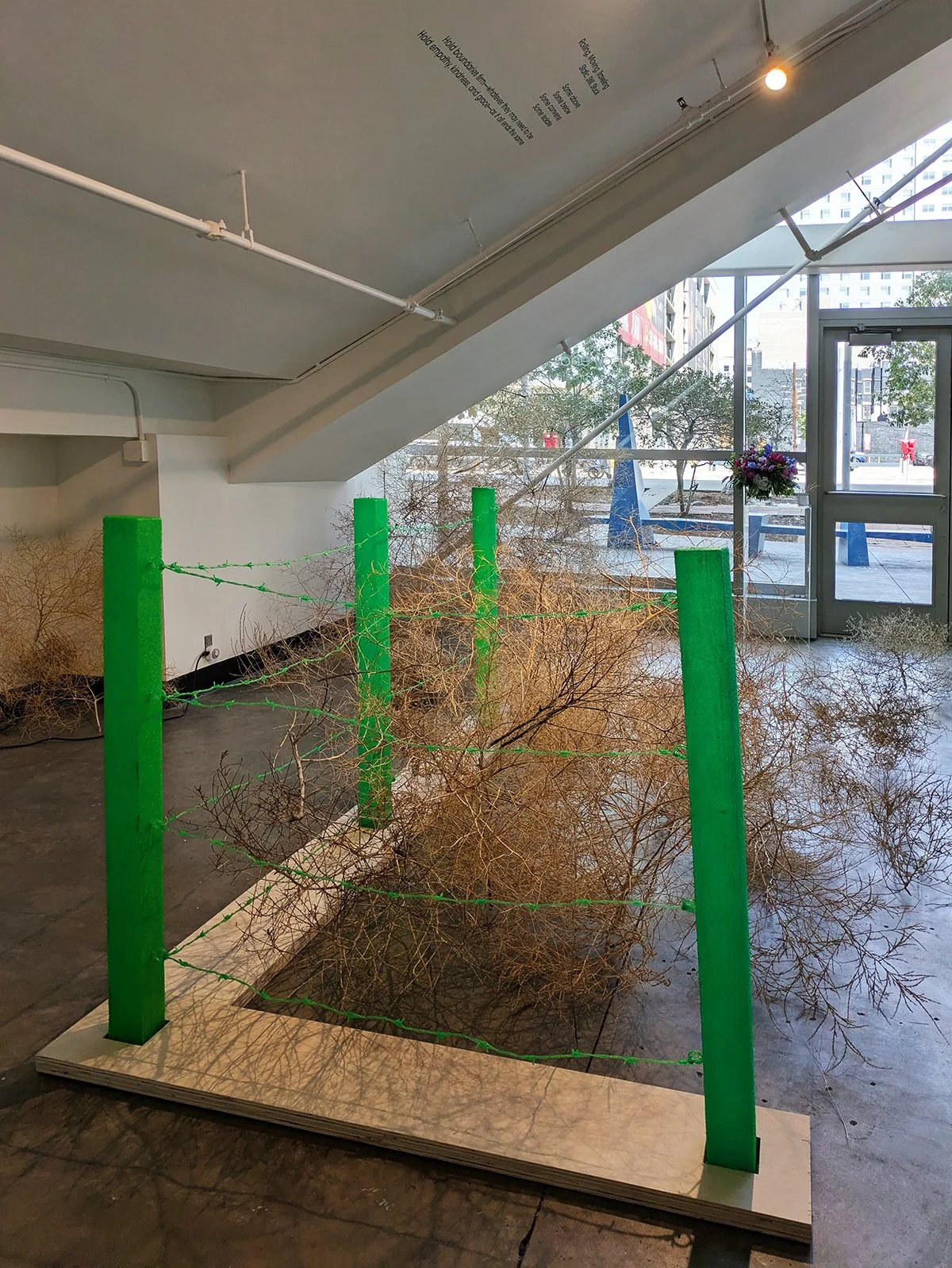
Agnes Ma’s latest installation, it all ends the same, transforms Understudy in downtown Denver into an acutely focused snapshot of a landscape. It captures what resembles the corner of a dusty, desert property fenced off with bright green posts and barbed wire.
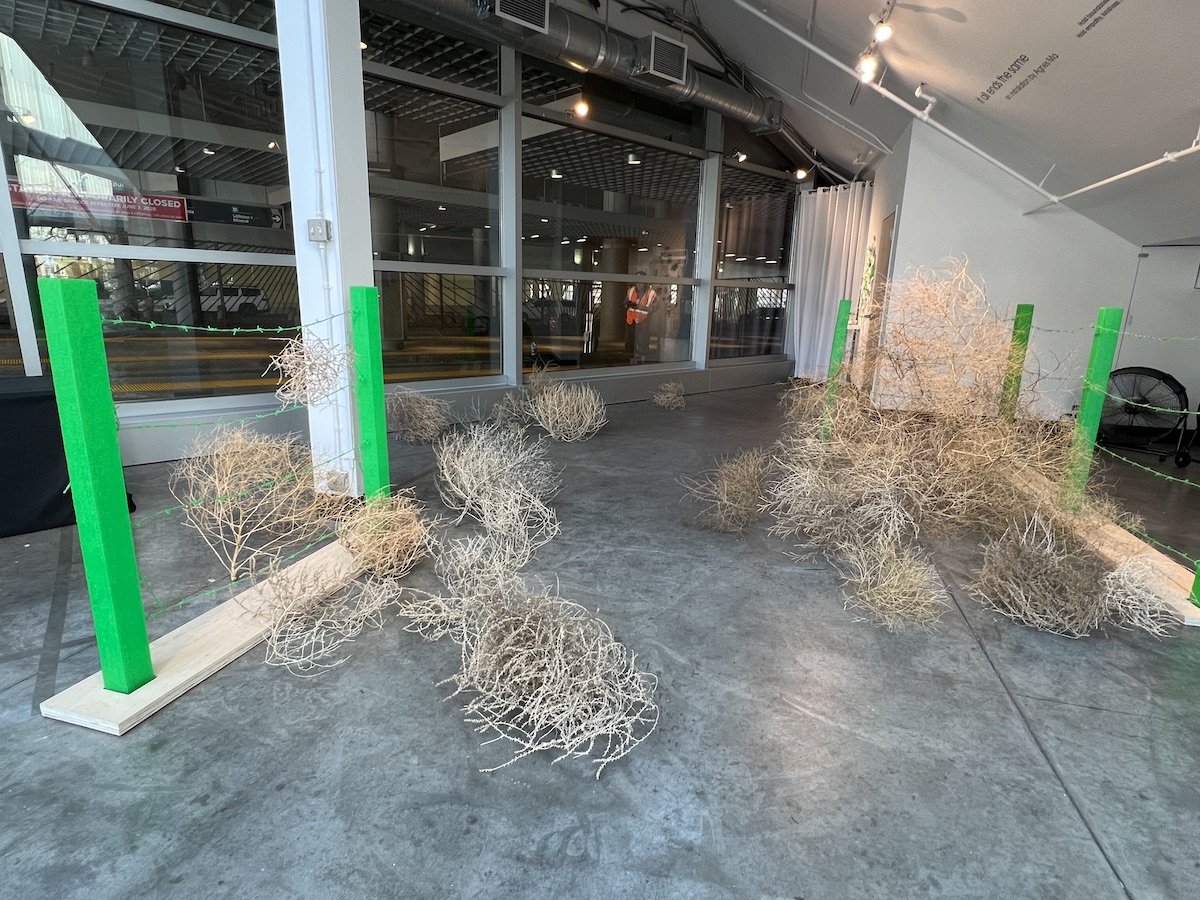
Agnes Ma, it all ends the same, 2026, PLA (bioplastic), wire, and found tumbleweeds. Image courtesy of the artist.
The piles of tumbleweeds throughout the gallery add to the western-movie-like set design, and electric fans mimic a flowing breeze meant to imitate, as Ma explains, “the sounds of standing in windswept Wyoming or the Great Plains area.” [1] We as viewers are transported to a place both specific and general. On closer inspection, however, the seemingly straightforward scene starts to unravel.
The barbed wire fences do not touch, making them more like gates than barriers.
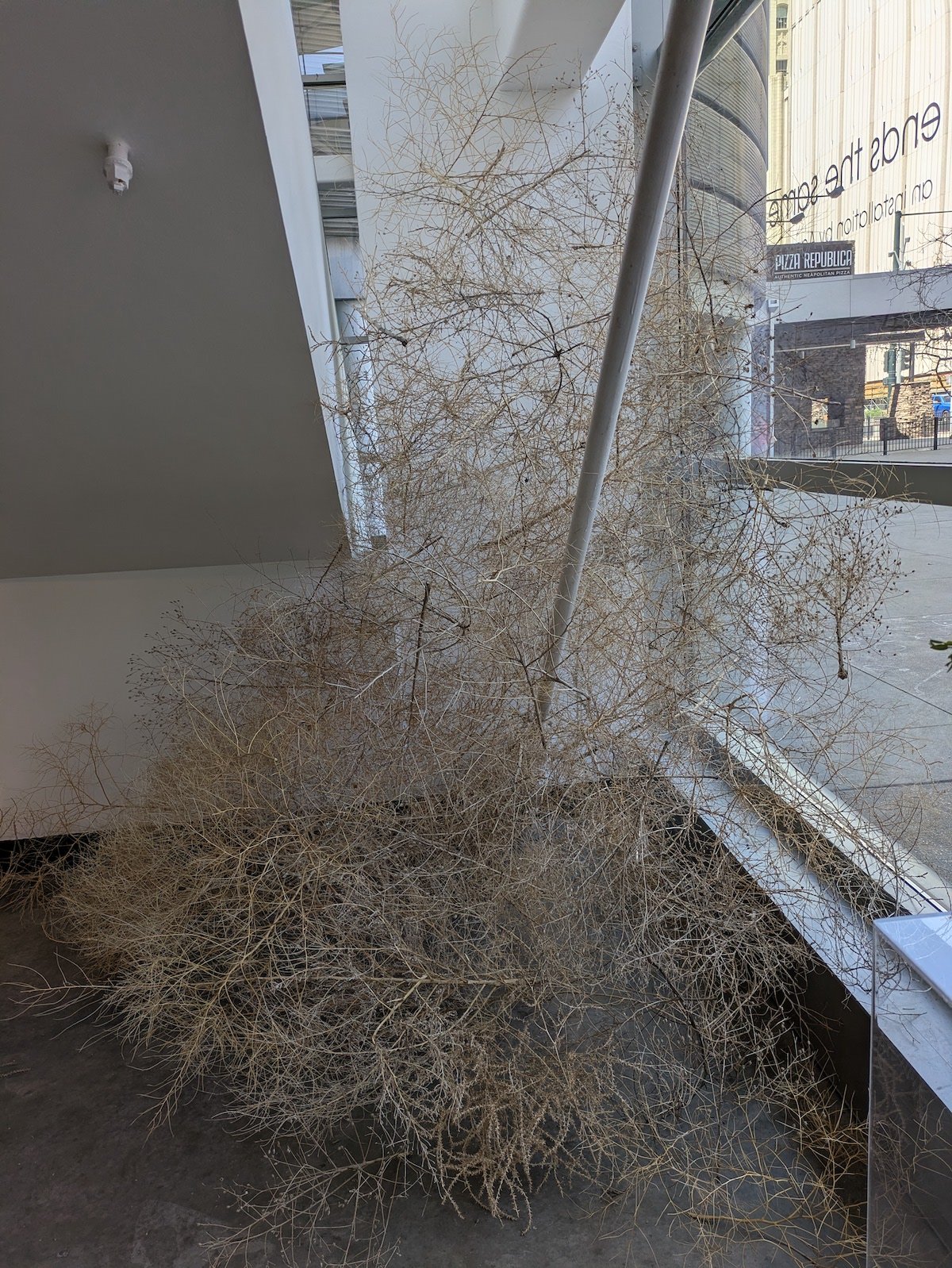
A view of tumbleweeds gathering near the gallery window in Agnes Ma’s it all ends the same, 2026, PLA (bioplastic), wire, and found tumbleweeds. Image by Maggie Sava.
In fact, they visually demarcate a path more than obstruct it. The tumbleweeds—the presumed main actors within the scene—press against the plastic-covered metal wires of the fences and also spill out around the room. Some are blown around by the fans, while others stack up in front of the gallery window.
What is more, we as viewers do not have a clear role on this stage. Are we meant to observe the movement of the tumbleweeds? Should we delicately traverse through the sections of fencing, careful not to disrupt anything? This viewer even fought the urge to pick up the tumbleweeds, freeing them from obstructions so that they could move even more freely around the room.
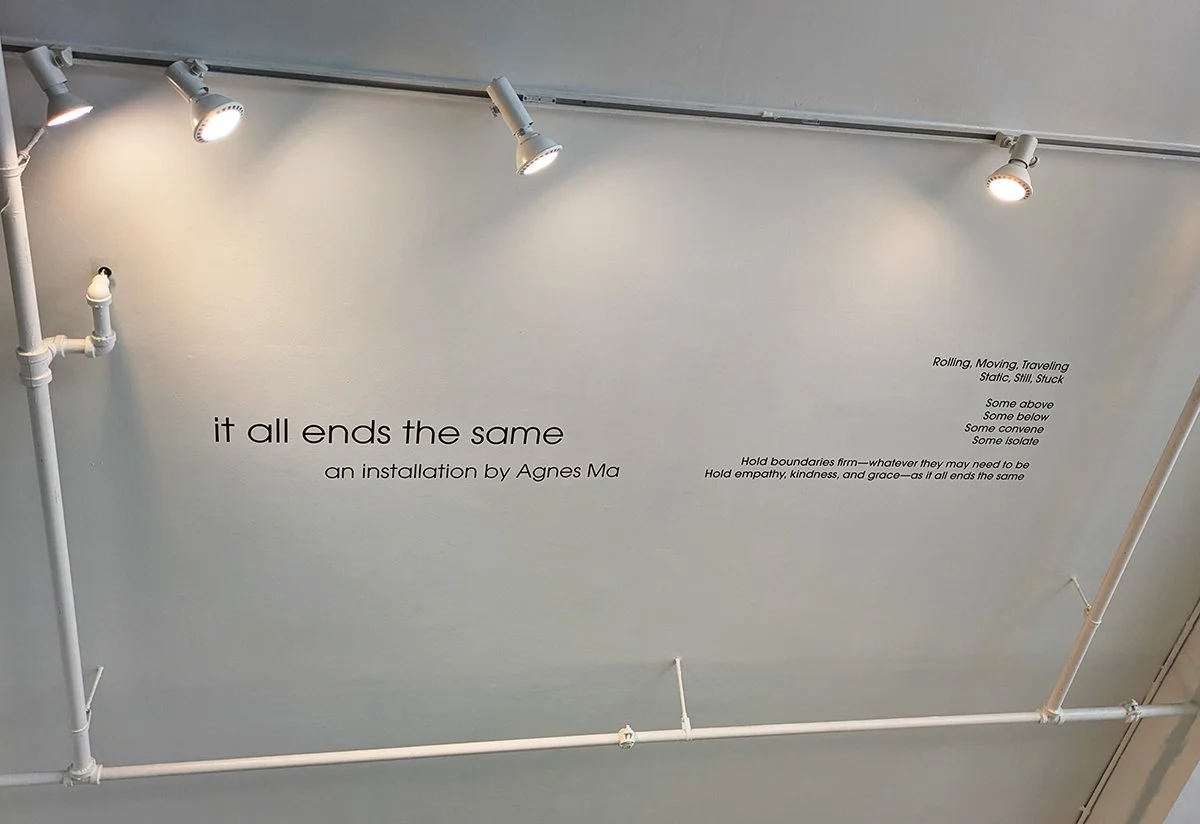
A view of the ceiling text in Agnes Ma’s it all ends the same, 2026, PLA (bioplastic), wire, and found tumbleweeds. Image by Maggie Sava.
As we meditate on the emerging tension in Ma’s installation, we are also called to meditate on her organizing statement, displayed on the ceiling of the gallery in the format of a poem:
Rolling, Moving, Traveling
Static, Still, Stuck
Some above
Some below
Some convene
Some isolate
Hold boundaries firm—whatever they may need to be
Hold empathy, kindness, and grace—as it all ends the same
What does it mean to travel through, when movement oscillates between the active status of rolling and the passive experience of being stuck? How do we navigate through the shifting experiences of convening and isolating, which can sometimes occur unpredictably or be caused by forces out of our control? And what does it mean to have boundaries, when they can be both gates and fences?
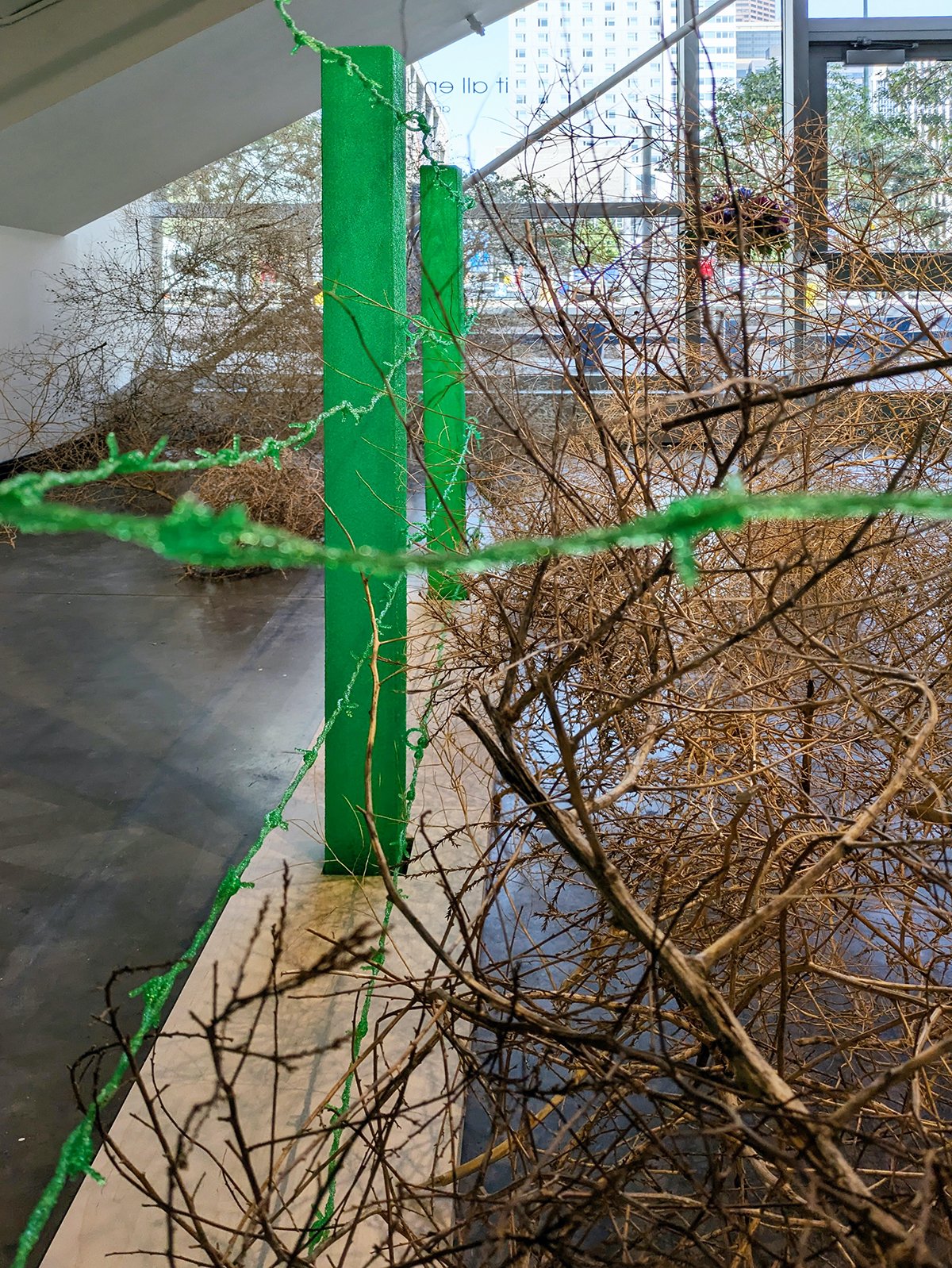
A detail view of Agnes Ma’s it all ends the same, 2026, PLA (bioplastic), wire, and found tumbleweeds. Image by Maggie Sava.
When Ma asks us to hold empathy, kindness, and grace, it seems like she is also revealing to us how those feelings and mindsets must make room for entanglement, intricacy, and difference, like the idea of staying soft amidst the brittle branches of tumbleweeds and the presence of barbed wire.
Ma’s installation crystalizes contradiction through several key elements, including the seeming futility of having fencing that does not close off space. One of the most visibly immediate iterations of contradiction is the combination of the neon green fence posts and wiring with the earthly tones of the tumbleweeds. Ma notes her specific reference to “manufactured and industrial materials handmade in a toxic, oozy, glowing green plastic” set against the natural shades and forms of the plants. [2]
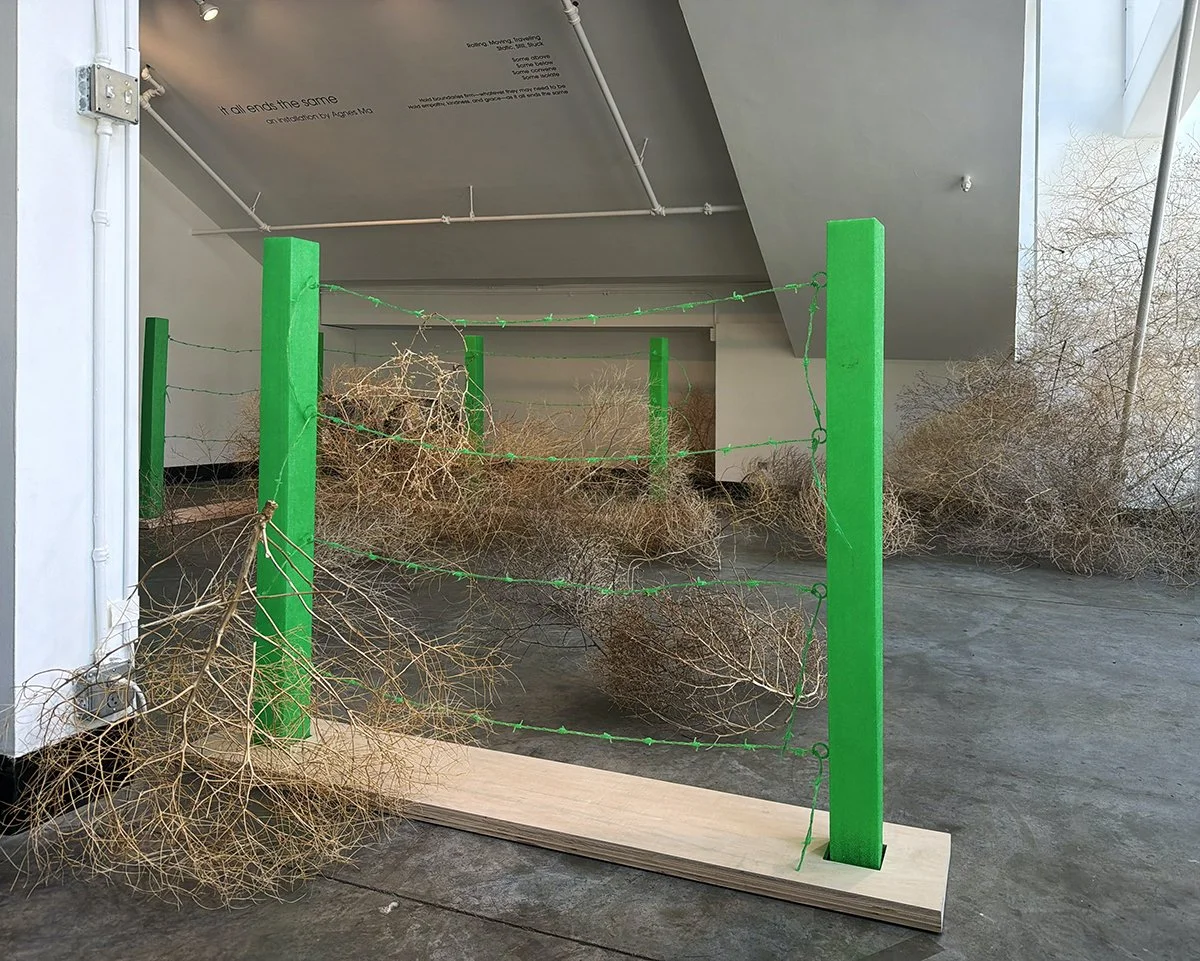
An installation view of Agnes Ma’s it all ends the same at Understudy, 2026, PLA (bioplastic), wire, and found tumbleweeds. Image courtesy of Annie Geimer, Understudy.
The artist utilizes PLA, a plant-based bioplastic commonly used in 3-D printing. PLA is considered a renewable resource, which the artist shapes using a handheld 3-D pen. While capturing the materiality of the mechanical process of 3-D printing, Ma again turns expectation on its head by transforming it back into a gestural, sculptural act in which the artist’s hand molds and it draws in three-dimensional space. In this process, the human and mechanical converge.
In my email exchange with Ma, she revealed some of the unexpected surprises and joys of working with a 3-D pen in her practice, which resonate in the affective nature of the material in the installation. She describes it as a playful technique that allows for experimentation with color, form, and scale. She noted that there is even a sonic element to the process of drawing and sculpting with the pen, as it creates what she describes as a “very satisfactory clanging sound.” [4]
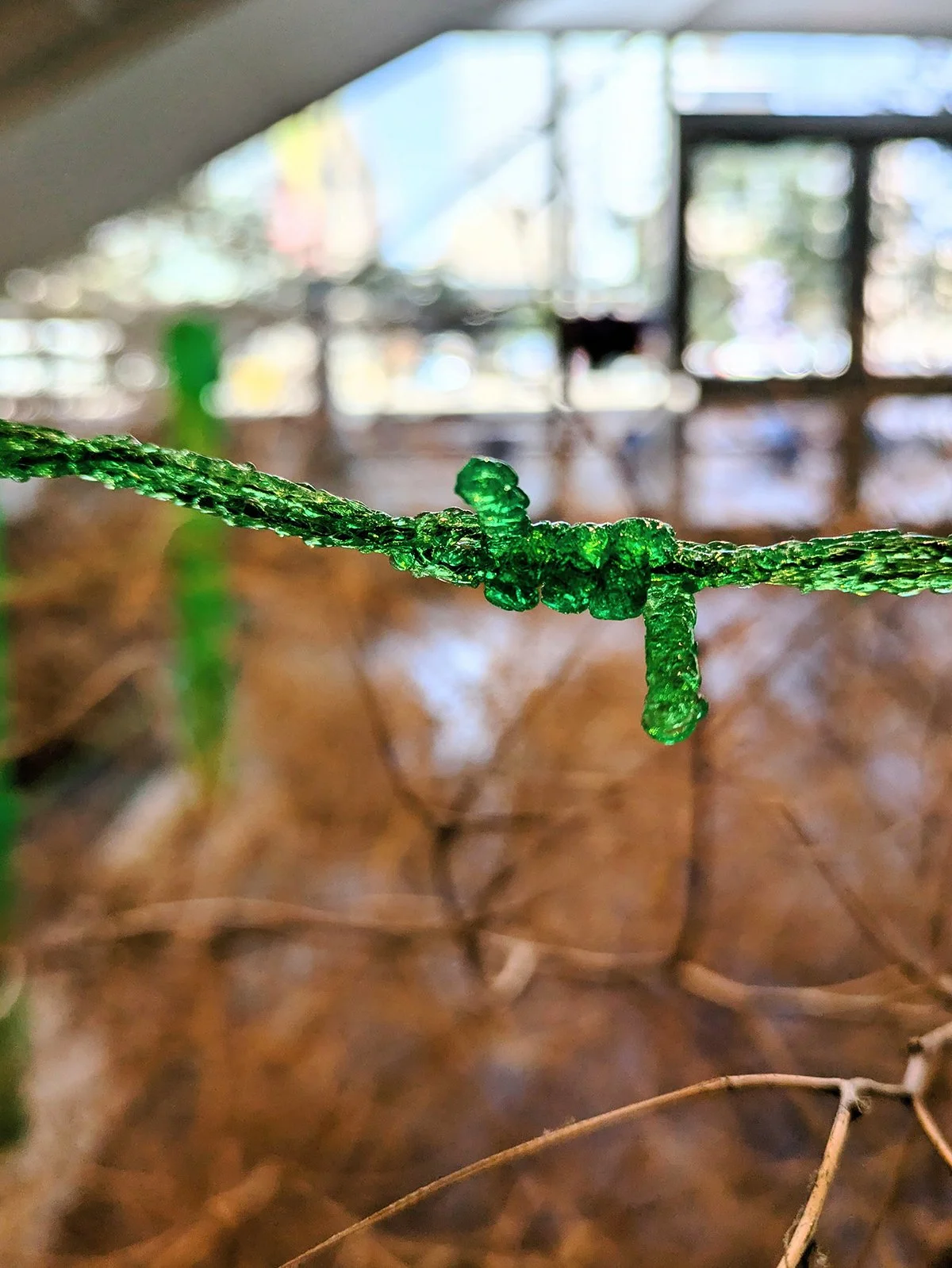
A detail view of Agnes Ma’s it all ends the same, 2026, PLA (bioplastic), wire, and found tumbleweeds. Image by Maggie Sava.
To appreciate the intricacies of Ma’s application of bioplastic in this exhibition, you must lean in to get a closer look at the details of the barbed wire itself. When you get near, you can see the almost bubbly surface texture of the plastic coating. You might also notice that the wire base is not actually barbed, and that Ma drew on the threatening points using the PLA.
Suddenly, the bite is taken out. These fences will not actually pierce skin or inflict pain, especially with the rounded plastic edges of their thorns. The barriers cease to be threats, instead becoming counterparts in the dance of the moving tumbleweeds, almost like partners in the drama of the scene.
In our correspondence, Ma explained: “I see ourselves in the tumbleweeds, accumulating in dense populations or escaping to isolation. I see how movements of one can affect another, both for better or for worse. I see how we might end up somewhere that we did not expect. More and more, I just see how so much of our existence is circumstantial and that everybody could benefit if they just focused a little bit less on themselves and had a little more empathy towards one another.” [4]
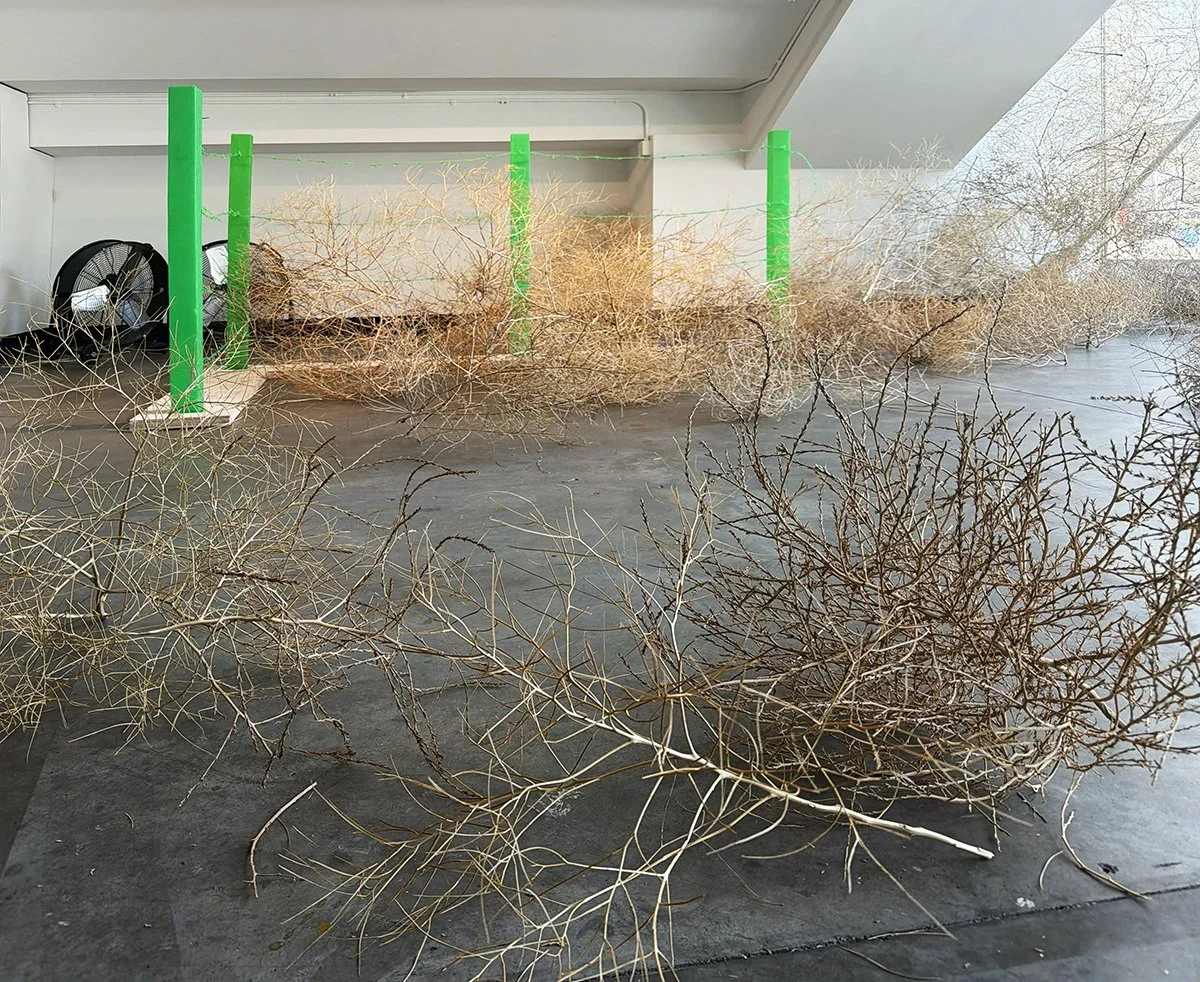
Agnes Ma, it all ends the same, 2026, PLA (bioplastic), wire, and found tumbleweeds. Image courtesy of Annie Geimer, Understudy.
As Ma suggests in it all ends the same, people’s lives often follow irregular and unpredictable paths shaped by constructed obstacles, in the case of the fencing, and by uncontrolled factors, like the breeze in the air. Often, this experience causes us to become myopic, only considering our condition when in fact we are too often scrambling over and around one another to try to get past whatever is in our way. In relinquishing ourselves to the feeling of being untethered, like a tumbleweed, do we forgo our connection to those around us who are also pushing up against the fence?
In botanical terms, tumbleweeds are a seed-releasing system called a diaspore—a word with an unmistakable connection to the notion of diaspora, which takes its source from the same Greek root, meaning scattering. In our contemporary climate, in which the topic of migration draws vitriolic political responses and direct violence, it is hard not to make the association between the movement of diaspore plants and of people experiencing uprooting and displacement.
Similarly, the barbed wire fences mimic those used to demarcate private property and disrupt movement, or even to imprison. However, Ma’s gates do not form closed borders. it all ends the same visualizes how the tumbleweeds gather and become trapped within the fencing, and also how they have the potential to traverse and exist within the gaps and the spaces beyond. Perhaps this arrangement contests what our ideas of being out versus in might be. Here, there are porous passages instead of strict borders on a variety of scales, from the personal to the international and environmental.
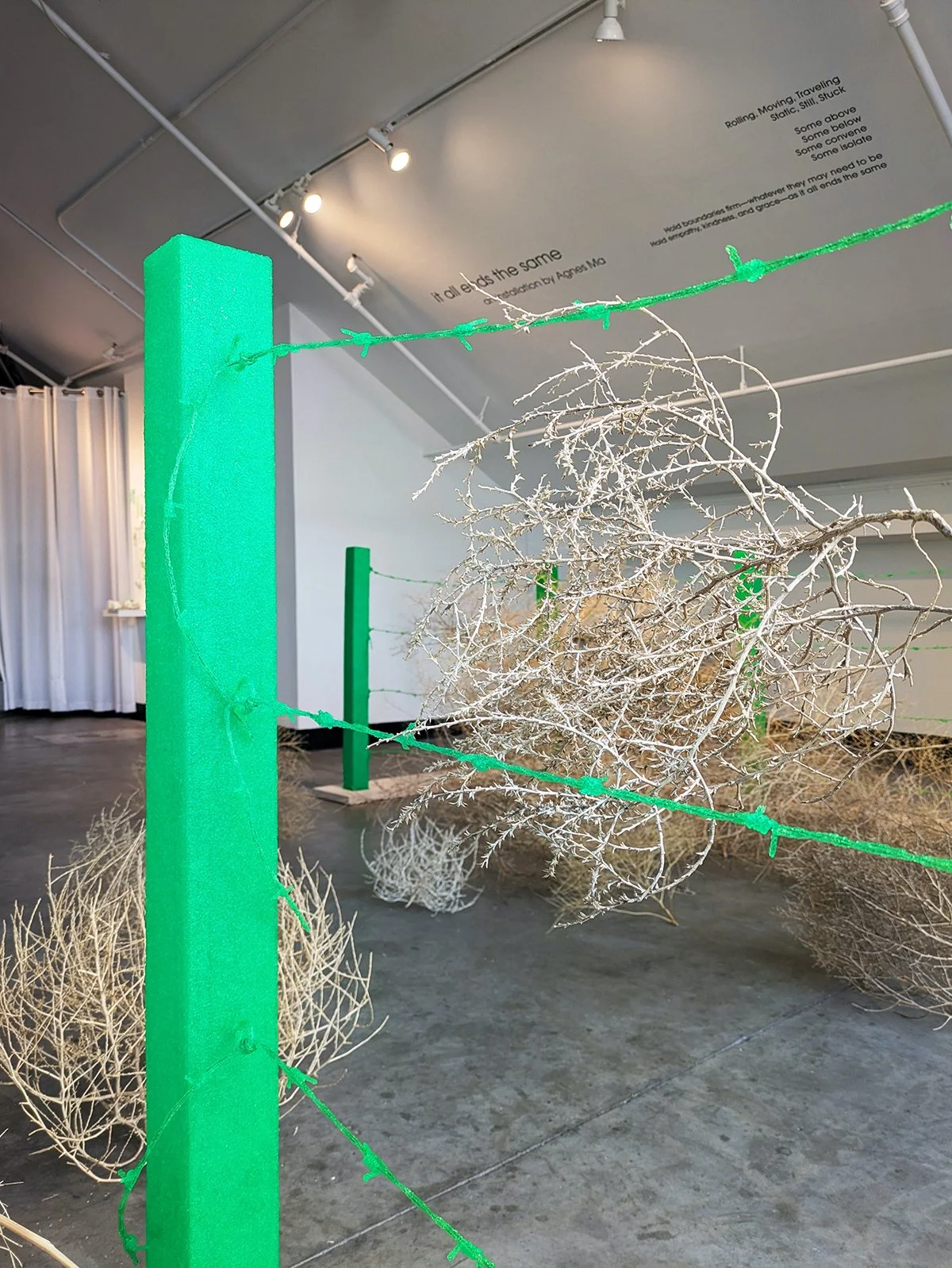
A detail view of Agnes Ma’s it all ends the same, 2026, PLA (bioplastic), wire, and found tumbleweeds. Image by Maggie Sava.
Simultaneously, Ma directs viewers' attention to the idea of holding boundaries firm, “whatever they may be.” In this way, we as viewers must interrogate the differences between boundaries and borders. While they can both demarcate edges, boundaries have a more colloquial connotation of personal and emotional limits.
Embracing Ma’s notions of complexity and contradiction, we must view boundaries as being an expansive concept, while borders are a limiting one. Boundaries can protect while also giving us the pathway to be more. Boundaries can be respectful and kind, providing a roadmap for more enriching engagement and behavior. Boundaries encourage existing in relationship to others, while borders enforce separation.
it all ends the same draws viewers in through what at first appears to be simplicity—a somewhat minimal aesthetic with an emphasis on a few, albeit significant, motifs, and through its non-prescriptive and nonnarrative nature. We are not handed the answers by this exhibition, nor are we instructed on how to interact with it. We are invited to consider our approach and our engagement for ourselves. The richness of the work fills that space that is left open. Suddenly, tension is abundant and unresolved. Dynamics begin to shift. A zoomed-in view of land becomes a stage and a backdrop for examining interactions and relationships.
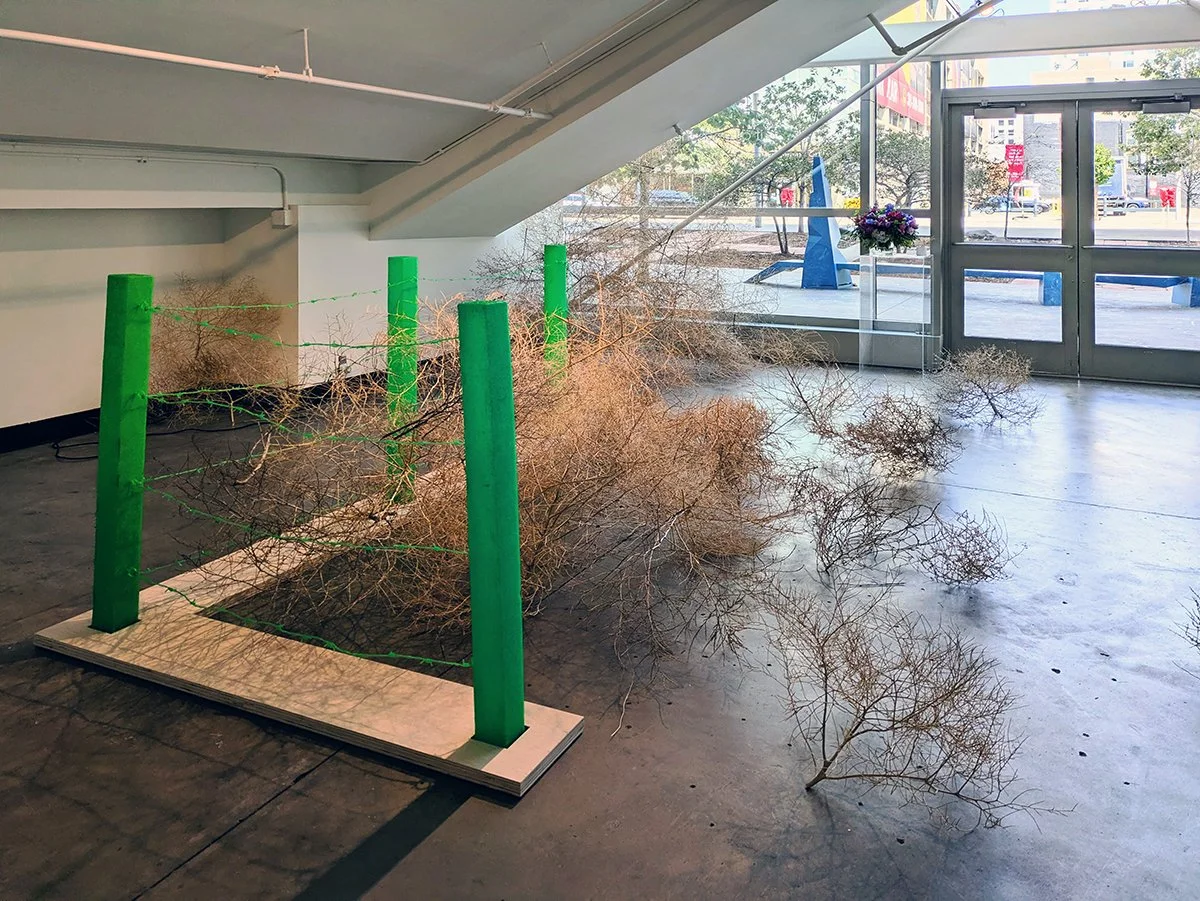
Agnes Ma, it all ends the same, 2026, PLA (bioplastic), wire, and found tumbleweeds. Image by Maggie Sava.
In Ma’s artist statement, she leaves us with several difficult questions about how we as people connect and co-exist with our surrounding world: “How can we support life on this earth sustainably when everything is interwoven? How can we subsist humbly while still maintaining a quality of life? How can humanity progress without leaving anybody behind?” Inevitably, these queries cannot be answered in one sitting. In fact, these are vast, philosophical lines of thinking. It seems like we are meant to exist perpetually within these reflections, figuring them out along the way as we do our best to, as Ma asks, be good.
For better or for worse, we do not even receive a definition or guidebook of what being good means from this exhibition. What we do learn is that the best way to strive for goodness might just be through the humility gained by the embrace of complexity and difference—a humility of knowing that these experiences do not need to lead to hierarchy and division, when, as the artist reminds us, it will all end the same.
Maggie Sava (she/her) is an art historian and writer based in Denver. She holds a BA in art history and English, creative writing from the University of Denver and an MA in contemporary art theory from Goldsmiths, University of London.
[1] From my email exchange with Agnes Ma, August 11, 2026.
[2] From the artist’s statement for the exhibition.
[3] From my email exchange with Agnes Ma.
[4] Ibid.