
Retroflection | Conduit
Wynne Reynolds: Retroflection: a decade of mixed media explorations | Travis Vermilye: Conduit
Edge Gallery
6501 W. Colfax Avenue, Lakewood, CO 80214
August 21–September 6, 2026
Admission: Free
Review by Paloma Jimenez
Networks, biological and social, keep life thrumming along. Even within our increasingly isolated society and compounding ecological crises, networks chart paths for continued survival. In their concurrent exhibitions at Edge Gallery in Lakewood, Wynne Reynolds and Travis Vermilye move through this theme of connectivity with two different conceptual approaches. Reynolds expels the thorny pain of the patriarchy with a relentless material curiosity and collaborative creation, while Vermilye looks outside of human narratives towards the meditative and generative properties of mycelial networks.
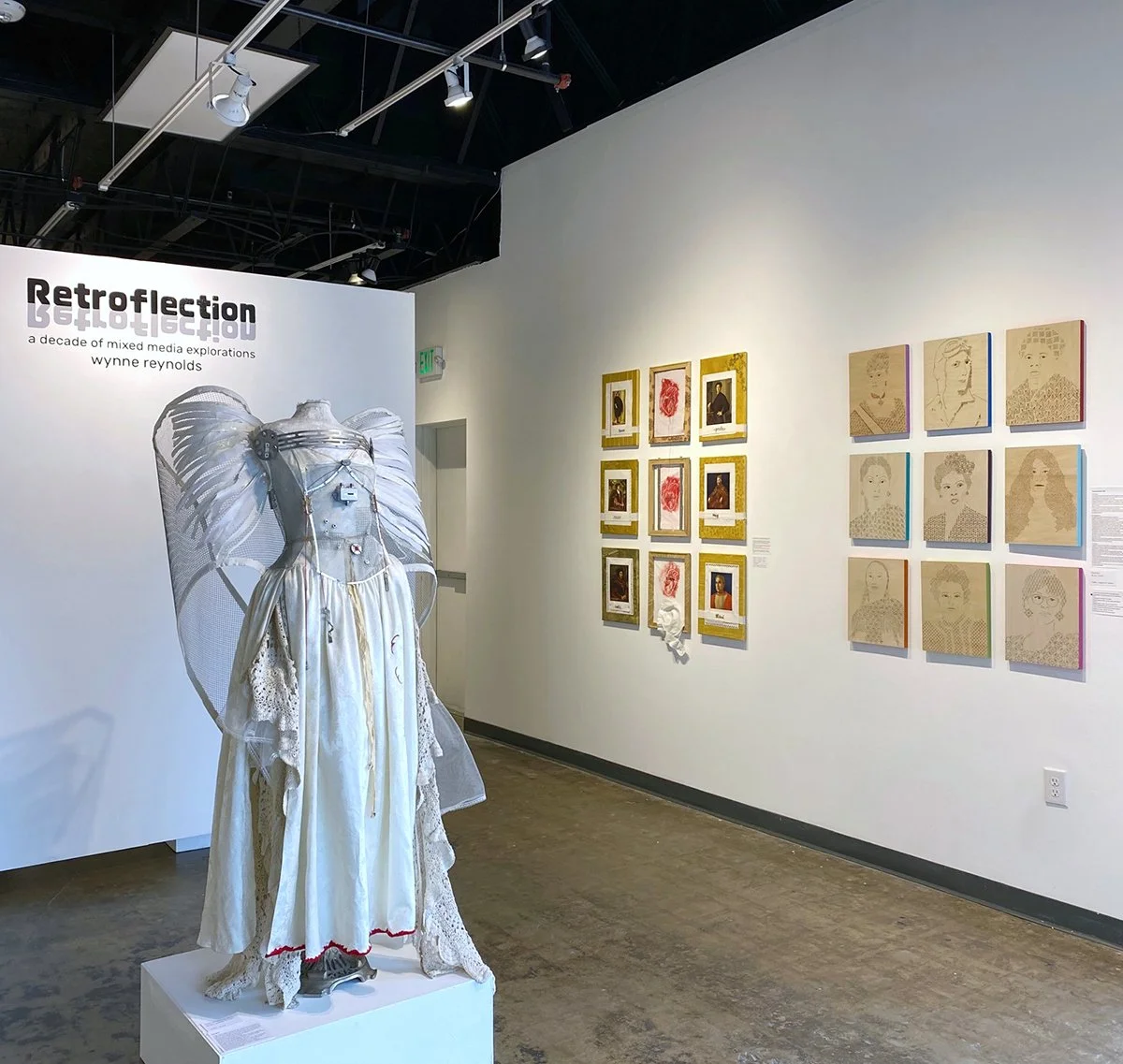
An installation view of Wynne Reynolds’s exhibition Retroflection: a decade of mixed media explorations at Edge Gallery. Image by Paloma Jimenez.
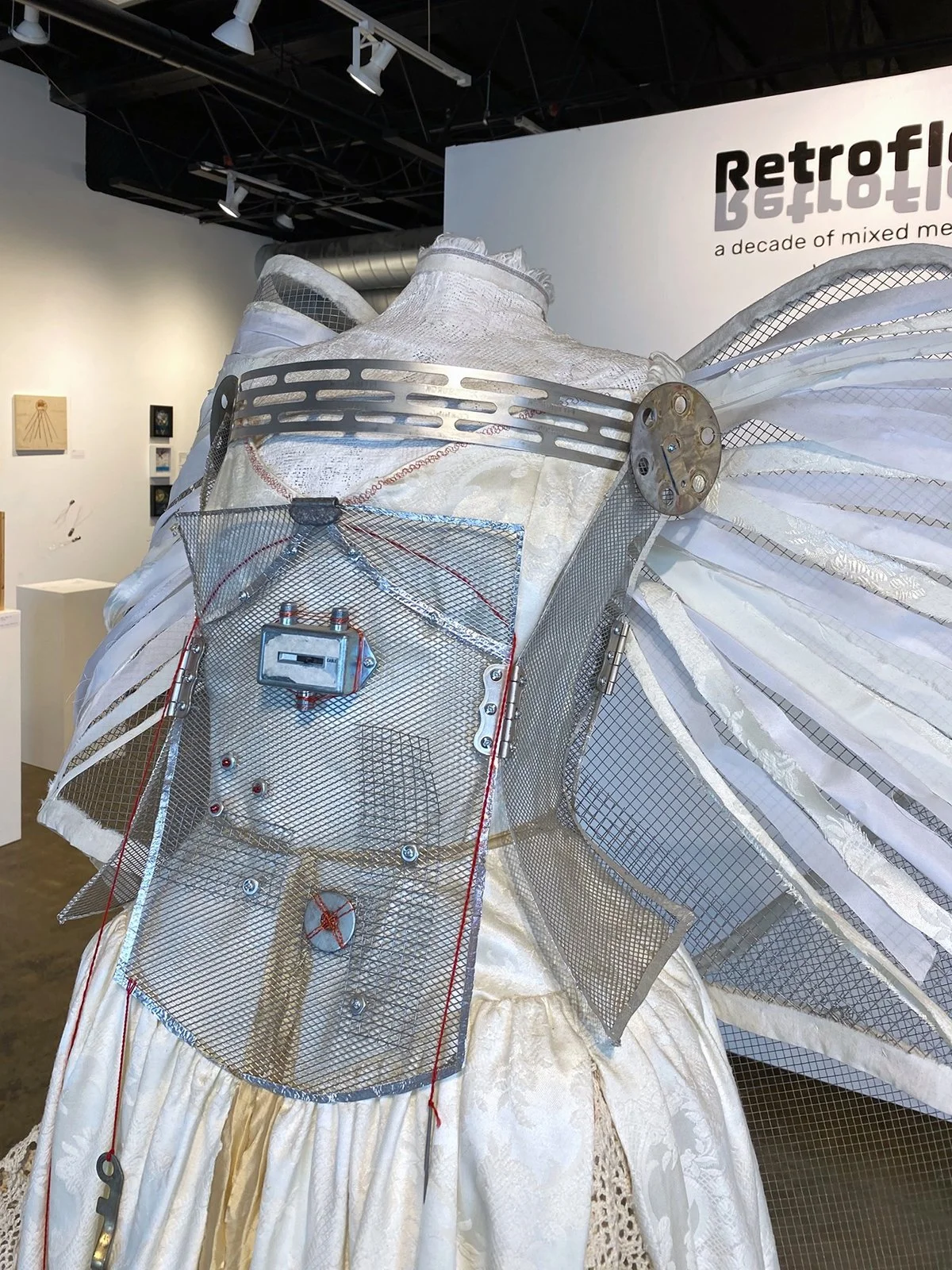
A detail view of Wynne Reynolds’s Nike (Winged Victory), mixed media. Image by Paloma Jimenez.
In Retroflection, Wynne Reynolds presents pieces from many different bodies of work. She oscillates between hard and soft materials, and hard and soft feelings. At the entrance, a mixed media dress fit for a cyborgian Miss Havisham, titled Nike (Winged Victory), traverses both the textured past and potential futures. Her attention to detail keeps it rooted in the present battles against authoritarianism. The intricate handiwork of vintage lace doilies transitions into a stiff grid of hinged metal mesh. Hardware bits dangle from blood red threads, tools or talismans. It is a suit of angelic armor for a modern war.
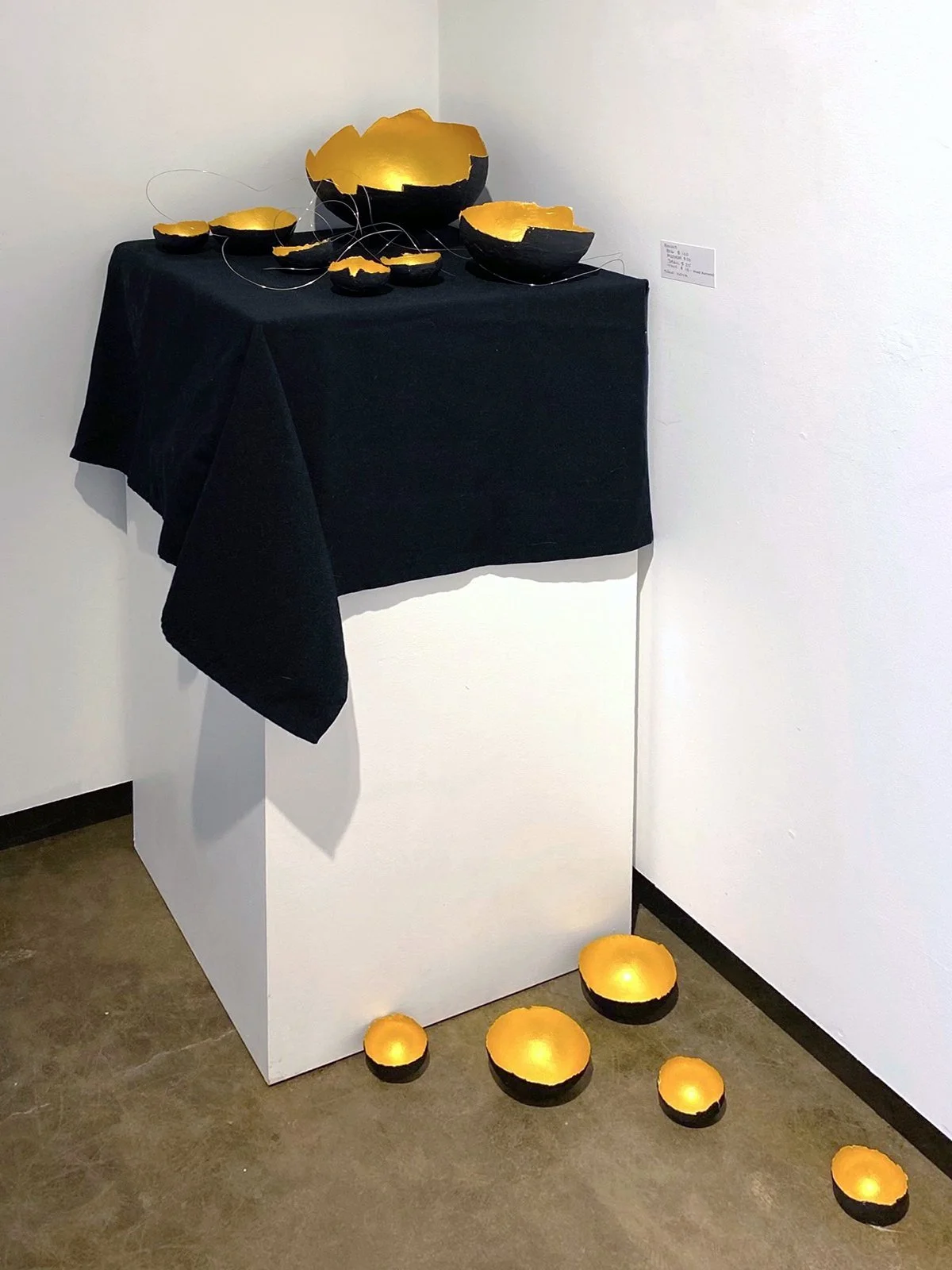
Wynne Reynolds, Bowls, plaster and paint. Image by Paloma Jimenez.
Reynolds is intimately entangled with her materials. Her figurative work contains more direct messages, but narratives emerge from even her most abstract pieces. A group of eggshell thin black bowls contains radiant gold interiors. Alluring objects, but also a poignant reminder to keep close one’s sources of inner illumination.
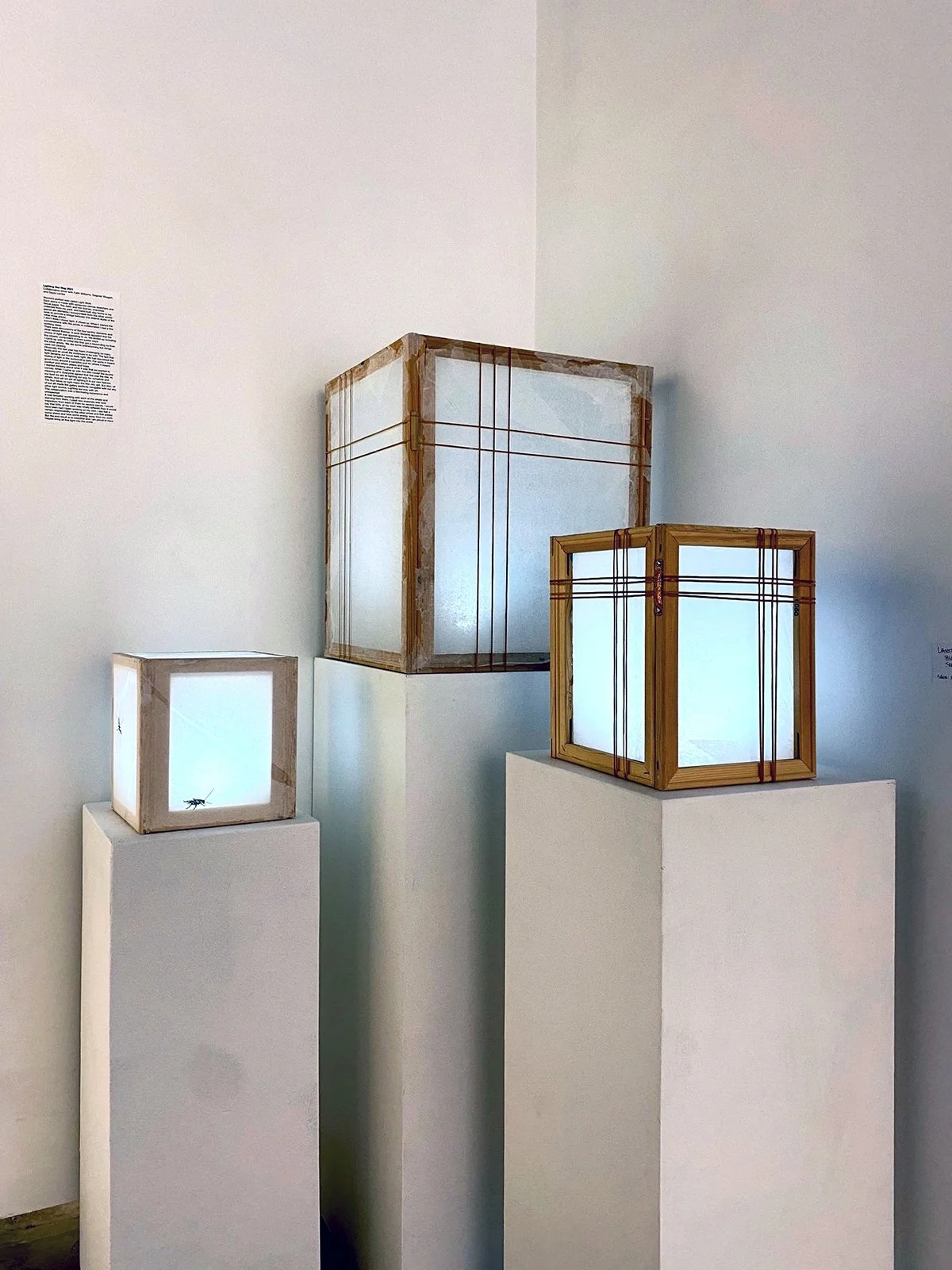
Wynne Reynolds, Lanterns, reclaimed canvas stretchers and tissue paper. Image by Paloma Jimenez.
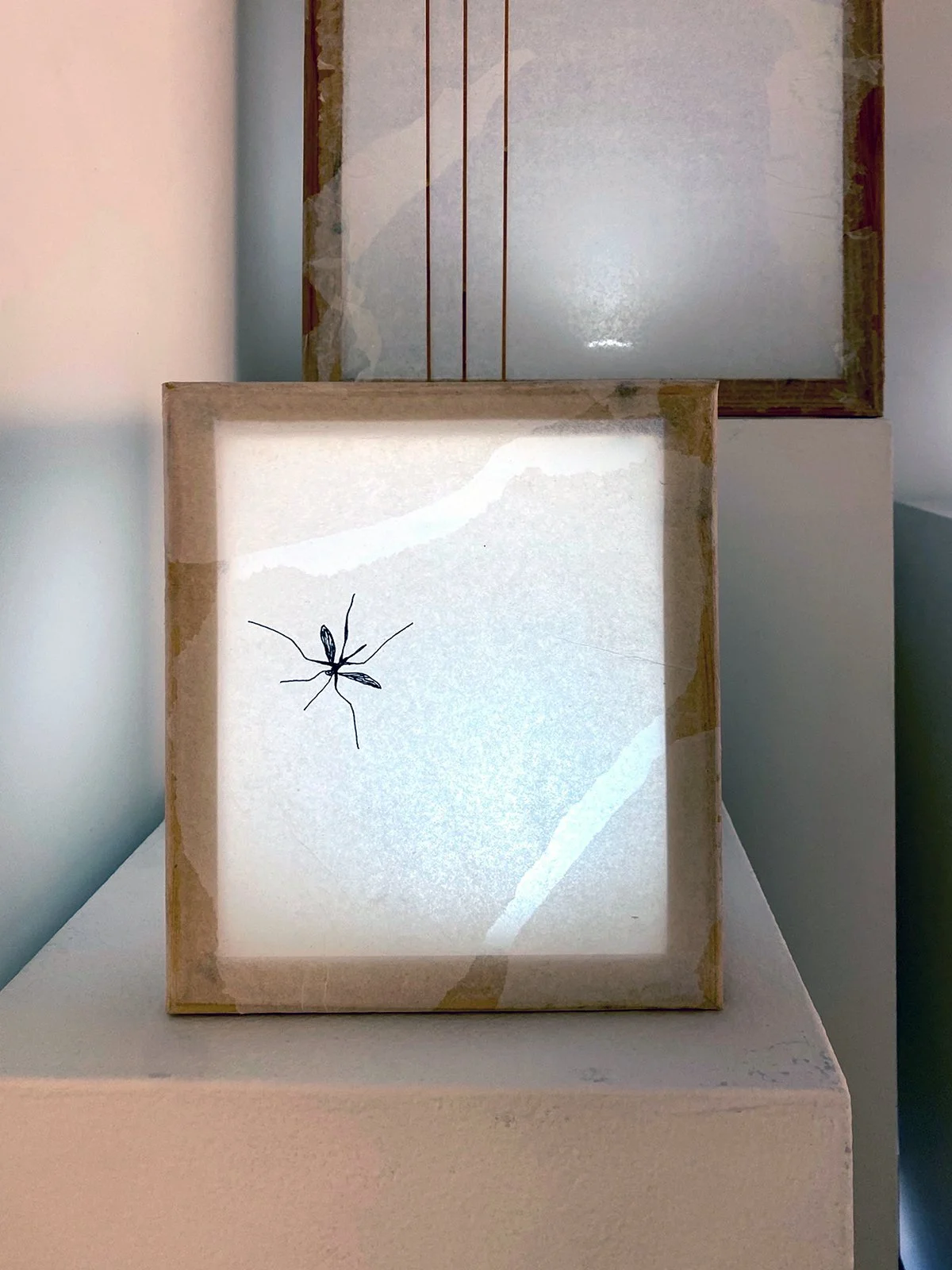
A detail view of Wynne Reynolds’s Lanterns, reclaimed canvas stretchers and tissue paper. Image by Paloma Jimenez.
Nearby, lanterns constructed out of canvas stretchers and torn tissue paper glow in a corner. A drawn cricket inhabits one screen; a spindly mosquito another. Two-dimensional media becomes a sculptural light source and a common pest becomes the protagonist. Playing with dichotomies and churning out something new seems to be at the crux of Reynolds’s practice.
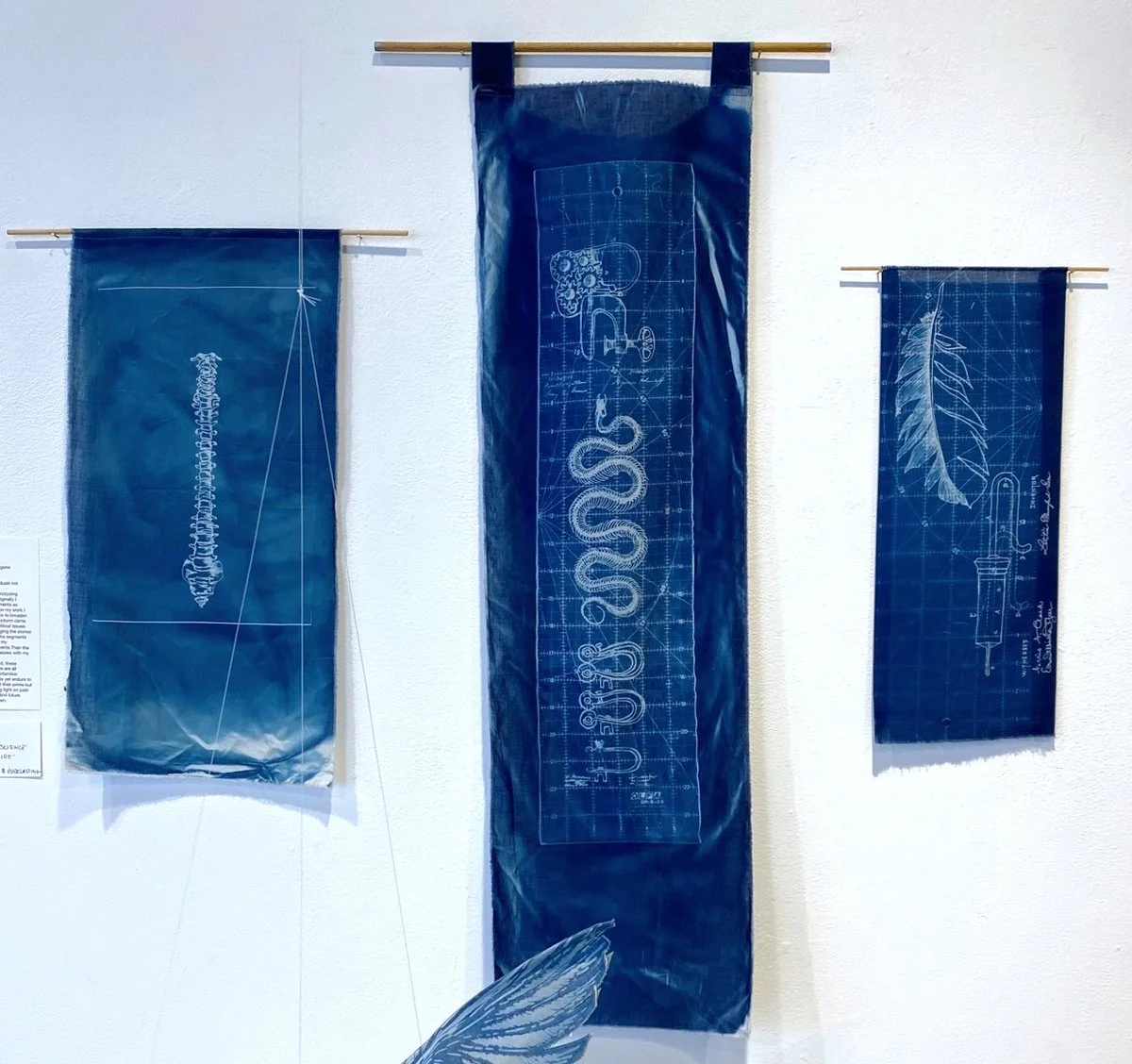
Wynne Reynolds and Faith Williams Dyrsten, Obsolete & Everlasting, cyanotypes on fabric. Image by Paloma Jimenez.
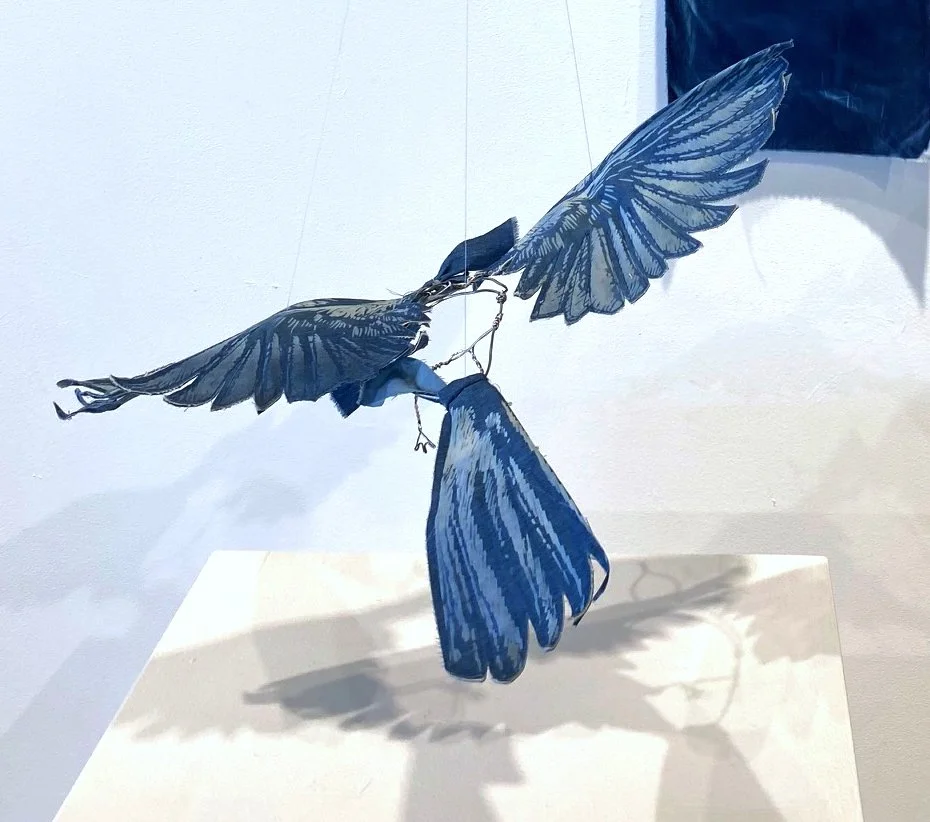
Wynne Reynolds and Faith Williams Dyrsten, Woodhouse Scrub Jay, wire and cyanotype on fabric. Image by Paloma Jimenez.
Collaboration also plays an important role, as evidenced by the many other artists credited throughout the show. She created the wire and cyanotype Woodhouse Scrub Jay with Faith Williams Dyrsten. Despite its apparent incompleteness, the bird is taking flight, finding an inspirational buoyancy in the vulnerability of exposing its process. Wynne Reynolds finds the point of tension between materials and twists it until the knots come loose.
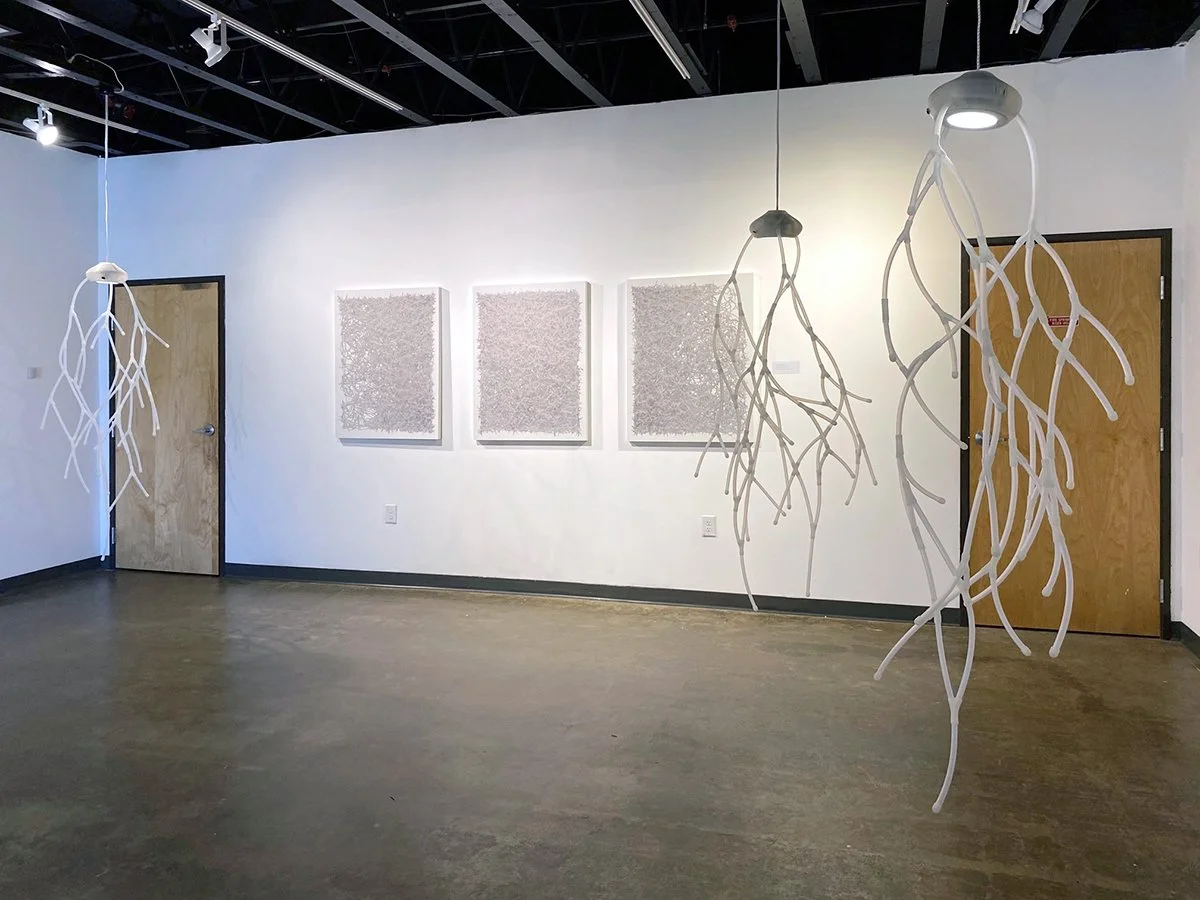
An installation view of Travis Vermilye’s exhibition Conduit at Edge Gallery. Image by Paloma Jimenez.
Travis Vermilye’s Conduit exhibition in the back half of the space opts for a more subdued, but equally explorative tone. Monochromatic work and dimmed gallery lights pulse with an inviting life force. His statement on the wall begins: “All around us beneath our feet, vast mycelium networks branch, thread, and connect to transport water, nutrients, and chemical signals within and between species of fungi and plants.”
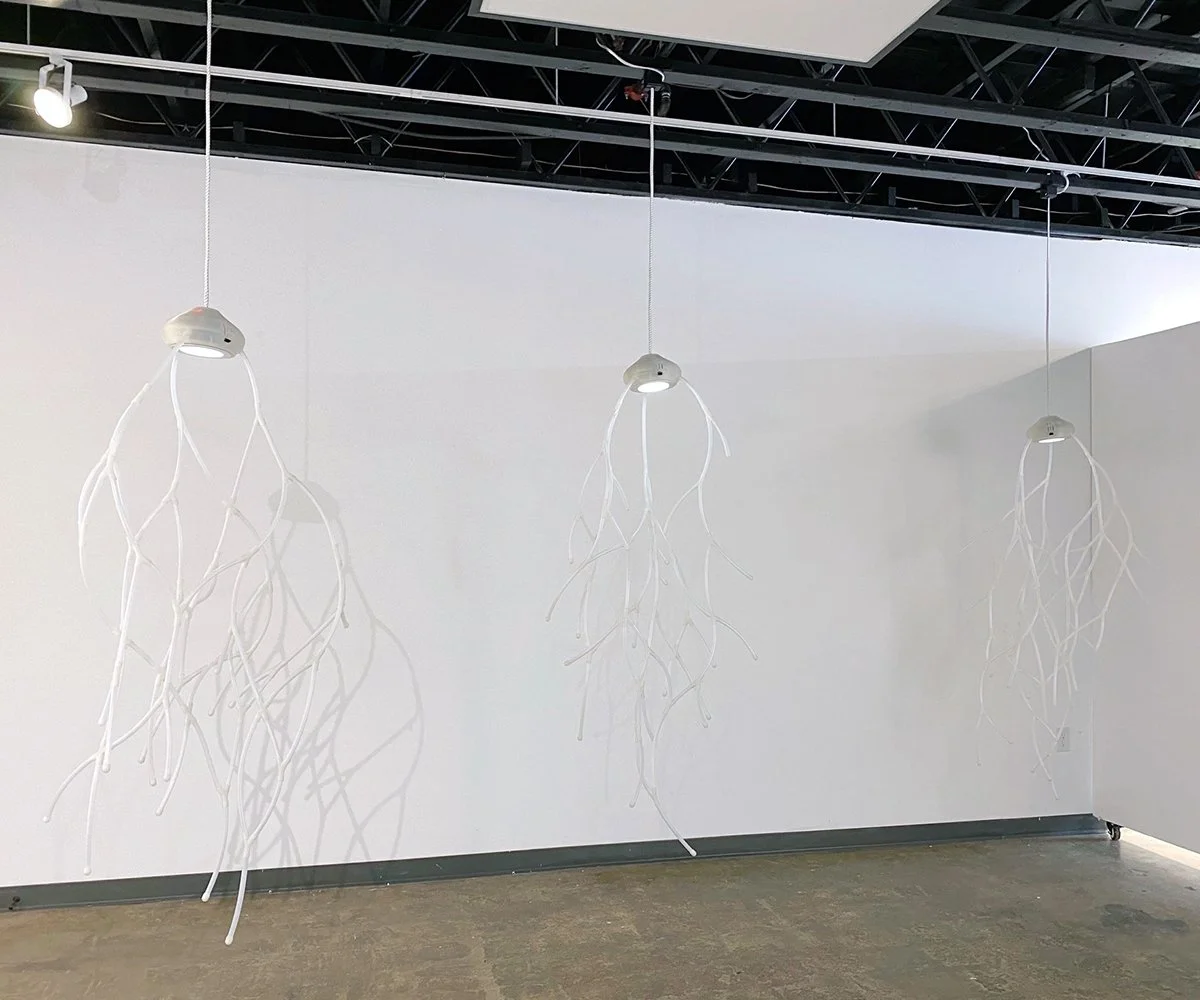
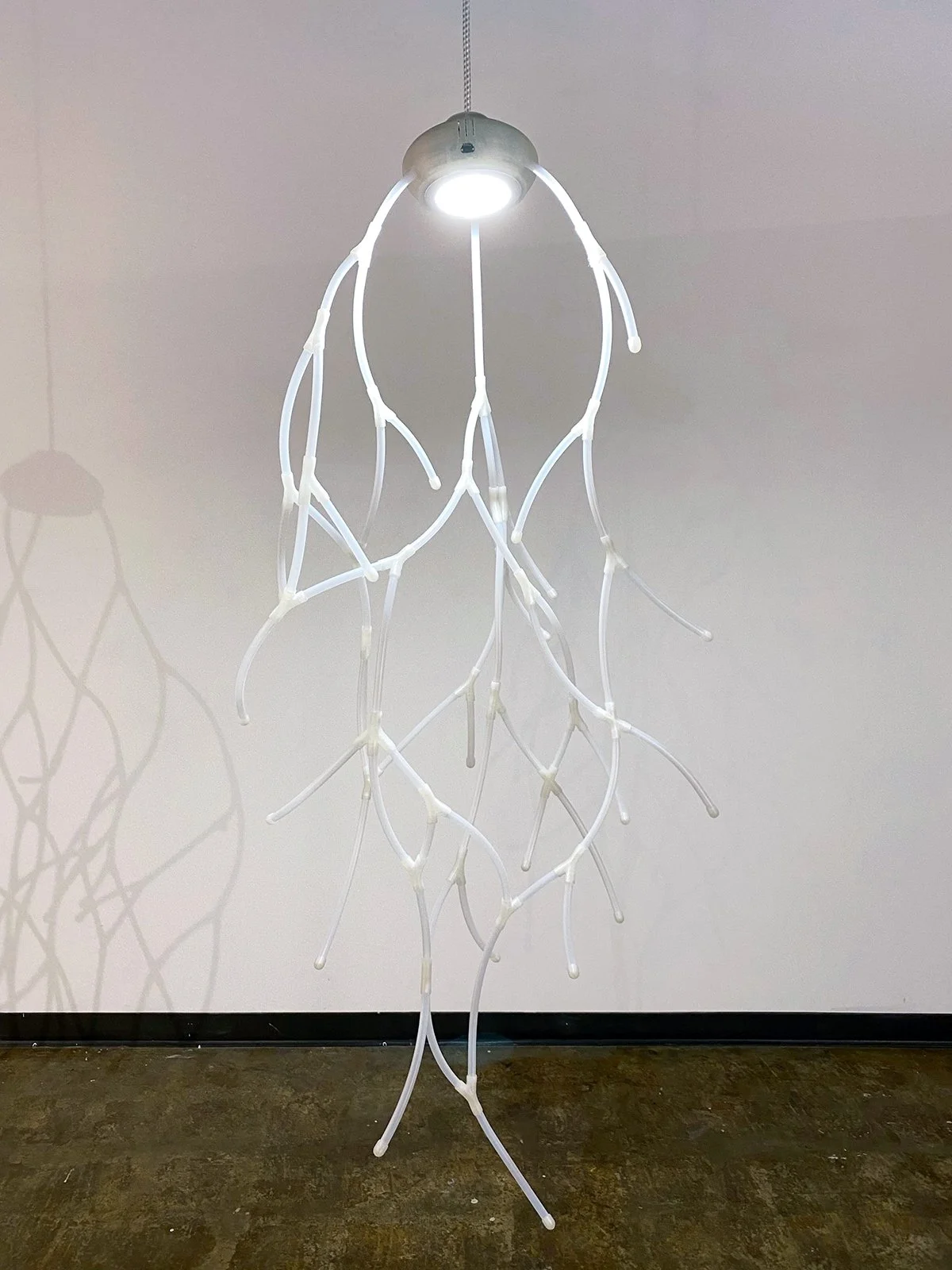
An installation view of Travis Vermilye’s Mycosentient hanging sculptures, 3-D printed PLA plastic joints, polyethylene tubing, and Arduino micro-controlled lights. Image by Paloma Jimenez.
While the choice of materials is more sterile than the real mycelium networks snaking through the loam below, it reflects the artist’s interest in setting up the space as an “ongoing experiment—a laboratory of sorts.” [1] A group of six rounded, white mushroom-shaped bulbs hang from the ceiling with branching trails of tubing. The circular arrangement in the room mimics a common spread pattern for mycelium, which starts in one spot and reaches outwards for nutrients, with mushrooms fruiting at the outer edges. I stand in the middle and become the origin spore for the surrounding light. The slowly flickering bulbs become a clouded sun dancing around the forest floor.
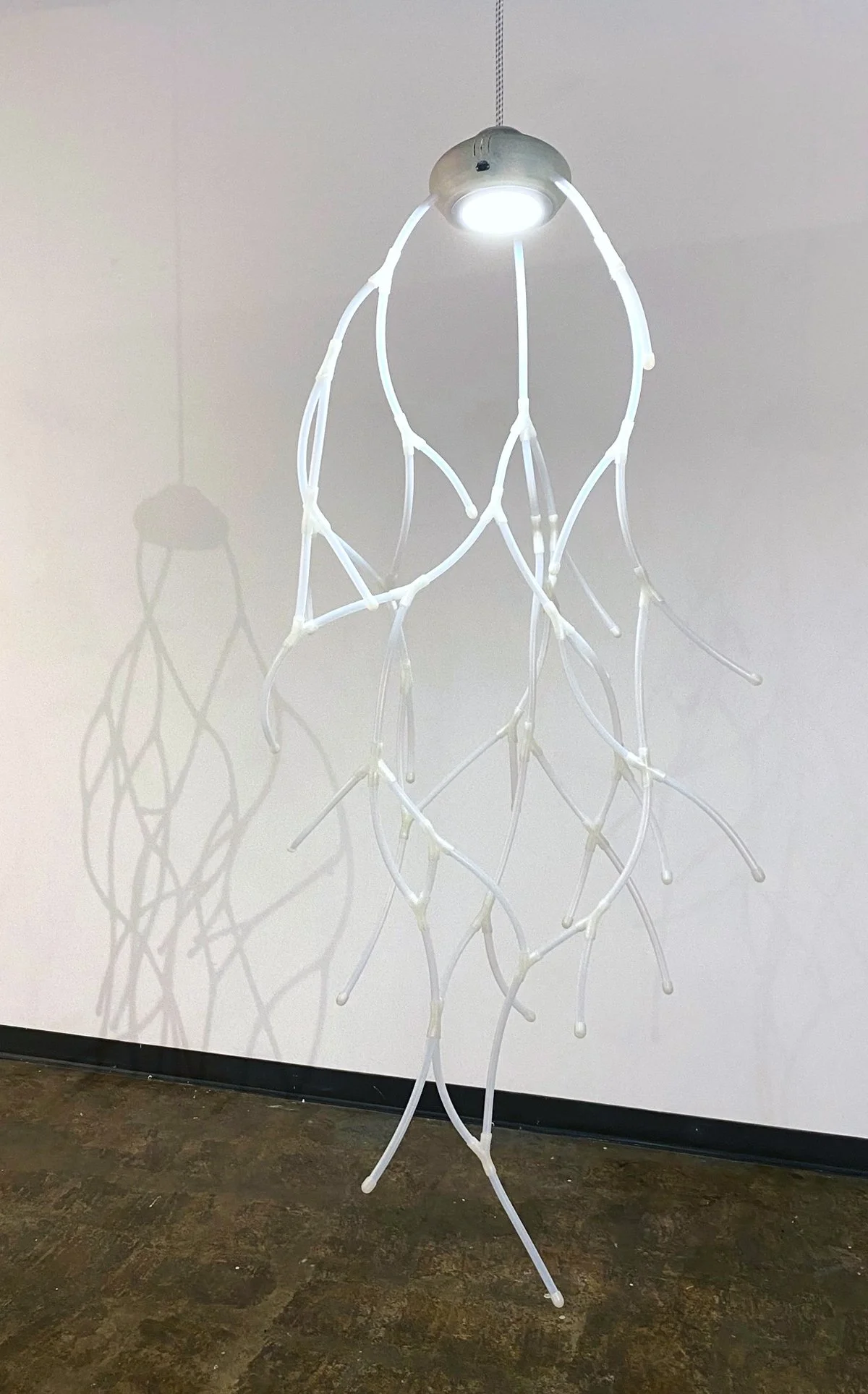
Travis Vermilye, Mycosentient 02, 3-D printed PLA plastic joints, polyethylene tubing, and Arduino micro-controlled lights. Image by Paloma Jimenez.
In the book How to Change Your Mind, Michael Pollan suggests that the biological impetus behind psilocybin’s mind-altering capabilities is to fundamentally change how the animal that consumes fungi relates to nature. The continued survival of fungi, and all life, depends on a quintessential understanding of interconnectedness.
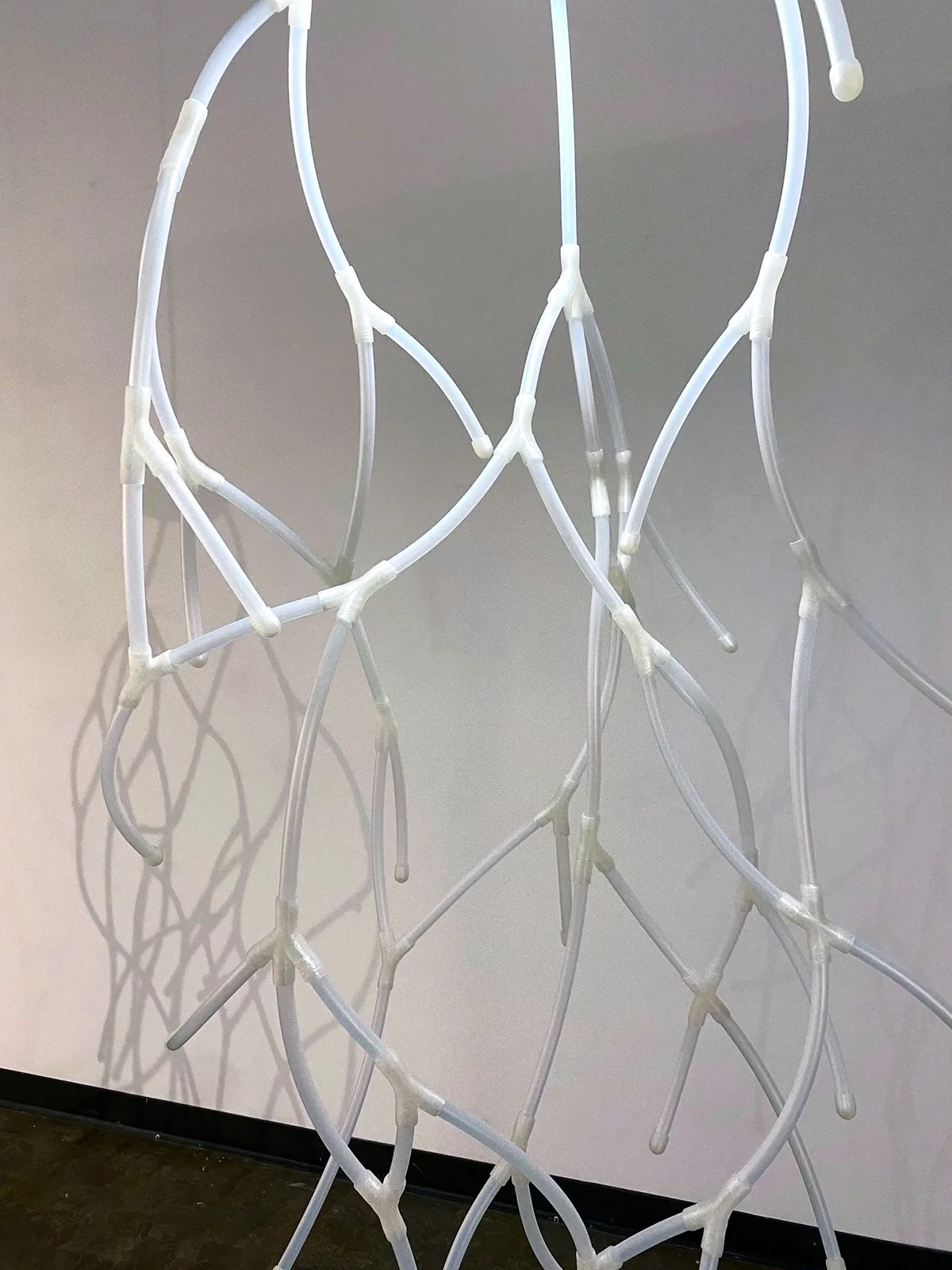
A detail view of Travis Vermilye’s Mycosentient 02, 3-D printed PLA plastic joints, polyethylene tubing, and Arduino micro-controlled lights. Image by Paloma Jimenez.
How do we diverge from selfish paths? How do we become more like mycelium? Travis Vermilye sets up a space for pondering these questions with the unique viewing perspective of being below. We are viewers, subjects, and activators of the Mycosentient hanging sculptures. Arduino micro-controlled lights with proximity sensors grow brighter the closer you approach. [2] They feel like a living heartbeat. Plastic tubing dangles down to the floor like playful probes. The shadows cast on the wall create another visual network to meander through.
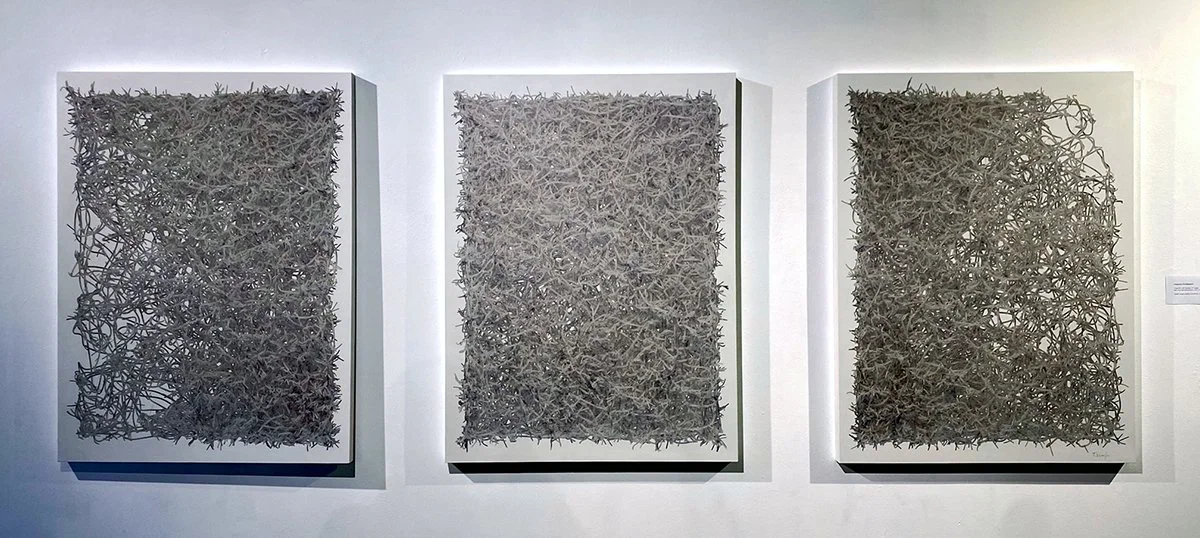
Travis Vermilye, Adaptive Proliferation triptych, digital image transfer and acrylic medium on panel, three 30 x 40 x 1.5 inch panels, wall mounted dimensions: 102 x 40 inches. Image by Paloma Jimenez.
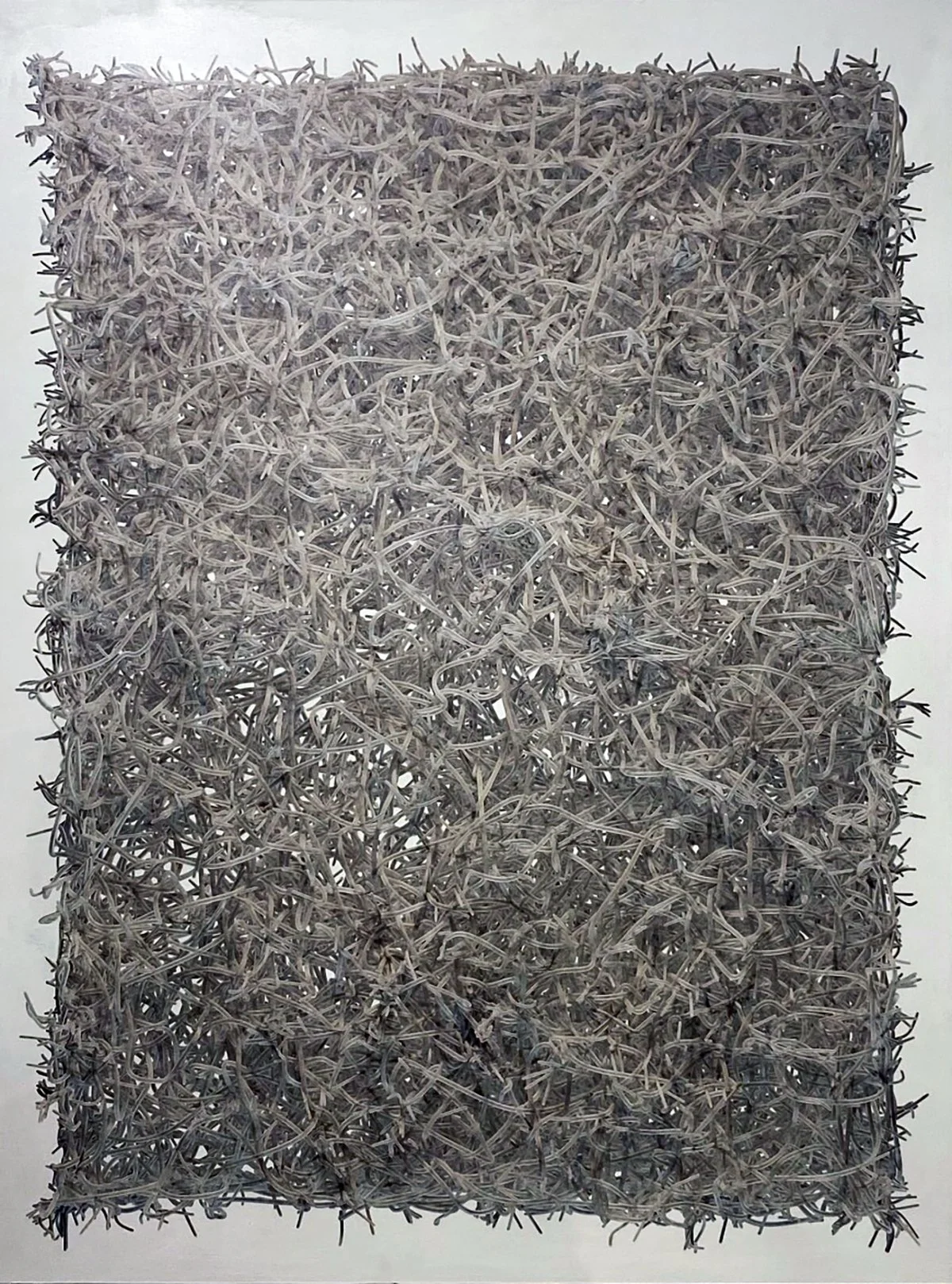
The center panel in Travis Vermilye’s Adaptive Proliferation triptych, digital image transfer and acrylic medium on panel, three 30 x 40 x 1.5 inch panels, wall mounted dimensions: 102 x 40 inches. Image by Paloma Jimenez.
On the far wall, Vermilye’s Adaptive Proliferation triptych offers a two-dimensional interpretation of the incomprehensible vastness of mycelium networks. The digital image, transferred onto a wooden panel and coated with acrylic medium, is reminiscent of the Microsoft Windows 3-D pipes screensaver. But rather than endlessly connecting, the organic lines of the central dense proliferation taper off into errant wisps on the side panels. A true network might run out of resources eventually, but it can also regain momentum after adapting to new conditions.
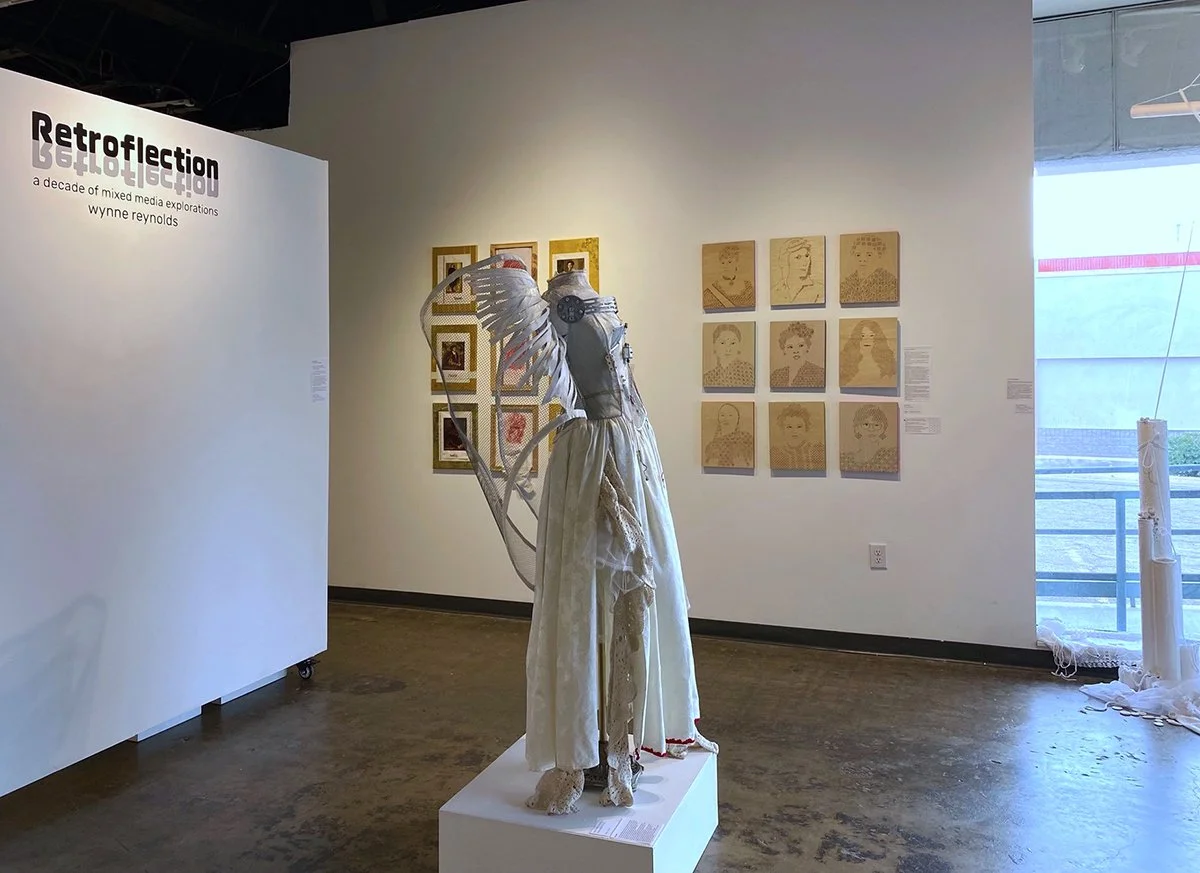
An installation view of Wynne Reynolds’s exhibition Retroflection: a decade of mixed media explorations. Image by Paloma Jimenez.
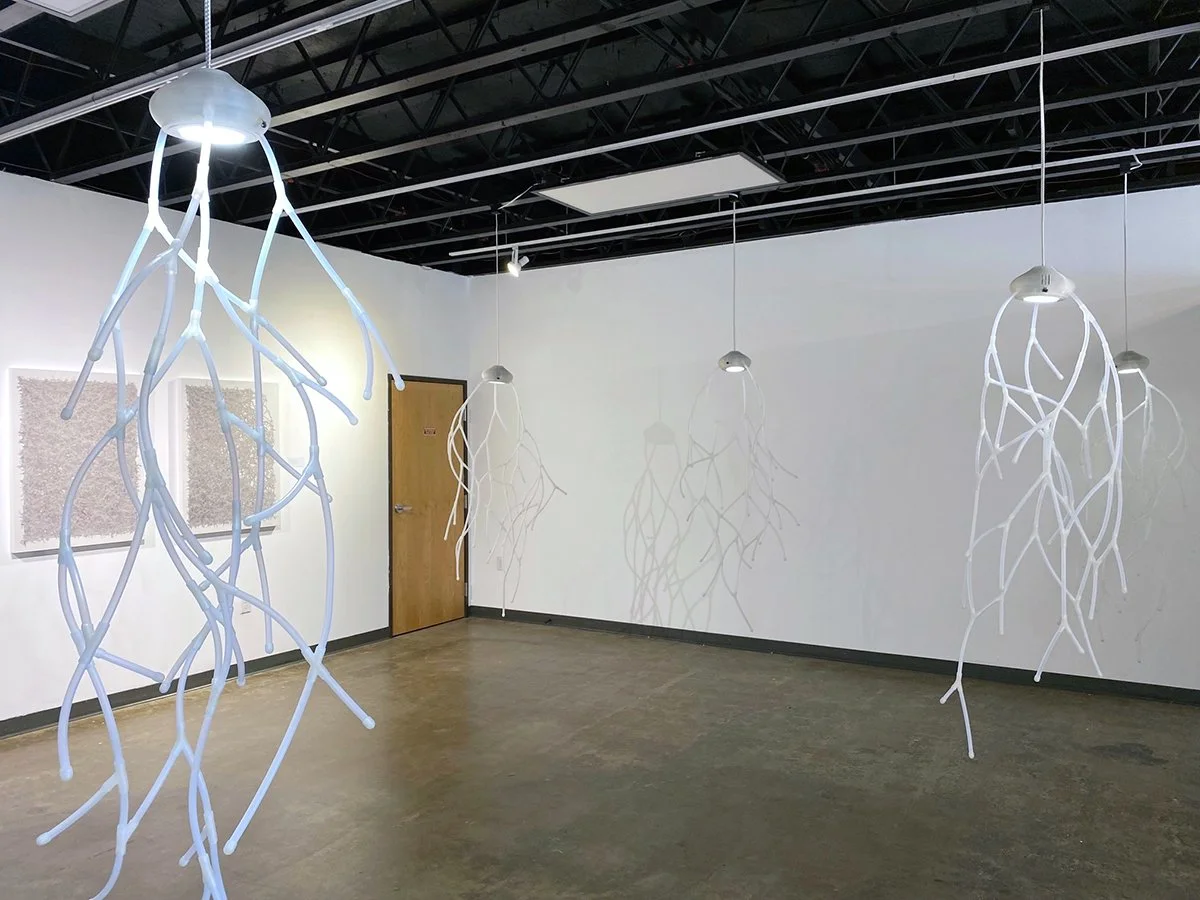
An installation view of Travis Vermilye’s exhibition Conduit. Image by Paloma Jimenez.
Travis Vermilye and Wynne Reynolds both dive into the complexities of human networks through biological metaphors and material experimentation. These artists offer two potential paths in changing course towards a more empathetic society: finding harmony within dichotomous concepts and understanding that we are part of a timeline much longer than human memory.
Paloma Jimenez (she/her) is an artist and writer. Her work has been exhibited throughout the United States and has been featured in international publications. She received her BA from Vassar College and her MFA from Parsons School of Design.
[1] From the exhibition wall text.
[2] From my conversation with the artist.