
Concrete Creativity
Concrete Creativity: Historic Murals of the Pueblo Levee
Sangre de Cristo Arts and Conference Center
210 N. Santa Fe Avenue, Pueblo, CO 81003
April 18–August 15, 2026
Admission: $10 for Seniors (65+), Military, Veterans, Educators, Education Faculty & Staff, Students, First Responders, Healthcare Workers, Museum Workers, and Library Workers; $12 for the general public
Review by Madeleine Boyson
It’s the sort of exhibition that’s ideal for a cultural center—one part art, two parts historical archive, three parts public engagement. Now on view in the Hoag Gallery at Sangre de Cristo Arts and Conference Center through August 15, Concrete Creativity: Historic Murals of the Pueblo Levee historicizes a public artwork that once held the Guinness World Record for the largest outdoor mural from 1995 to 2016. Slight but sufficient, the show functions primarily as promotion for the Pueblo Levee Mural Project’s conservation efforts while tapping into the potent sensation of local pride.
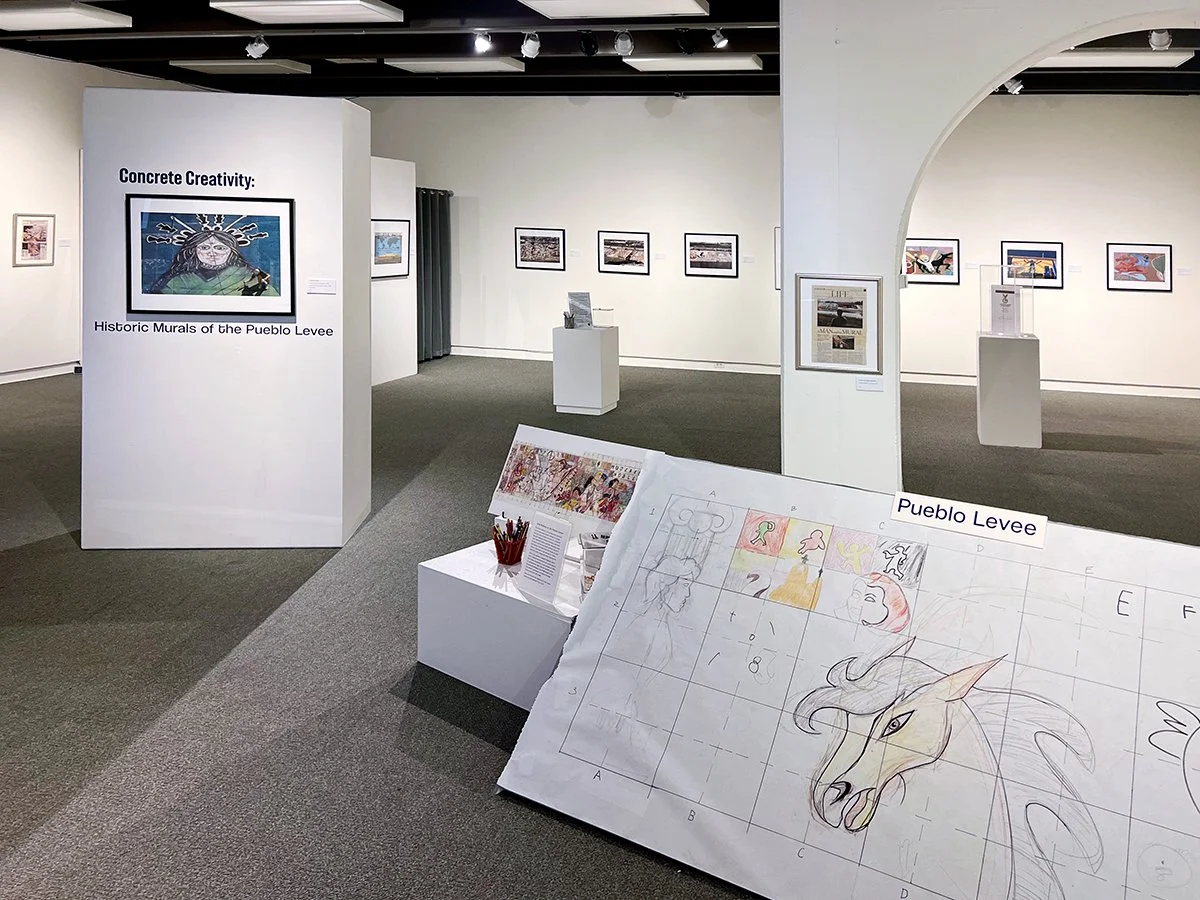
An installation view of Concrete Creativity: Historic Murals of the Pueblo Levee at the Sangre de Cristo Arts and Conference Center. Image by Madeleine Boyson.
The Arkansas River ambles through Southern Colorado’s second largest city with a flow that has raged and quieted depending on the season. [1] Soon after the Great Pueblo Flood killed hundreds in 1921, the city built a 3-mile-long, 60-foot-high concrete embankment to make a truce with the river. The resulting levee created an ideal spot for graffiti and anti-war statements during the mid-century. Later, the levee’s canvas beckoned art students from the University of Southern Colorado and Colorado State University-Pueblo, who painted the embankment’s first murals in the dead of night.
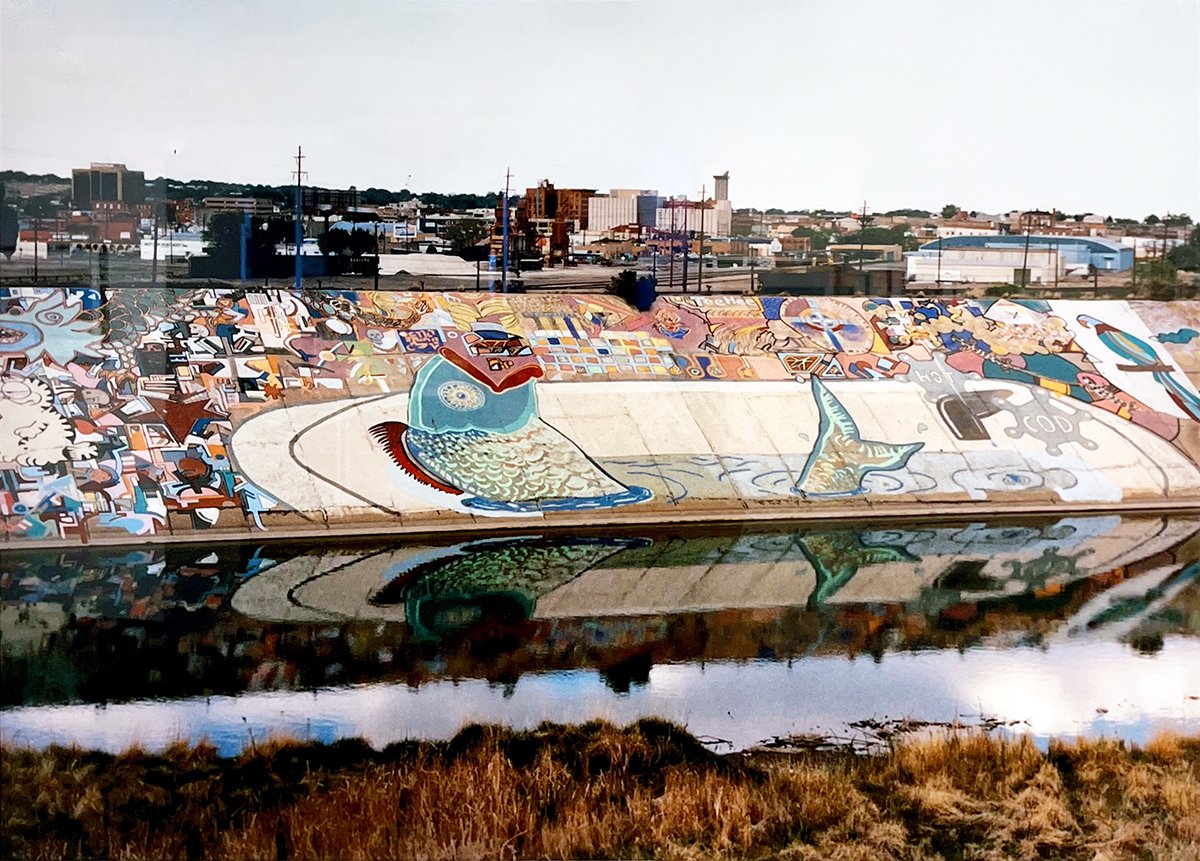
Cynthia Ramu, “Big Fish in the Bathtub” by Tee Hee and Others, no date, photograph. Image by Madeleine Boyson.
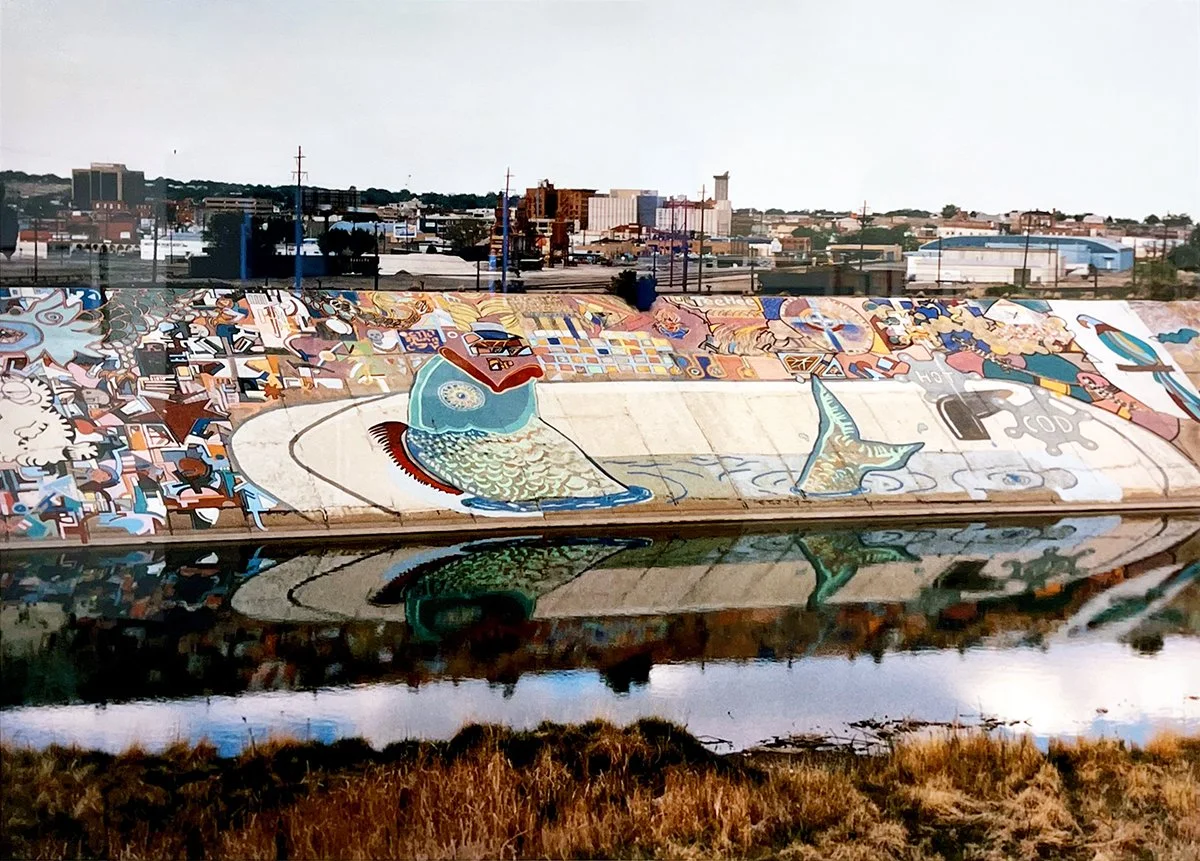
Students worked with flashlights, lookouts, and ropes to create the iconic Fish in the Bathtub near the 4th Street Bridge. The anonymous group quickly signed their work “Tee Hee,” a cognomen that self-disclosed the group’s benign impishness. “The TeeHees’ motto was appropriately rebellious,” notes a clipped article in the exhibition. “‘A little insanity is great, because it’s the only thing they can’t take away’.” [2]
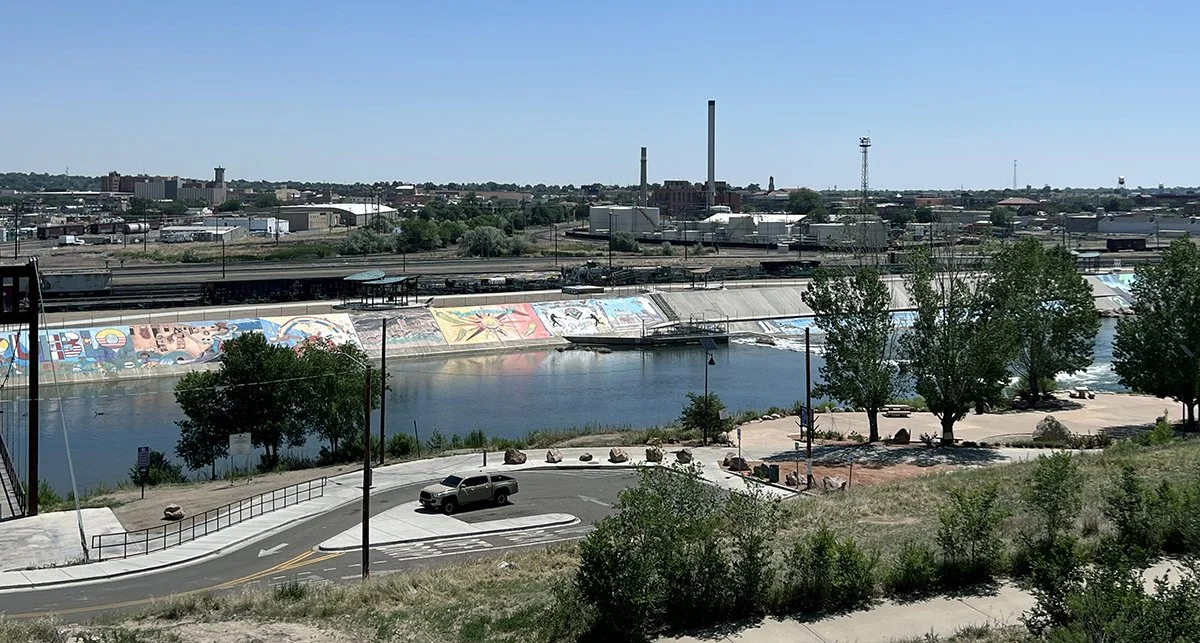
A view of the murals on the Arkansas River Levee. Image by Madeleine Boyson.
Still, neighbors called the police. Media attention rose and the murals became a political and legal issue for residents before university teacher, local artist, and paint recycler Dave Roberts called on then-District Attorney Gus Sandstrom to intercede. The Pueblo Levee Project was officially sanctioned in 1980 and Roberts assumed directorship, inaugurating a yearly paint-a-thon with recycled materials. Over the next half-century, an estimated 125 muralists would paint over 149 murals on the concrete embankment.
Mural-making flourished from the 1980s to the early aughts. Calls for proposals coincided with word of mouth and brought local, regional, and international artists to the site. Among them was Cynthia Ramu, who moved from Denver to Pueblo in 1988 to work on a mural and ended up coordinating the project from 1989 onwards.
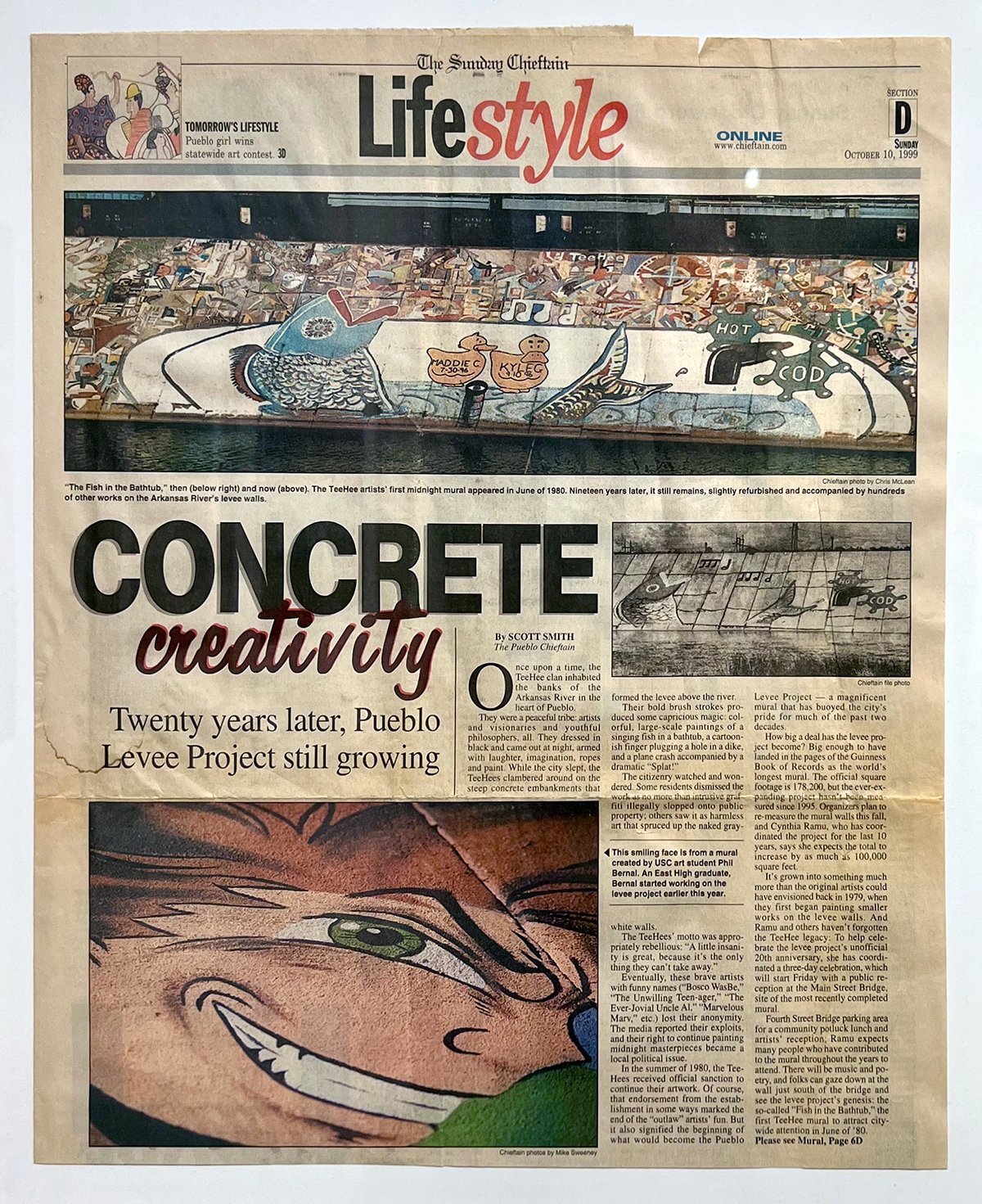
Scott Smith, “Concrete Creativity: Twenty years later, Pueblo Levee Project still growing,” The Sunday Chieftain, October 10, 1999. Image by Madeleine Boyson.
Concrete Creativity takes its title from framed articles, including a 1997 Independent “I Spy” clipping and 1999 Pueblo Chieftain newsprint that hang in the exhibition. The title is as much a commemoration of the murals as it is a snapshot of Ramu’s involvement in the project and advocacy for its world record status as well as the sometimes-named, sometimes-anonymized artists over the last forty years.
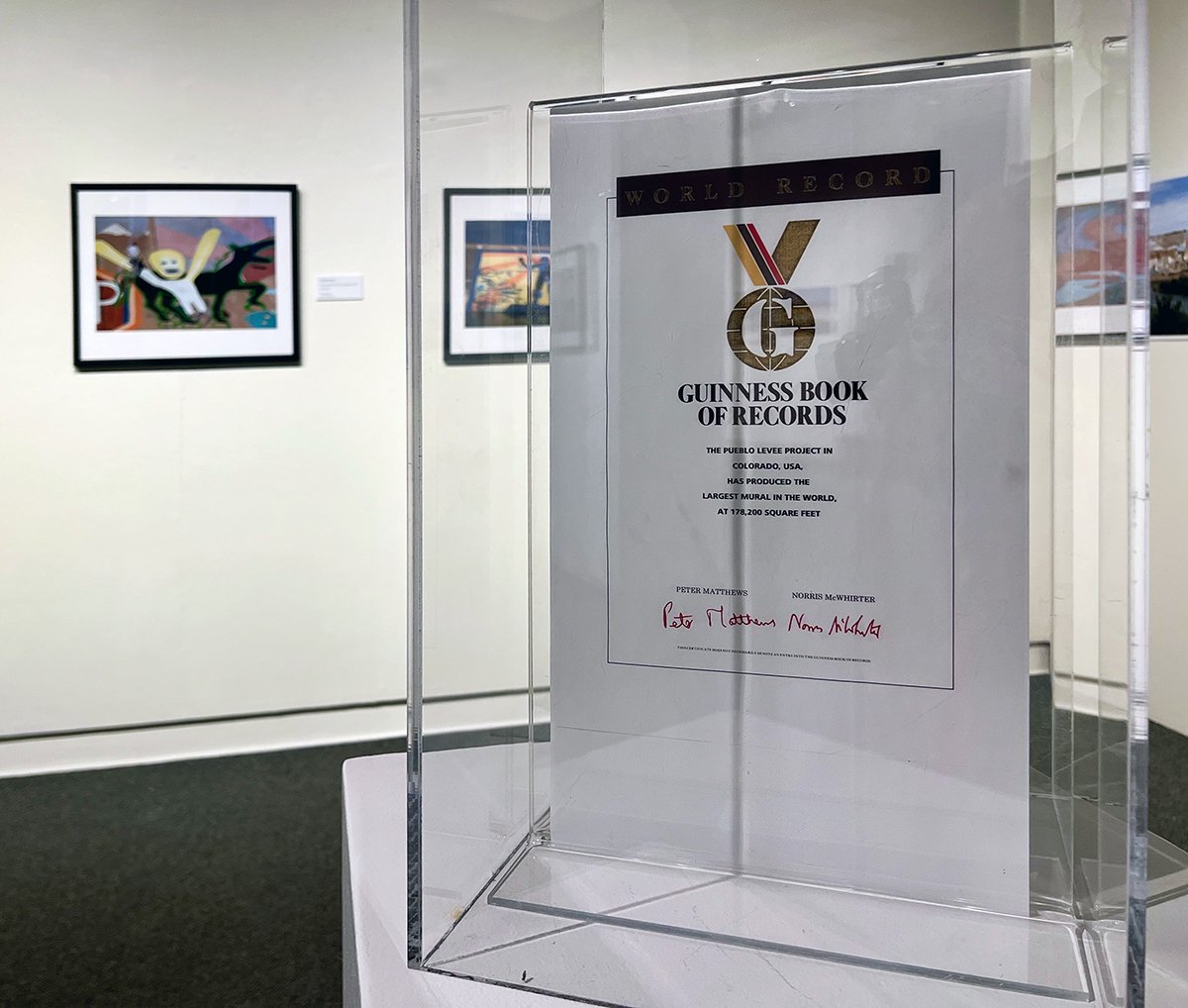
The Guinness Book of Records certificate for the Pueblo Levee Project in Colorado, USA, in Concrete Creativity: Historic Murals of the Pueblo Levee. Image by Madeleine Boyson.
On view are less artworks than items of ephemera: enlarged and grainy photographs of the levee paintings hang beside newspaper clippings, yellowed with acidity, and the Guinness Book of World Records certificate for “Largest Mural in the World.” Yet much like the project itself, there is no singular artistic or institutional voice that speaks for these paintings, and so visitors must traverse the project’s storyline on their own, parsing lightning strikes of creativity out of a much larger thunderous clap.
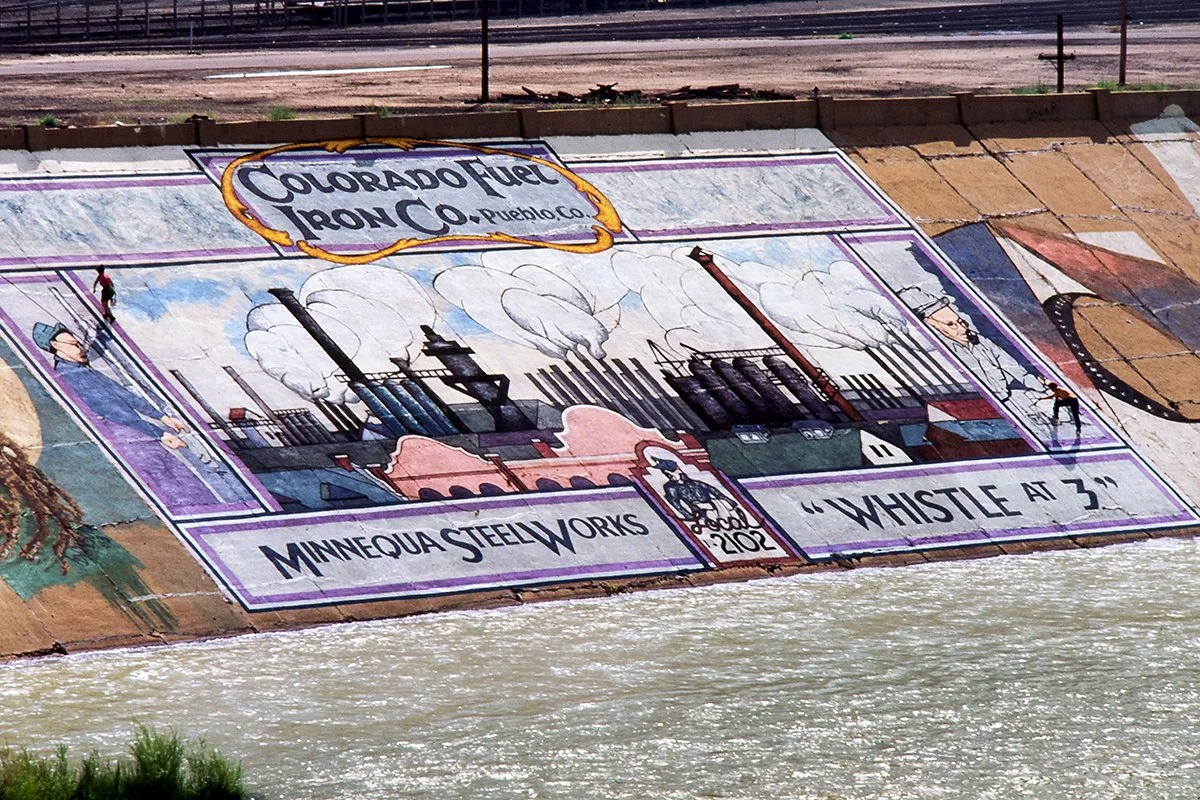
Cynthia Ramu, Colorado Fuel & Iron Company’s Minnequa Steel Works, 1991, photograph. Image courtesy of Cynthia Ramu.
Ramu’s photographs (it is sometimes unclear if they are her photographs, or photographs of her murals, or both), pinpoint moments in Pueblo’s regional psyche. One mural commemorates the Colorado Fuel & Iron Company’s Minnequa Steel Works building, which was at one time the largest single employer in the region.
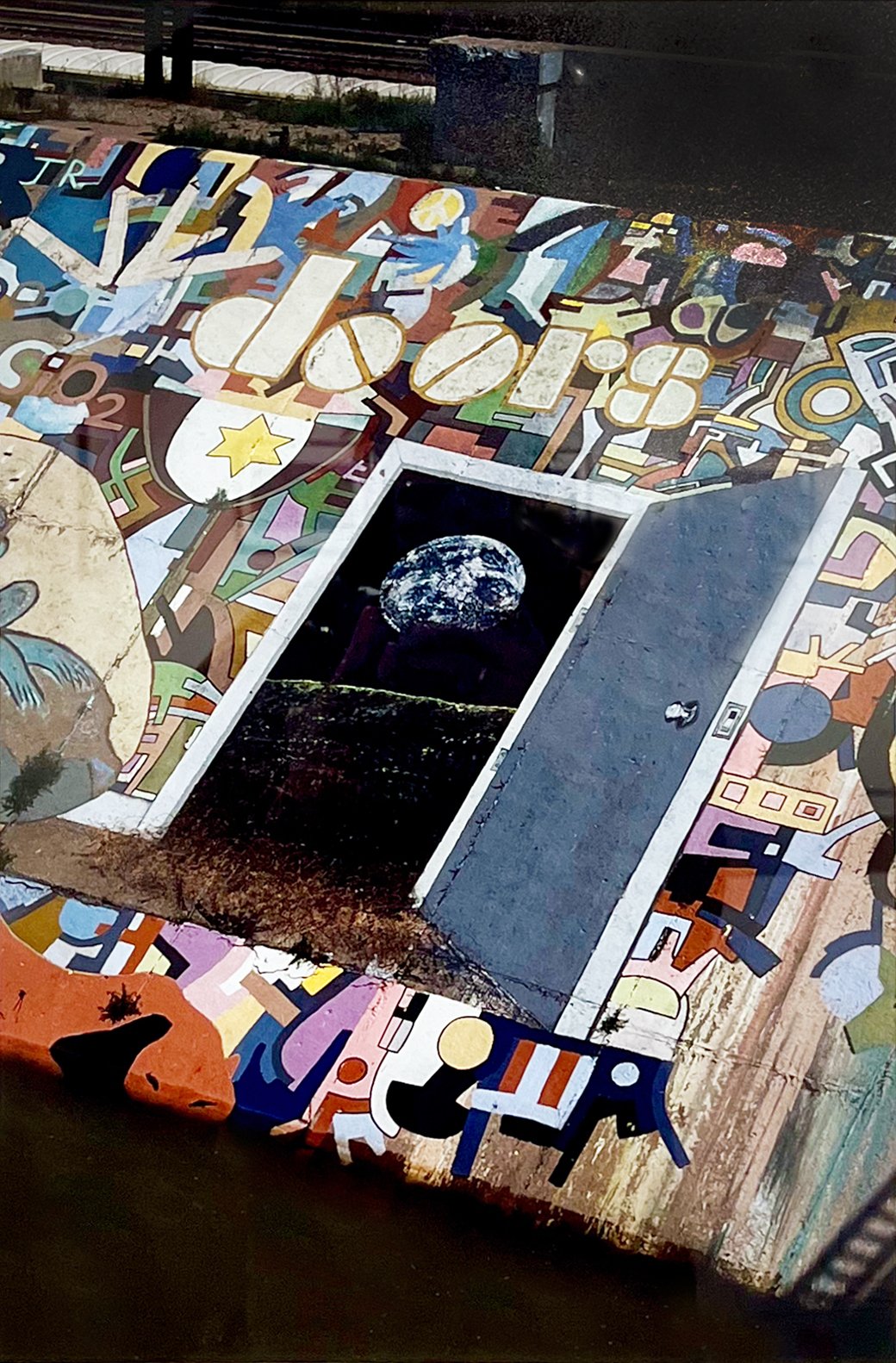
Cynthia Ramu, “Earth Rise” by Cynthia Ramu, 1991, photograph. Image by Madeleine Boyson.
Elsewhere, visitors can see Earth Rise from 1991—a reproduction of William (Bill) Anders’ Apollo 8 mission photograph affixed behind an open door. Across the room, “Levee mural painters to begin 11th year this weekend” features a photograph of Ramu hunched over, perfecting the mural’s doorknob. This photograph within a mural within a photograph within a news cutting within an exhibition is what characterizes the show and the project; everything here is a nod at and a connection to something else.
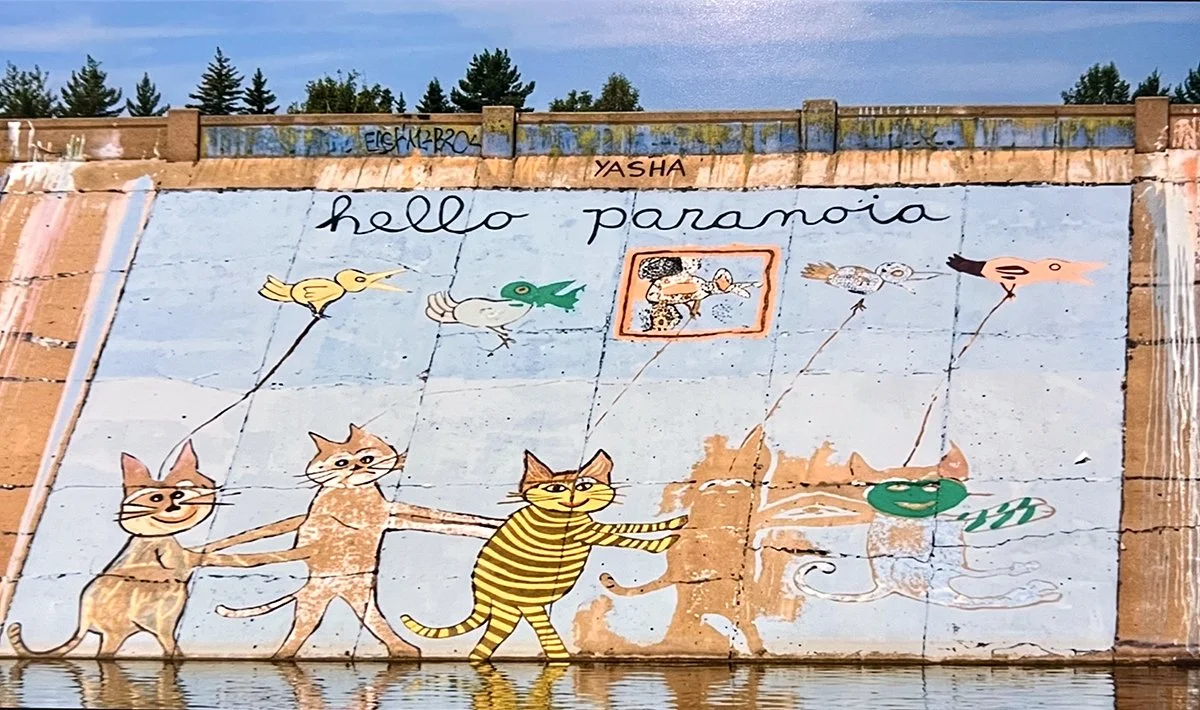
A detail view of Cynthia Ramu’s Hello Paranoia, 1985, photograph. Image by Madeleine Boyson.
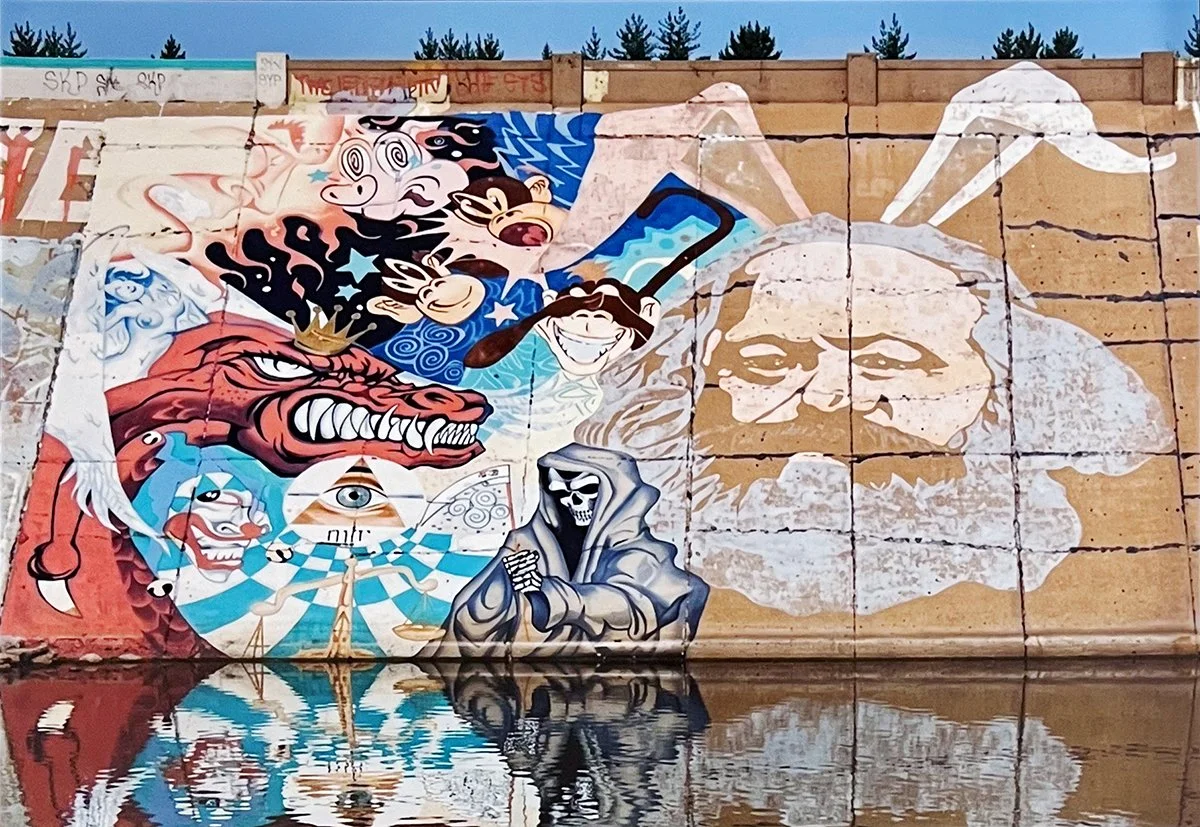
Cynthia Ramu, Karl Marx, 1982, photograph. Image by Madeleine Boyson.
Visitors can see what the 4th Street bridge fish looked like when it first appeared in a bathtub accompanied by the comical “Hot” and “Cod” faucet knobs and what it became by 1999, with two rubber duckies and a significant portion of abstract additions. Other notable historic works include Hello Paranoia from 1985, Groucho Marx and Karl Marx (the latter wearing bunny ears), Adjust or Adjust by Phil Vallejo (1980), and The Corn Maiden by Ramu, which now sits extracted from the Arkansas River levee as a memorial to Judith Pierce, whose ashes are mixed into the paint.
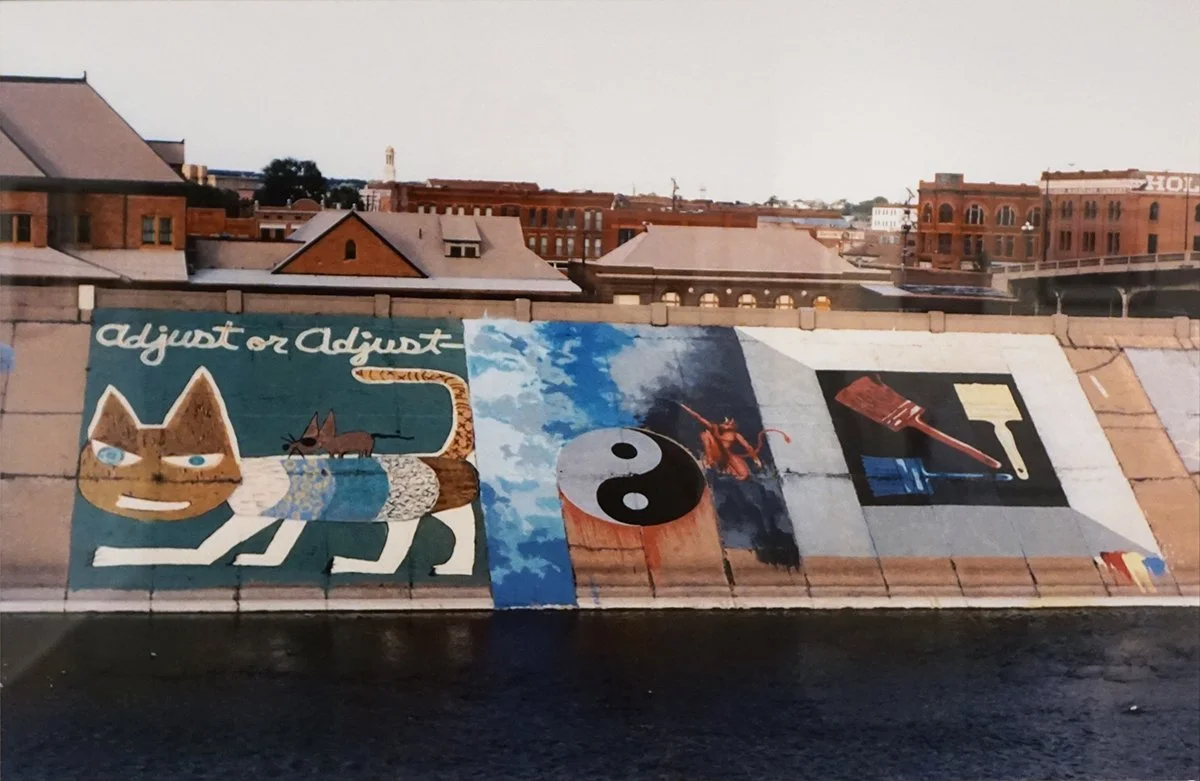
Cynthia Ramu, “Adjust or Adjust” by Phil Vallejo, 1983, photograph. Image by Madeleine Boyson.
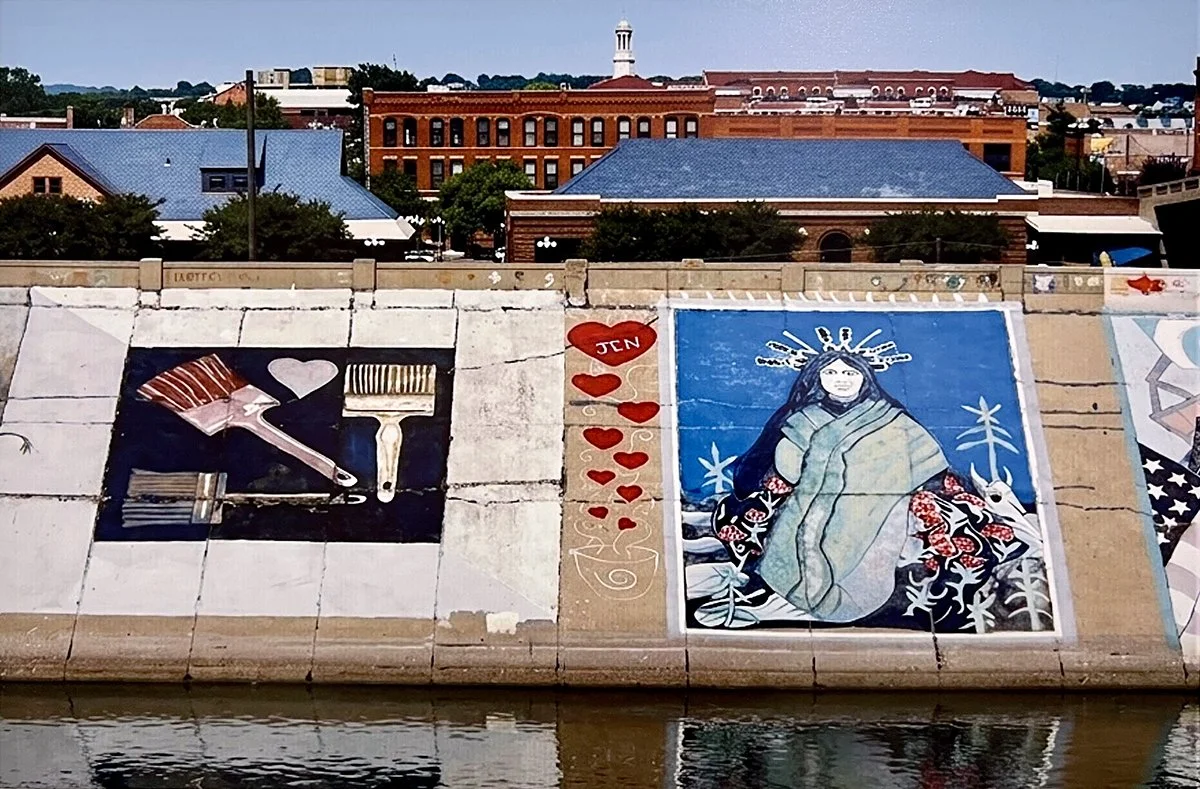
Cynthia Ramu, Paint Brushes and Corn Maiden, no date, photograph. Image by Madeleine Boyson.
Today, most of the historic murals have been removed or replaced after FEMA-mandated repairs to the embankment in 2016 rendered much of them obsolete. The levee’s newer, sturdier construction is half the height of the original embankment and negated the project’s world record title. [3]
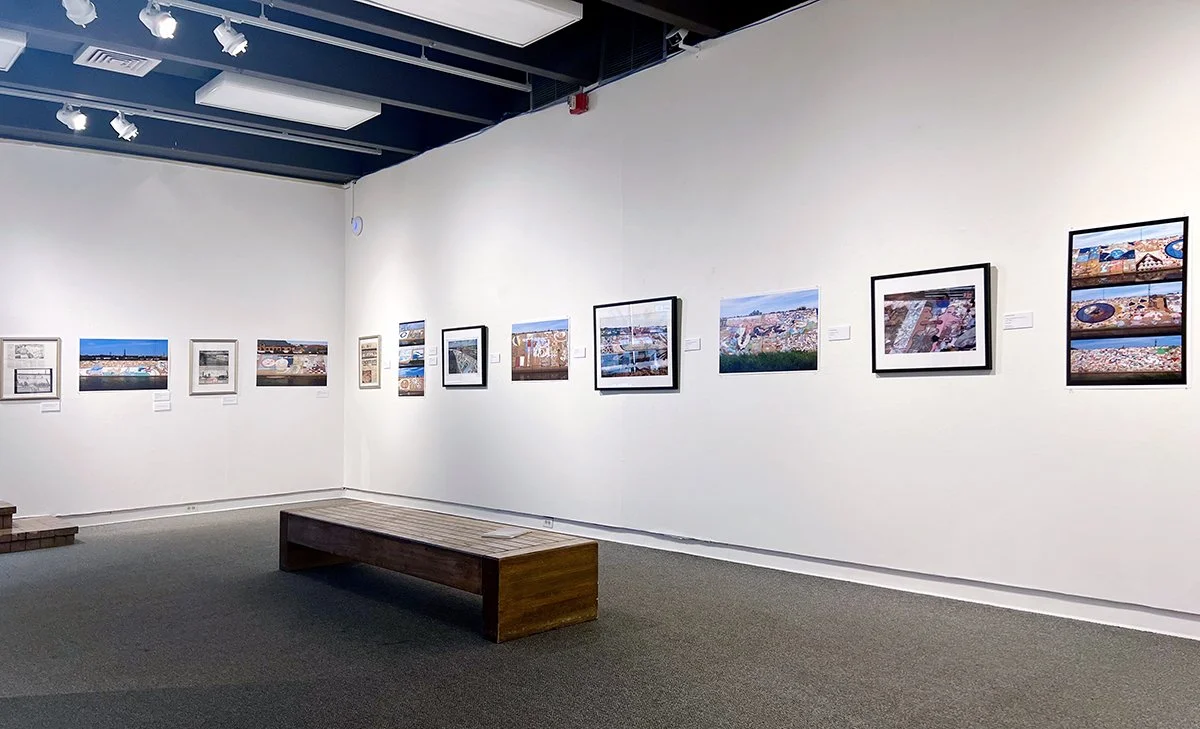
An installation view of Concrete Creativity: Historic Murals of the Pueblo Levee. Image by Madeleine Boyson.
Ramu has also partnered with the Pueblo Conservancy District to enact updated Levee Mural Guidelines and submission processes, and she continues to support artists who contribute monthly to the mural. The artist’s goal and an aim of the exhibition is to reclaim that world record title and to keep the history of the Pueblo Levee Mural Project alive. “It’s an endless project,” said Ramu in an undated USC Today’s “Levee mural project kicks off” article from the 1990s. And she was right. Much like the riparian zone they adorn, the murals celebrated by Concrete Creativity are ever-changing but ever-present, flowing more or less steadily but always onwards through Pueblo.
Madeleine Boyson (she/her) is an Editorial Coordinator at DARIA and a Denver-based writer, poet, and artist. She holds a BA in art history and history from the University of Denver.
[1] The Arkansas River is also known as Rio Nepesta which may be short for Nepestle or Nepesta, and which may originate in the Osage word Ne Shusta ("red water"). As a large tributary to the Mississippi Rivera trading post for the Ute and Comanche, and a New Spain outpost, the Arkansas lies at the center of imperial occupation.
[2] Quoted in Scott Smith, “Concrete Creativity: Twenty years later, Pueblo Levee Project still growing,” The Sunday Chieftain, October 10, 1999.
[3] The title is now held by Seoul, South Korea.