
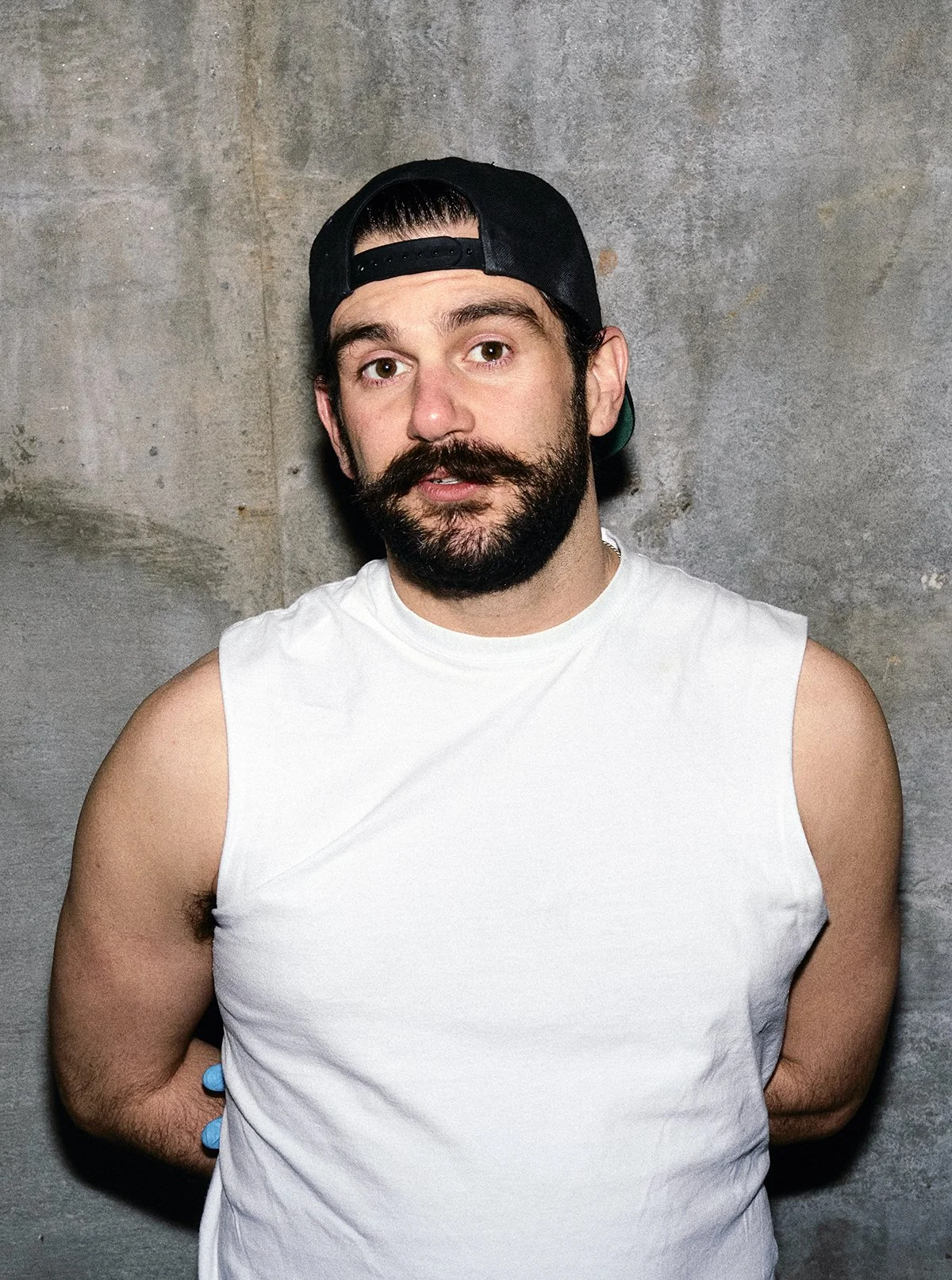
Chris Bristow
Artist Profile: Chris Bristow
Never Forget
by Jillian Blackwell
When Chris Bristow makes a work of art, he makes it slowly, stitch by stitch, hand-embroidering surfaces that he later paints over. He makes it quickly, creating drawings in Procreate®, where he can try out different elements and colors, working with multiple layers. In many ways, his art pulls in opposing directions. It contains both a tongue-in-cheek irreverence, but also a yearning for slowness, both of which feel quintessentially millennial.
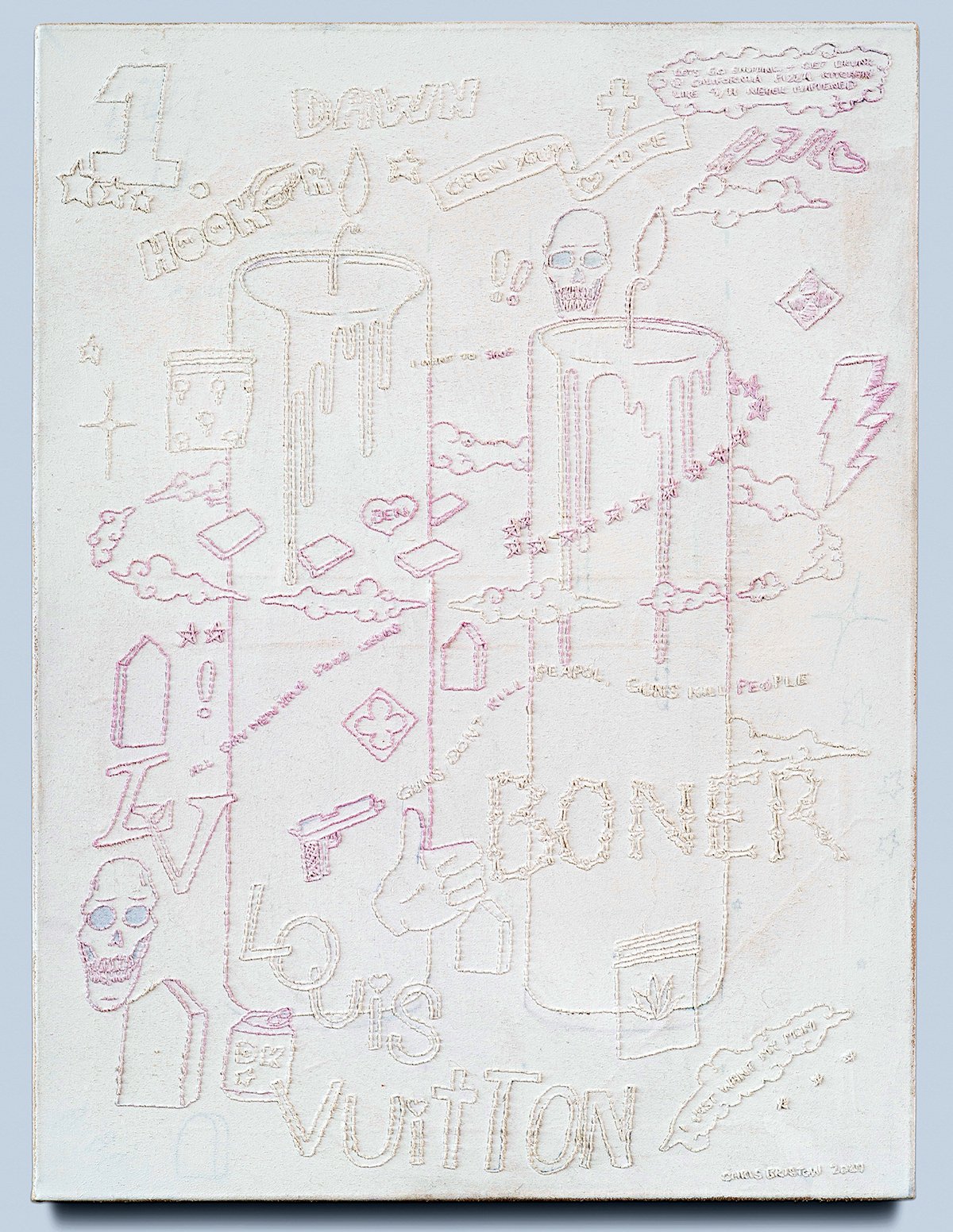
Chris Bristow, Transmission, 2024, acrylic and embroidery on canvas, 24 x 18 inches. Image courtesy of the artist.
When defining himself within art history, he says, “I am part of a cohort of millennials unified in their experiences of knowing life pre- and post-internet and pre- and post-9/11.” Bristow becomes a voice for this cohort, balking at late-stage capitalism, waxing nostalgic for 1990s-style media and aesthetics, discarding a disappointing reality, and creating surreal worlds of his own.
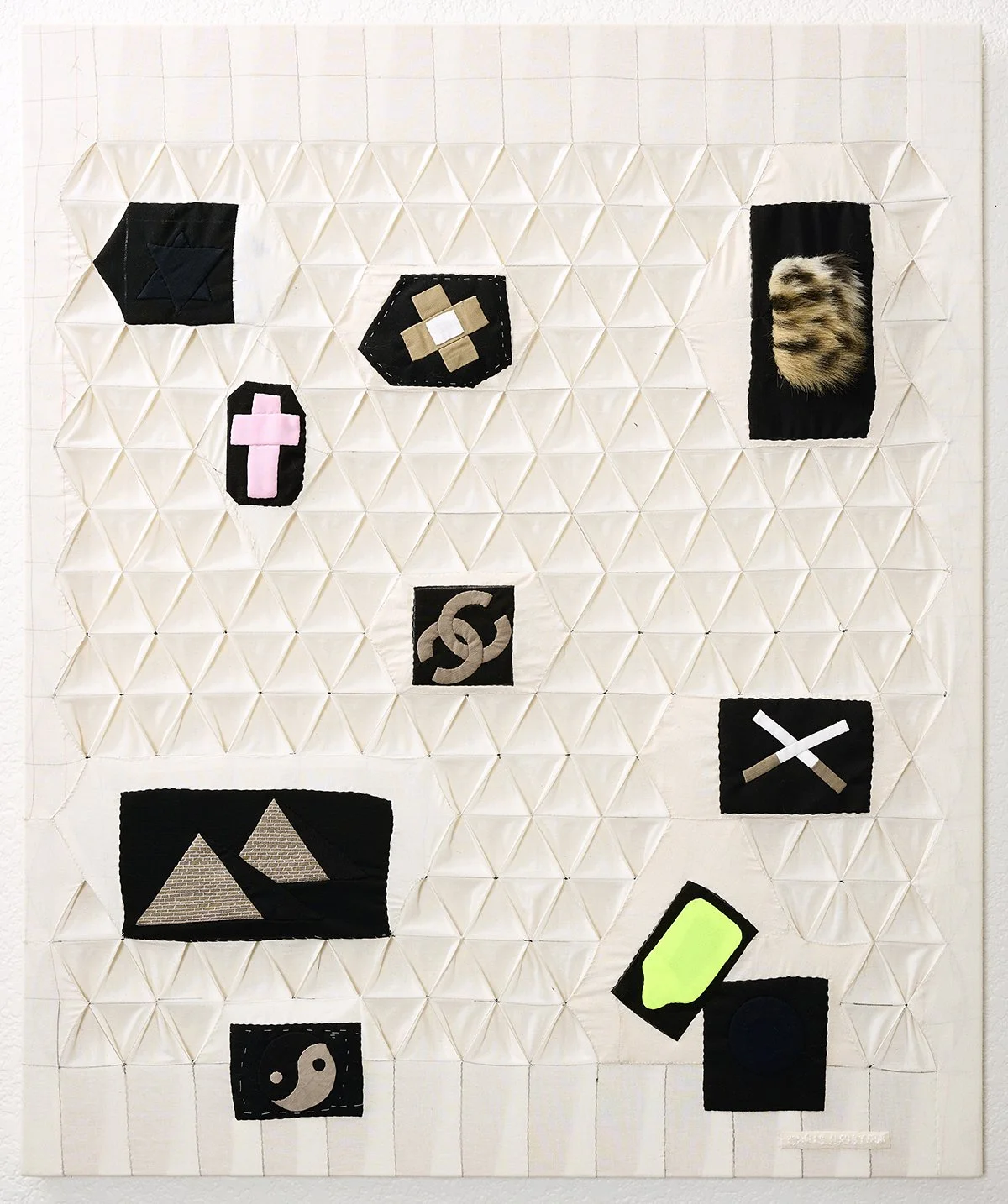
Chris Bristow, Composite (Police Uniforms), 2024, cotton muslin, scraps from police uniforms, faux fur, pencil, and thread, 36 x 40 inches. Image by John Roemer.
In Composite (Police Uniforms), Bristow produces a painting that is, in actuality, closer to a patchwork quilt than a painting. There is no paint—he creates the composition instead by piecing together muslin and scraps from police uniforms, as indicated in the title. Bristow pokes fun at the police and their pageantry by queering these uniform scraps: pulling the material out of context and adorning it with symbols. He uses many symbols over and over again across multiple works, plucking them out of the zeitgeist. They scatter across the patchworked surface: a yin-yang symbol, pyramids, cigarettes, the interlocking Chanel c’s, the Star of David, a cross, and a band-aid.
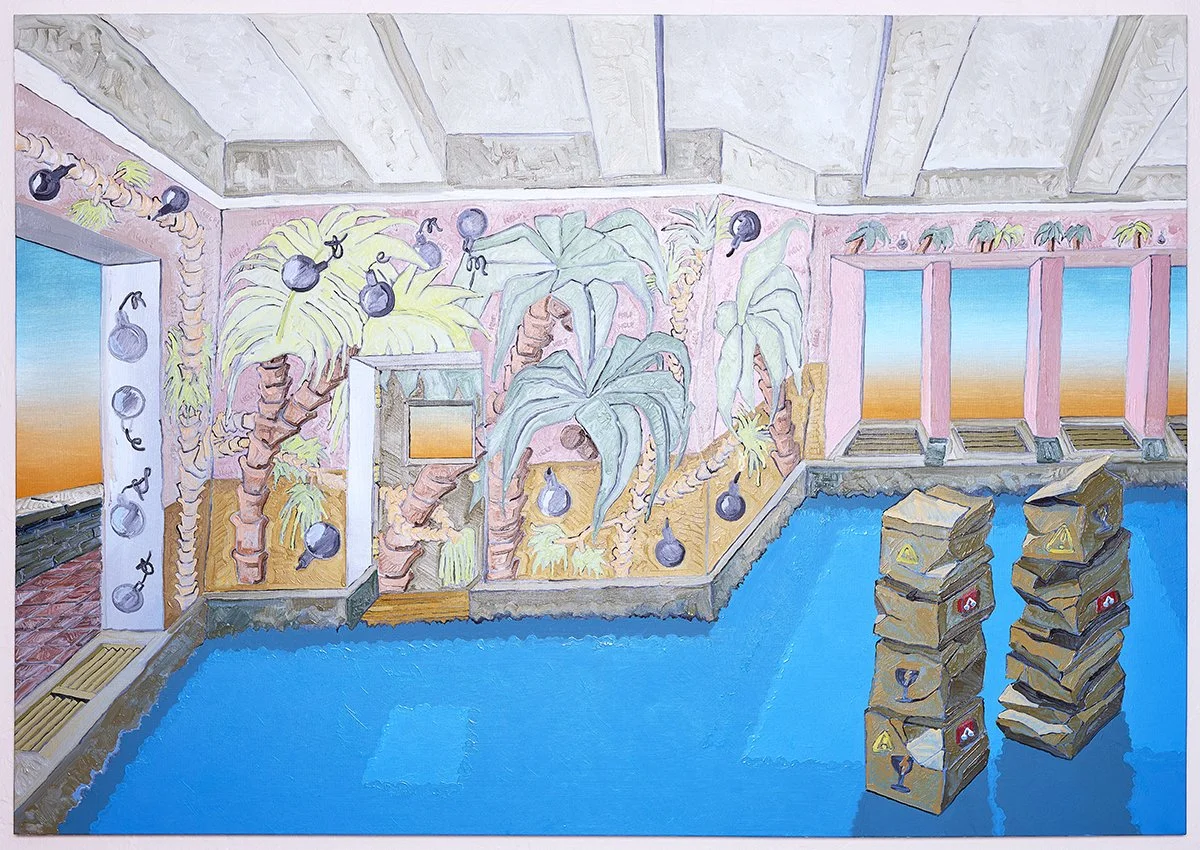
Chris Bristow, Rest Term, 2025, oil and embroidery on canvas, 56 x 80 inches. Image courtesy of the artist.
We as viewers are presented with this salad of symbols and given the task of figuring out how to decode them. Or could these symbols be just scraps themselves? Perhaps, in the tradition of quilting, Bristow uses what materials he has around him—logos, religious iconography, cultural ephemera—and sews them together to make a composite. The way the parts do not add up to a whole points to a feeling of futility, their amassing and illogical combination akin to the onslaught of media we sift through in our daily lives.

Chris Bristow, Panem Et Circenses, 2025, hand-embroidery and hand-sewn elements, scraps from police uniforms and other scrap material, and pencil on canvas, 40 x 30 inches. Image by Erynn McConnell.
This feeling of futility bends toward social critique in Panem Et Circenses. Again, symbols, images, and words are patched onto a surface. Yin-yangs, crosses, and the Chanel c’s appear again. The Twin Towers occupy one small patch at the top of the painting, floating in clouds with angelic halos. The word “help” calls out twice on the surface, once in a small patch at the center and again in a blue badge, fringed and festive like a prize ribbon. The title is emblazoned on a banner across the bottom of the work: “PANEM ET CIRCENSES.” Thus, indicating that this is what this collection of things is: panem et circenses, Latin for bread and circuses.
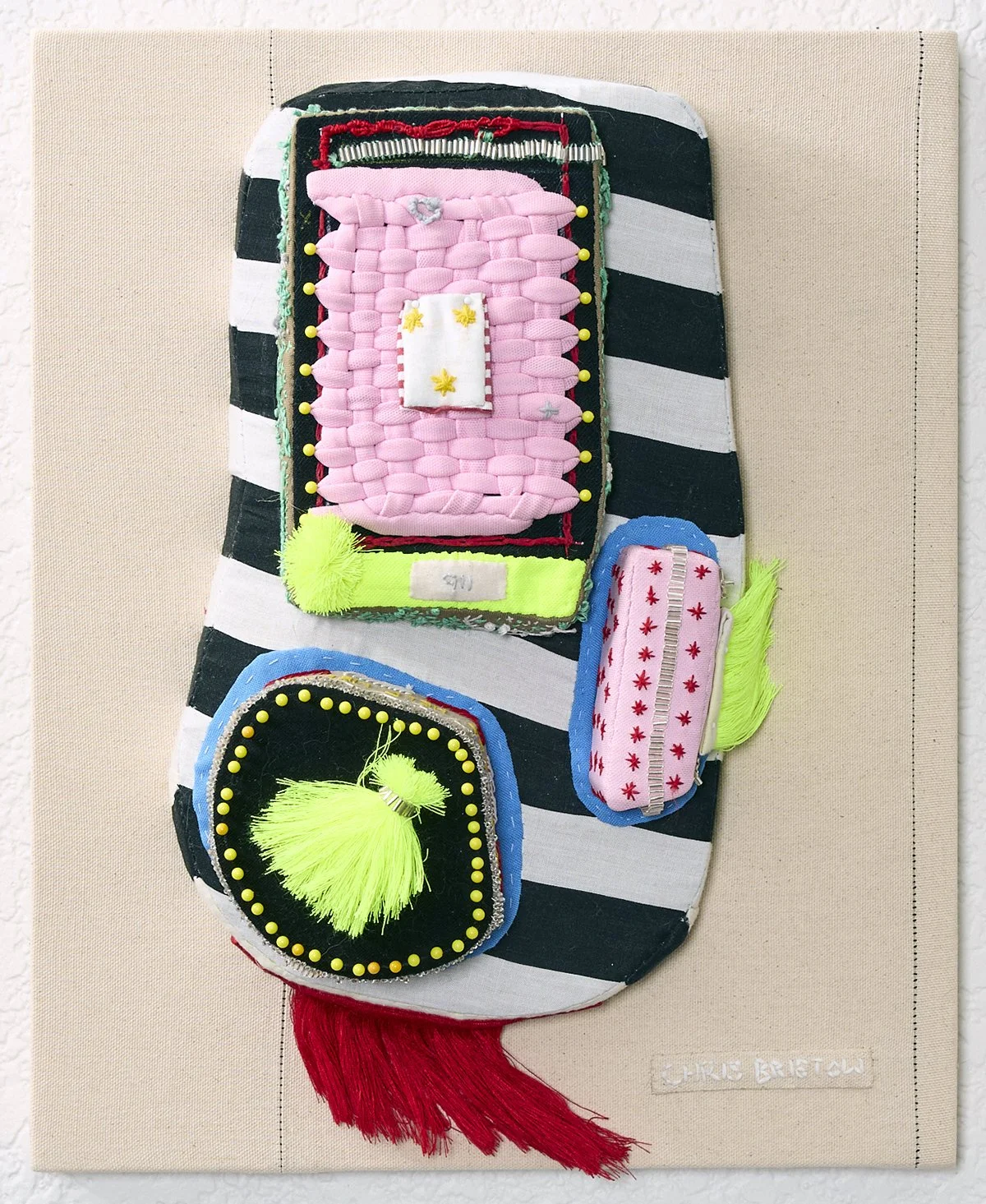
Chris Bristow, Help, 2025, scraps from police uniforms, pins, glass beads, and thread on canvas, 16 x 13 inches. Image courtesy of the artist.
This phrase is attributed to Juvenal, a Roman poet, and encapsulates the idea of an ill-functioning government keeping its citizens appeased and distracted. [1] The cries for help are small and frivolous, overwhelmed by a cascade of bread, with three-dimensional stuffed slices piling up and a plump boule dangling. This critique feels both direct and generalized, a result of a general loss of faith in our society and a feeling of frustration. Yet Bristow’s sewn and embroidered works are quintessentially soft, held in his hands and worked on for hours as he passes the needle back and forth through the fabric. The artist must have sat with these thoughts of disillusionment and frustration for all those hours, and, in the end, the result is plush, frilly, and familiar.
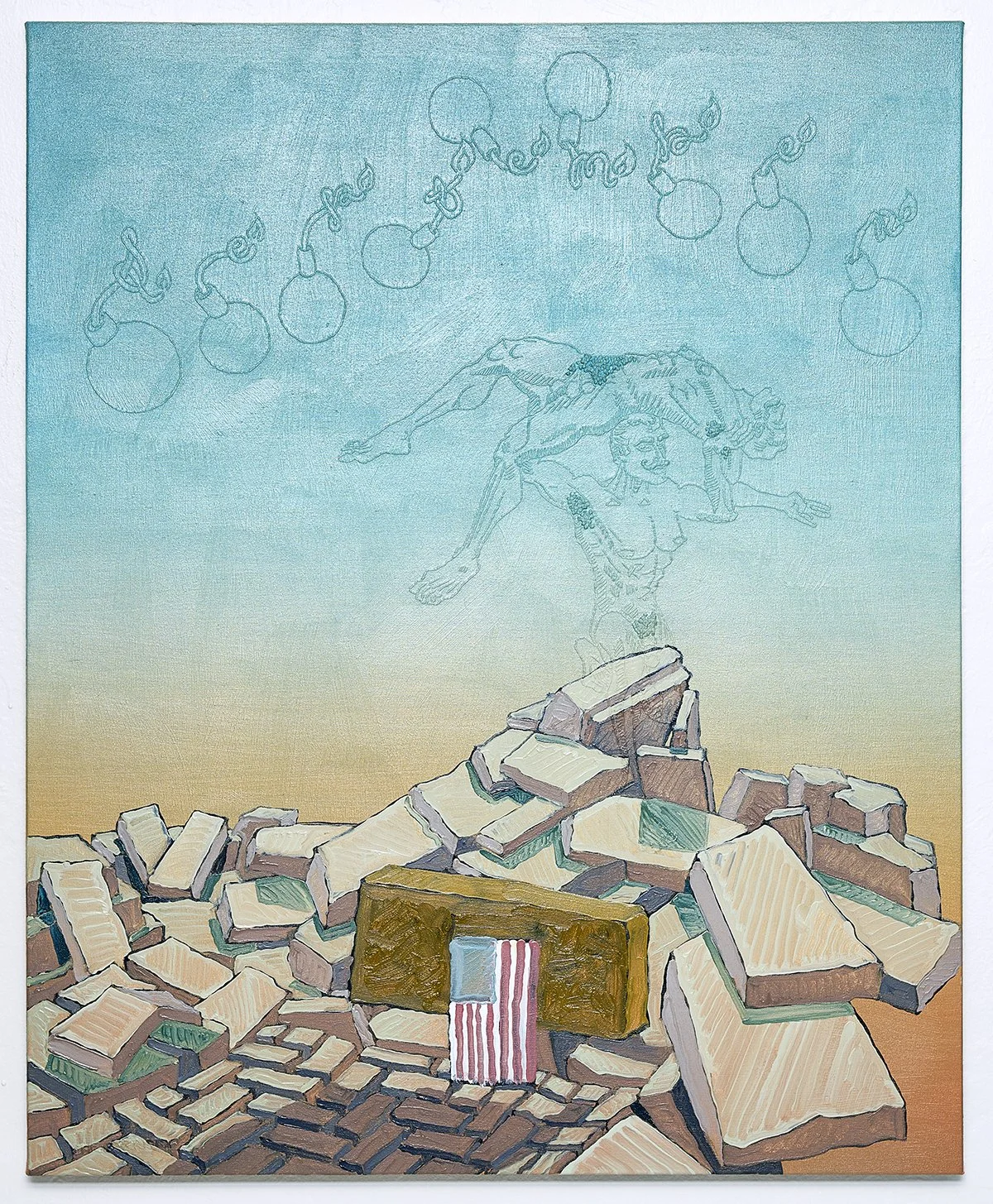
Chris Bristow, September, 2025, oil and embroidery on canvas, 40 x 30 inches. Image courtesy of the artist.
For his day job, Bristow works as a tailor at a public safety uniform supply company, which has greatly influenced his practice: “I have been sewing for work, and that has made its way into my paintings. I have been thinking a lot about the visibility of labor, the time involved in sewing, and structures of authority.” Bristow’s use of the hand is a reclaiming of sorts, second after second reified with each stitch: “with the hand-sewing and embroidery I am depicting time.” The underpainting to the disillusionment of his images is his own hand—it is both the foil and the backstop. In the onslaught of the digital world and of late-stage capitalism, we ask to slow down, to simply be quiet, and yet we are also entangled, incapable of isolating ourselves from reality.
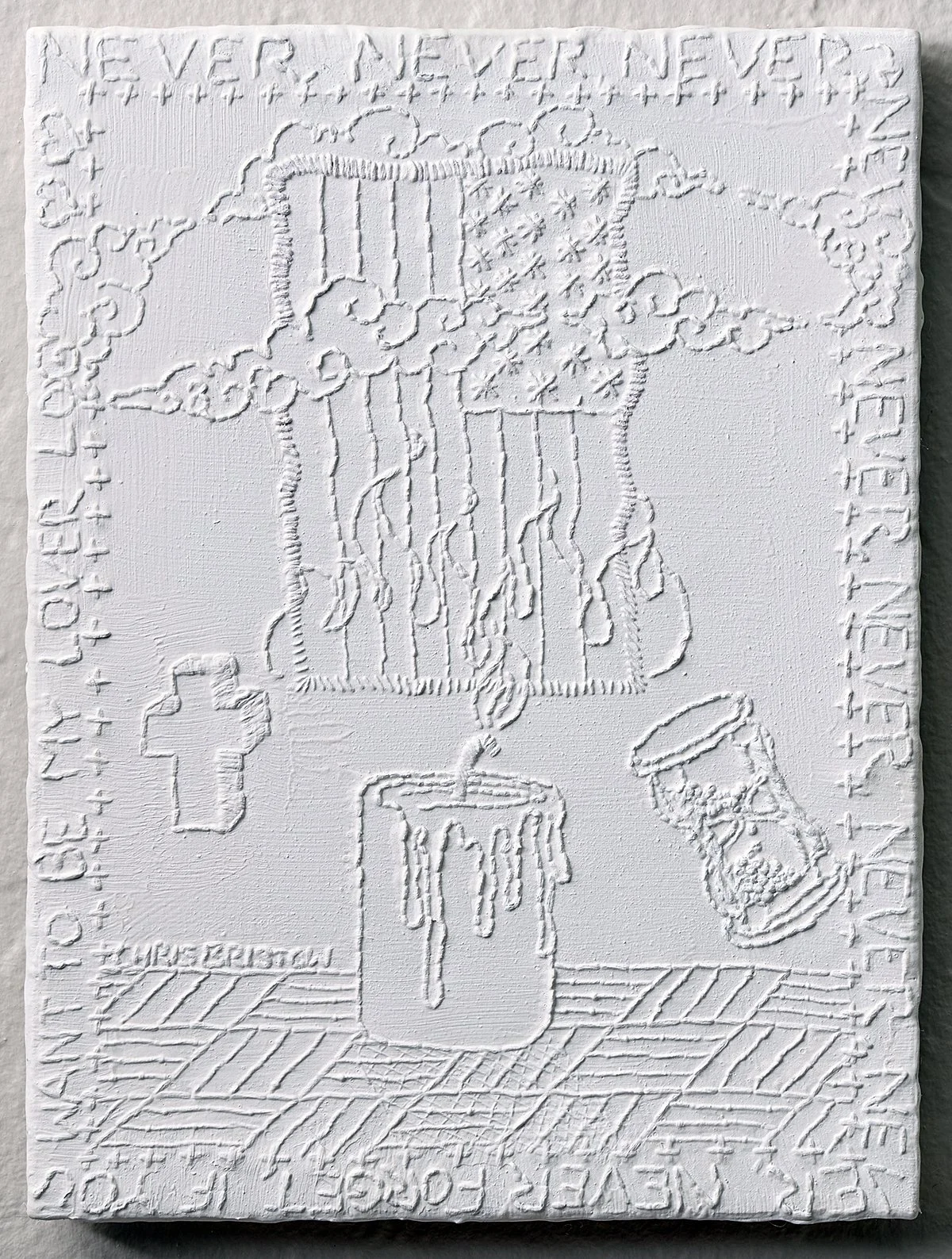
Chris Bristow, Never Never, 2025, embroidery and acrylic on canvas,12.5 x 9.5 inches. Image by John Roemer.
In Never Never, the text “NEVER, NEVER, NEVER, NEVER, NEVER, NEVER, NEVER, NEVER, NEVER FORGET, IF YOU WANNA BE MY LOVER, LOVER…” runs around the edge of the canvas, like an embroidery sampler, or a Jenny Holzer scrolling text, or a gas station LED sign. Bristow confides, “I feel safe in the familiarity of advertising, the copywriting that makes you remember McDonald’s fondly and the humor in a Pinesol® ad. It feels so American, and so familiar.” “Wannabe,” the Spice Girls song Bristow references, was released in 1996, and certainly was still on the radio waves when the Twin Towers were hit. And the moment the Twin Towers were hit was a moment we will never, never, never, never, never forget.
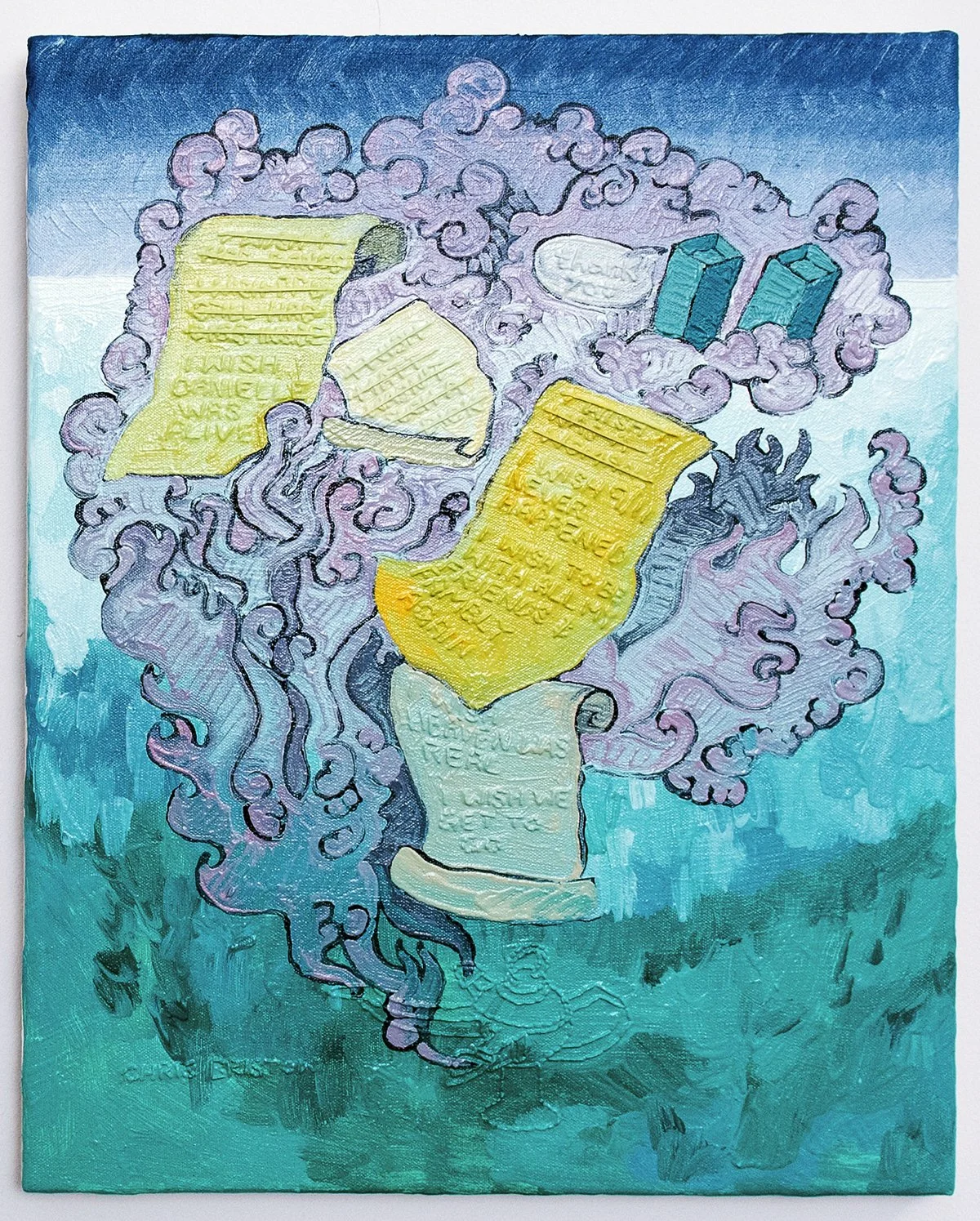
Chris Bristow, Three Wishes, 2025, oil and embroidery on canvas, 24 x 18 inches. Image by Erynn McConnell.
A column candle à la Pottery Barn ignites a floating American flag. Caricatured flames crawl up the fabric, as they might up the bicep of a biker. A blocky cross floats off to the left, an hourglass to the right. All the drawing in this work Bristow does with a needle. He then covers the stitches uniformly in white gesso, producing a monochrome painting. This reductive overlay makes the forms feel like a tattoo flash sheet or even your high school binder—are these things free-associated? From cross to flag to fire to time? Do these symbols run through the millennial mind, like the lyrics, “if you wanna be my lover”? Cross, flag, fire, time; stitch after stitch after stitch?
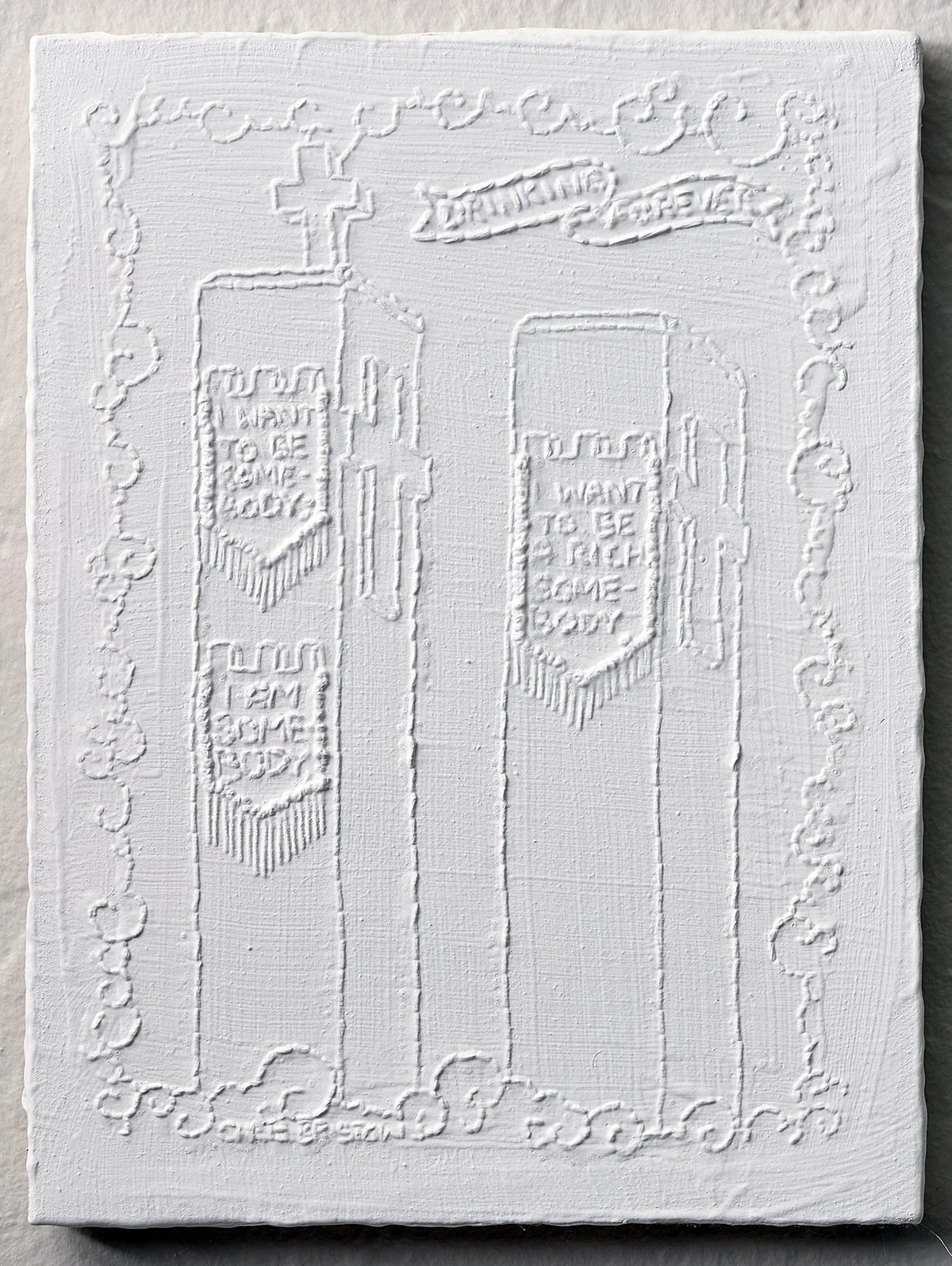
Chris Bristow, I Want to Be Somebody, 2025, acrylic and embroidery on canvas, 12.5 x 9.5 inches. Image courtesy of the artist.
“I also like the idea of embroidering and partially obscuring text with paint because it feels like a documentation of when capitalism did not feel so ugly,” says Bristow. His work claws at the inextricably enmeshed nature of capitalism and Americanism. The millennial is the double-headed Janus, hinging at 9/11, looking backward at the (ill-fated and over-promised) American dream, and looking forward to the dystopian present we are living in.
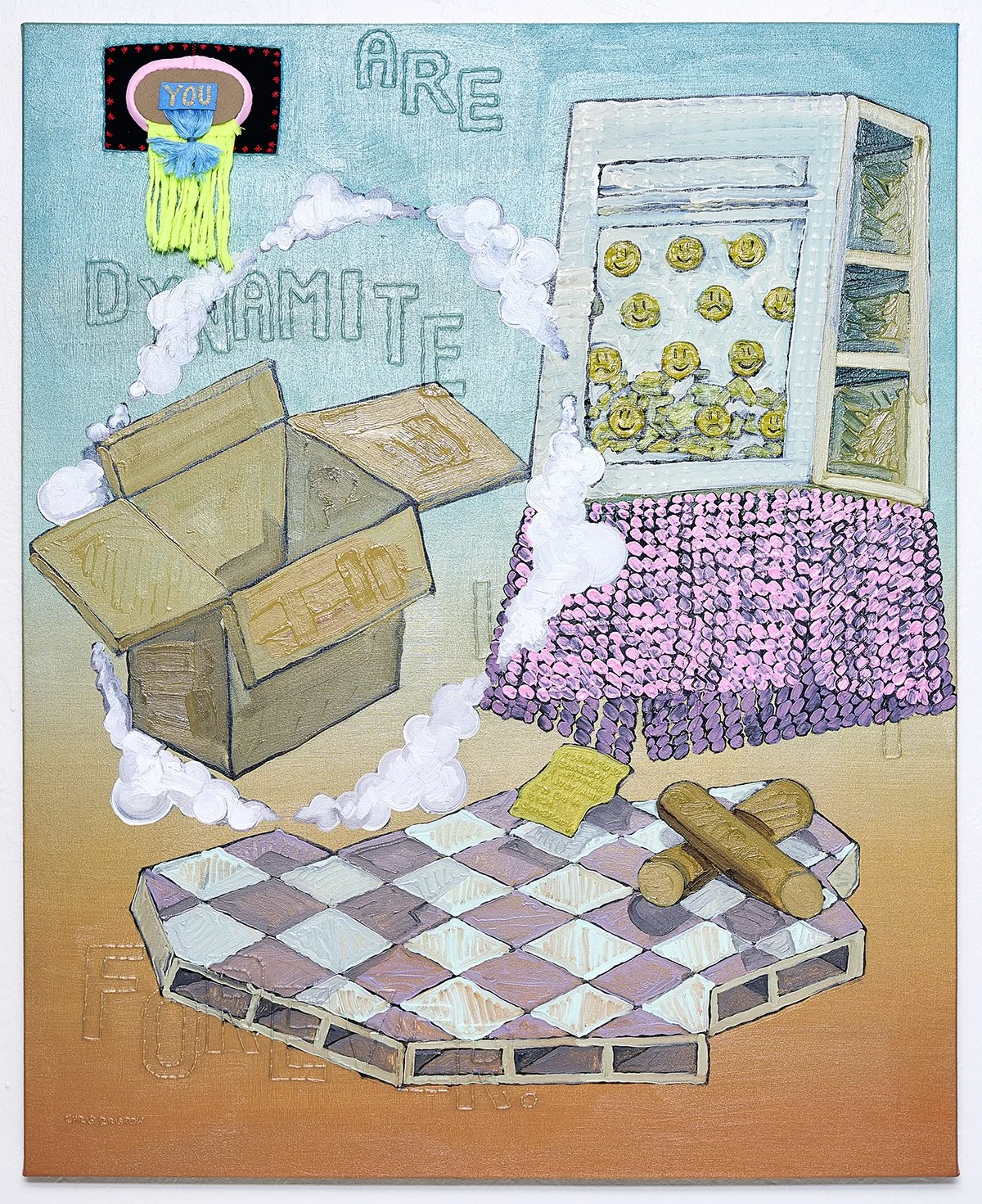
Chris Bristow, You are Dynamite, 2025, oil and embroidery on canvas with elements sewn from police uniforms, 40 x 34 inches. Image courtesy of the artist.
Bristow states, “I use the former World Trade Center as a symbol for capitalism often in my work because it represents the shift from the unexamined fruits of capitalism (affordable housing, living wages, abundant jobs with ease of entry) to a darker, hyper-consolidated-wealth-uber-unregulated capitalism we see today.” There is a particularly bittersweet taste in the mouth of the millennial, forever and futilely nostalgic for an undelivered promise of a future.
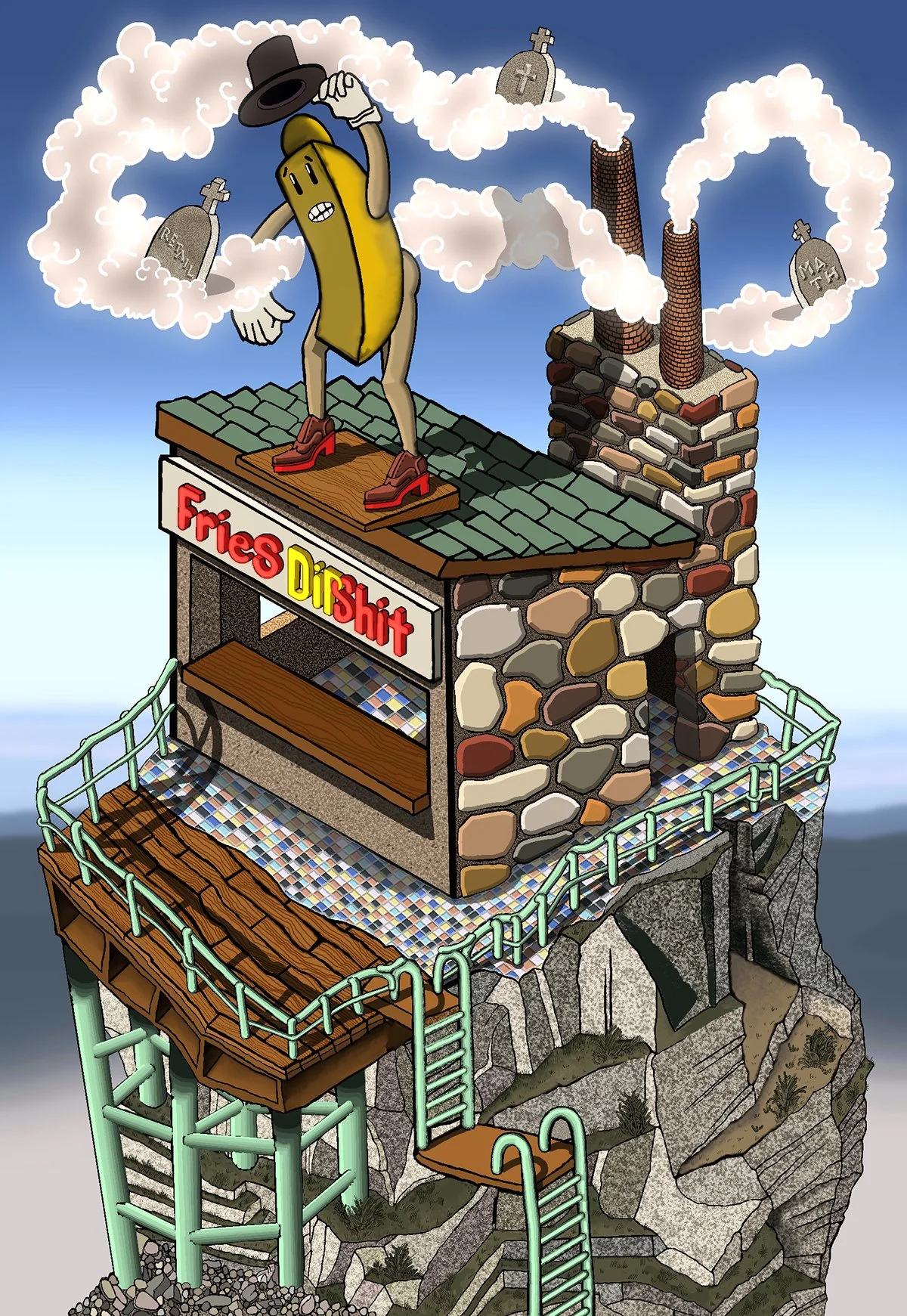
Chris Bristow, Enlightenment, 2025, digital painting, 1280 x 720 pixels. Image courtesy of the artist.
Turning from the disappointing landscape of our present moment, Bristow sometimes creates his own spaces within his paintings, which are entirely imagined. When speaking about his paintings, he asserts, “I do not use photo references in my work as I was always taught it creates a very flat painting if you simply look at or trace a photo onto canvas. I want to be a painter and not a photographer.” Instead of using photographs, Bristow often begins paintings with a drawing he then puts into Procreate. “The ability to create layers and edit on Procreate is transformative,” he says. Through using a digital tool, Bristow is not only creating an imagined space, he is world building.
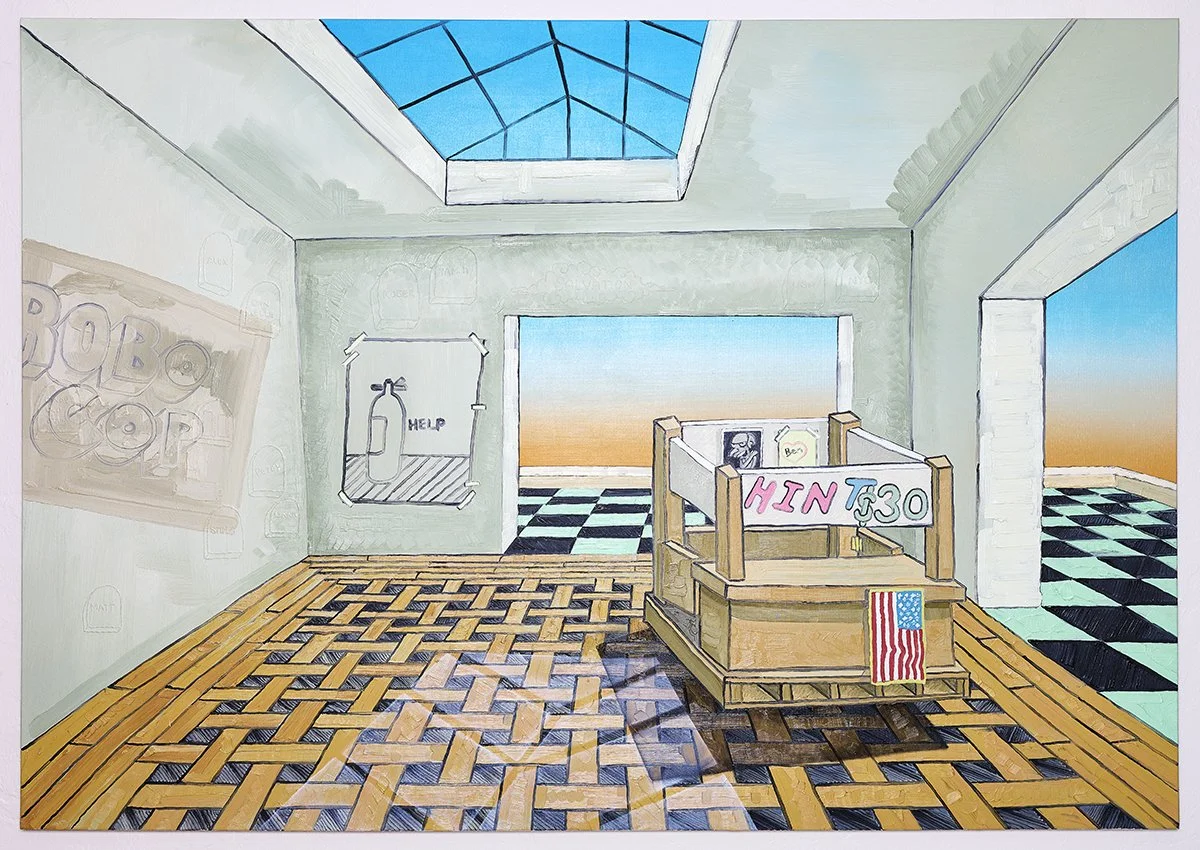
Chris Bristow, Mother II, 2025, oil and embroidery on canvas, 56 x 80 inches. Image by John Roemer.
For instance, his painting Mother II depicts a large and mostly empty room that opens out onto a terrace. A skylight above and the two open doorways let in a sunset glow of orange fading into intense blue. The paint handling is generous and luscious, the enjoyment in its brushstrokes seeping into the depicted space. The work references EarthBound, Bristow’s favorite video game, that was released for the SNES (Super Nintendo Entertainment System) in 1994. [2] The room is expansive and enigmatic, still holding the artist’s signature references to pop culture, still crying out “help” in small text, and yet the space has a calmness to it. Bristow has made a space of his own that still has remnants of our maddening reality but carves out a respite for the artist and the viewer alike.
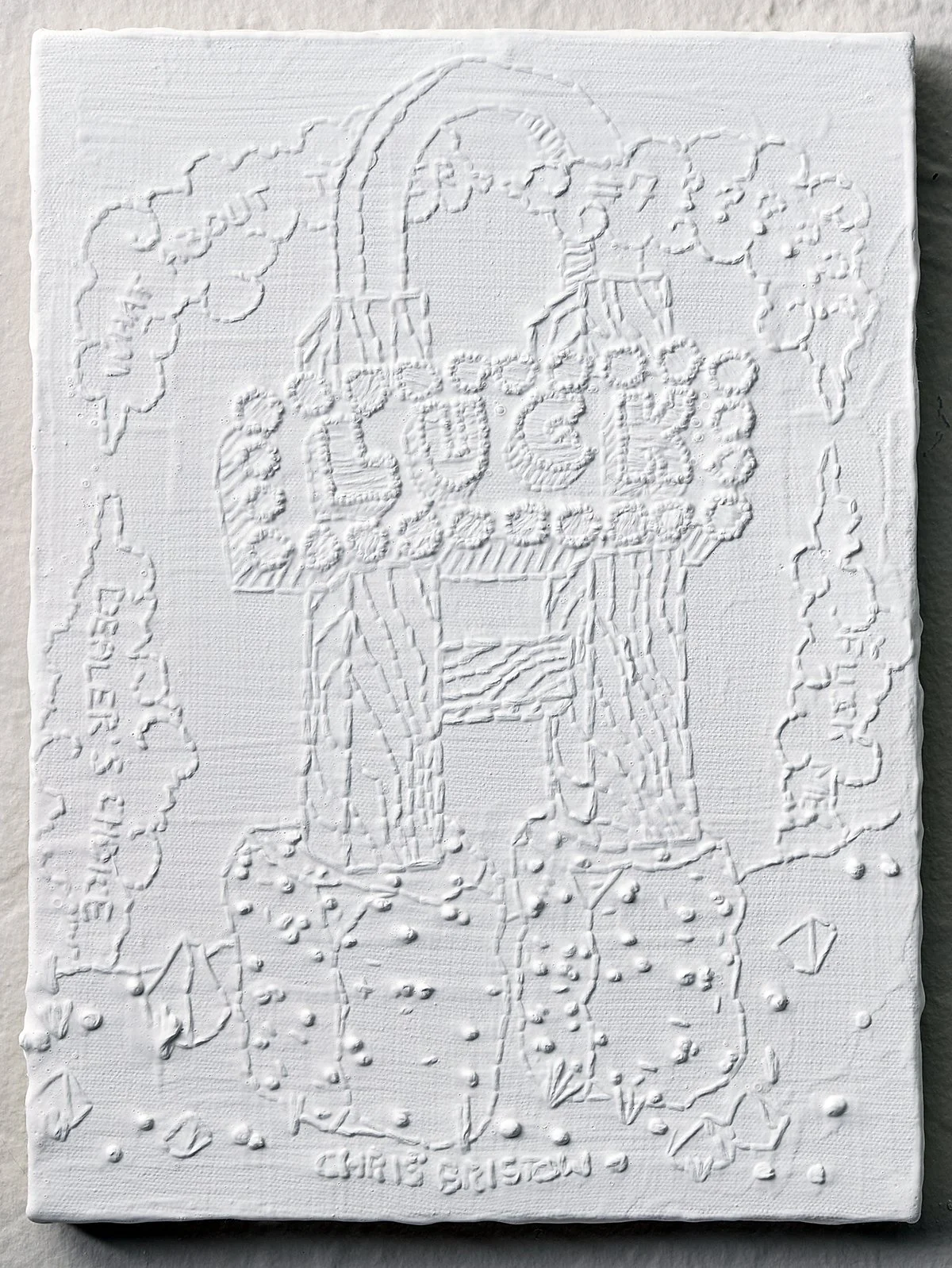
Chris Bristow, Selection, 2025, acrylic and embroidery on canvas, 12.5 x 9.5 inches. Image courtesy of the artist.
Bristow’s paintings encompass feelings from despair to exasperation to cheekiness, even to crudeness. His hand is evident across their surfaces, marking time and making a record of our times. For millennials, he voices despair but also dauntlessness, harboring a sarcastic resiliency in familiar tokens of our shared culture.
See Chris Bristow’s work for yourself in the exhibition Rest Term at Lane Meyer Projects in Denver through March 15th.
Jillian Blackwell (she/her) is an Editorial Coordinator at DARIA as well as an artist, curator, and art handler. She holds a BA in fine arts with a concentration in ceramics from the University of Pennsylvania and an MFA in painting from Cranbrook Academy of Art.