
Tricia Waddell
Artist Profile: Tricia Waddell
Textures of the Inner Self
by Djamila Ricciardi
In Tricia Waddell’s studio, a vibrant menagerie of eight- to fourteen-inch-tall soft sculptures rest on various shelves and plinths. Each work has a powerful presence. Some appear amoeba-like with boldly patterned, multi-colored surfaces.
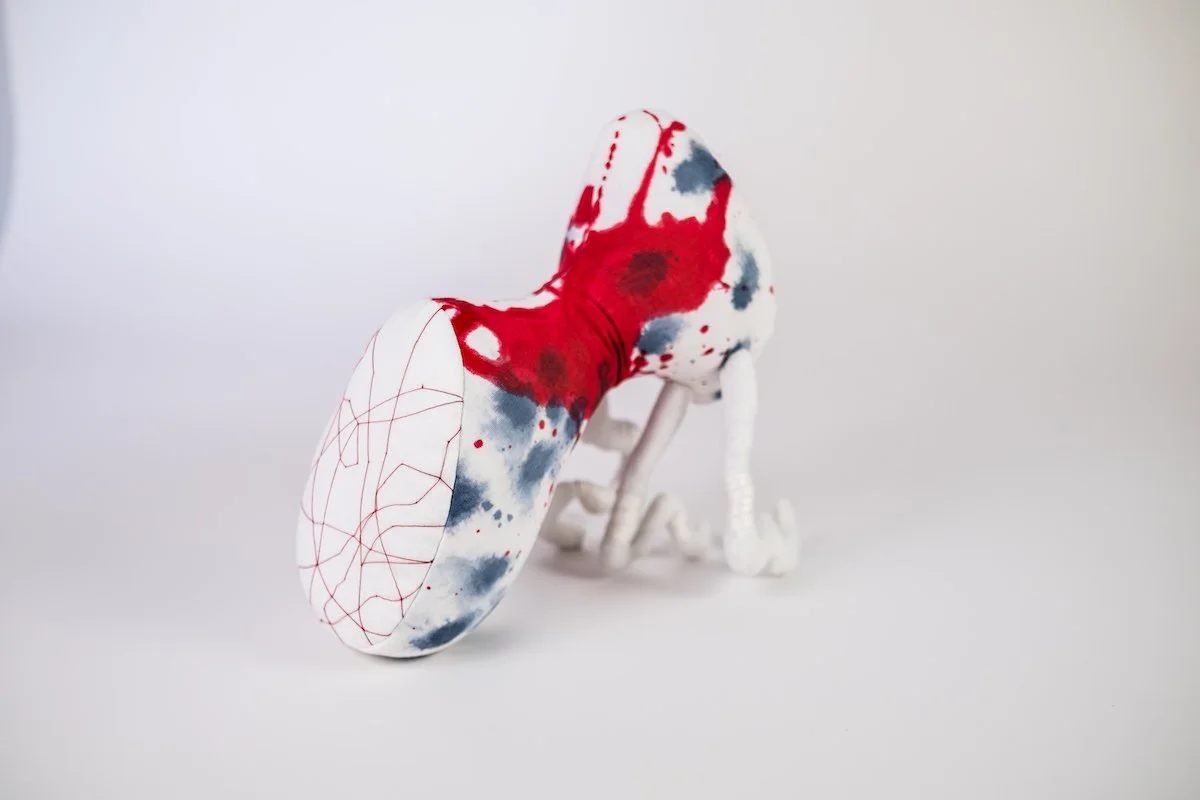
Tricia Waddell, Courage to break her own heart, 2025, linen, fiber-reactive dye, textile paint, hand embroidery, wire, wire mesh, thread, and stuffing, 10 x 6 x 10 inches. Image by Aubreigh Brunschwig, courtesy of the artist.
Take, for example, Courage to break her own heart (2025), an organism with a snowy, hourglass body splashed with red and blue. Other figures resemble earth-bound cephalopods with tangled tentacles and delicately hand-stitched embellishments, such as Take Me Anywhere but Home (2024), an octopus-like form with a large head covered in green knots resembling lichen.

Tricia Waddell, Take Me Anywhere but Home, 2024, linen, fiber-reactive dye, thread, stuffing, wire, and hand-embroidery, 14 x 8 x 14 inches. Image by Aubreigh Brunschwig, courtesy of the artist.
Tactile elements like dressmaker pins stuck into the fabric and long fringes of embroidery floss dangling down add complexity and visual interest to each piece. For instance, in Feel Me All at Once (2022) a fringe of blue string trails behind the form, like the long hair or skirt of this creature which resembles a hand with three fingers and a head. An incredible range of hand-dyed colors, from teal and indigo to crimson, salmon, and chartreuse contribute to the collection’s emotional cohesion.
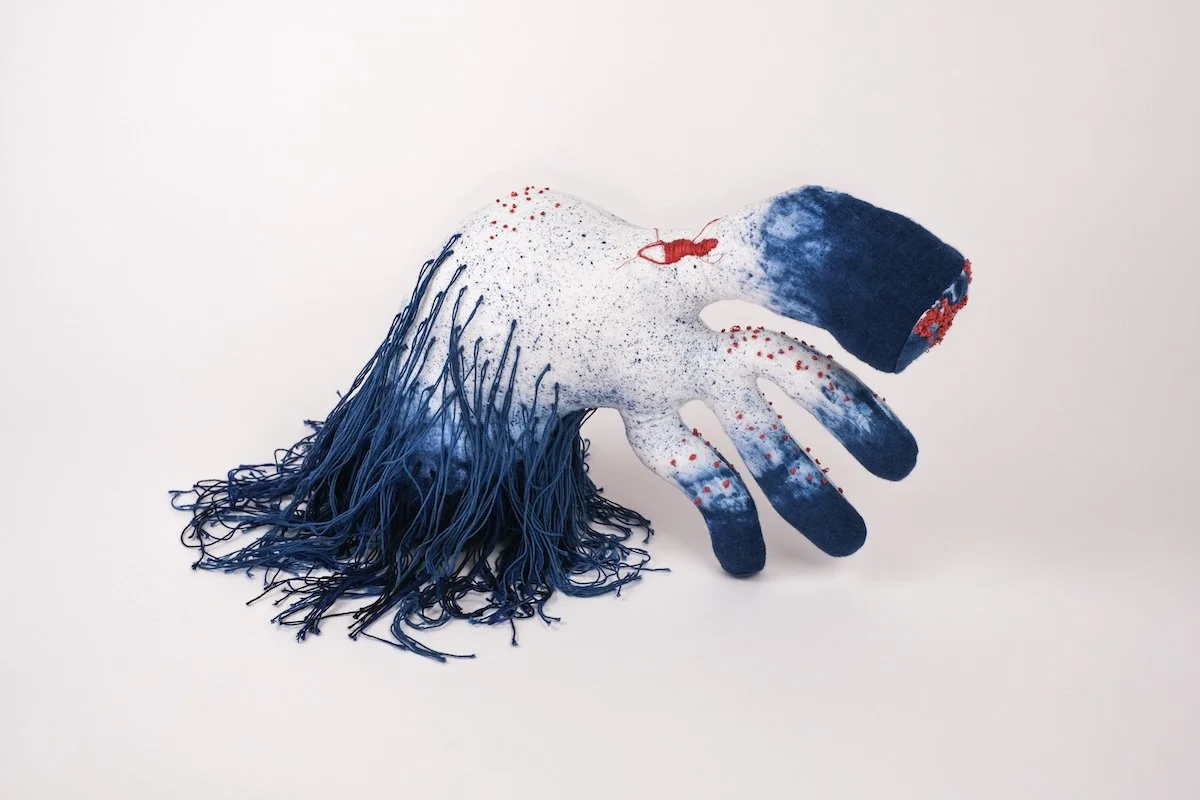
Tricia Waddell, Feel Me All at Once, 2022, linen, fiber-reactive dye, thread, hand embroidery, and stuffing, 8 x 13 inches. Image by Aubreigh Brunschwig, courtesy of the artist.
In her artist statement, Waddell refers to these non-representational sculptural objects as “self-portraits and expressions of everything I keep hidden.” [1] These figures are the outcome of a deep psychic excavation in which complex moods and difficult feelings are brought to the surface. By privileging her own interiority and giving her emotions material form, she boldly surrenders to the quiet depths of her mind and heart.
It is a profoundly vulnerable process through which she finds agency. The resulting totemic sculptures contain the intense energy of the artist’s inner life. Although the work is unabashedly personal, it is also relatable. By engaging with Waddell’s work, viewers can begin to understand what it is like to feel small and broken at times, but ultimately resilient.
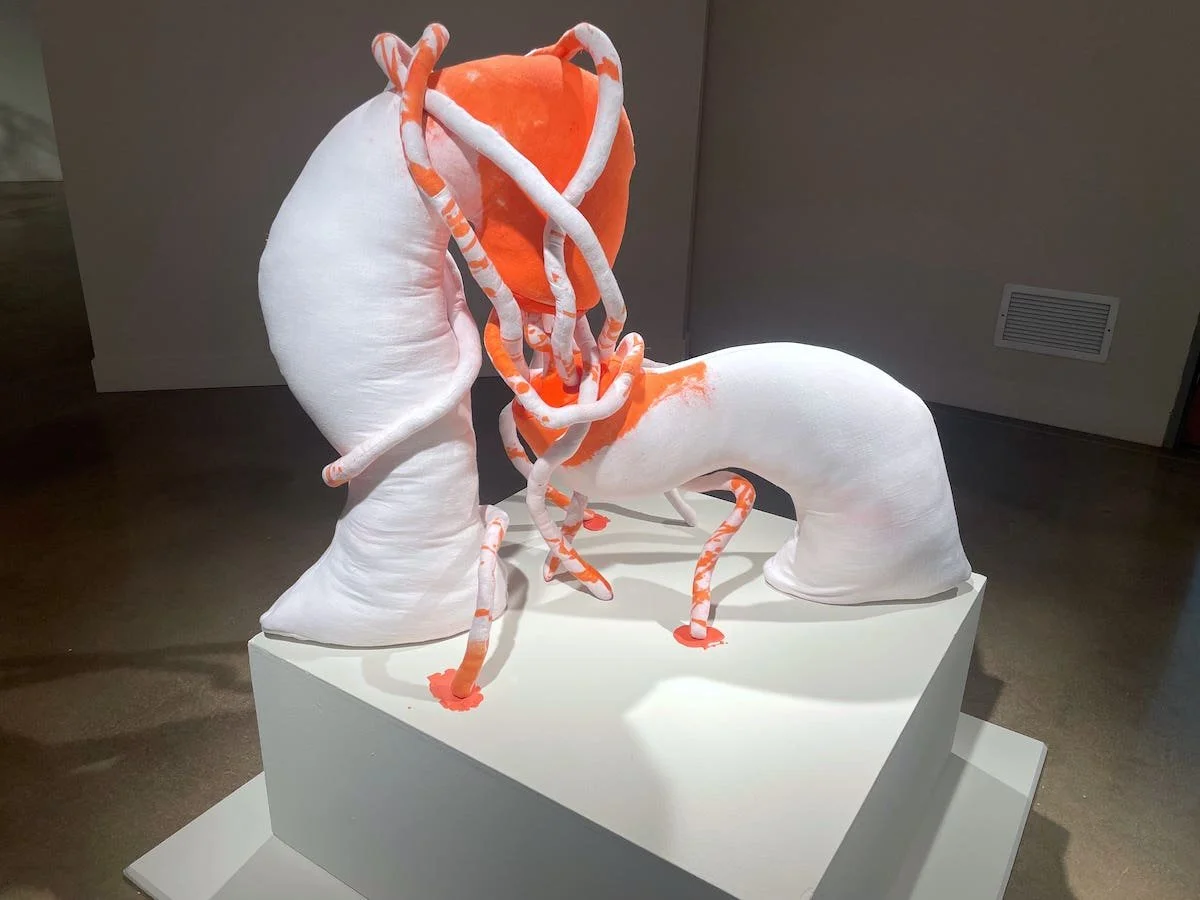
Betwixt and Between, 2024, linen, fiber-reactive dye, encaustic wax, stuffing, and wire, 38 x 42 x 9 inches. Image by Aubreigh Brunschwig, courtesy of the artist.
Waddell’s current body of work consists of more than a dozen soft sculptures that first emerged from the morass of the post-COVID era in 2022. During an extended period marked by mass-scale chaos and obligatory isolation, the textile-based artist, who had been formally trained as a fashion designer, began to experiment with new modes of expression.
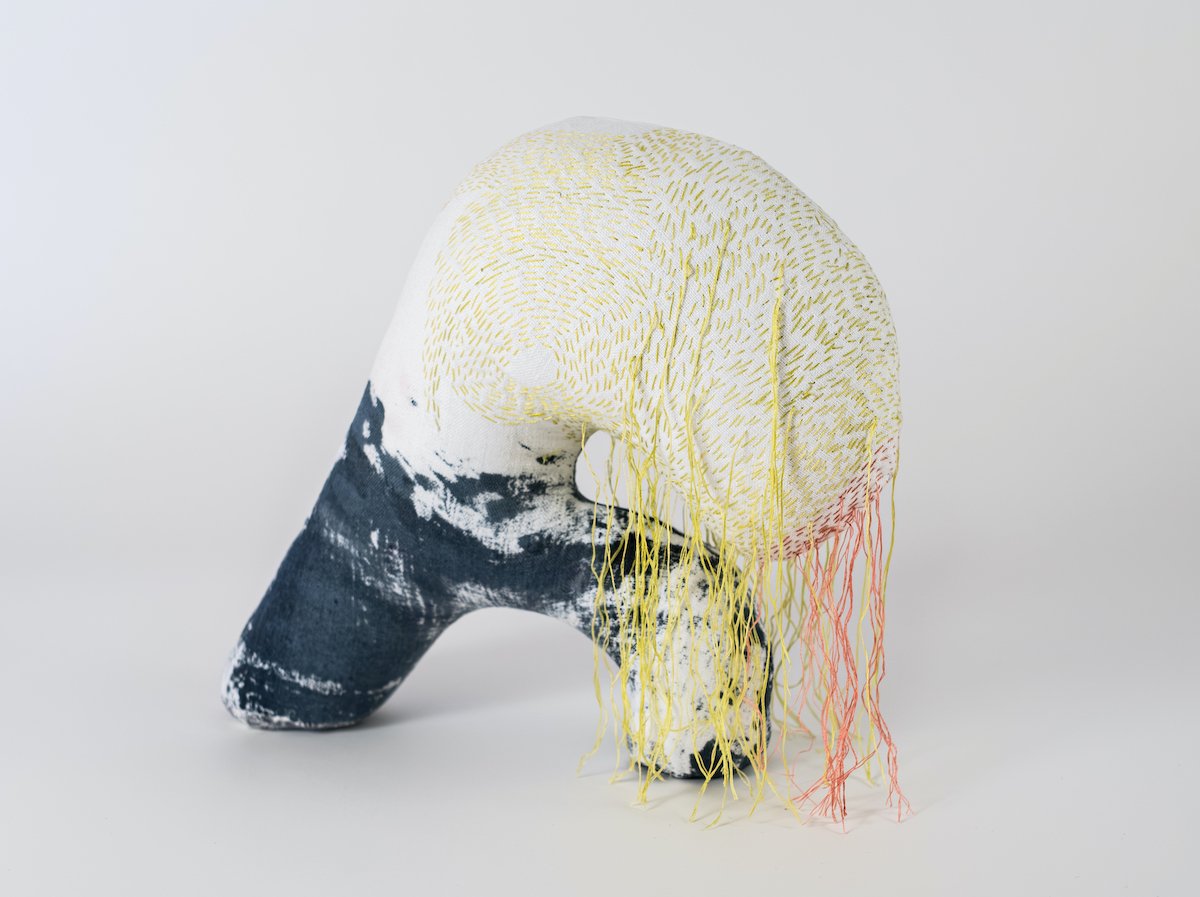
Tricia Waddell, Loneliness grew under her skin, 2025, linen, fiber-reactive dye, hand embroidery, thread, and stuffing, 10 x 6 x 10 inches. Image by Aubreigh Brunschwig, courtesy of the artist.
She gathered scraps of leftover fabric to make a doll-like form. Before she completed the process of sewing up the figure, Waddell hid a secret message inside that she had written by hand on a piece of paper. This private gesture was the genesis of her latest creative trajectory. As she recounts, after making that first piece, “I asked myself the question: ‘what if you had the emotion on the outside?’” Her soft sculptures are the visual response to that inquiry—the inner struggle made manifest.

Tricia Waddell, Showed Up and Felt Out of Place, 2024, linen, fiber-reactive dye, thread, stuffing, wire, waxed thread, twine, and hand-dyed sand, 20 x 9 x 14 inches. Image by Aubreigh Brunschwig, courtesy of the artist.
With evocative titles like Loneliness grew under her skin, Showed Up and Felt Out of Place, and I told the world I’m fine, Waddell offers her viewers clues about the raw psychological source material and drops hints about what the art is “about” while still leaving plenty of space for interpretation. The poetic allusions and quasi-confessional language that the artist deftly employs also creates an invisible protective barrier around herself. The names she chooses for each piece can come from overheard song lyrics, snippets of conversation, or journal entries.
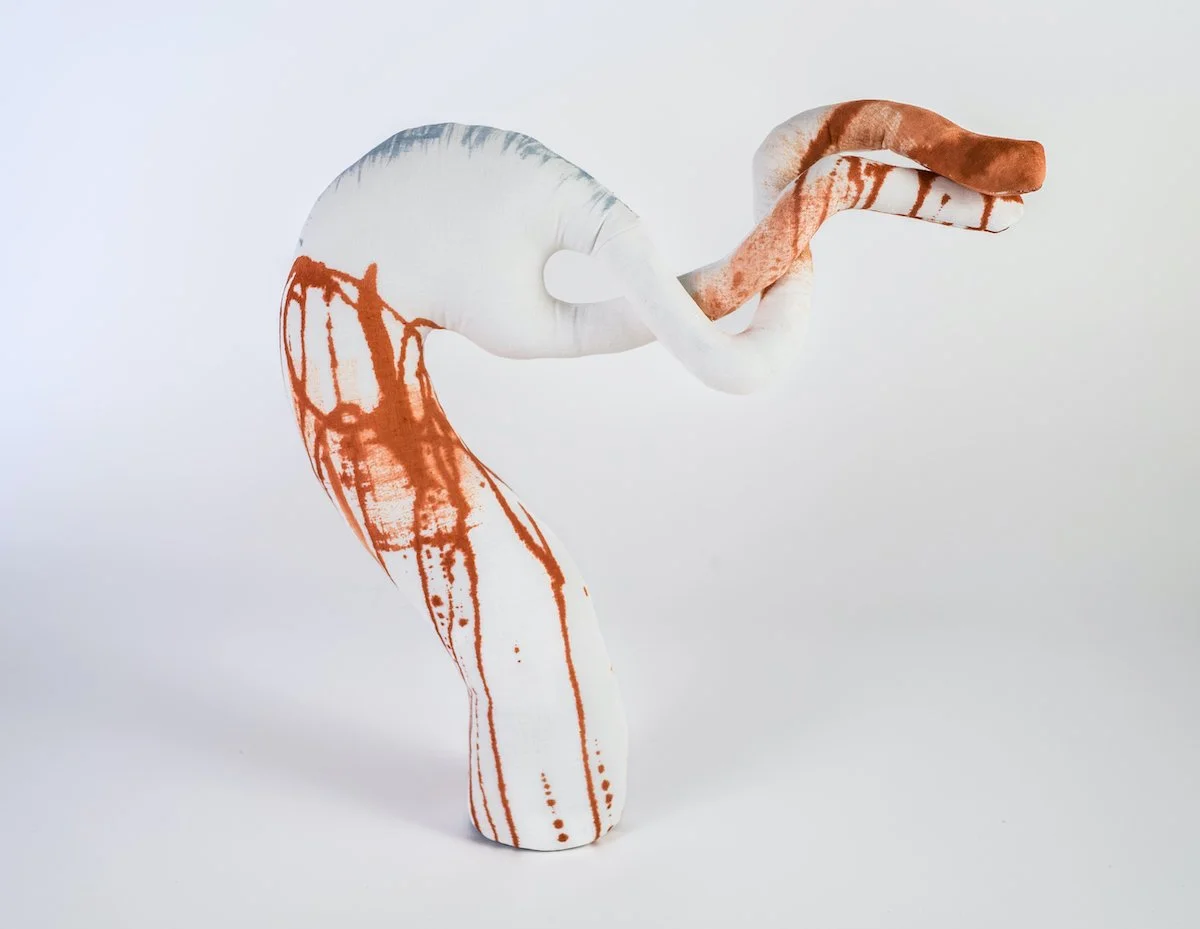
Tricia Waddell, I told the world I’m fine, 2025, linen, fiber-reactive dye, wire, thread, and stuffing, 18 x 12 x 5 inches. Image by Aubreigh Brunschwig, courtesy of the artist.
Waddell’s approach is rigorous and borrows heavily from her artistic background. Looking at her work today, it might seem like an unexpected shift for a person who previously worked as a fine art photographer and fashion designer. After all, these are two creative fields that are generally thought to be exclusively oriented towards surface-level appearances. But seen from another angle, the glossy images cut from magazines that appear on the artist’s inspiration board reveal something much deeper about the self-protective layers we wear—a tacit acknowledgement that what is seen is not always known.
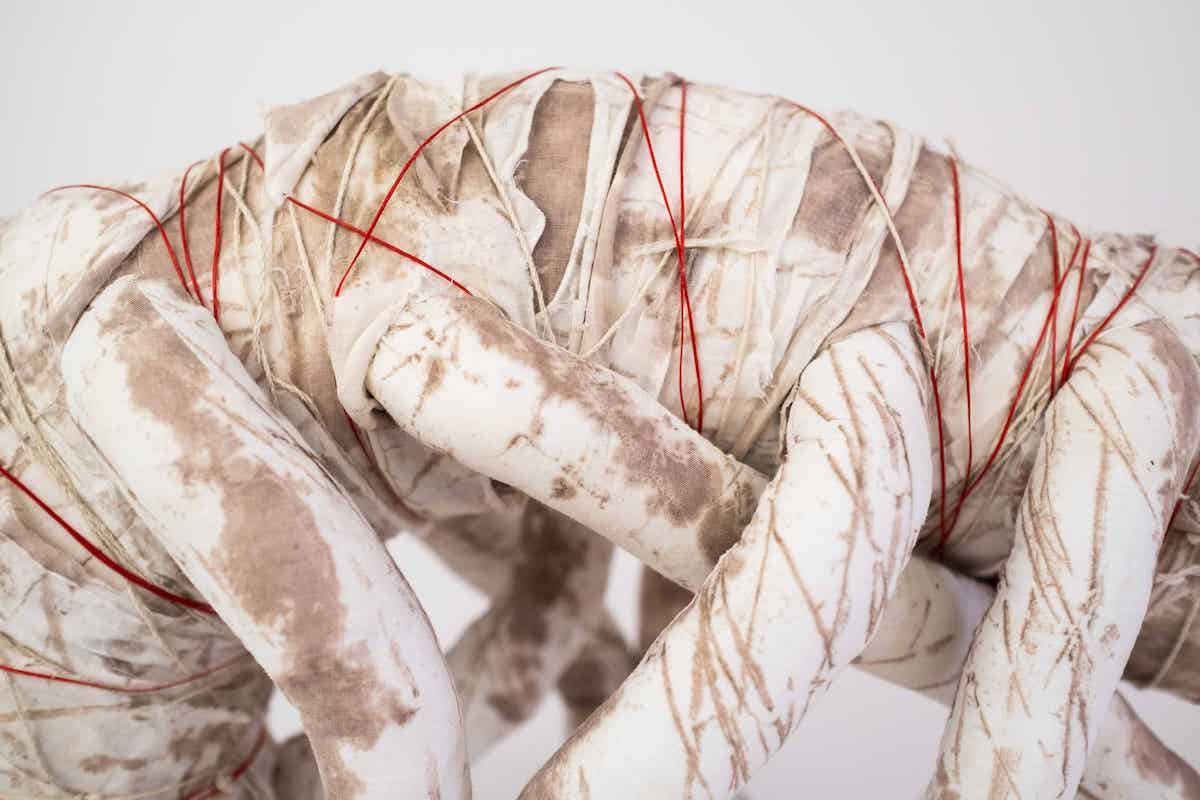
A detail view of Tricia Waddell’s Showed Up and Felt Out of Place, 2024, linen, fiber-reactive dye, thread, stuffing, wire, waxed thread, twine, and hand-dyed sand, 20 x 9 x 14 inches. Image by Aubreigh Brunschwig, courtesy of the artist.
There is an extraordinary amount of effort that goes into the creation of each sculpture. Waddell tends to work on multiple projects at a time, which means it often takes months to complete a single work. Each element is done by hand, with an attentive focus on craft. Inspired by her fashion training, the artist follows a working sequence that always begins with drawing. Using sketches as a point of reference, she engages in a process she describes as “an act of translation” that involves cutting patterns for the form out of muslin fabric.
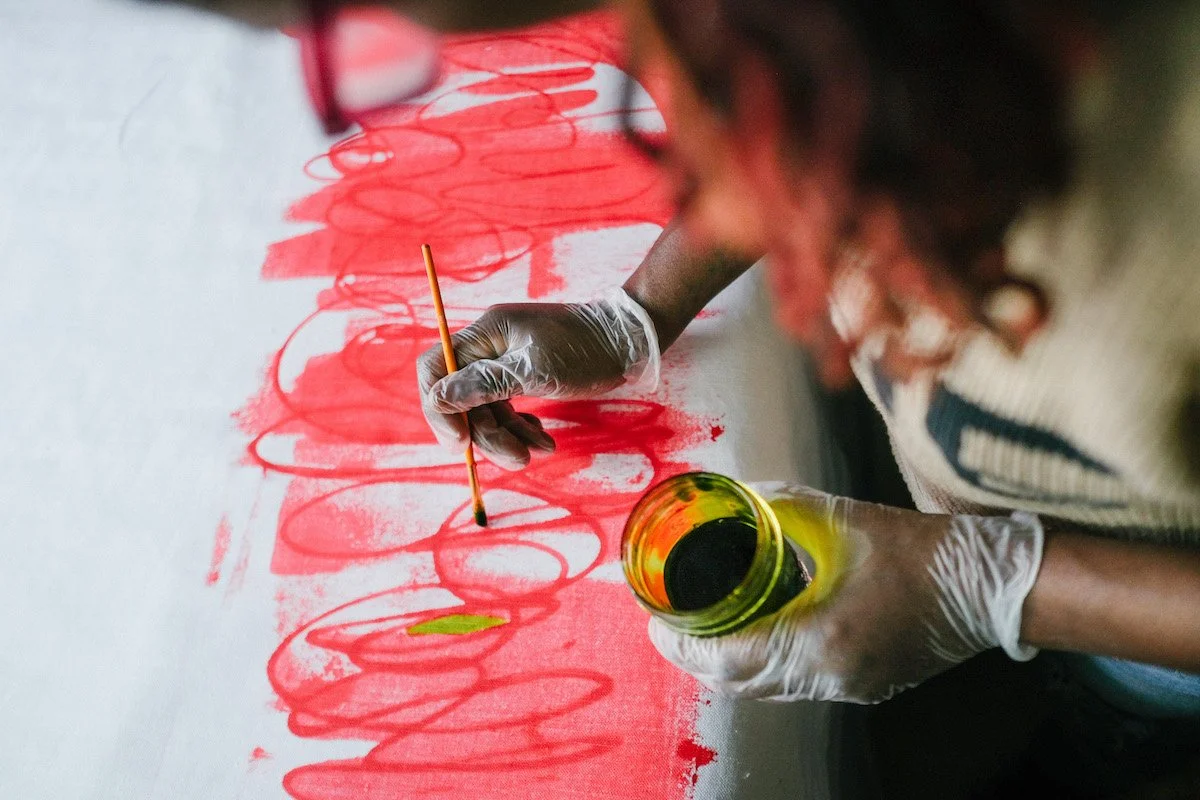
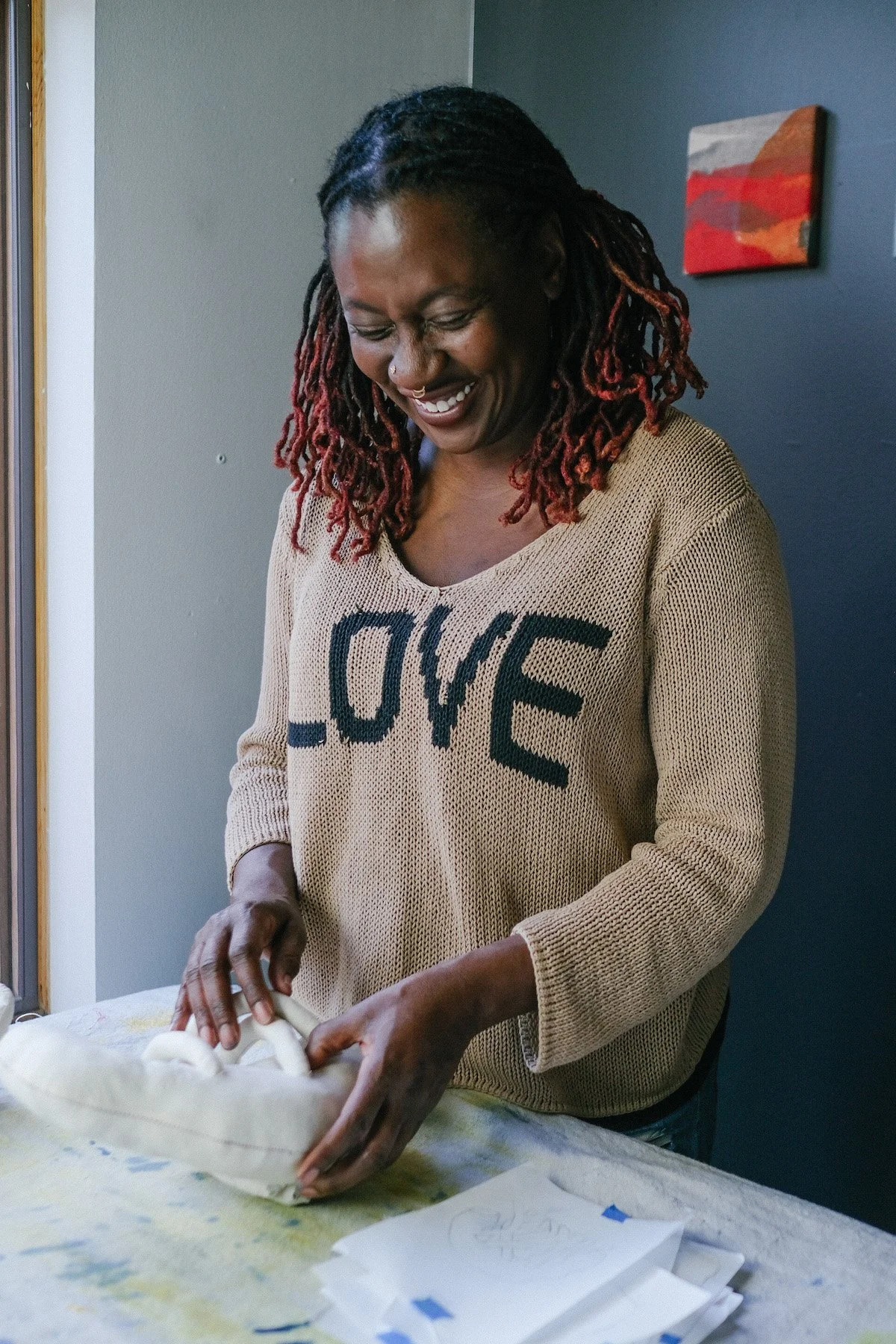
A view of Tricia Waddell working in her studio. Image by Aubreigh Brunschwig, courtesy of the artist.
She further explains that “once I get the form where I want it, the next stage is figuring out what the fabric might be.” With a specific design in mind, she uses fiber-reactive dye to create unique patterns and colorful textures on the cloth she selects. Using the language of abstraction, she applies dye like a painter in various hues that range from light stains to vibrant splotches.
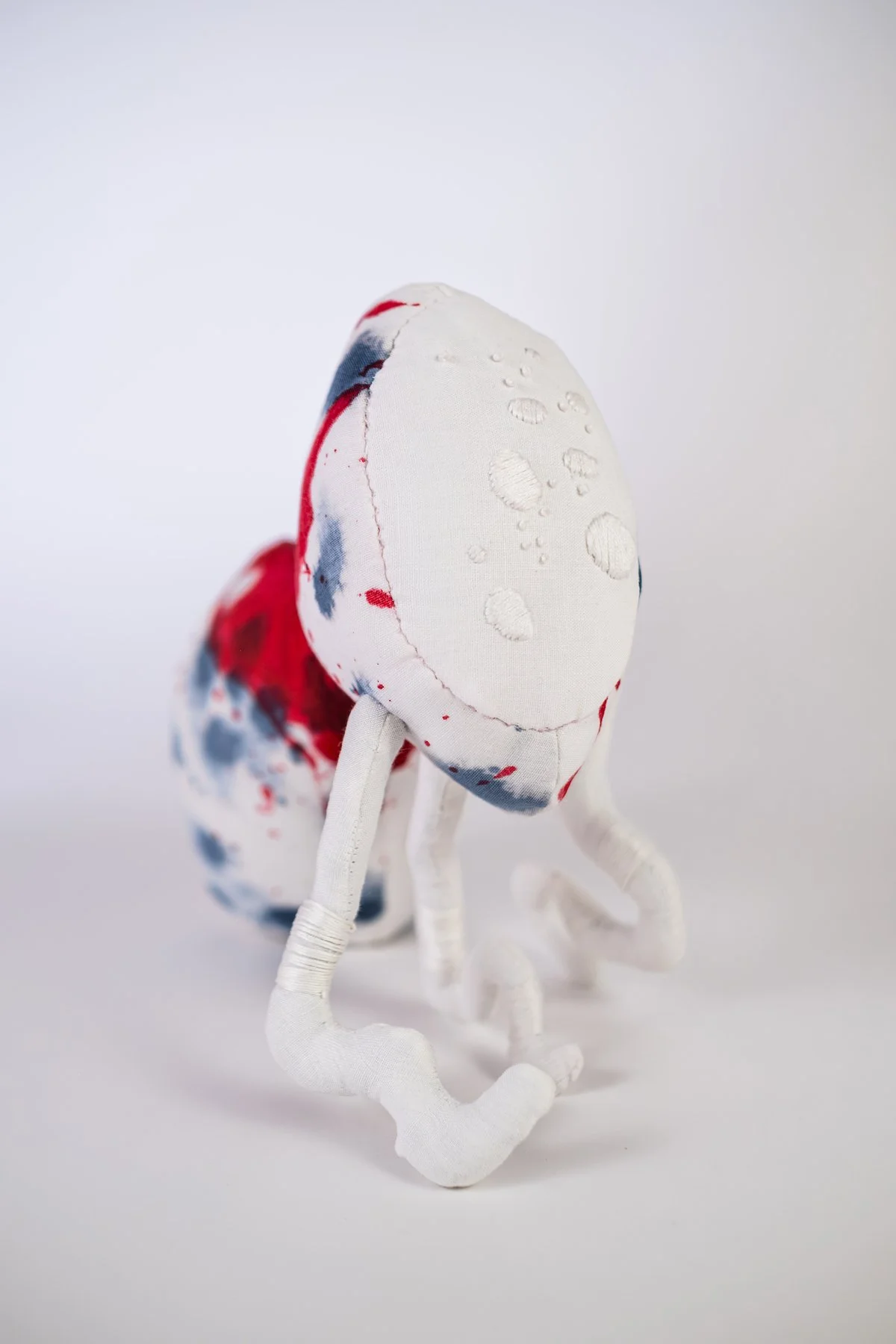
A detail view of Tricia Waddell’s Courage to break her own heart, 2025, linen, fiber-reactive dye, textile paint, hand embroidery, wire, wire mesh, thread, and stuffing, 10 x 6 x 10 inches. Image by Aubreigh Brunschwig, courtesy of the artist.
Everything about this work is intentional—Waddell seriously considers the color, shape, and form of each piece. As she notes, “I have to know what the piece is about in order to know the emotional ways to express the feeling.” As if composing a song, she knows what notes to play. Music, in fact, is often a source of inspiration. Familiar songs reverberate in Waddell’s headphones as she sets about to work in the studio.
In describing how just a few notes can instantly bring us back to a precise memory or significant moment in our lives, she tells me how “music can act as the prompt, especially with a song that means something to me…I think to myself: ‘I want to make a body of work that feels like this [song].’” A group of completed sculptures might even be described as a kind of “soundtrack” to an internal mood.
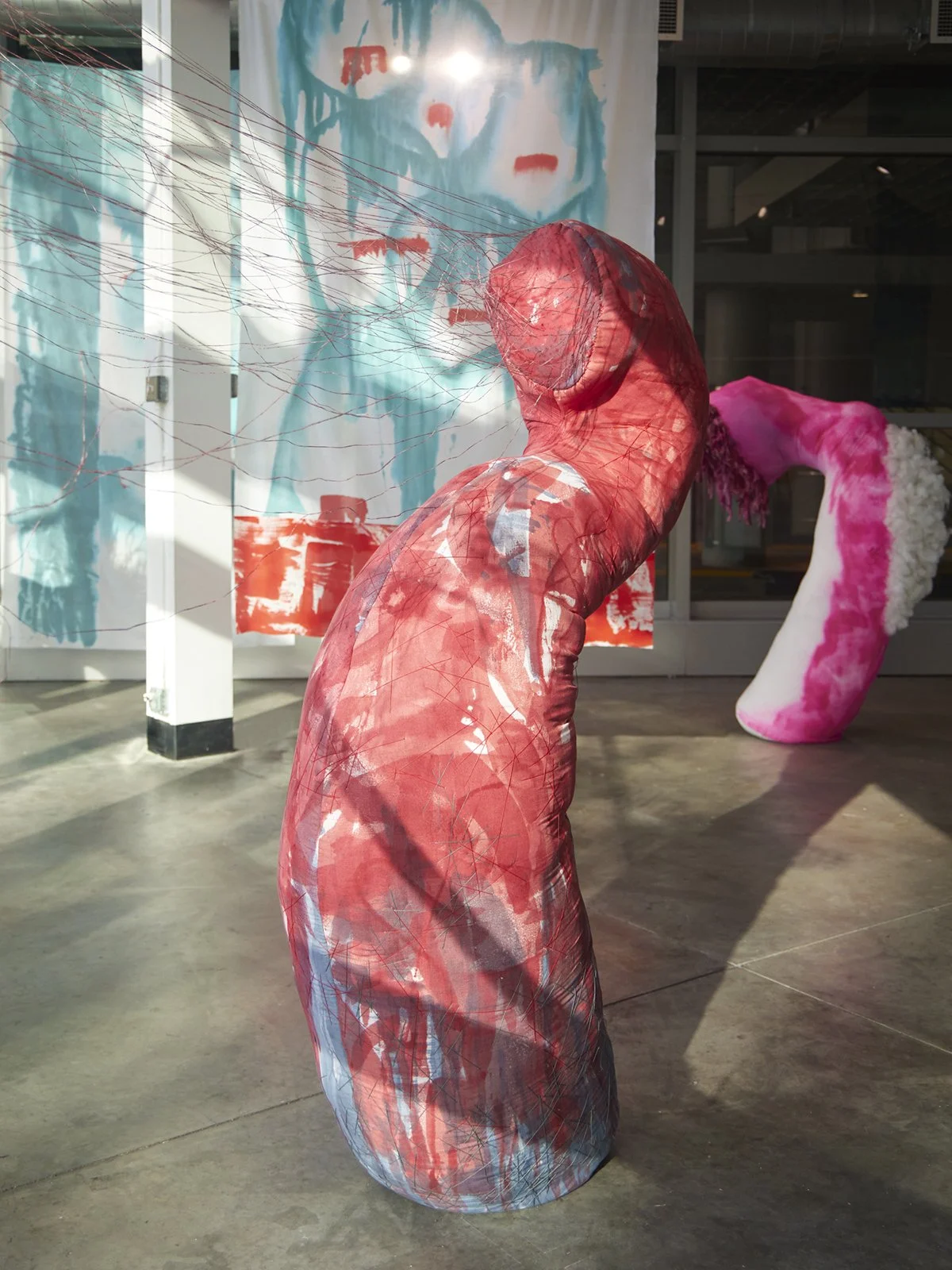
An installation view of Tricia Waddell’s exhibition We Will Be Strange at Understudy. Image by Third Dune Productions, courtesy of Understudy.
It’s no surprise that some of the sculptures almost seem to sway in a rhythmic manner, because as Waddell says, “an implied sense of movement is very key to me.” For this, she references images of dancers and studies different dance poses. To capture the tension between opposing feelings, the artist is mindful of the inner architecture of each figure. She uses wire armatures along with weighted beads to create shape and balance. She then densely packs the sculptures with cotton batting, so they maintain the integrity of their shape. This transforms an inert mass of cloth into a creature that writhes and recoils or lurches forward.
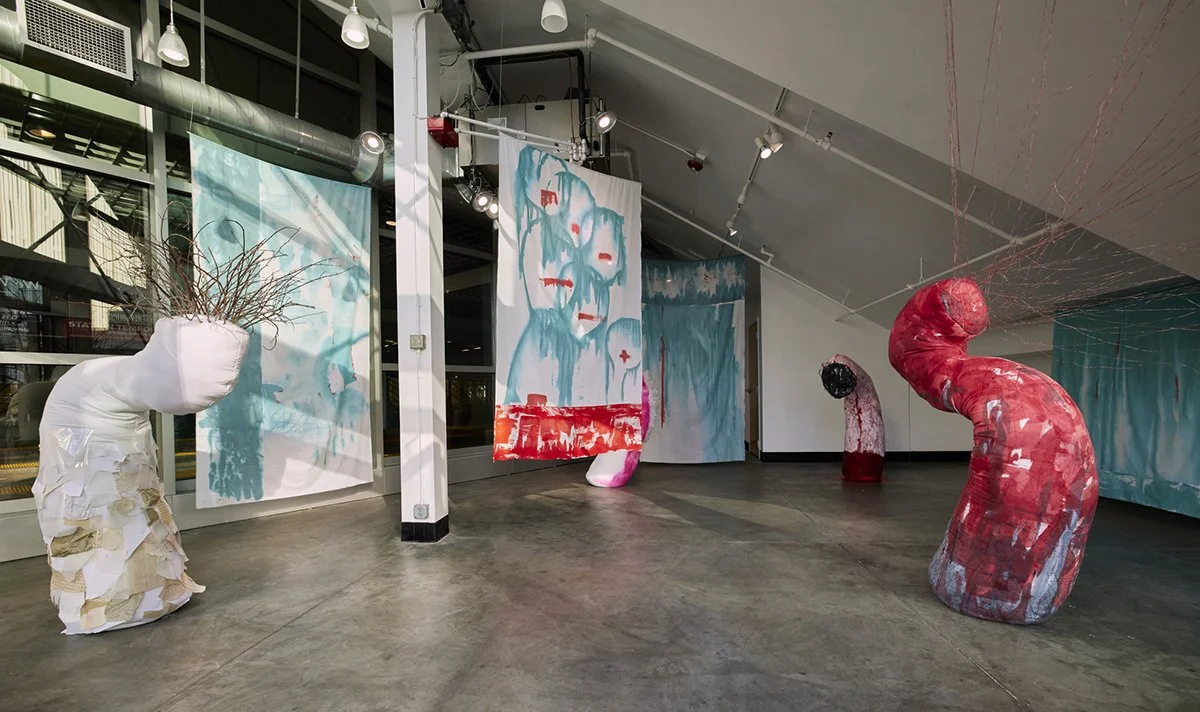
An installation view of Tricia Waddell’s exhibition We Will Be Strange at Understudy. Image by Third Dune Productions, courtesy of Understudy.
This multi-faceted creative now finds herself moving through a transitional period. She admits that the last year and a half was a nonstop whirlwind. In 2024, Waddell presented a major solo show at Understudy in downtown Denver. [2] Titled We Will Be Strange, it featured four massive soft sculptures and large hand-dyed cloth panels suspended from the ceiling.
This was an opportunity for her to play with the scale and to build an immersive environment. She was able to amplify the visceral impact of the work by incorporating sonic elements with the help of Denver-based sound artist Ben Coleman. The collaboration prompted her to push her imagination in a different direction, and she looks forward to the possibility of working with other artists in the future.
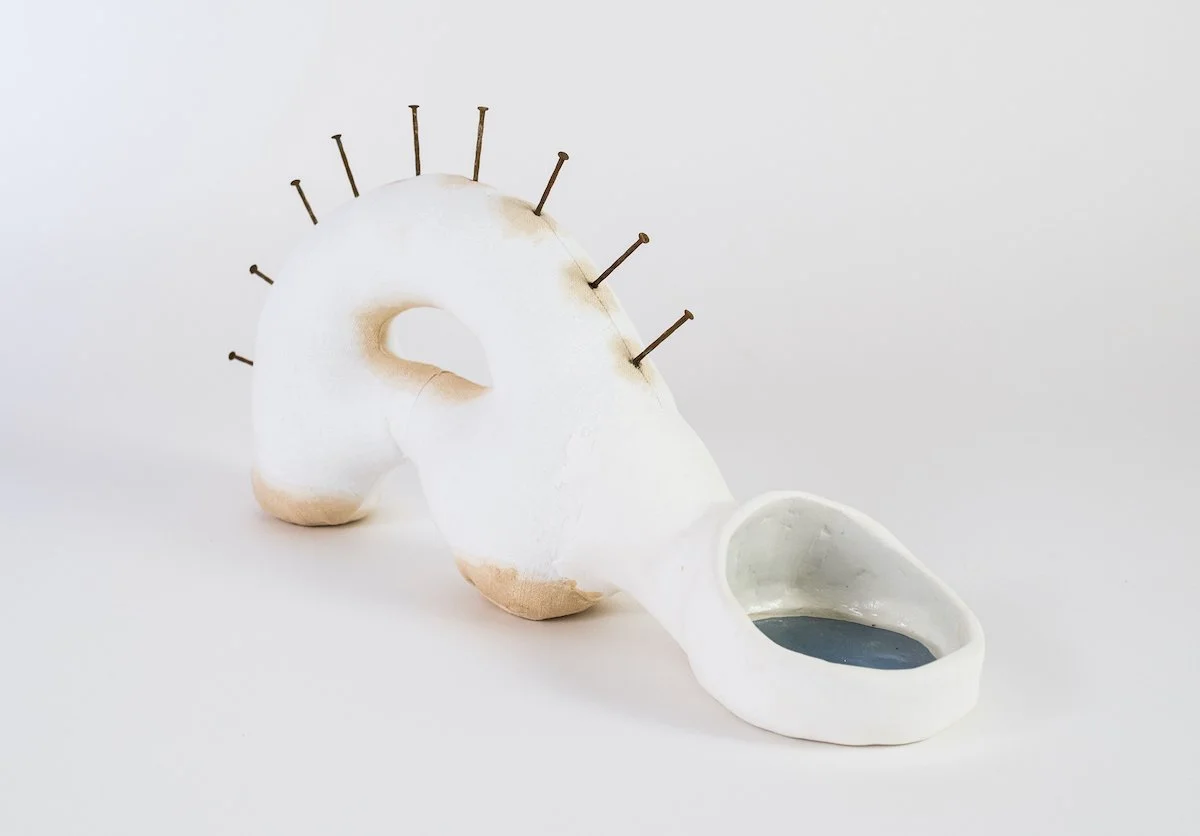
Tricia Waddell, Hold on, more is coming, 2025, linen, clay, resin, acrylic paint, tea, nails, thread, and stuffing, 9 x 6 x 15. Image by Aubreigh Brunschwig, courtesy of the artist.
Another impactful experience was her recent online residency at the School of Visual Art (SVA) in New York. This five-week intensive period pushed Waddell to evolve her practice in unexpected ways. While she remains “interested in what you can do with fabric that you can’t do with other mediums,” her mentors encouraged her to blend other materials into her work. Within this supportive community she realized that “every material has its own essence” and she delighted in the result of what happened when she “combined the weight of clay with the softness of fabric” in her latest experiments.
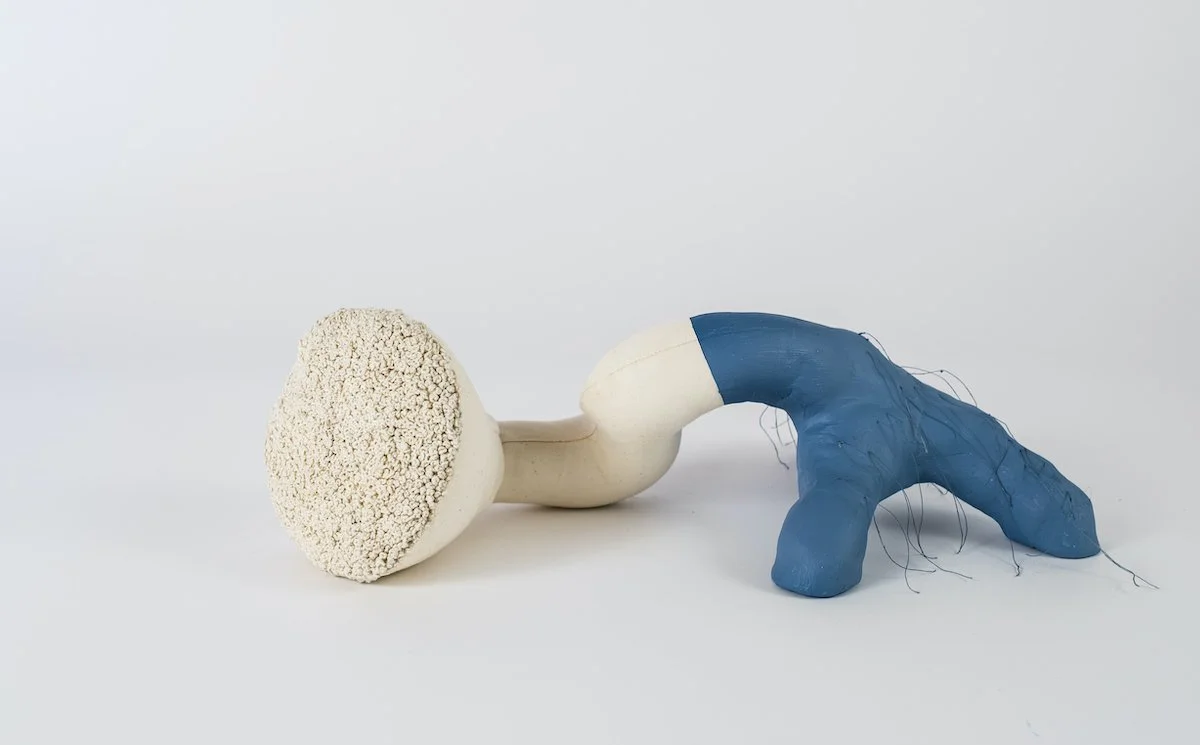
Tricia Waddell, Bottom of the River, 2025, muslin, clay, hand embroidery, acrylic paint, wire mesh, thread, and stuffing, 6 x 8 x 16 inches. Image by Aubreigh Brunschwig, courtesy of the artist.
A dense cluster of cream-colored French knots bursts from the disc-shaped face of the piece titled Bottom of the river, making it look like the inner floret of a sunflower. This figure has a three-pronged navy-blue tail made of clay which gives it a sense of gravity.
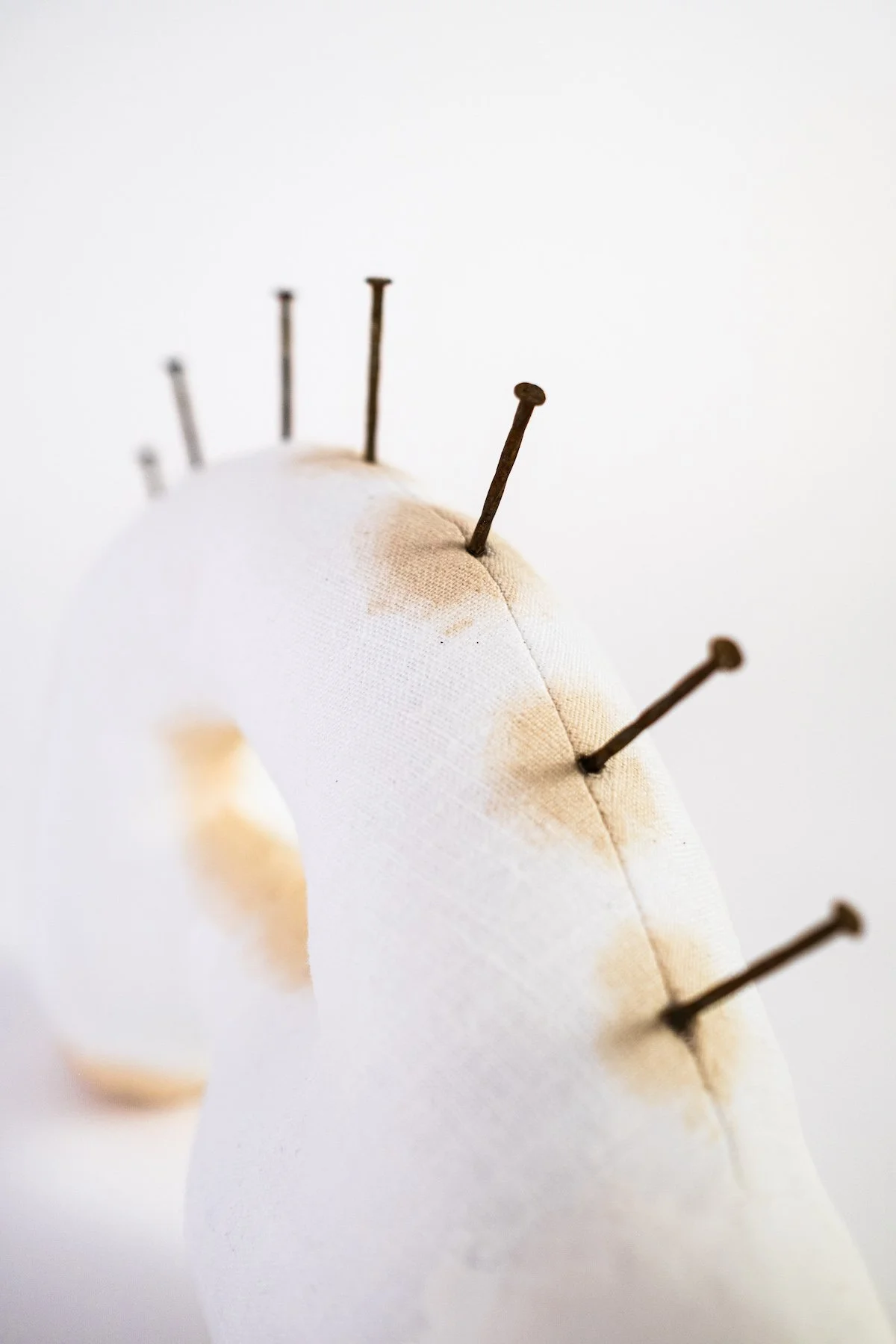
A detail view of Tricia Waddell’s Hold on, more is coming, 2025, linen, clay, resin, acrylic paint, tea, nails, thread, and stuffing, 9 x 6 x 15. Image by Aubreigh Brunschwig, courtesy of the artist.
Another sculpture called Hold on, more is coming has a ceramic reflection pool for a head and it seems to arch its back, displaying a row of rusty nails arranged along its spine. These works made in spring 2025 mark a welcome turning point for the artist who is continuing to invite more spontaneity into her work along with the inclusion of unexpected elements.
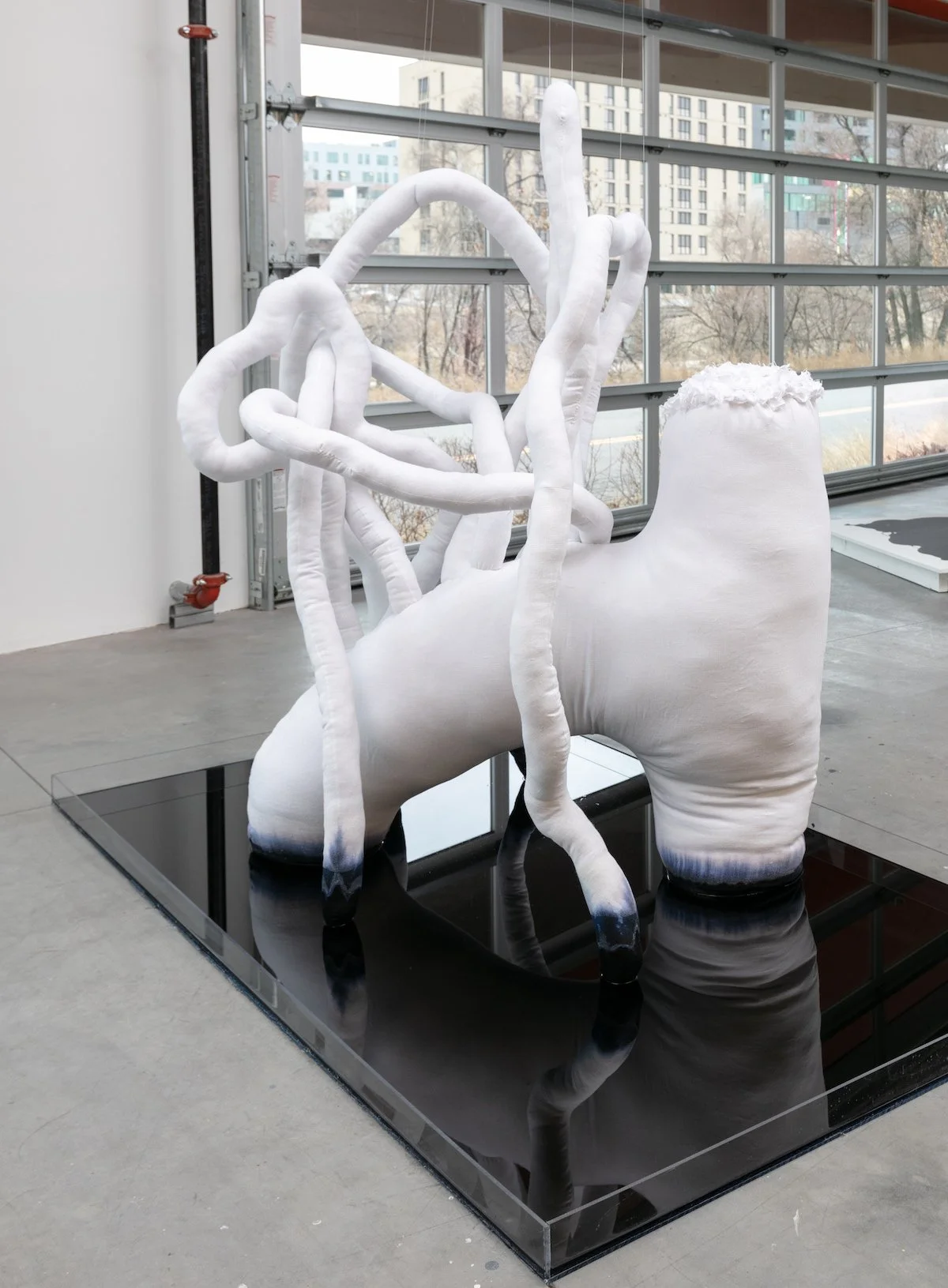
Tricia Waddell, Her Body Said So Much, 2024, linen, fiber-reactive dye in plexiglass tray, polyester stuffing, and wire, 45 x 30 x 55 inches. Image by Aubreigh Brunschwig, courtesy of the artist.
What’s next for this artist? Larger scale work is certainly in the offing, including wall pieces that will immerse the viewer in her emotional landscape. Already, she feels that the planning process is “starting from a more intuitive place.” She is eager to dig deeper into her psyche and to get looser and messier in the execution of the work itself. In her exploration of memory and liminal spaces she wants to figure out how the sculptures can be, in her words, “less well behaved” and “less pretty.”
Djamila Ricciardi (she/her) is a fifth generation Denverite who is actively involved in the local arts community. She has a BA in Art History from Scripps College in Claremont, CA and is a recent graduate of the MA Art History/Arts of the Americas program at the University of Arkansas where she was the inaugural recipient of the Community Impact Award for her original research and writing.
[1] From artist’s website: www.studioblkbird.com/about.