
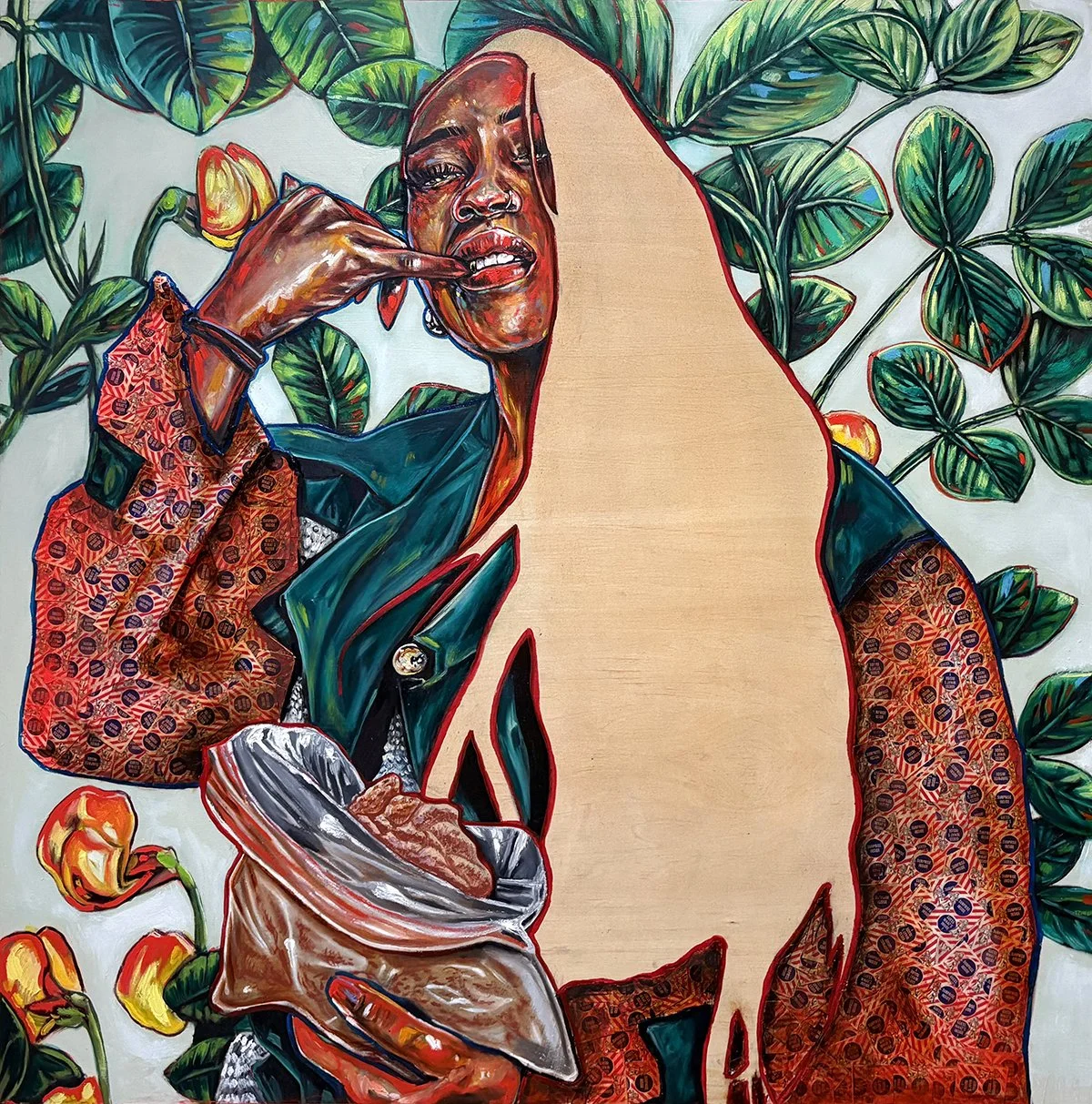
Nourished
Jazz Holmes: Nourished
Denver Botanic Gardens, Freyer–Newman Center
1007 York Street, Denver, CO 80206
September 27, 2025–March 22, 2026
Curated by Jazz Holmes with assistance from Moira Casey, Assistant Curator of Exhibitions, Denver Botanic Gardens
Admission: $16.50 for adults; $12.50 for seniors, military, and veterans; $12 for children; free for members and children under 2
Review by Laura I. Miller
Jazz Holmes may change the way you think about food.
Popular Western representations of food that come to mind for me are: The Last Supper by Leonardo da Vinci, Basket of Apples by Paul Cézanne, and Banana by Andy Warhol. These are all works in which food is the object telling the story of the subjects who represent it.
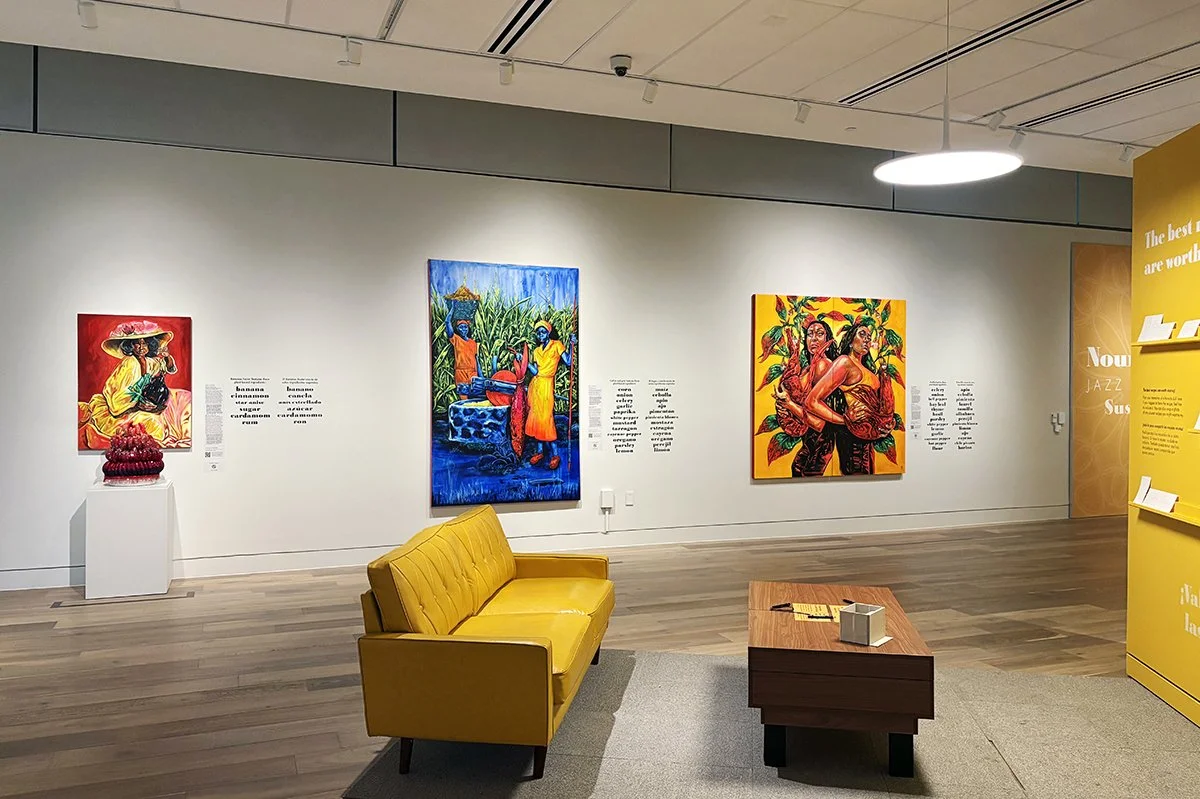
An installation view of Jazz Holmes’ exhibition Nourished at Denver Botanic Gardens’ Freyer–Newman Center gallery. Image by Laura I. Miller.
In Nourished, her exhibition on display at the Denver Botanic Gardens, Jazz Holmes pays homage to the Creole food that has shaped her. But these paintings are not still lifes, and the relationship to food isn’t one of subject to object. Holmes’ work is vibrant, living, dynamic; it elevates the raw materials of Creole cuisine to co-creator alongside the people who harvest and prepare it. These paintings flip the idiom “you are what you eat” on its head, showing us that food is more than an object to be consumed—it’s a partner and a mirror, inseparable from the humans who nourish it and are nourished by it.
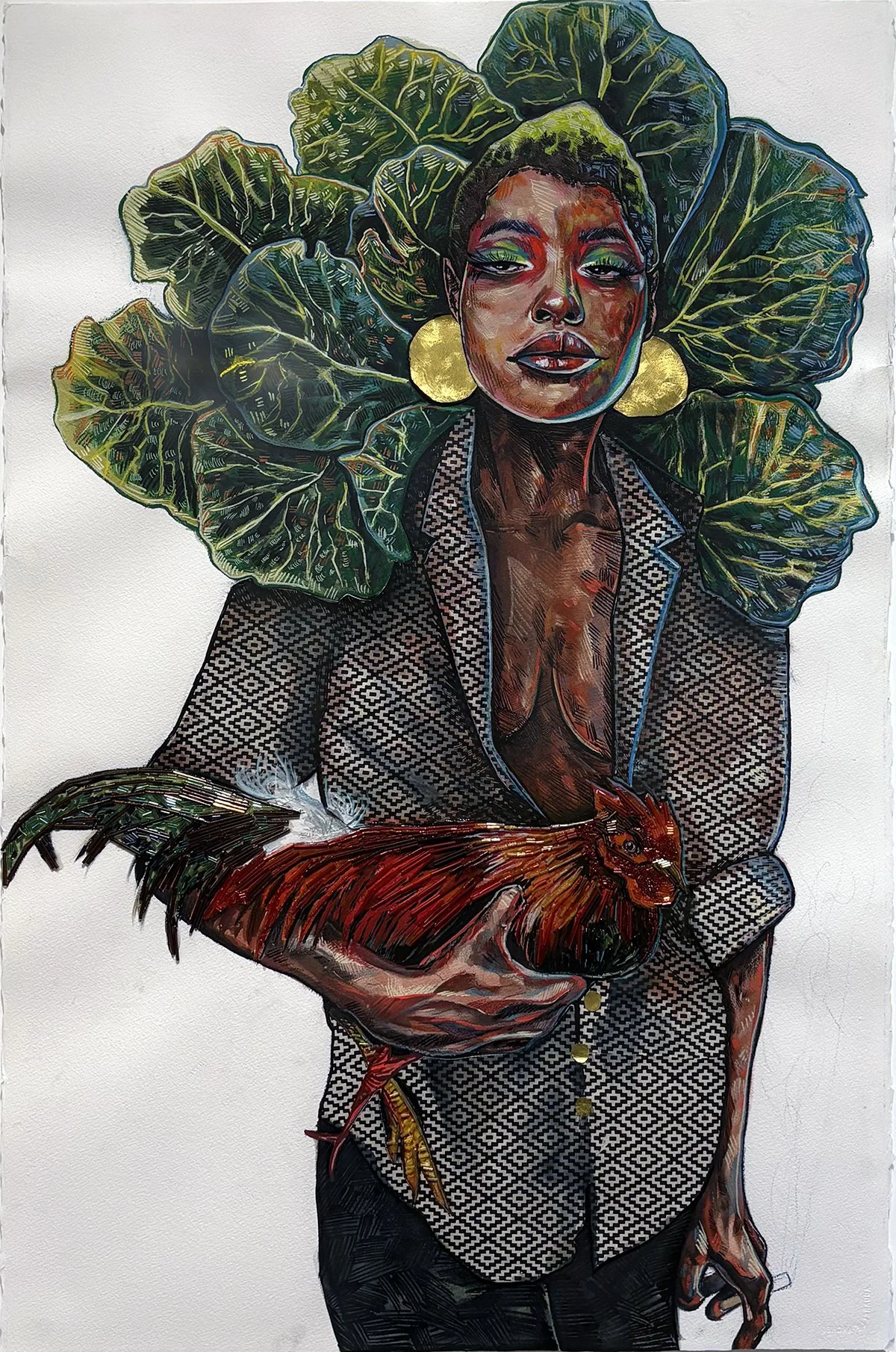
Jazz Holmes, Tchoupitoulas, 2024, gouache paint, graphite, and beads. Image by Laura I. Miller.
Growing up in the South, Holmes spent her childhood working on the ancestral sharecropping farms owned by her grandmother and her grandmother’s siblings. Her parents, both artistic themselves, encouraged her in drawing, and she went on to earn a BFA in studio art from the University of Western Florida before moving to Colorado to pursue an MFA in drawing from Colorado State University in Fort Collins. Holmes struggled to decide whether to become an artist or a chef, she told VoyageDenver, before realizing she could carve out space for both.
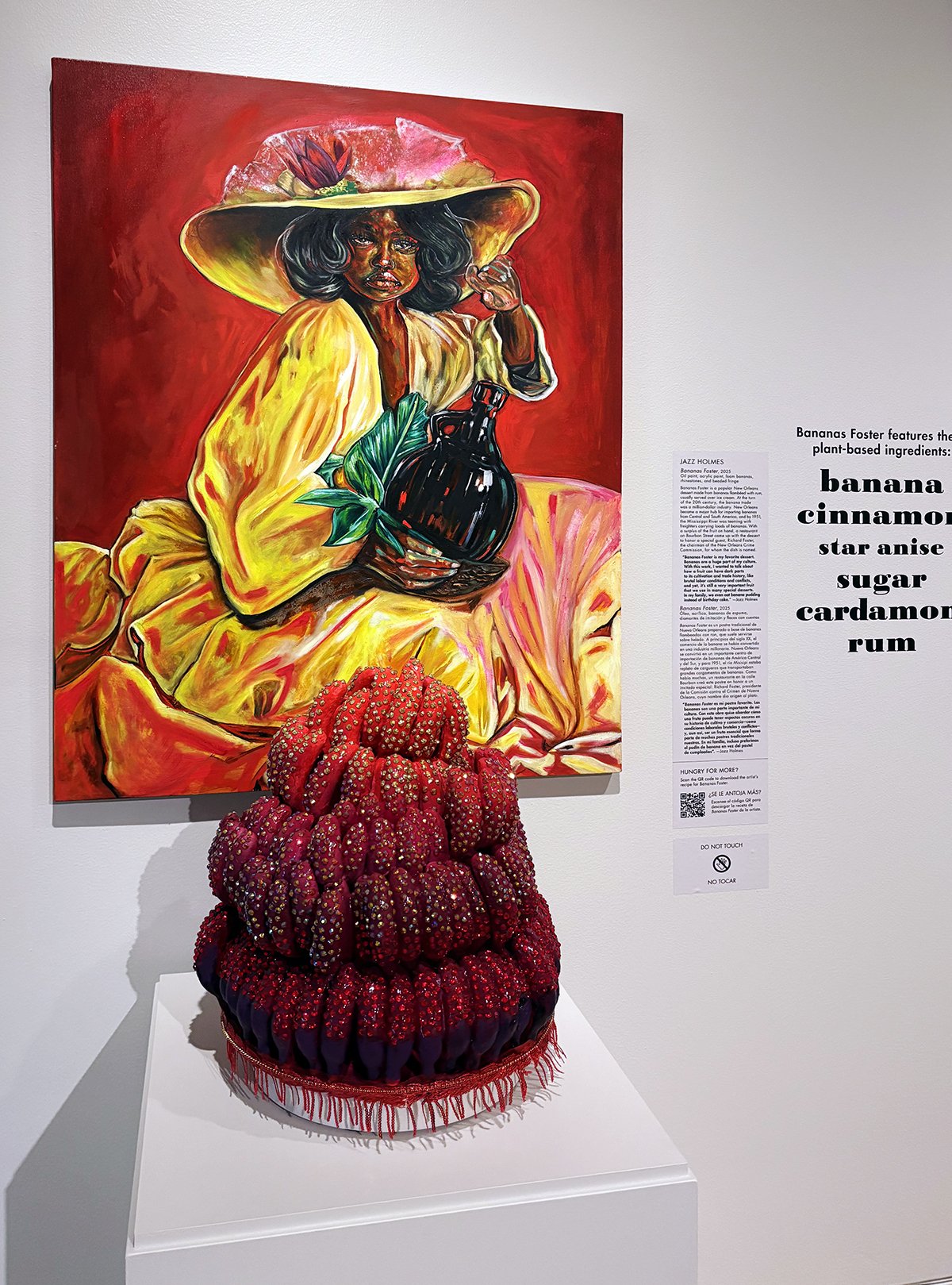
Jazz Holmes, Bananas Foster, 2025, oil paint, acrylic paint, foam bananas, rhinestones, and beaded fringe. Image by Laura I. Miller.
In Nourished, each painting features a dish or an ingredient, alongside the people—including herself—who prepare them, and most paintings are paired with lists of ingredients and QR codes that lead to Holmes’ recipes. The paintings and mixed-media works are titled: Mirepoix, Grapevine, Allium cepa, Étouffée, Chattahoochee, Bananas Foster, Hoppin’ John, Sorrel, Okra, Tchoupitoulas, Fufu, and Southern Caviar.
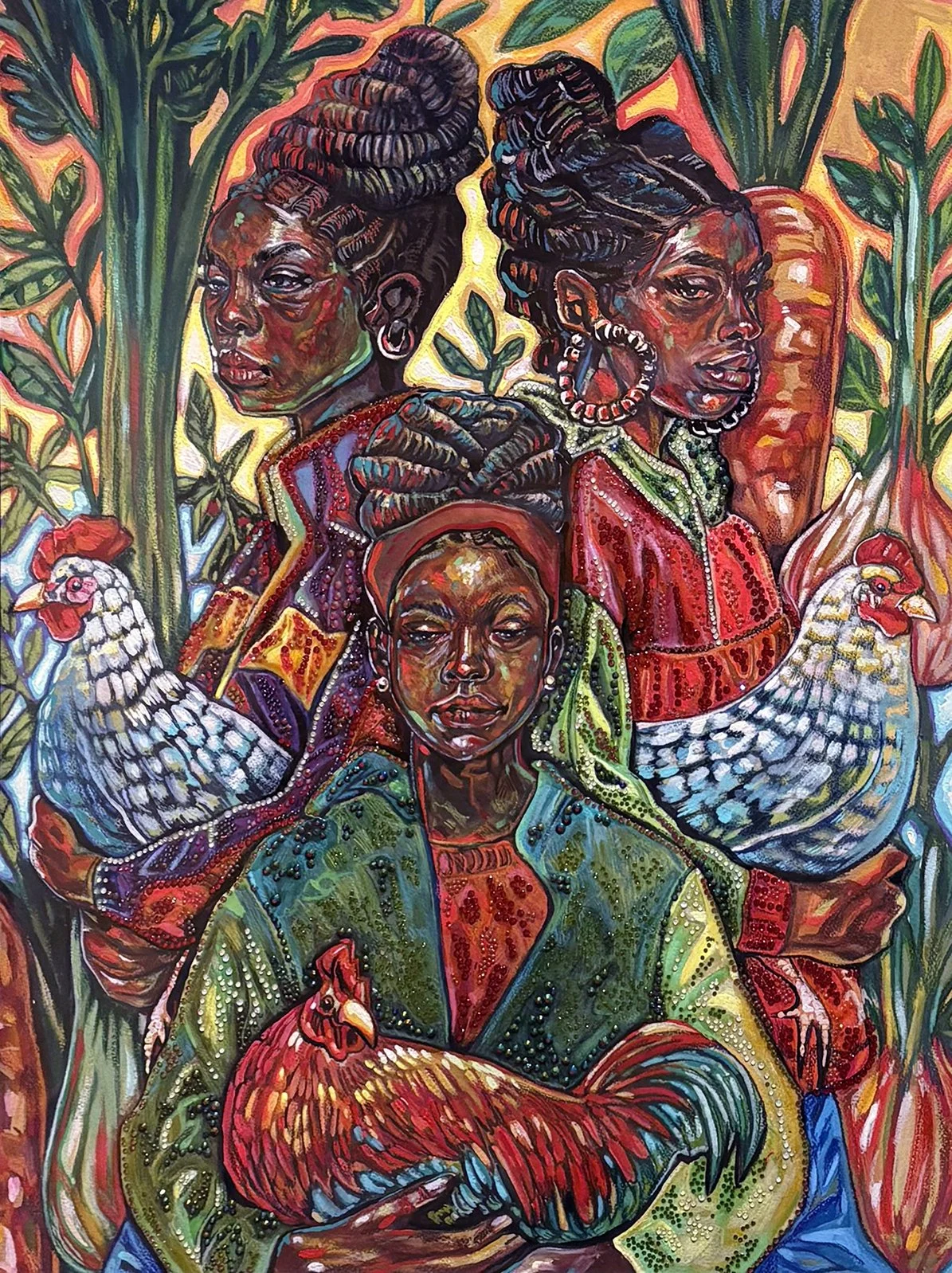
Jazz Holmes, Mirepoix, 2025, gouache paint and rhinestones. Image by Laura I. Miller.
Fittingly, the first painting that greets the viewer is Mirepoix, which is a combination of carrot, celery, and onion that serves as the foundation for many Creole and French dishes. In Holmes’ painting, three Black women, bejeweled in rhinestones, hold chickens against a backdrop of carrot, celery, and onion plants. The jewels are literal, not painted representations, and though they’re hard to see in photos of the works, their effect is nothing short of dazzling in person. The red, yellow, purple, and green rhinestones accentuate the warm colors prevalent in everything from the women’s skin tones to the chickens’ feathers to the vegetables’ fruit and leaves. Holmes’ use of vibrant colors, mirrored in the plants, animals, and people, carries through all of the works in the exhibition, contributing to the themes of connection and unity.
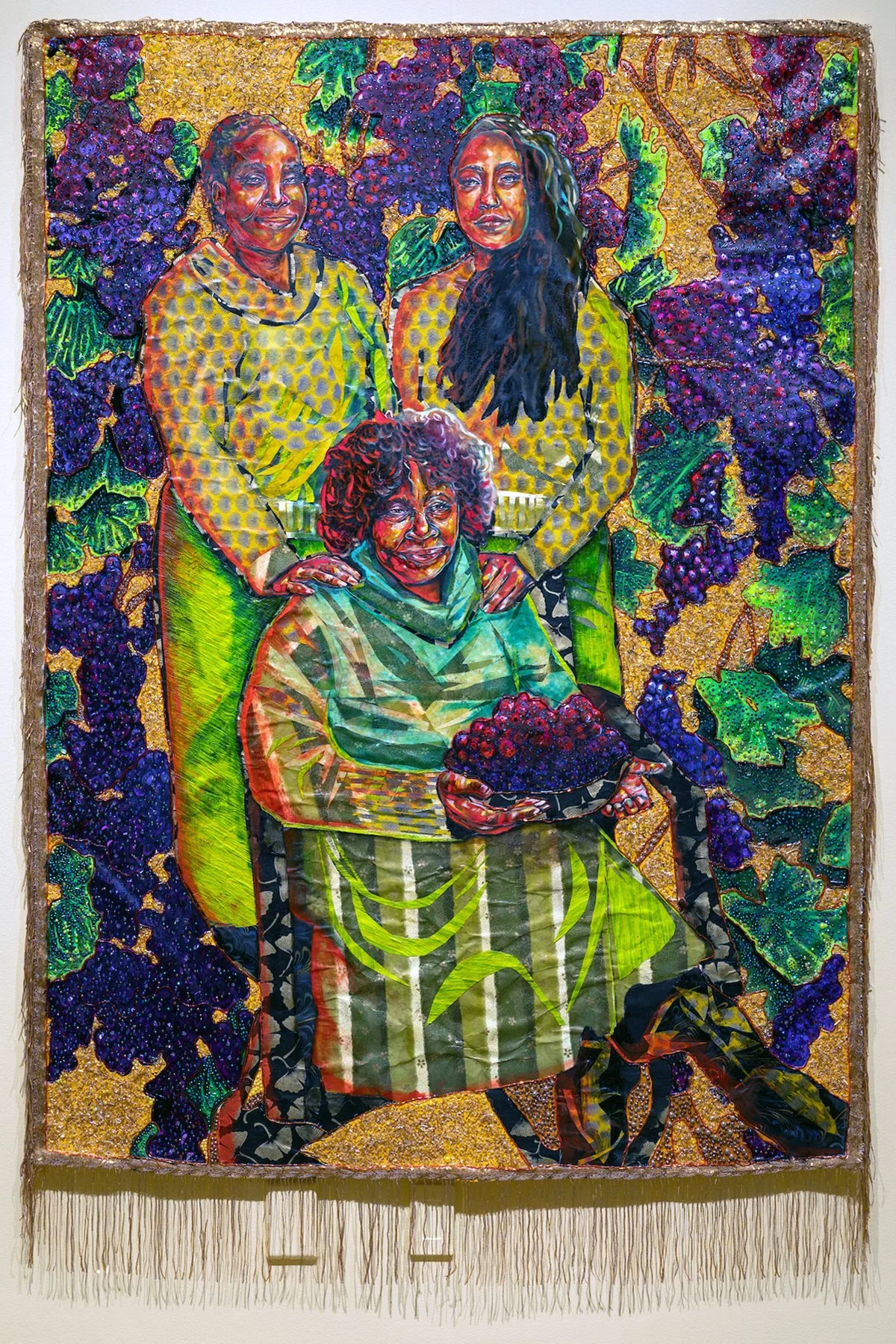
Jazz Holmes, Grapevine, 2025, oil paint, collage, rhinestones, and beads. Image courtesy of Denver Botanic Gardens.
In addition to rhinestones and paint, Holmes also incorporates collage into many of these pieces. Grapevine is a large-scale textile work featuring oil paint, collage, rhinestones, and beads, which depict three Black women—Holmes with her mother and grandmother—against a backdrop of grapevines. Here, the backdrop, grapes, and vines are beaded and bejeweled, and the artist portrays the women with paint and collage. This mixed-media approach brings texture, depth, brightness, and playfulness that enliven the tradition of portrait paintings.
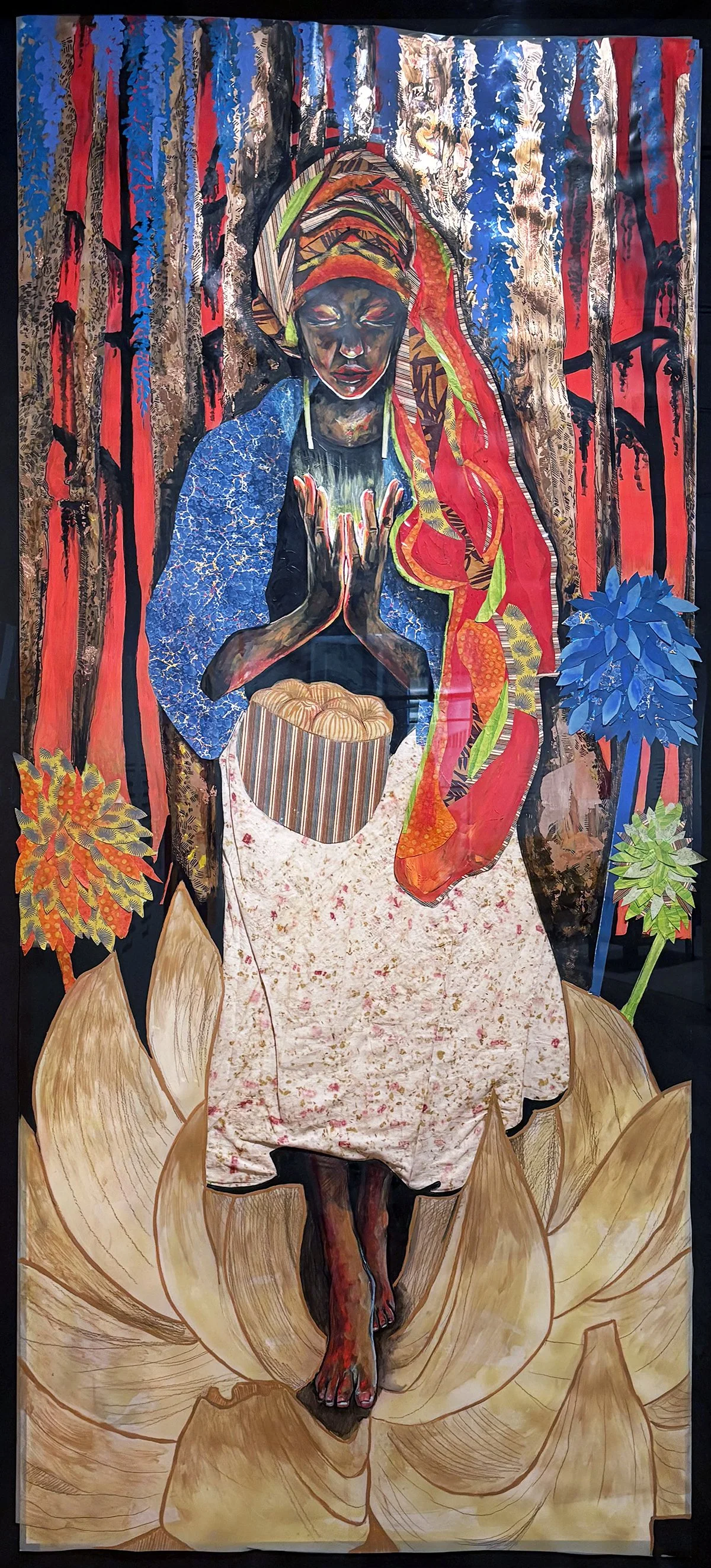
Jazz Holmes, Allium cepa, 2024, acrylic paint, collage, onion-dyed cotton, and copper leaf on Mylar. Image by Laura I. Miller.
Holmes introduces another element, copper leaf, in Allium cepa, which is the Latin term for the onion plant. The painting depicts a woman with a colorful headdress emerging from onion petals, a basket of onions on her lap and an aura of light emitting from her joined hands. The copper leaf embellishes what appear to be tree trunks in the background.
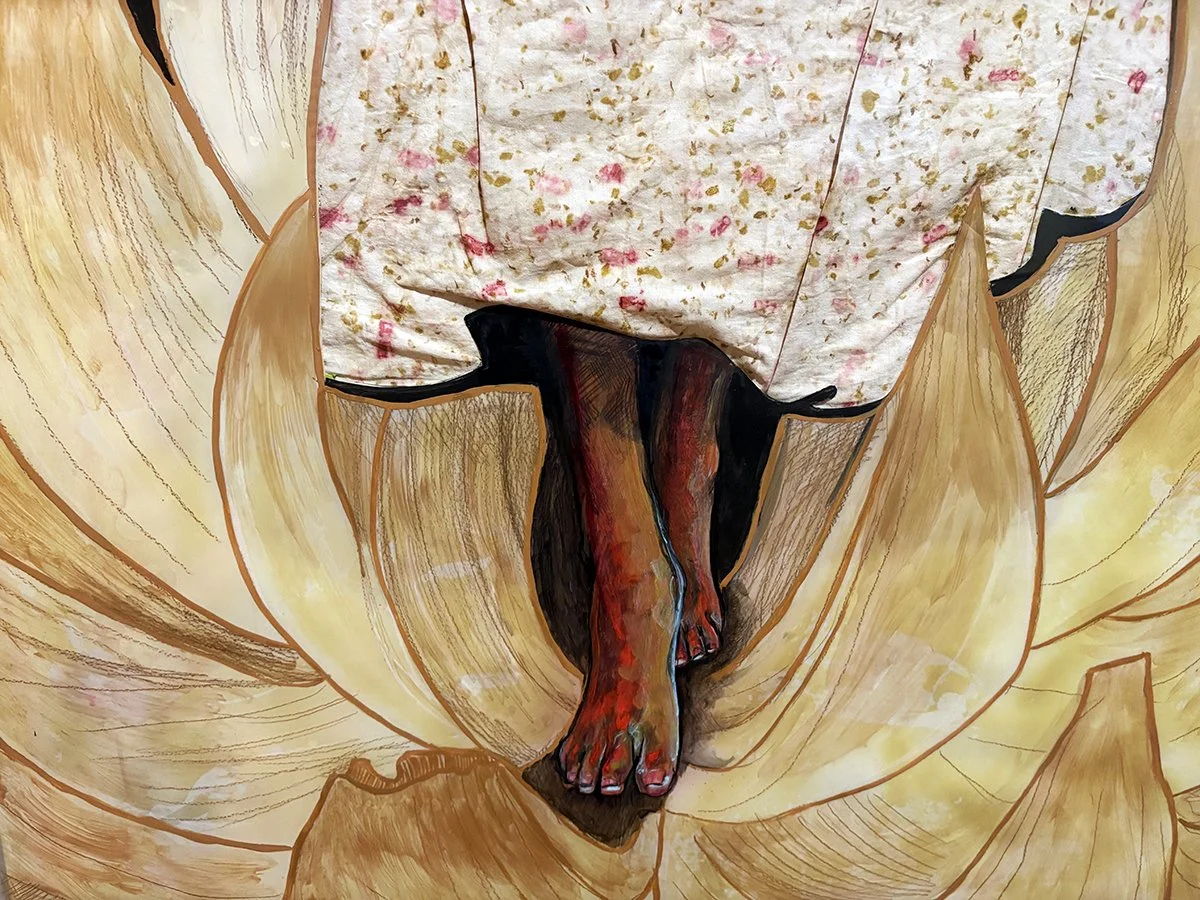
A detail view of Jazz Holme’s Allium cepa, 2024, acrylic paint, collage, onion-dyed cotton, and copper leaf on Mylar. Image by Laura I. Miller.
Again, the person’s clothing is represented by collage, as are the blossoms of the onion plant, creating depth and dimension. Of the painting, Holmes says: “When we lived in Louisiana, there was a bayou right by our home that glowed red in the sunrise. I was envisioning this goddess standing in the bayou on an onion in bloom, like a water lily, praying for a better onion crop and giving the onion harvest to all of us.”
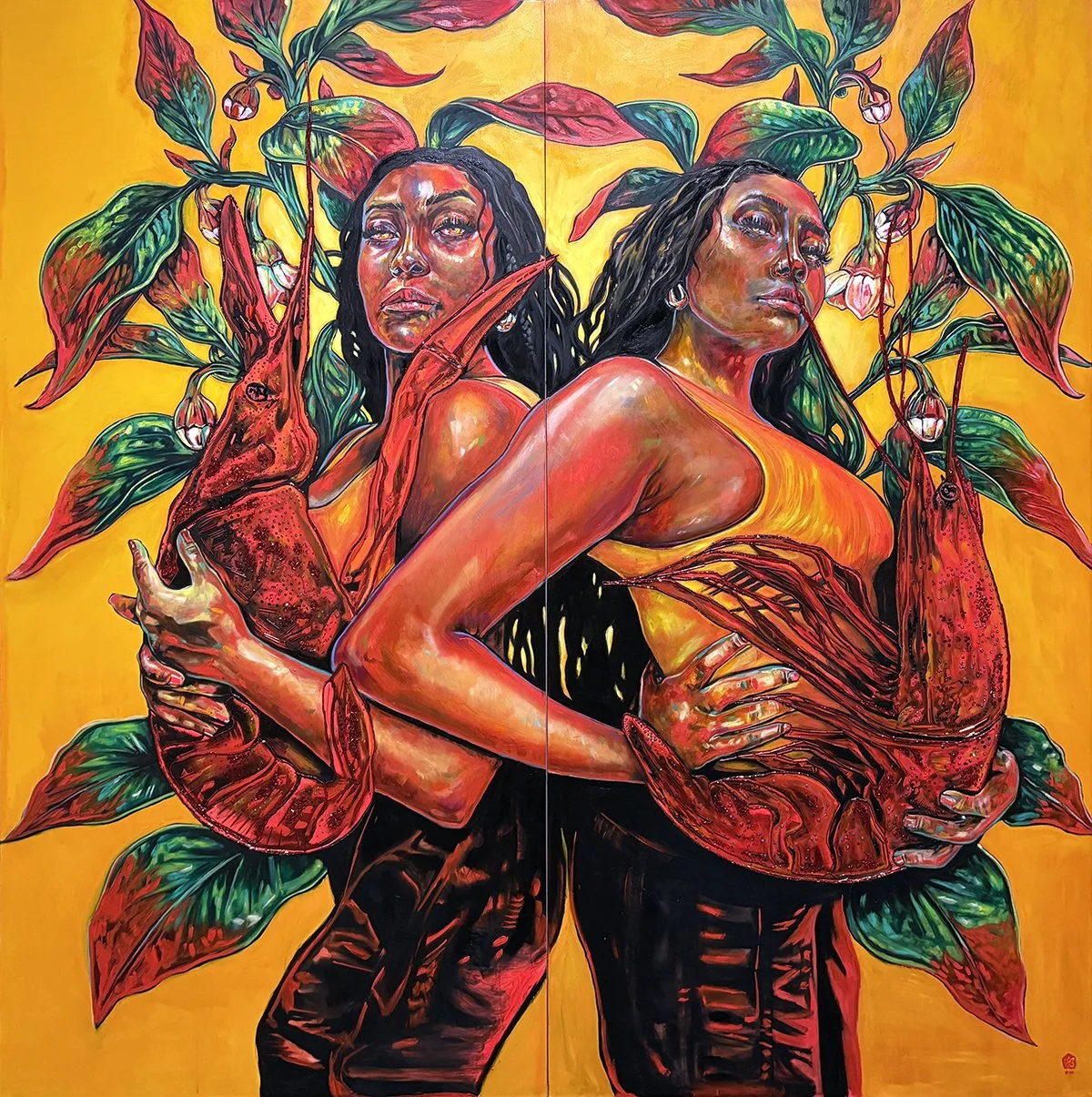
Jazz Holmes, Étouffée, 2025, oil paint and rhinestones. Image by Laura I. Miller.
For all their attention to the sacred, Holmes’ works are also extremely playful. Her self-portrait Étouffée shows Holmes’ figure doubled, each image of her cradling a crawfish against a backdrop of pepper plants. Red, orange, and yellow dominate the painting, with accents of green and black. The enlarged crawfish, which resemble human infants in their size and positioning, give off a surreal quality, while also poking fun at portraits of women and their offspring.
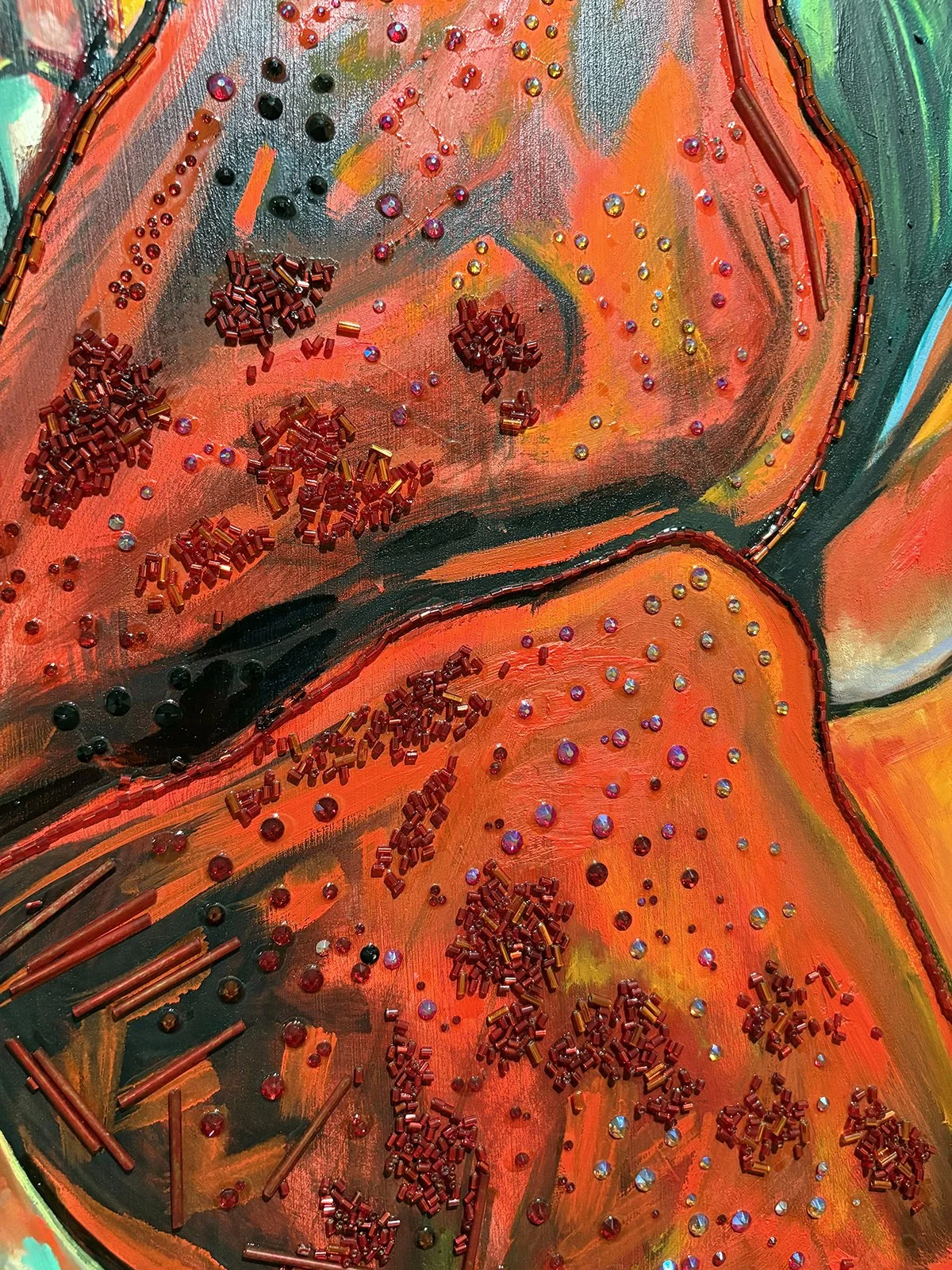
A detail view of Jazz Holme’s Étouffée, 2025, oil paint and rhinestones. Image by Laura I. Miller.
On the placard, a quote from Holmes tells the story of her family fighting over whether to use shrimp or crawfish in étouffée and says, “This work is meant to be a humorous self-portrait of me protecting my recipe, cradling my ingredients like they are my babies.”
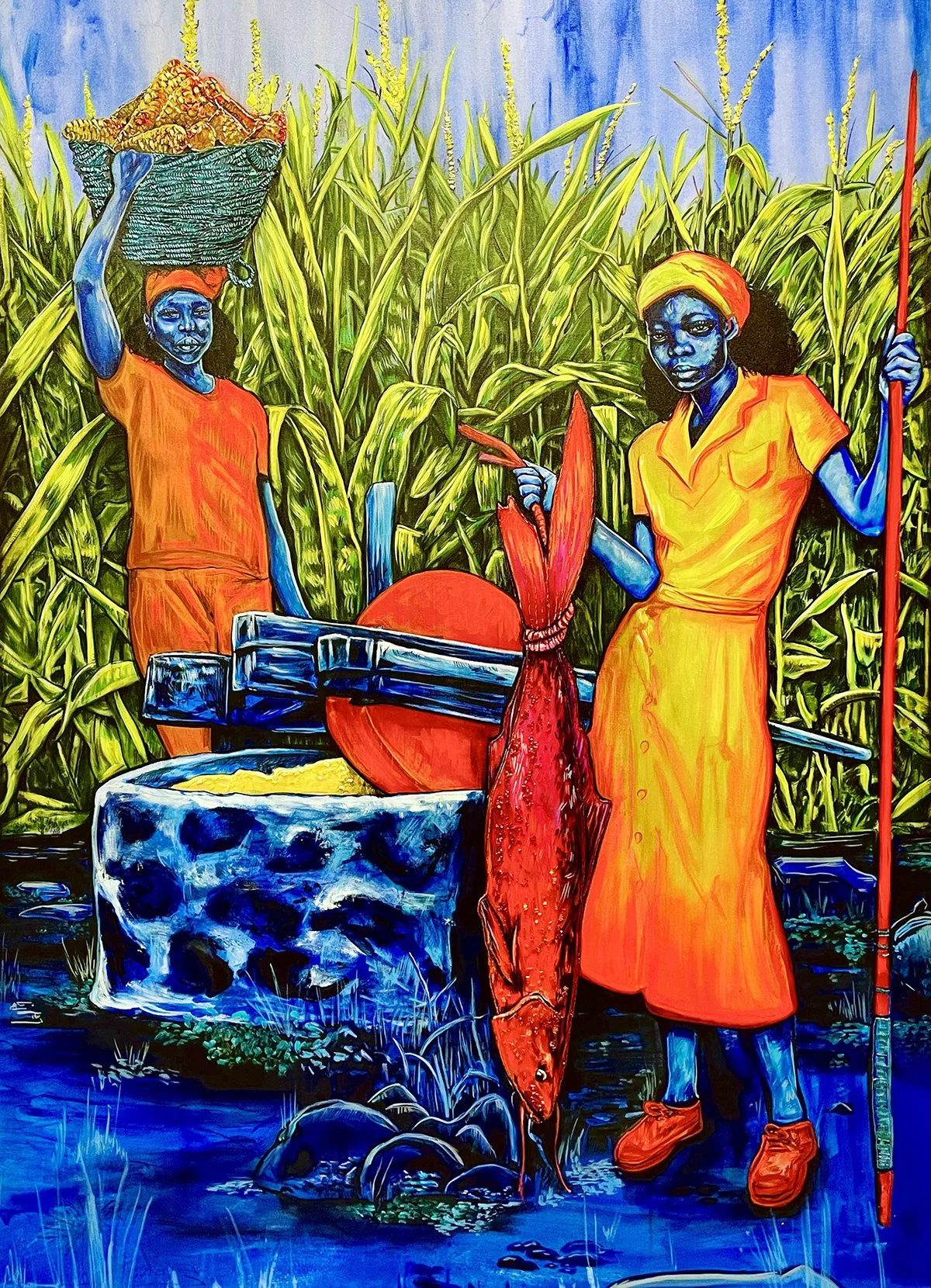
Jazz Holmes, Chattahoochee, 2023, acrylic paint and beads. Image courtesy of Denver Botanic Gardens.
Chattahoochee is one of the only paintings whose title comes from a river, not from the ingredients—corn and catfish—depicted. The work tells the story of Holmes and her great aunt, Louise, with whom she often picked and shucked corn. One day, as they were about to leave after fishing unsuccessfully, Louise snagged a giant catfish from the Chattahoochee River—a catch that would feed the family for a week.
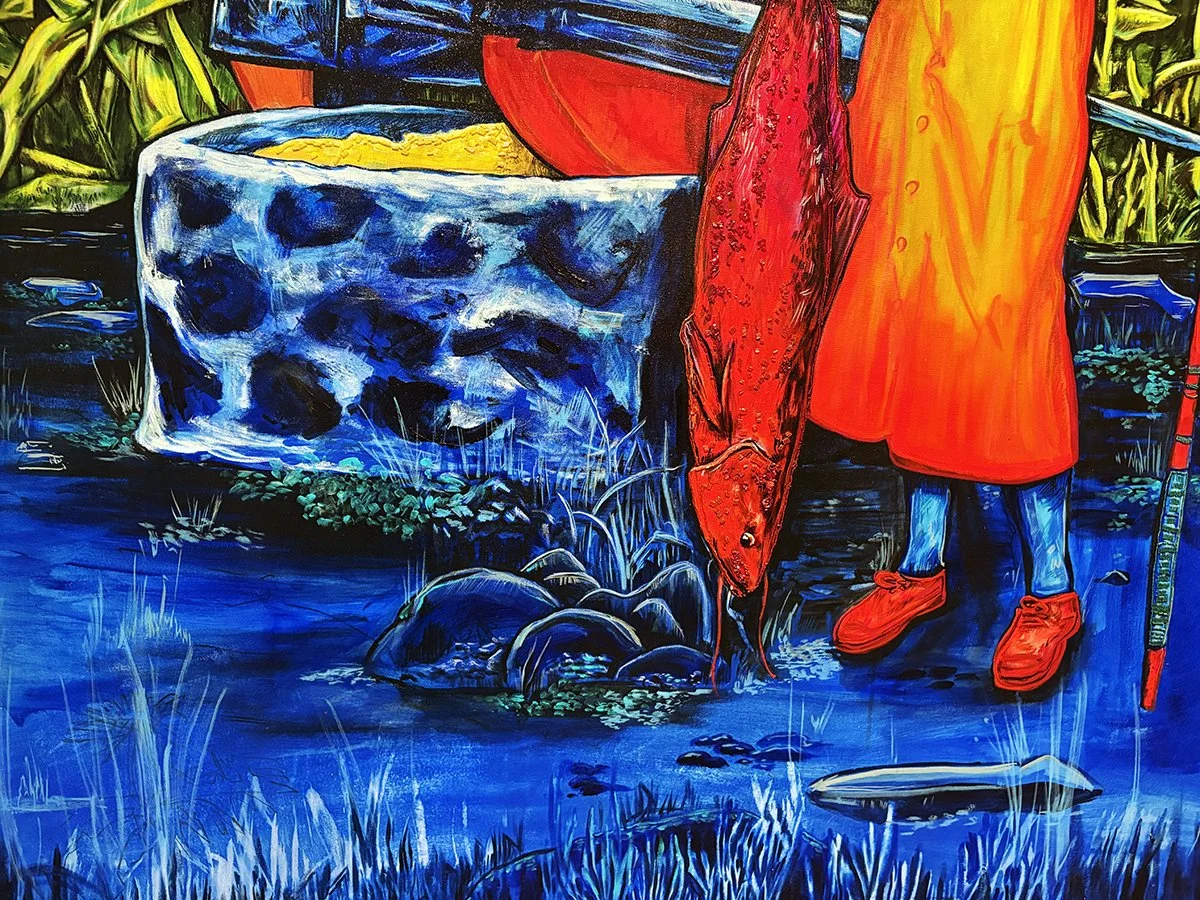
A detail view of Jazz Holmes’s Chattahoochee, 2023, acrylic paint and beads. Image by Laura I. Miller.
The deeply saturated blue of the river, the women’s skin, and the sky stand in contrast to the deep green of the corn stalks and the vibrant red of the catfish that Louise holds. Holmes’ use of color here evokes Pablo Picasso’s blue period, as well as Frida Kahlo’s surreal portraiture. This painting stands out as an example of Holmes’ uncanny abilities as a masterful artist and storyteller.
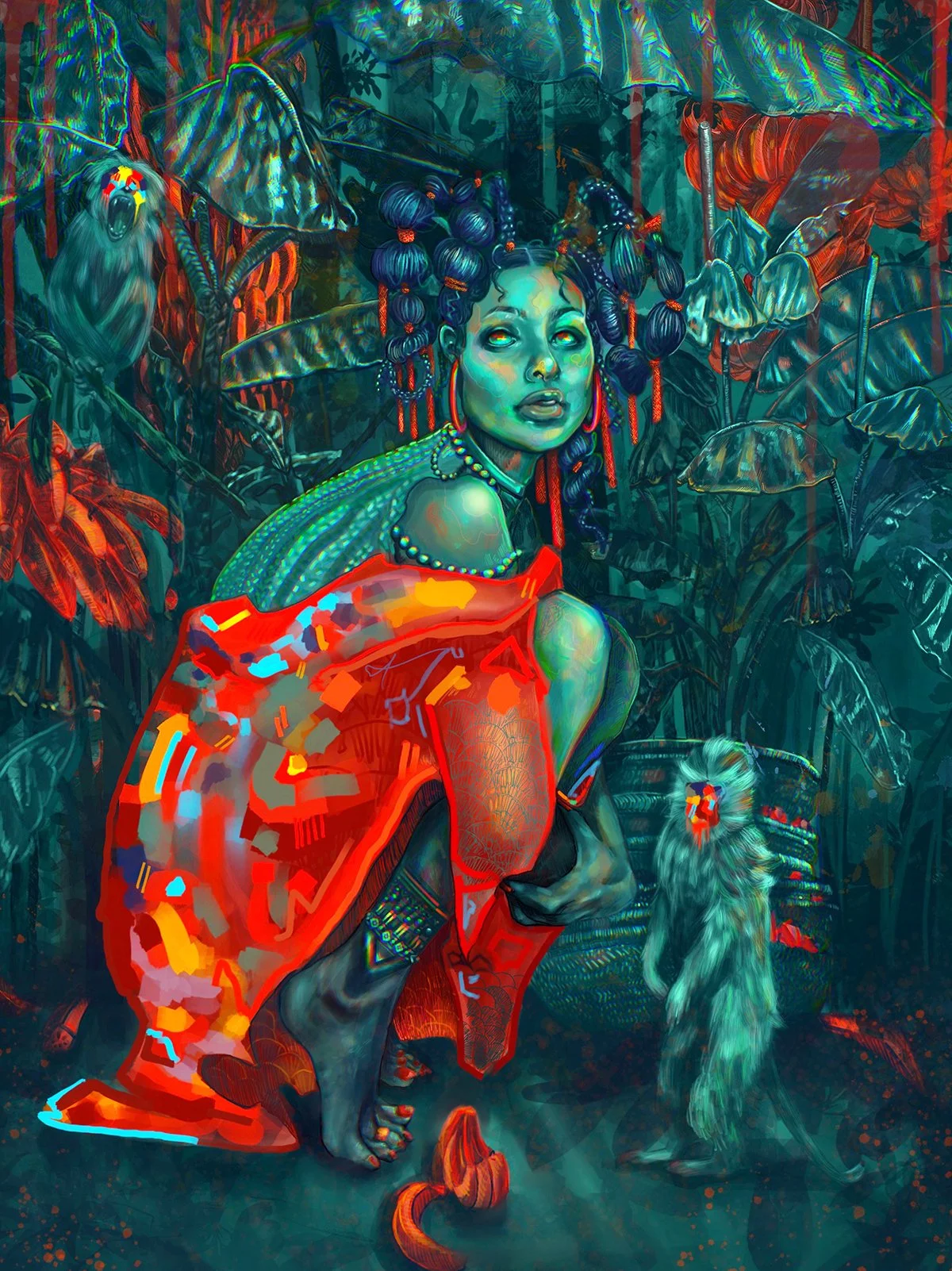
Jazz Holmes, Fufu, 2020, dye-sublimation print of digital painting. Image courtesy of Denver Botanic Gardens.
While the majority of these pieces use mixed media—primarily collage, beads and rhinestones, and gouache paint—two works stray from this tradition. Fufu and Okra, both of which are dye-sublimation prints of digital paintings, pay homage to Creole ingredients in one dimension. These relatively smaller works retain the otherworldly qualities and vibrant use of color of the larger works, but without the addition of beads, rhinestones, or collage.
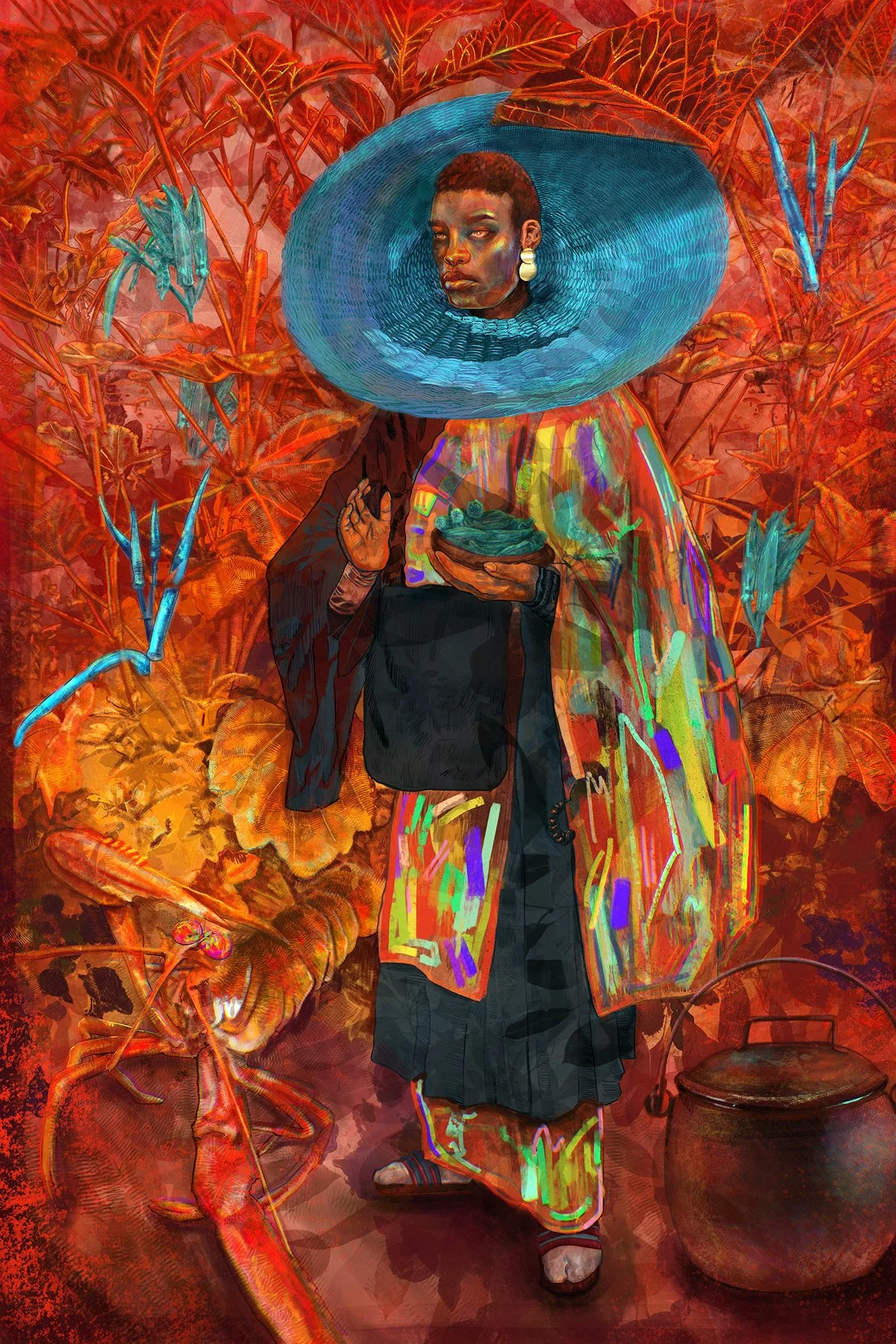
Jazz Holmes, Okra, 2021, dye-sublimation print of digital painting. Image courtesy of Denver Botanic Gardens.
As one of the earliest works on display (from 2021), Okra perhaps represents a seed or a sketch that led to Holmes’ later, large-scale pieces. She says of the work: “I had a dream of an ancestor offering okra to my family. Following him was a langoustine, a small lobster-like shellfish that we use along with okra in our recipe for gumbo. In the painting, I decided to include the langoustine and my grandmother’s gumbo pot.”
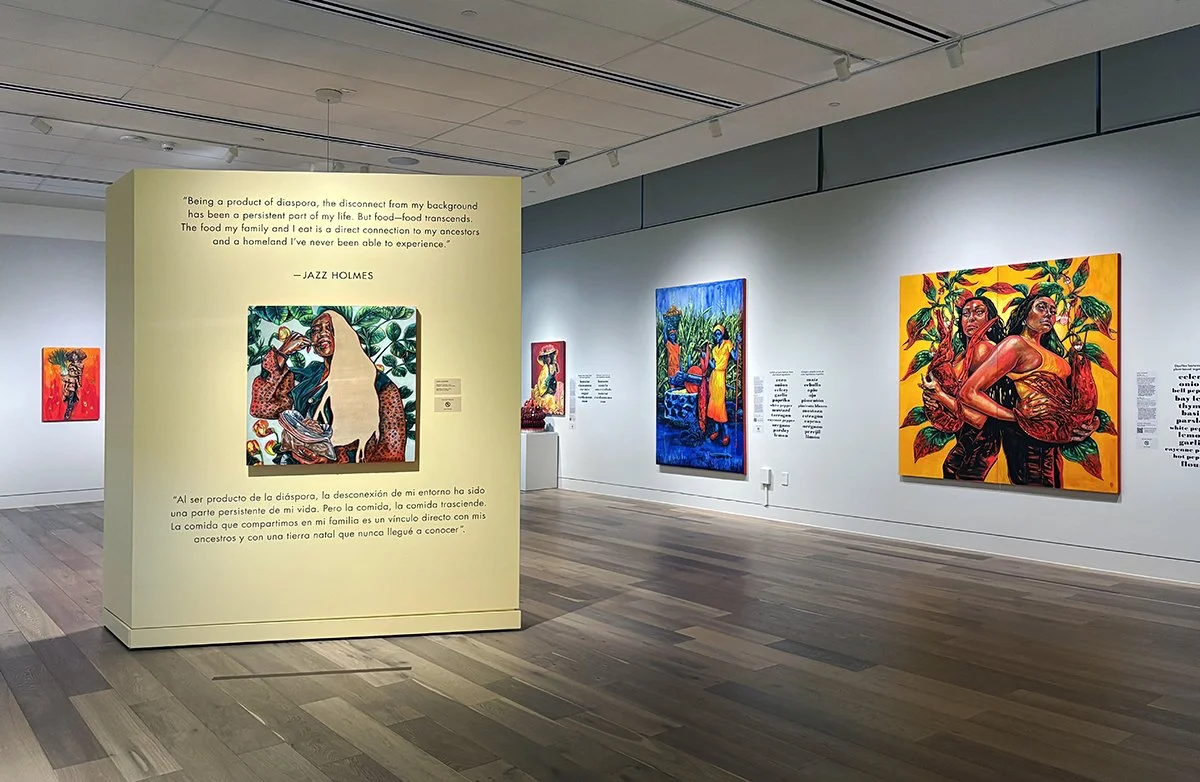
An installation view of Jazz Holmes’ exhibition Nourished at Denver Botanic Gardens’ Freyer–Newman Center gallery. Image by Laura I. Miller.
So many of the paintings tie Holmes’ interior—her subconscious, her lineage, her spirit—with the external world of family, place, nature, and animals. As you enter the exhibition, in the middle of the space stands a self-portrait of Holmes with a quote above that reflects this sentiment: “Being a product of diaspora, the disconnect from my background has been a persistent part of my life,” Holmes writes. “But food—food transcends. The food my family and I eat is a direct connection to my ancestors and a homeland I’ve never been able to experience.”
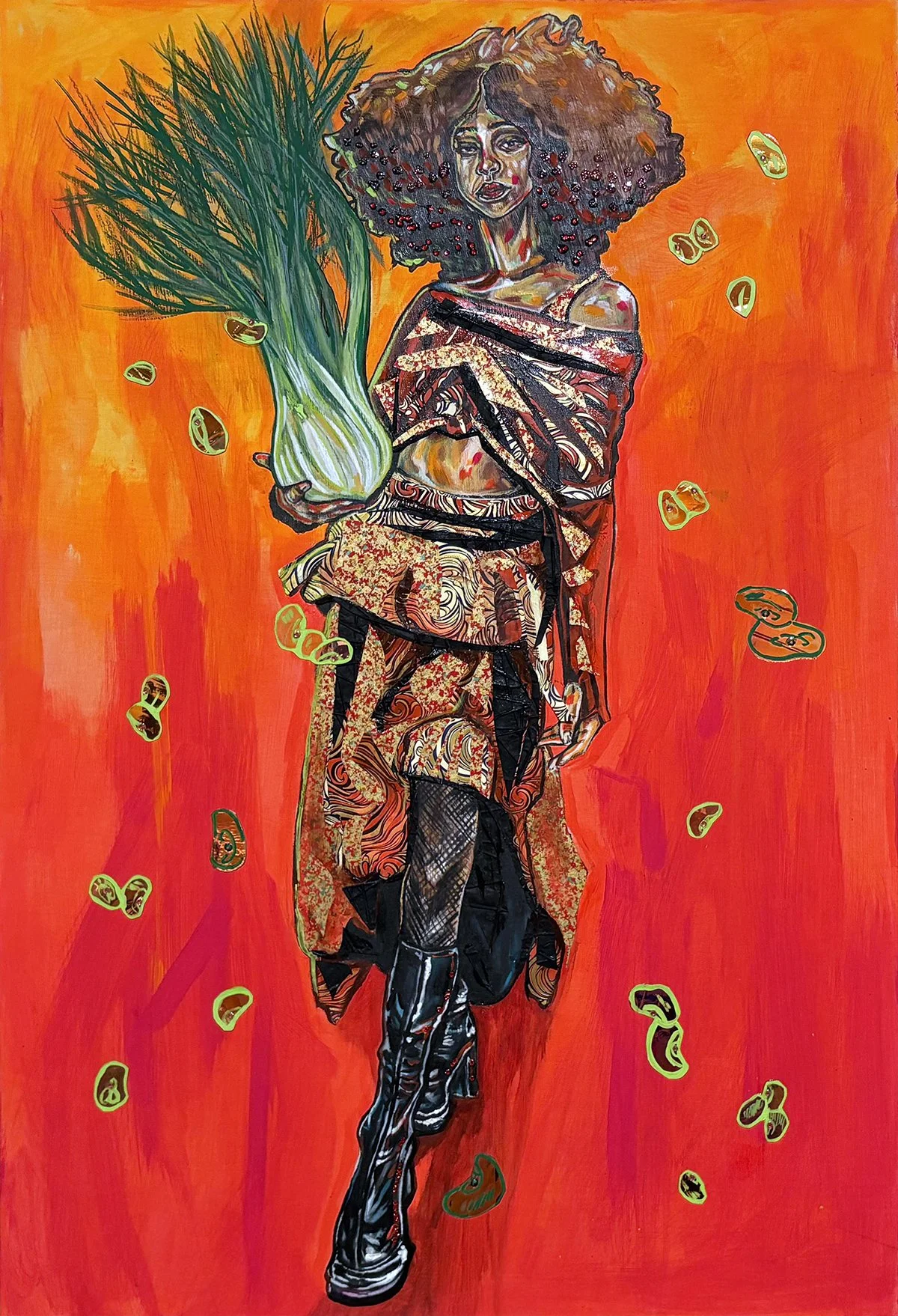
Jazz Holmes, Hoppin’ John, 2025, acrylic paint, collage, acetate, and rhinestones. Image by Laura I. Miller.
The exhibition runs from September 27, 2025, to March 22, 2026—a time of the year marked by cold and hibernation in Colorado. Yet I can’t imagine an exhibition with more warmth and spirit. Now is the perfect time to view these paintings and let them settle into your bones, bringing nourishment from the outside in.
Laura I. Miller (she/her) is a Denver-based writer and editor. Her articles, reviews, and short stories appear widely. She received an MFA in creative writing from the University of Arizona.