
Second Body
Jodi Stuart: Second Body
Galleri Gallery, Meow Wolf Denver, Convergence Station
1338 1st Street, Denver, CO 80204
March 17–June 15, 2026
Admission: $39-$52
Review by Raymundo Muñoz
Plastics are a pervasive part of our lives and the world we live in. While their many forms and characteristics provide us with a staggering amount of (often cheap) uses, their long-lasting pollution in landfills, our lived environments, and our own bodies have proven insidious and inescapable. In her solo exhibition Second Body—currently on view at Meow Wolf’s Galleri Gallery—New Zealand native and Denver-based artist Jodi Stuart draws inspiration from our complicated and expansive relationship with plastics, creating works that are not meant to solve the plastics problem necessarily, but rather give new life, forms, and purpose through upcycling and artmaking.
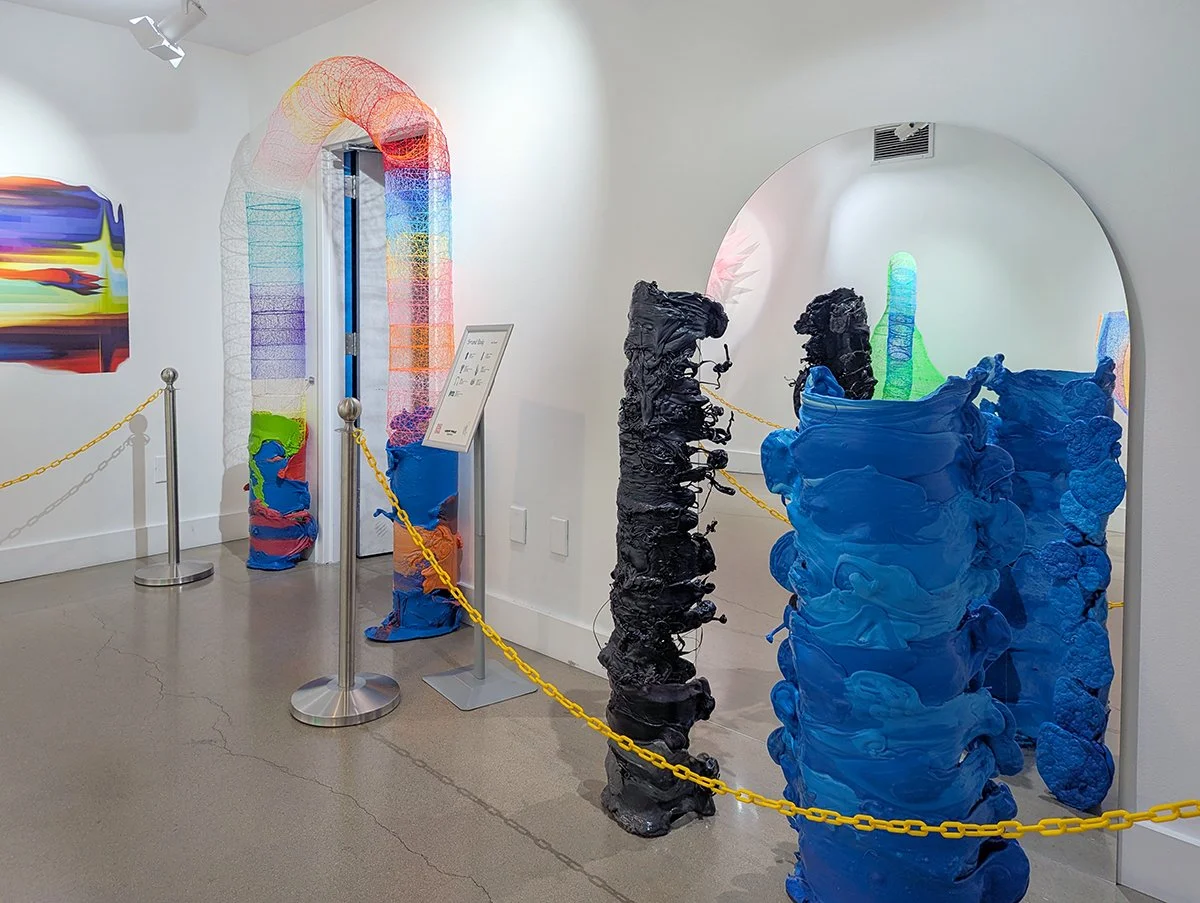
An installation view of works in Jodi Stuart’s Second Body exhibition in Meow Wolf’s Galleri Gallery at Convergence Station in Denver. Works on the opposite side of the gallery can be partially seen in the mirror behind Stuart’s Primitive works. Image by Raymundo Muñoz.
Galleri Gallery is tucked away in the vast, imaginative, and overwhelming art-based theme park that is Meow Wolf’s Convergence Station. Compared to the hyper-stimulating fantasy world that operates within the institution’s walls, Galleri Gallery is a portal to the outside world, offering small but mighty exhibitions that celebrate the works of contemporary artists, some of whom are previous collaborators.
Stuart, for instance, worked with fellow Denver-based artist Libby Barbee to produce the Exo-Terrarium installation (next door to Galleri Gallery)—a fictional lab where art, science, and spiritualism coexist. Her work in Second Body, however, reflects her current practice (outside of Meow Wolf), a large part of which she developed during her Breck Create artist residency in Breckenridge, Colorado.
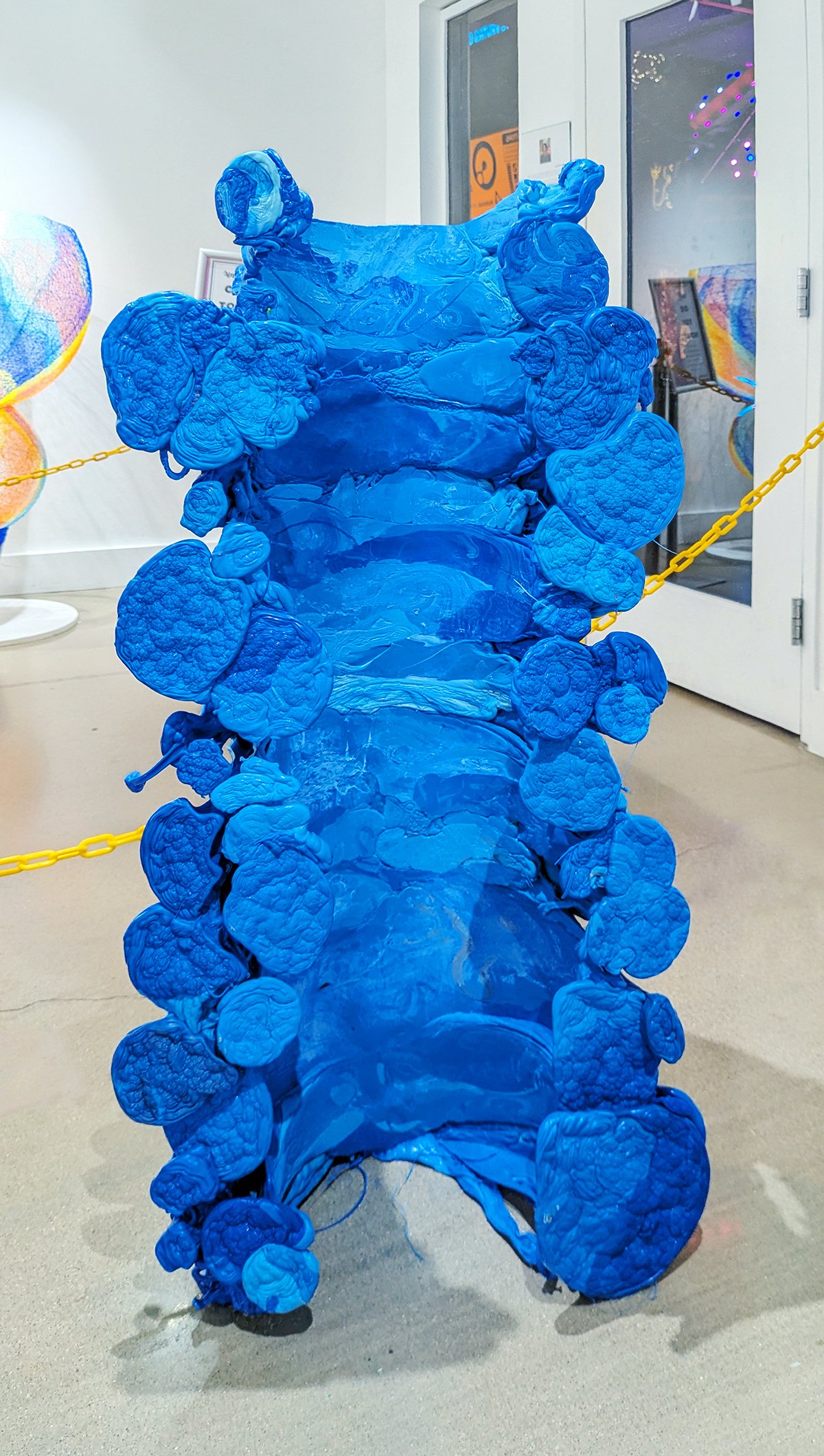
A backside view of Jodi Stuart’s Primitive #4 (Blue), recycled plastic, 13 x 63 x 12 inches. Note the textured puddles and ribbons formed through the layering of melted plastic. Image by Raymundo Muñoz.
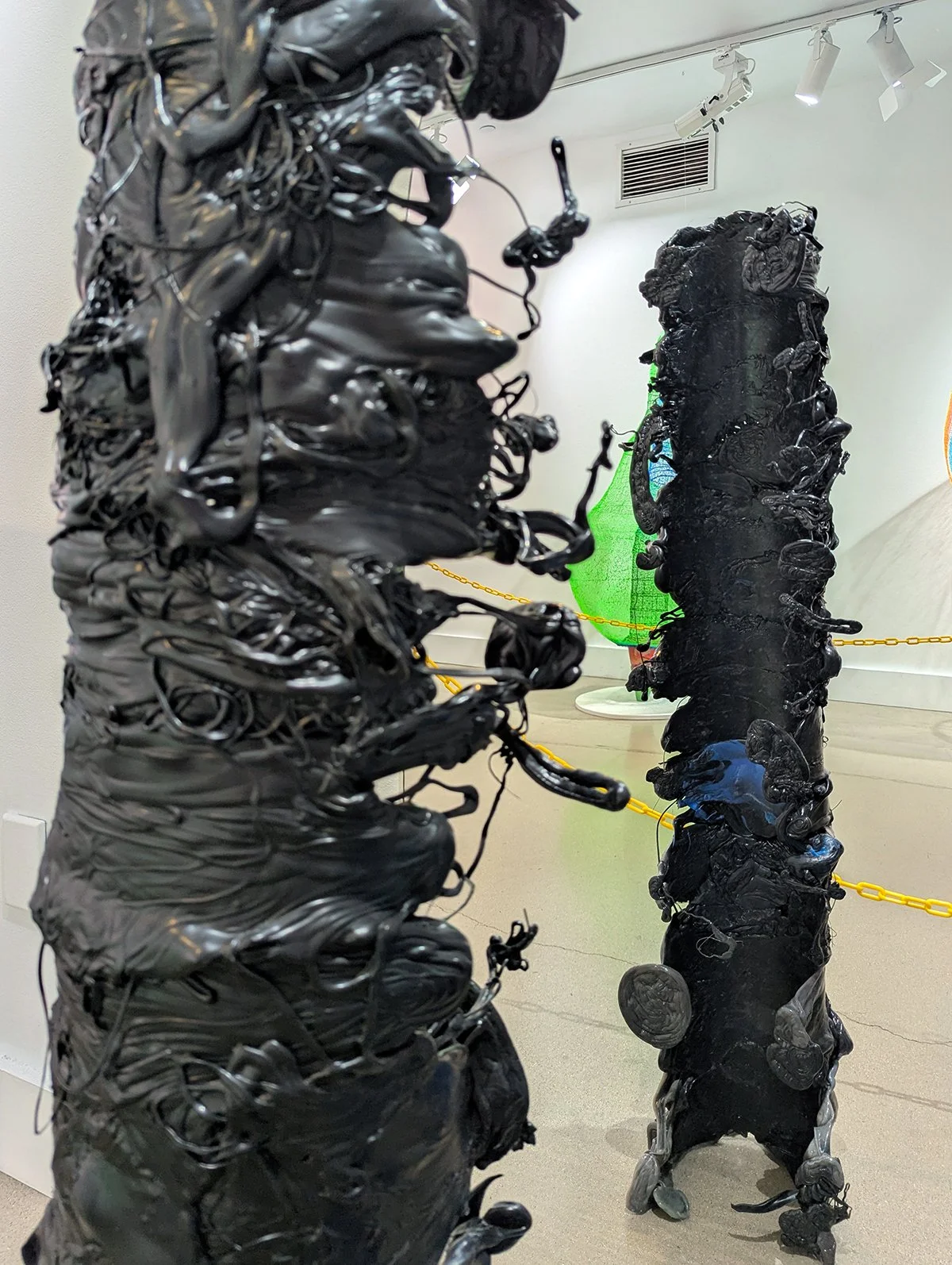
Jodi Stuart, Primitive #5 (Black), recycled plastic, 12 x 60 x 12 inches. This backside view through a mirror reveals the smooth inner surface which contrasts with the highly textured outer surface. Image by Raymundo Muñoz.
As part of Breck Create’s Precious Plastics initiative, Stuart spent four months last year experimenting in a “micro-recycling plant,” working with a large extruder to melt cleaned and shredded recycled #2 plastic (a.k.a. high-density polyethylene, or HDPE) into various new forms using a variety of molds. In her works Primitive #4 (Blue) and Primitive #5 (Black), for instance, Stuart poured ribbons and sheets of hot, liquefied plastic over metal-covered, concrete-form tubes. Once cooled and set, the results are heavy, human-sized sculptures that resemble caterpillars with strange inner and outer features that appear viscous, random, and taffy-like.
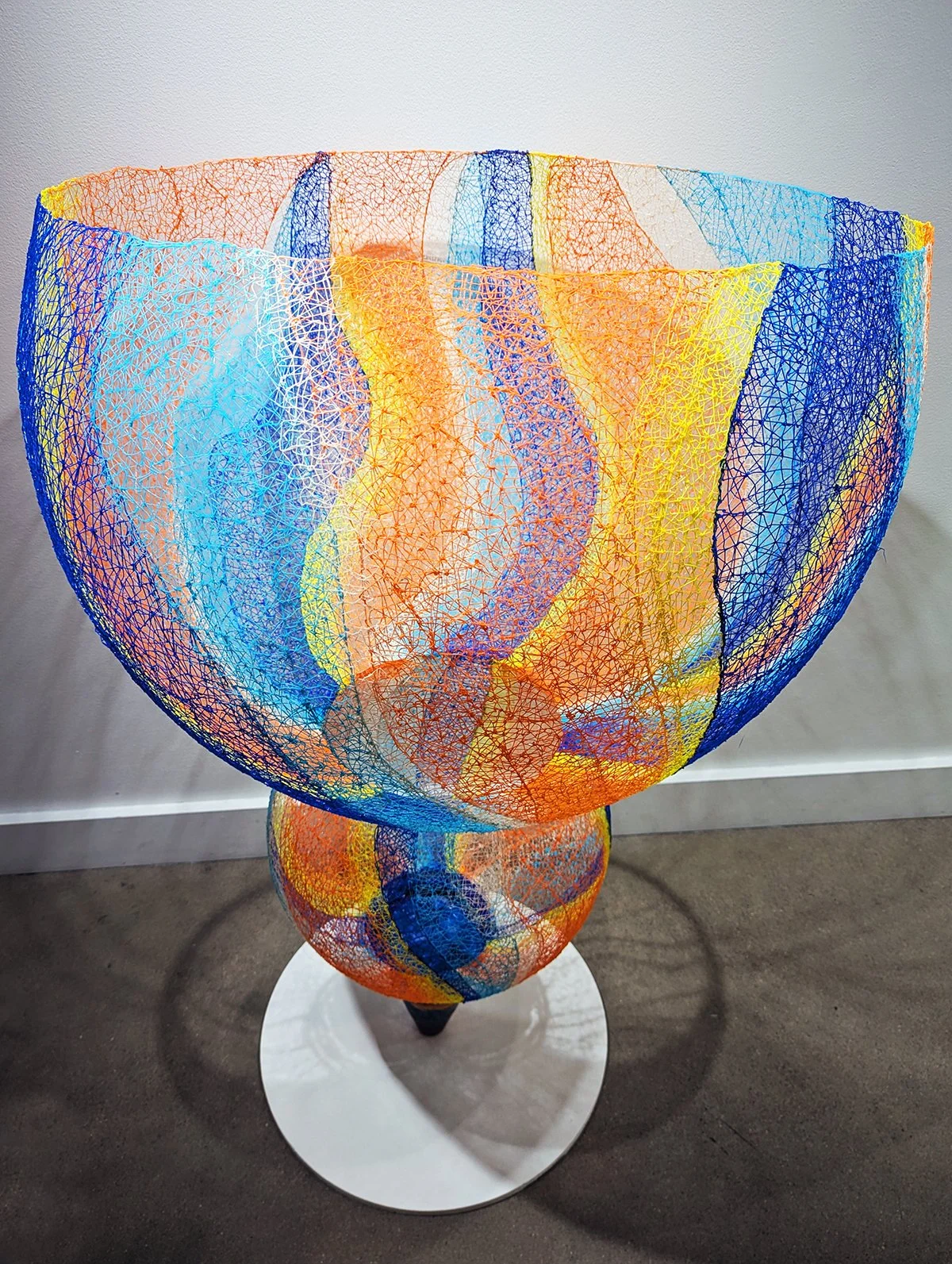
Jodi Stuart, Spectre #6, 3-D pen-formed PLA plastic and recycled plastic, 32 x 58 x 32 inches. Stuart made the top two round sections using a 3-D pen, while she produced the conical base by melting layers of recycled plastic into a metal cone mold. Image by Raymundo Muñoz.
In her Spectre series, Stuart experimented with filling conical molds with colorful layers of melted plastics to form solid, parfait-like bases for the large, yet lightweight sculptures. Essentially, this newly developed method is another version—albeit much larger and more imprecise—of the 3-D pen-formed, PLA plastic works for which she is already known.
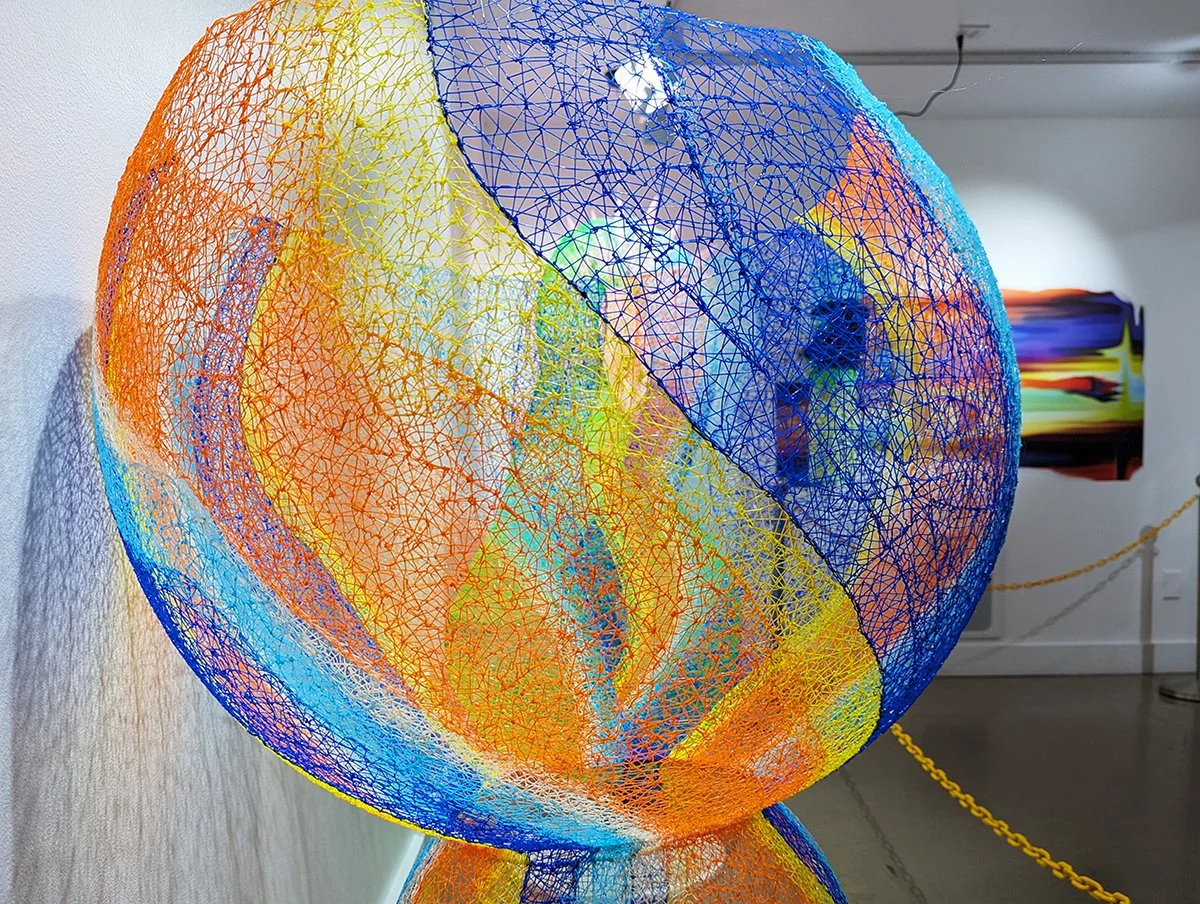
A detail of view Jodi Stuart’s Spectre #6, 3-D pen-formed PLA plastic and recycled plastic, 32 x 58 x 32 inches. Stuart created the round and hollow form using an inflatable exercise ball as a mold. Image by Raymundo Muñoz.
Stuart’s intense 3-D pen process is a marvel in patience, ingenuity, and planning. Using colored PLA plastics (polylactic acid plastics, by the way, are biodegradable) and a variety of molds (e.g. concrete-form tubes, exercise balls, piping tips, etc.), the artist slowly draws a detailed and chaotic web of fine lines that add up to light, yet durable, sheets that she later joins to create a variety of complex, three-dimensional shapes.
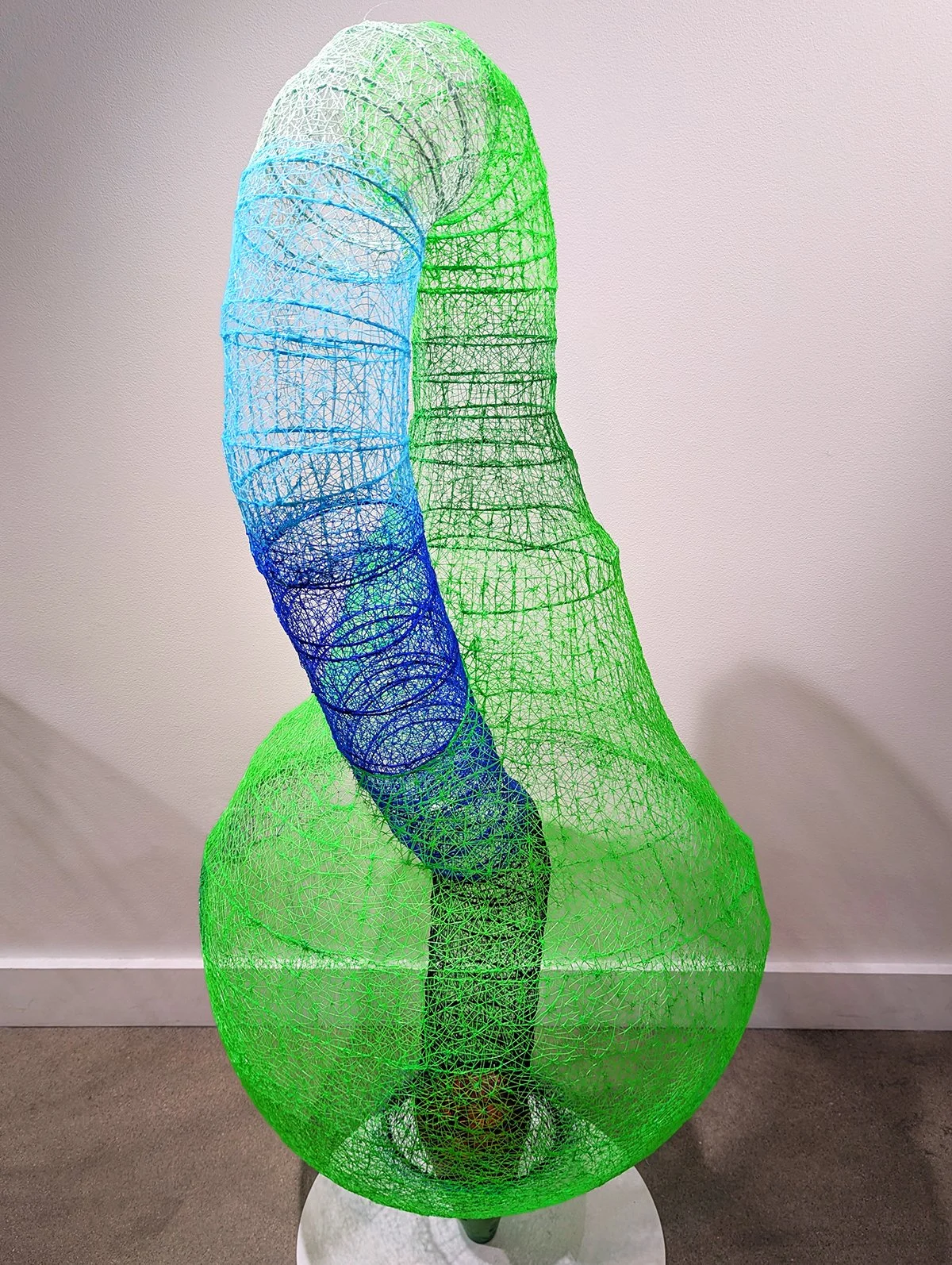
Jodi Stuart, Spectre #7, 3-D pen-formed PLA plastic and recycled plastic, 32 x 60 x 32 inches. Image by Raymundo Muñoz.
In Spectre #7, for instance, the artist finds inspiration in mathematics, creating her own version of a Klein bottle—a surface that, mathematically speaking, has no distinct inside or outside.
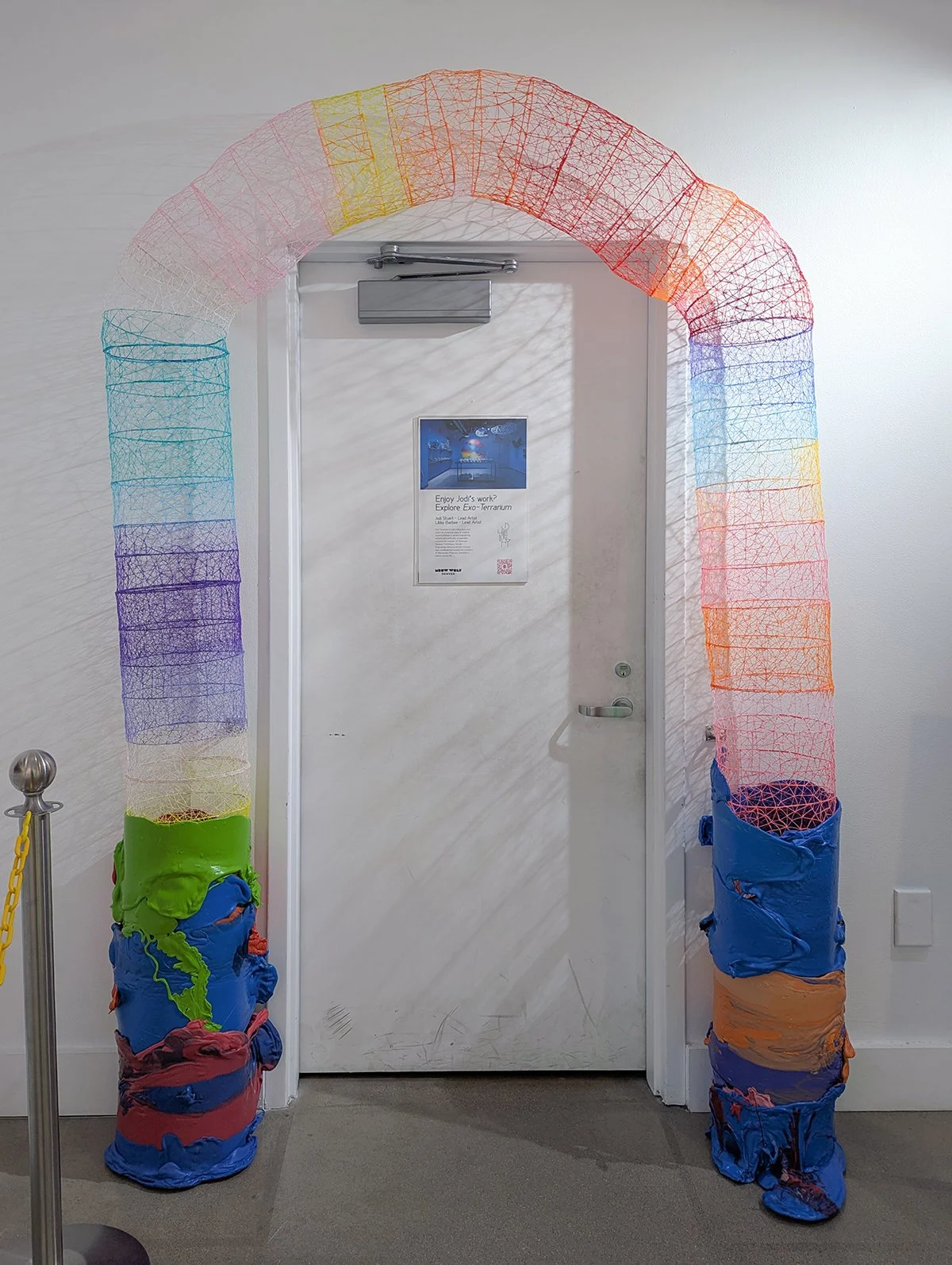
Jodi Stuart, Archway, 3-D pen-formed PLA plastic and recycled plastic, 36 x 80 x 12 inches. Image by Raymundo Muñoz.
Or consider Stuart’s Archway, a rainbow of a piece that outlines the doorway to her neighboring collaborative installation. Similarly, the swirling psychedelic patterns of the globular Spectre #6 may appear to be painted, but the artist created each band of color individually using colored PLA plastics.
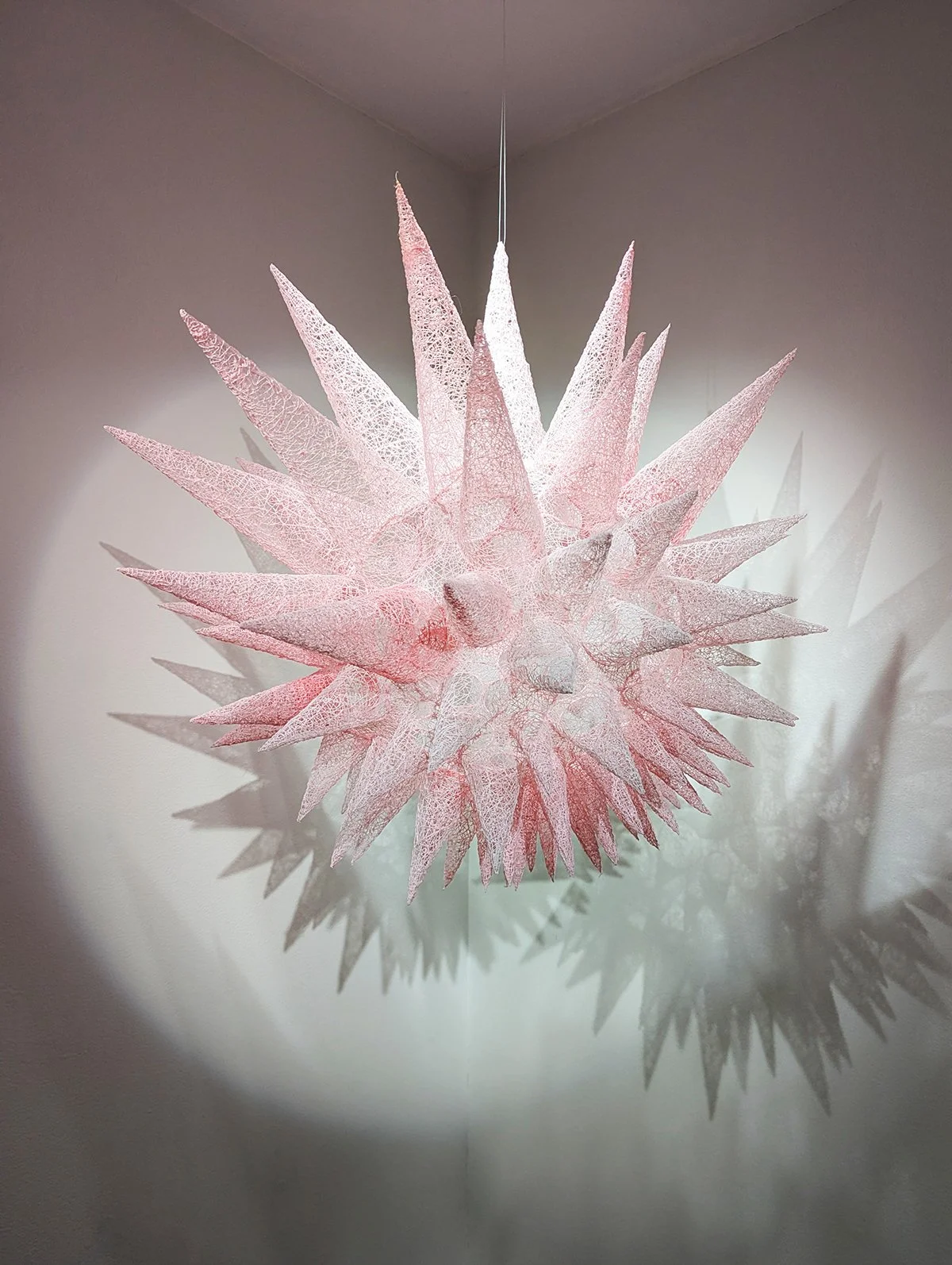
Jodi Stuart, Super Wicked, 3-D pen-formed PLA plastic and pigment, 48 x 48 x 60 inches. Image by Raymundo Muñoz.
In general, Stuart’s 3-D penned pieces have the interesting visual effect of having both intense color saturation and being partially transparent. Shining light through this type of work casts detailed and lacey shadows that are further enhanced by movement and multiple light sources. From its sea urchin-like shape alone, Super Wicked, in particular, yields an incredible array of spiky shadows. Additionally, Stuart hangs the work from a rotating disco ball motor, which not only reveals the complex dimensionality of the hot pink-colored sculpture but also produces an explosion of shadowplay. It gives viewers a creepy sense of a moving multitude.
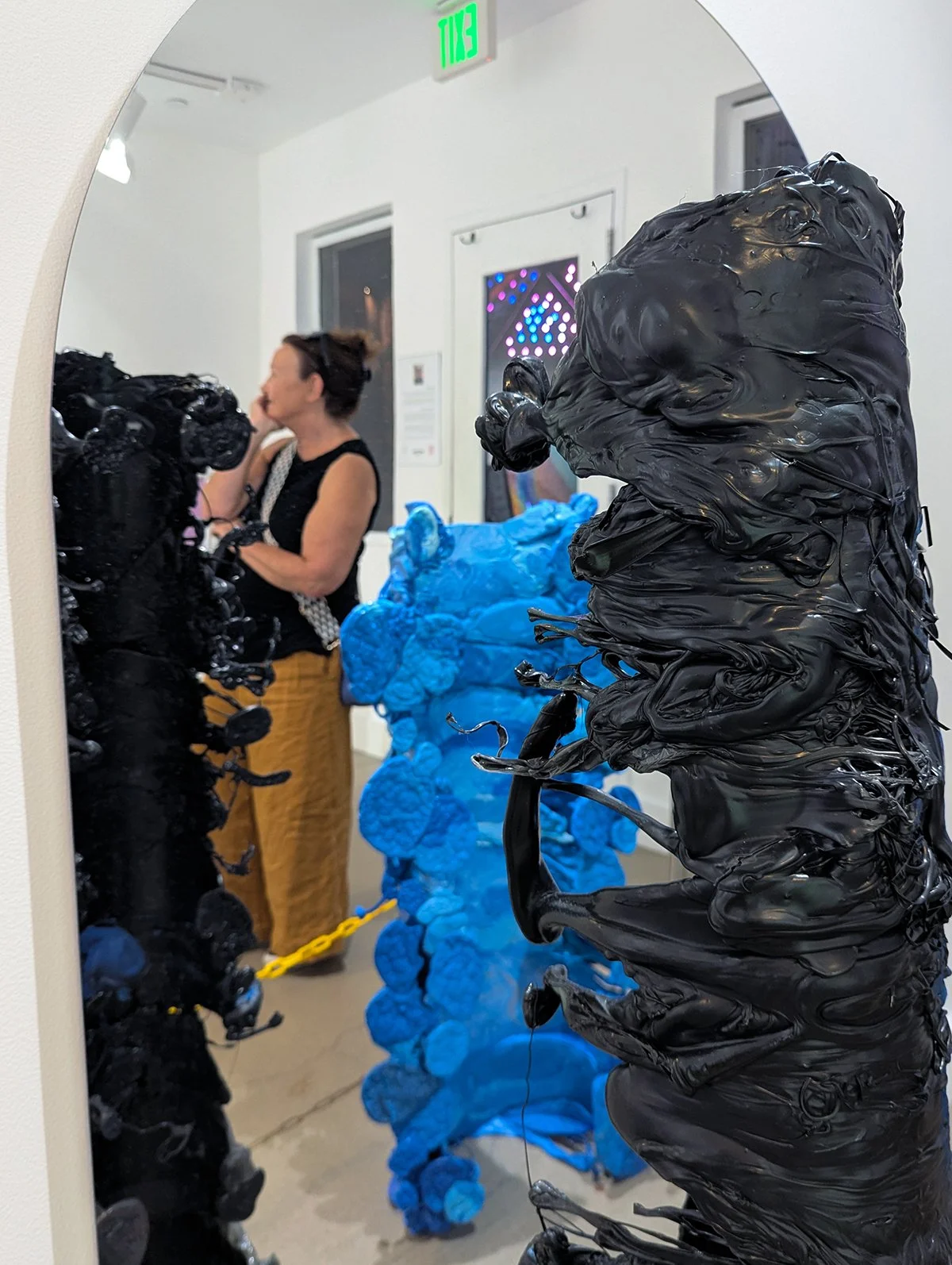
A view of the artist Jodi Stuart musing through a mirror alongside her works Primitive #4 and Primitive #5. Image by Raymundo Muñoz.
That uneasy feeling of being crowded and surrounded by beautiful yet threatening forms is underscored by the gallery’s decision to install Stuart’s human-sized pieces around the perimeter of the space. A large mirror on one side multiplies this crowd effect even more, supporting the exhibition’s theme of plastic’s pervasiveness.
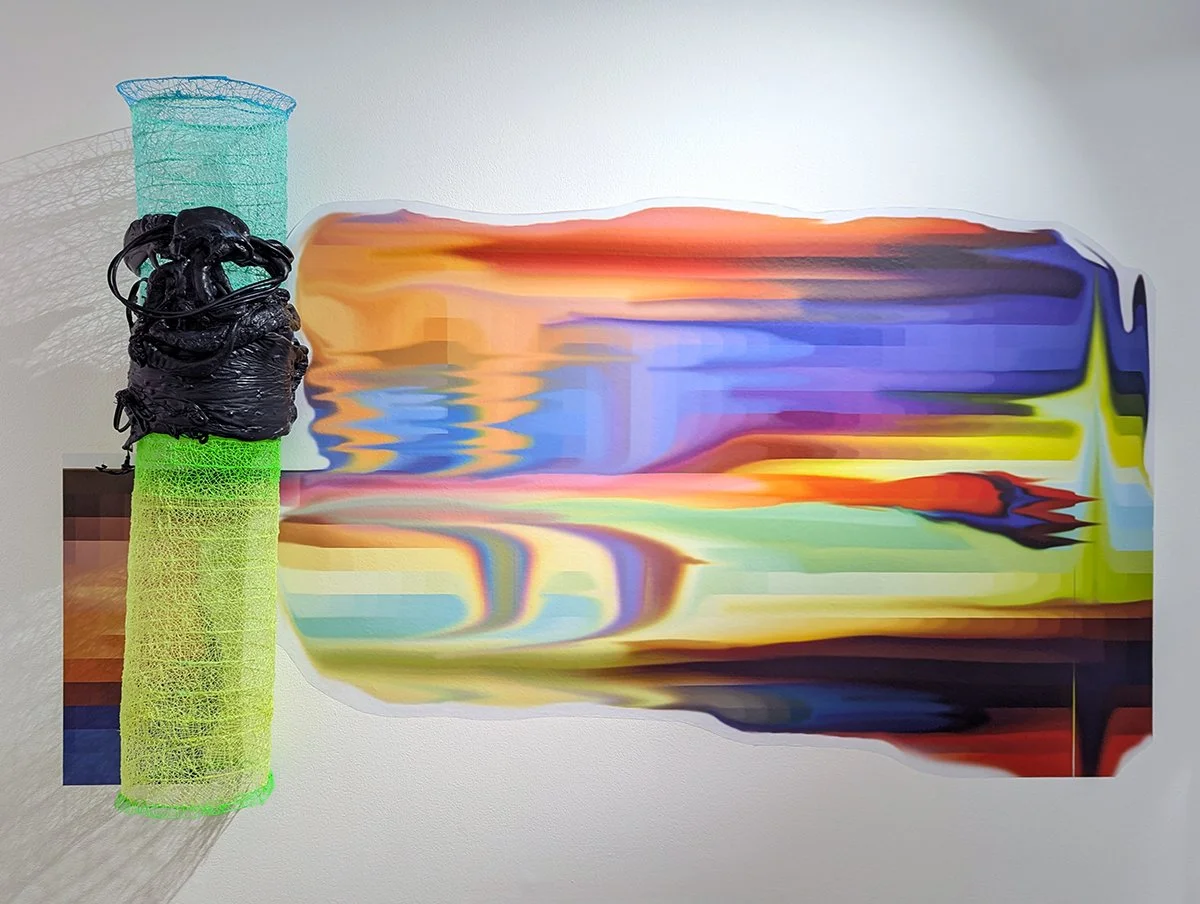
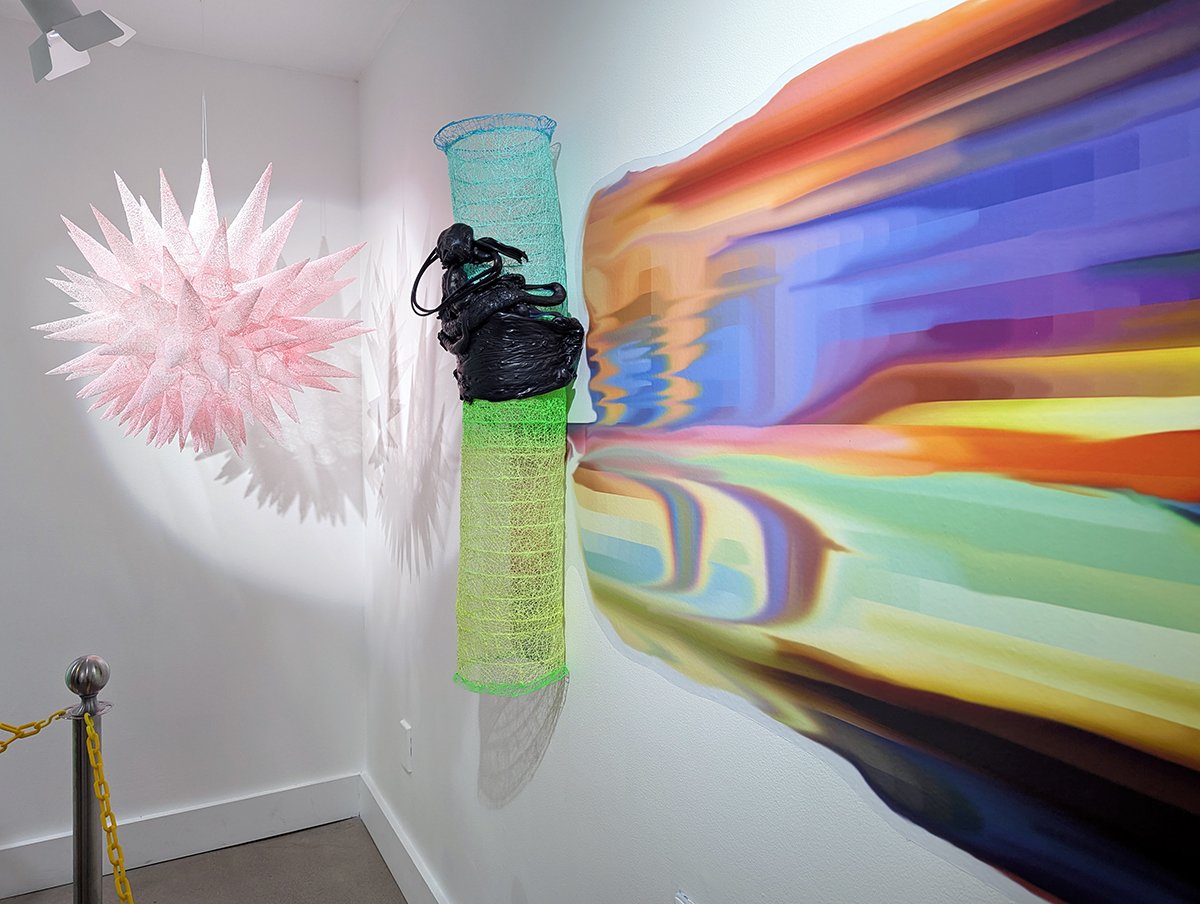
Jodi Stuart, Protraction #2, 3-D pen-formed PLA plastic, recycled plastic, and adhesive vinyl. 60 x 72 x 15 inches. Image by Raymundo Muñoz.
Adding to the crowd, Stuart’s Protraction #2 is an amalgamation of pieces and methods, combining 3-D sculptural elements with 2-D printed adhesive vinyl. Stuart created the 2-D vinyl section’s blurred image using bands of color distortions (or “glitches”) from New Zealand weather satellite images, which she montaged and manipulated further using Adobe Photoshop. It is a clash of geometric, biomorphic, and digital forms that begins to tie together many of the dichotomies in Stuart’s work: natural and artificial, light and dark, digital and analog, crafty and high-tech, sweet and toxic, fun and menacing, and waste and consumption.
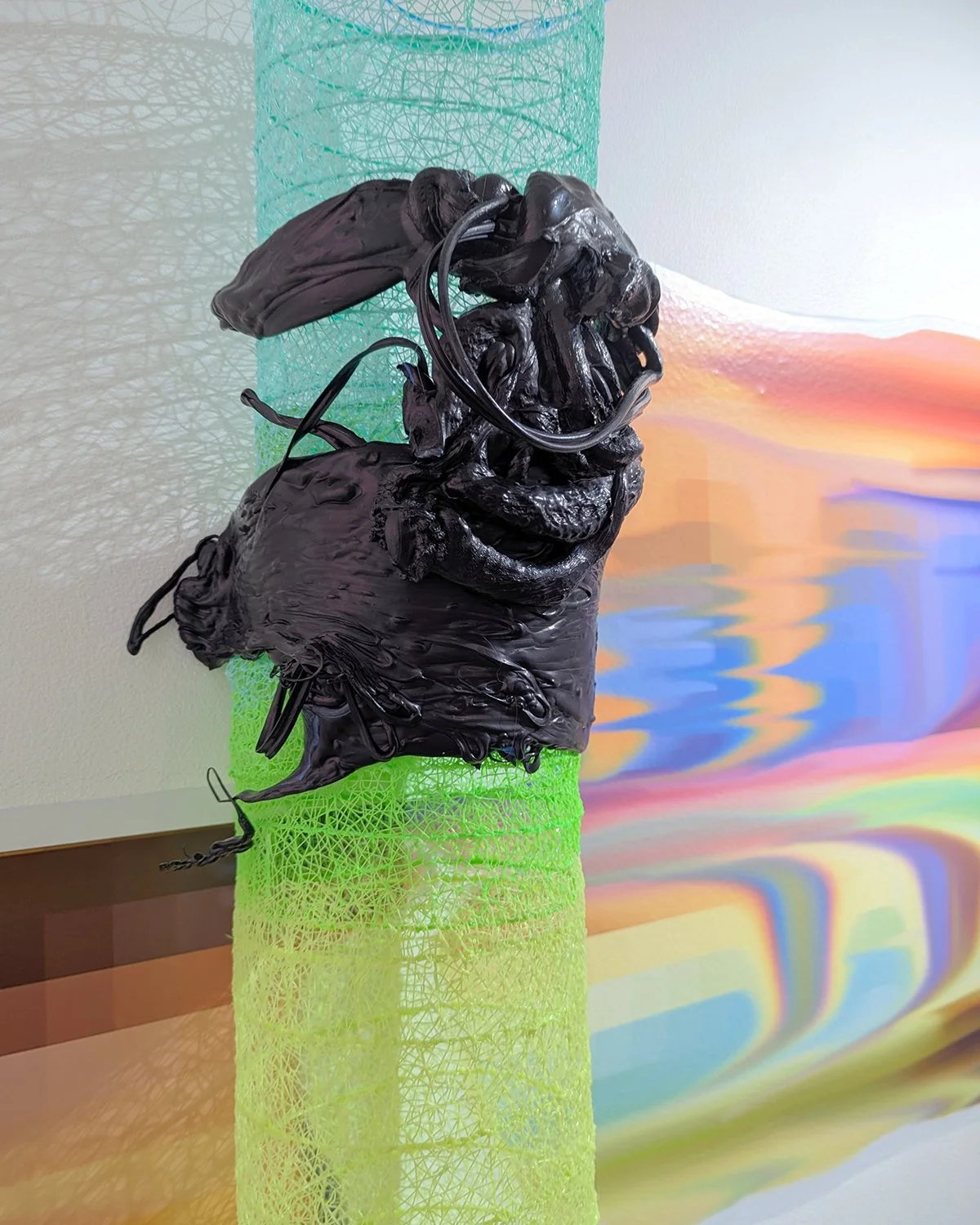
A detail view of Jodi Stuart’s Protraction #2, 3-D pen-formed PLA plastic, recycled plastic, and adhesive vinyl. 60 x 72 x 15 inches. Note the contrast of the flowing, black, biomorphic forms against the bright, colorful, and highly structured 3-D pen-formed sections. Image by Raymundo Muñoz.
While Stuart’s art practice explores the use and reuse of plastics to great effect, there is an internal tension inherent to her work. In my interview with the artist, she described her artwork as “happy in appearance, but the materiality of it is very toxic.” During her recent residency, for instance, she had to wear a respirator mask to protect herself from the toxic gases released during the melting of the recycled (or any) plastic. Not to mention all the micro-plastics she is regularly exposed to and that are likely preserved in her own body.
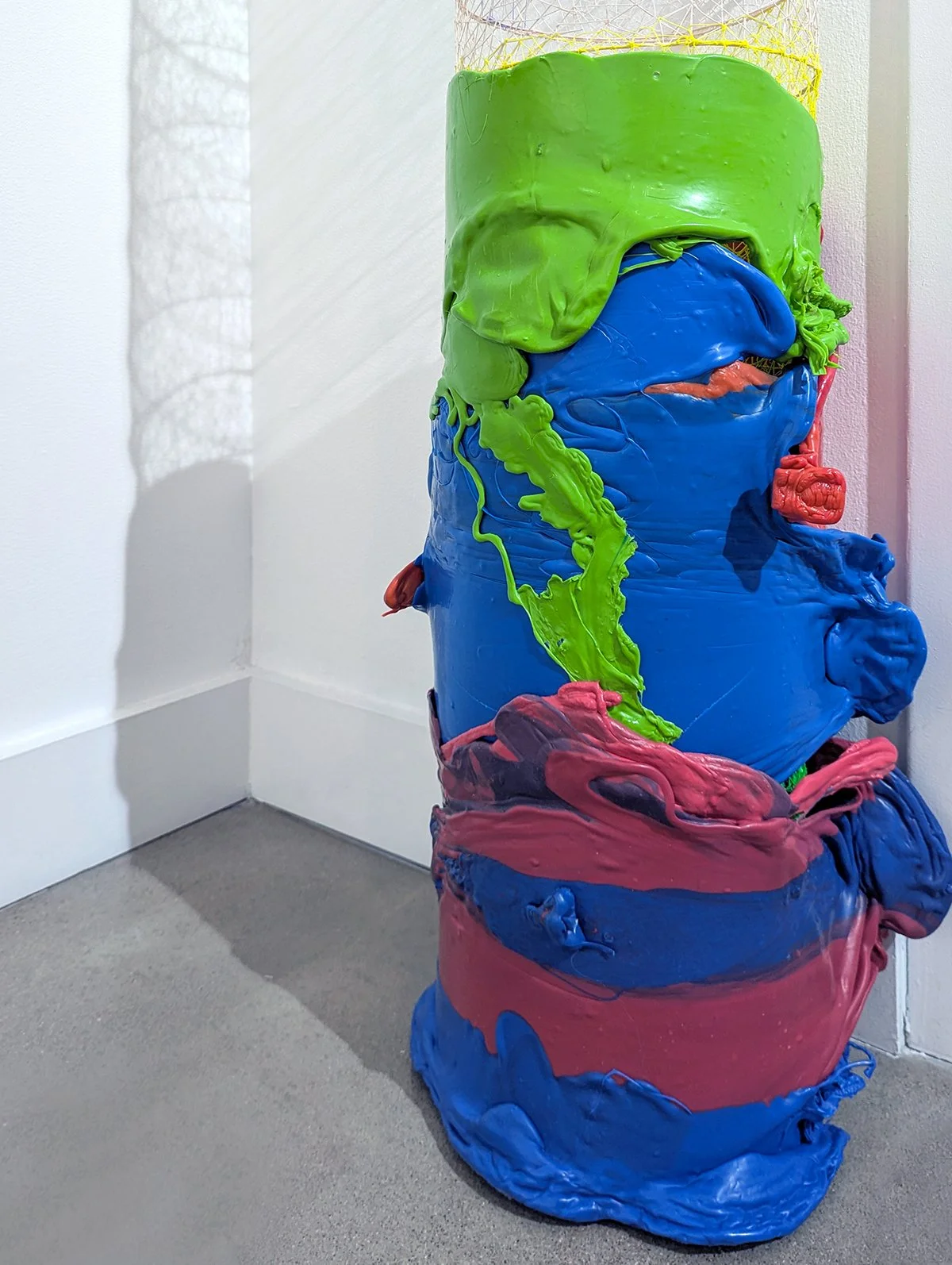
A detail view of Jodi Stuart’s Archway, 3-D pen-formed PLA plastic and recycled plastic, 36 x 80 x 12 inches. Stuart made the heavy base from melted recycled plastic during her artist residency at Breck Create’s Precious Plastics Lab in Breckenridge, Colorado. Image by Raymundo Muñoz.
The problem of toxicity in art media is nothing new for artists, unfortunately. Oil painters have long dealt with heavy metals in their pigments. Harsh solvents are the bane of printmakers. Mural artists inhale harmful aerosols and paint particulates, even in open air environments with plenty of ventilation. Untold quantities of “non-toxic, generally considered safe” acrylic paints are washed down countless sinks everyday, potentially damaging plumbing and septic systems. Not to mention, if you want to protect your artwork, you use “archival quality” packaging made from plastics that do not degrade.
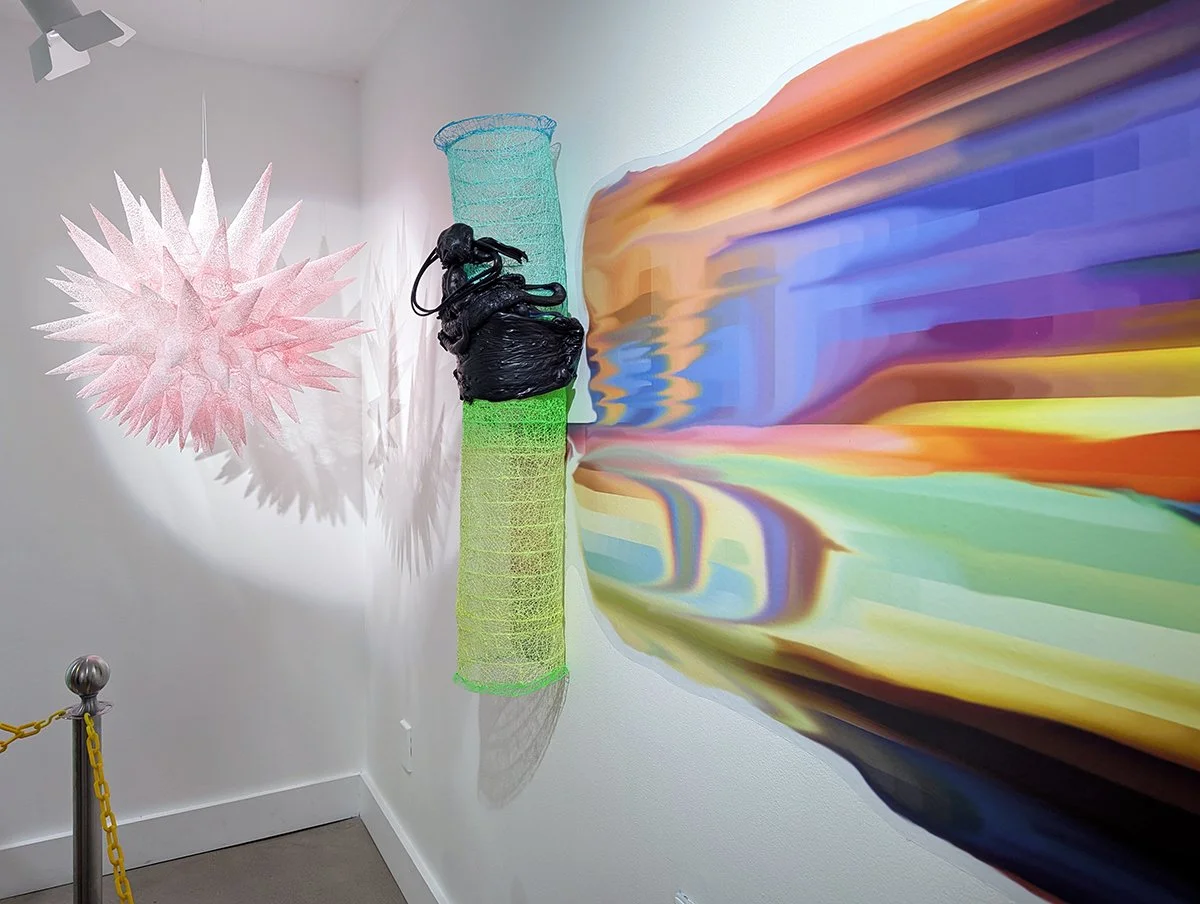
An installation view of Jodi Stuart’s Protraction #2 with Super Wicked in the background. Image by Raymundo Muñoz.
The title of the show, Stuart explained, comes from The Second Body by Daisy Hildyard, a book that philosophically explores the extension of every human body into the global environment. In her exhibition, Stuart relates this concept to the extension of plastics within our environment and within our own bodies. Like the shadows extending from her colorful sculptures, the effects of plastics are manifold and nuanced. And, in many ways, once our human bodies have long degraded, our plastic records—and art—may be all that remains. Archival quality, indeed.
Raymundo Muñoz (he/him) is a Denver-based printmaker and photographer. He is the director/co-curator of Alto Gallery and board president of 501(c)(3) non-profit Birdseed Collective. Ray is guided by the principle that art is a bridge, and it connects us to ourselves and each other across time and space.