
Reconstructing Perspectives
Kylee Covili and Jim Kearns: Reconstructing Perspectives
Lyons Community Library
451 4th Avenue, Lyons, CO 80540
April 15–July 14, 2026
Admission: free
Review by Paloma Jimenez
Despite the reliable order of a library, Dewey Decimal destiny always offers something a bit different than what you originally seek. A library collapses linear timelines and provides a space where many stories can intermingle and unusual analogies begin to form. This is similar to how Kylee Covili and Jim Kearns approach their materials in their Reconstructing Perspectives exhibition at the Lyons Community Library. Using precise construction and unexpected patternmaking, the two artists work with materials embedded with stories of previous lives and create something new out of the collected parts.
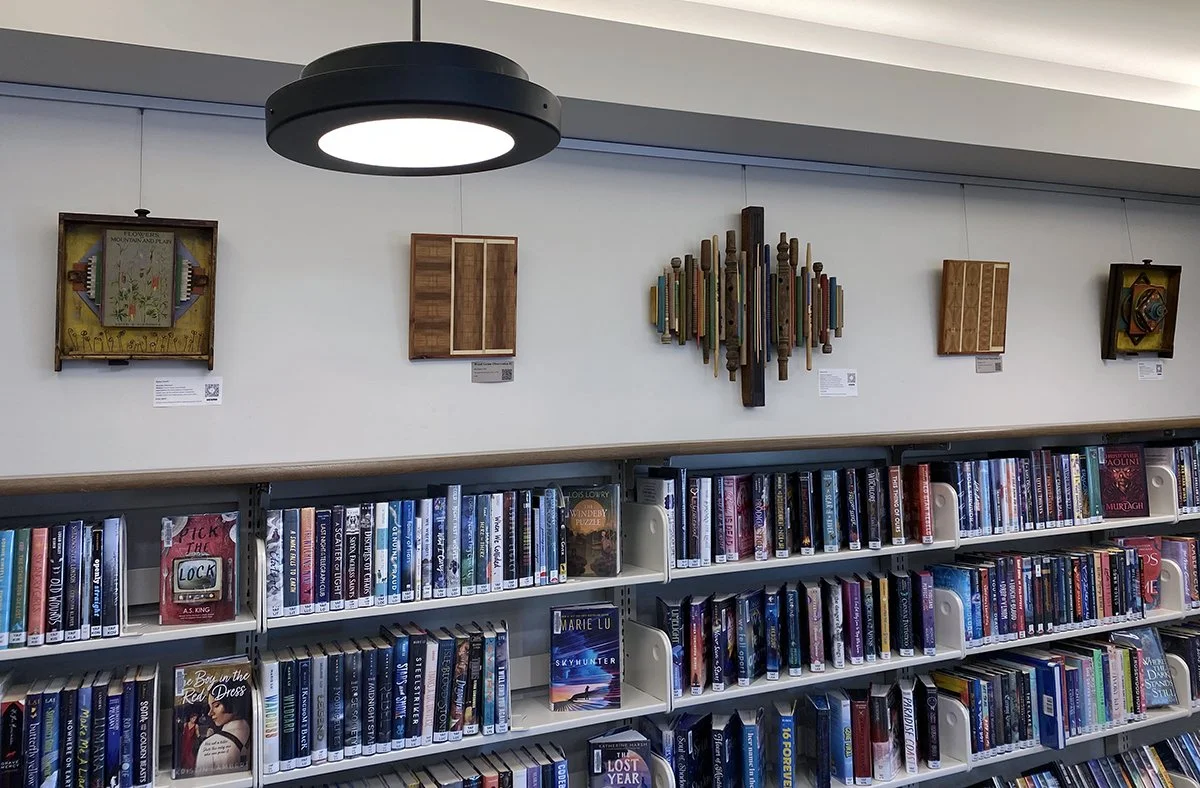
An installation view of the Reconstructing Perspectives exhibition at the Lyons Community Library. Image by Paloma Jimenez.
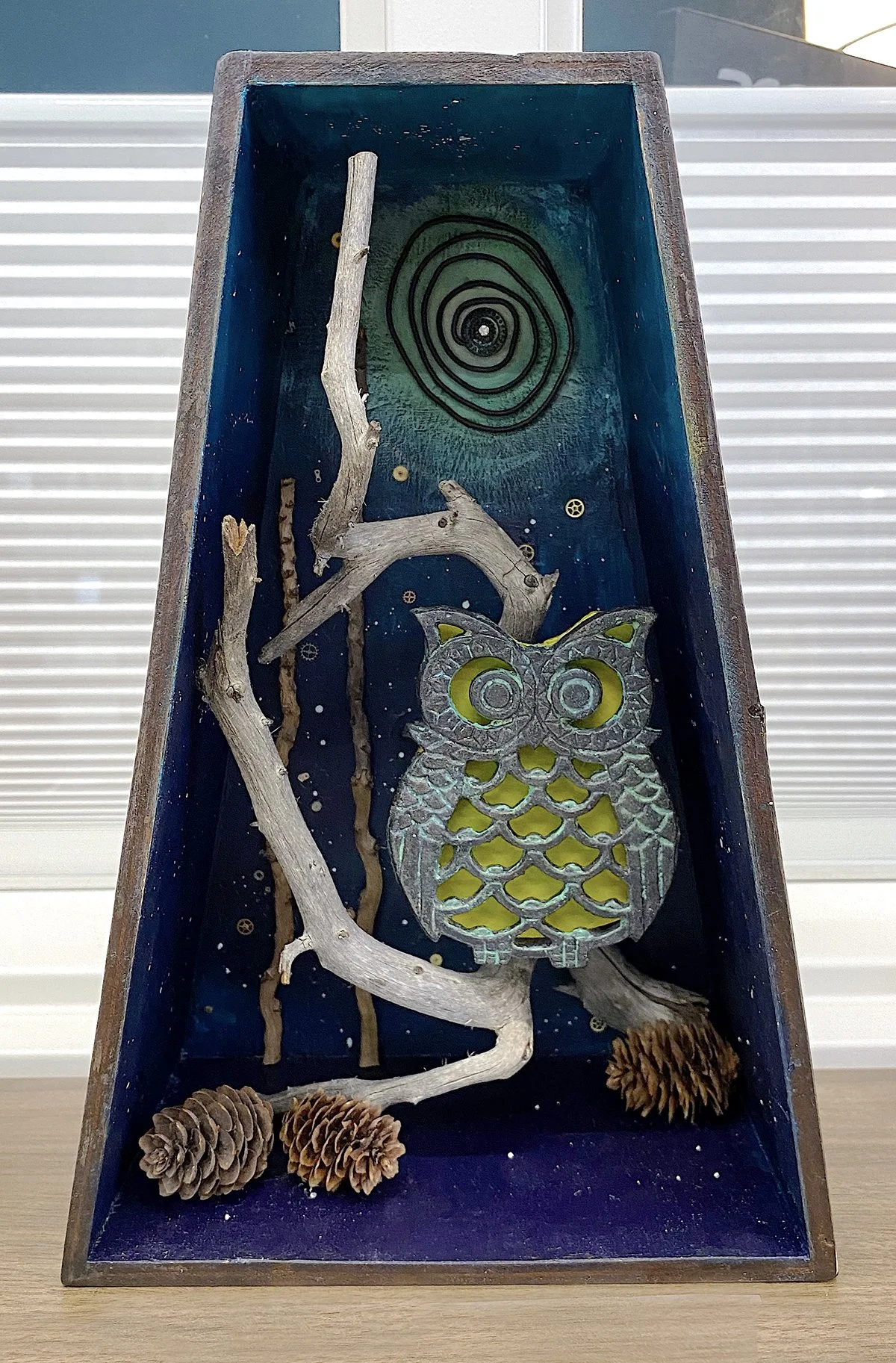
Kylee Covili, Midnight Wisdom, vintage cast iron owl trivet, vintage wooden box, wood branches, pinecones, watch parts, metal wire, button, and acrylic paint. Image by Paloma Jimenez.
Kylee Covili presents a collection of works that dig up an earthen symmetry from the often-chaotic world of vintage object assemblage. A distressed Southwestern color palette makes them feel like relics discovered amongst the surrounding rocks of Lyons. Some works feature dreamlike juxtapositions, such as the iron owl and spiral moon of Midnight Wisdom, in the manner of Joseph Cornell’s work—the godfather of assemblage.
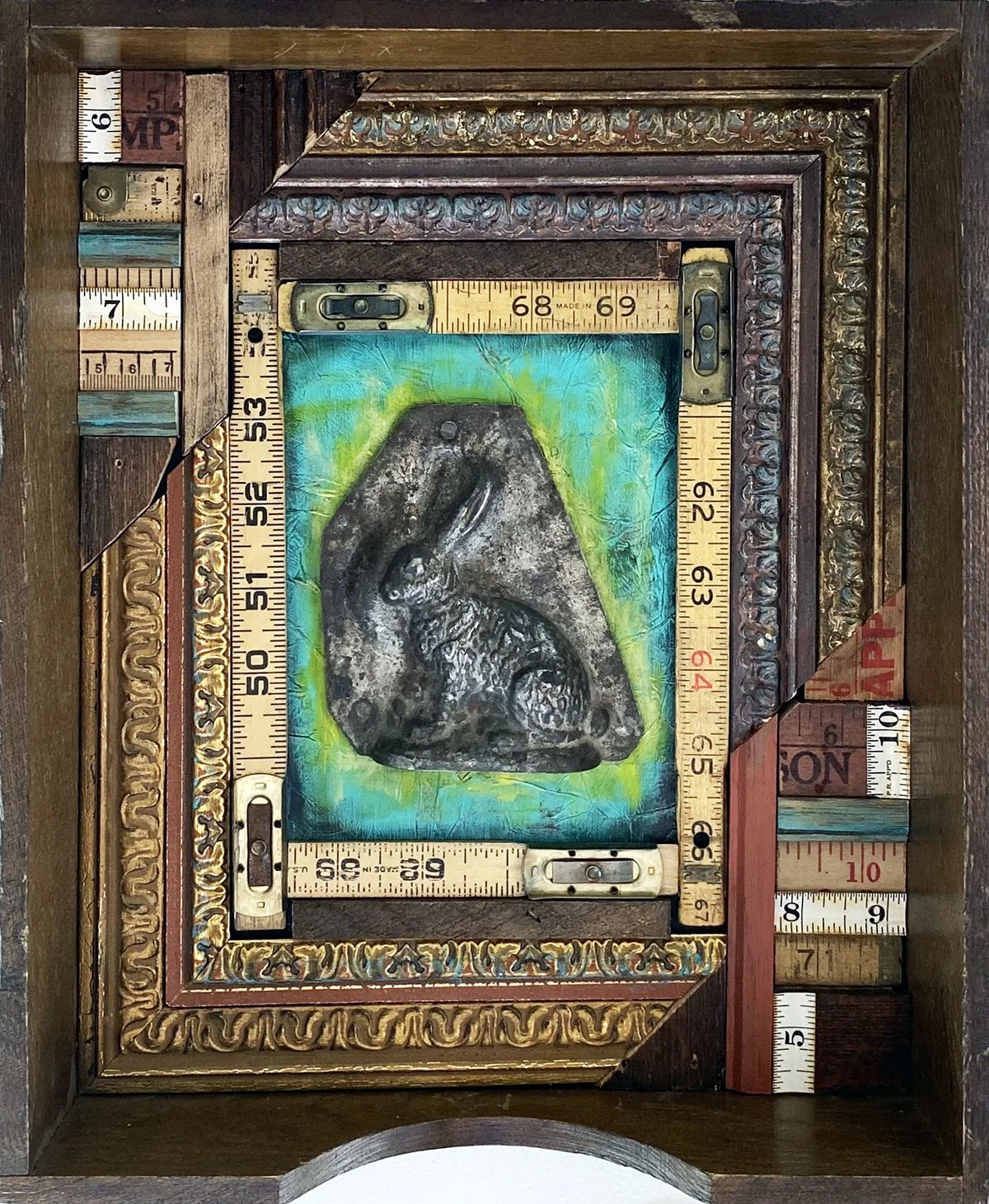
Kylee Covili, Run Rabbit Run, vintage metal rabbit candy mold, vintage measuring sticks, vintage frame pieces, vintage wooden desk tray, acrylic paint, and wood stain. Image by Paloma Jimenez.
Run Rabbit Run includes a vintage metal candy mold of a rabbit emerging from a burst of glowing turquoise inside of a wooden desk tray. Fragmented measuring sticks and scraps of gold frames keep the rabbit tightly trapped inside a measured memory.
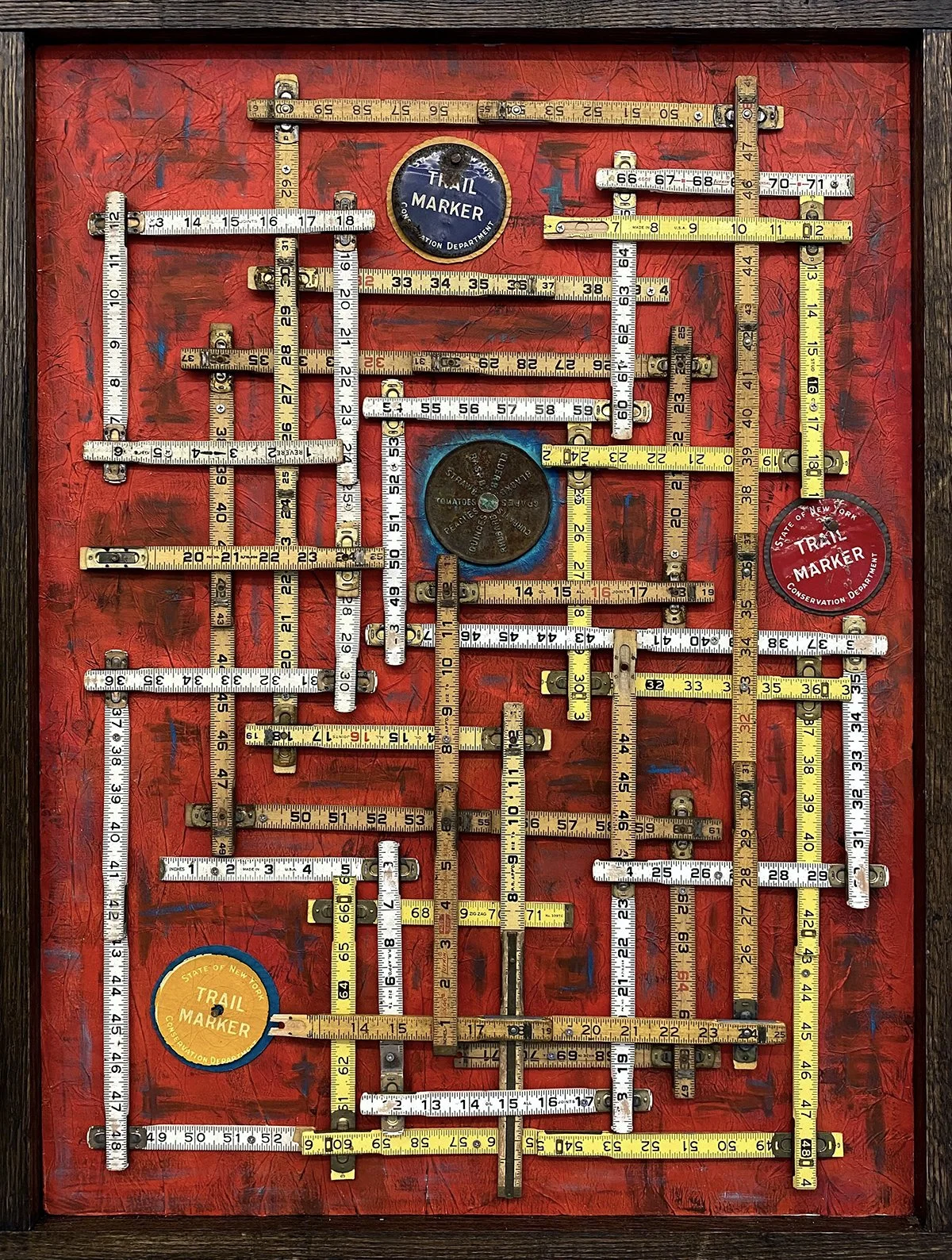
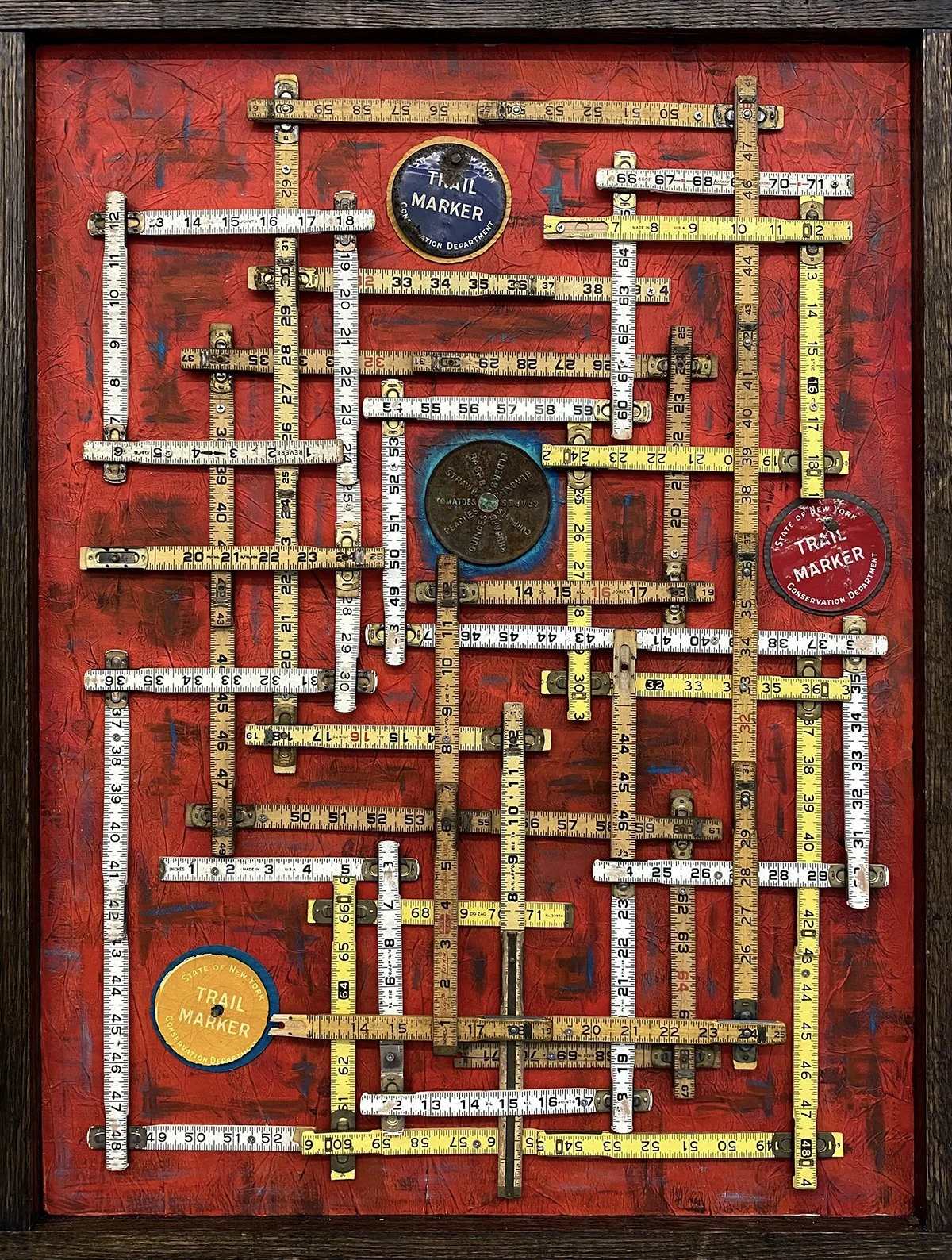
Kylee Covili, Which Way to the Farm Stand?, vintage foldable measuring sticks, turn-of-the-century Olney & Floyd vegetable can lid, vintage state of New York trail marker signs (pre-1970), acrylic paint, and wood stain. Image by Paloma Jimenez.
But Covili’s strongest pieces dispose of nostalgic symbolism and succumb to the meditative trance of repeated found shapes. The weathered white and yellow measuring sticks in Which Way to the Farm Stand? transform into gridded pathways between checkpoints. Against a bright red punch, the lines meander in search of the central blue-rimmed can lid. Embossed fruit names signify an abundant rest stop.
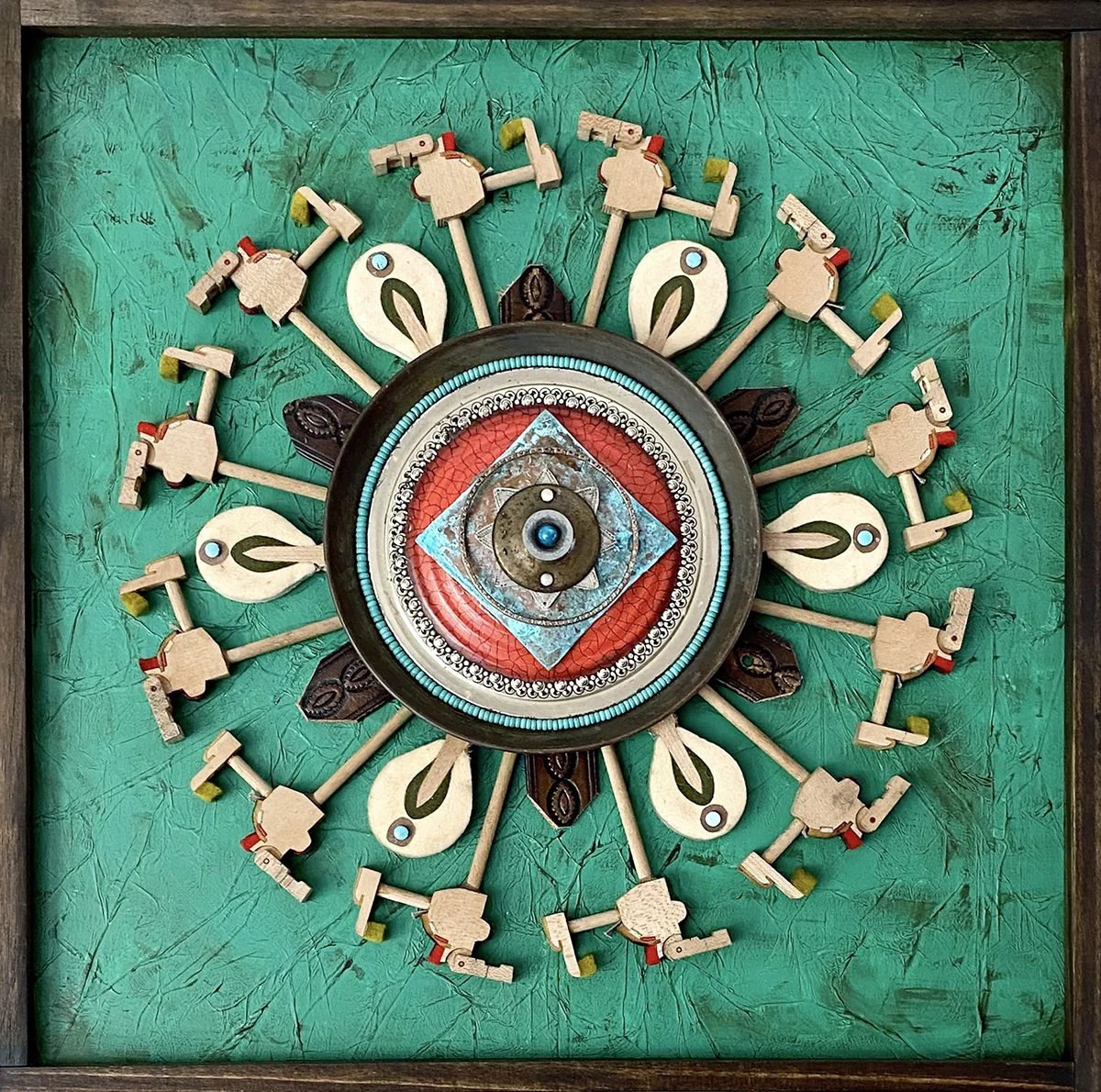
Kylee Covili, Around the Wheel #2, piano hammers and parts, copper dish, vintage tin lid, turquoise beads, salvaged checkerboard, leather belt pieces, various metal pieces, acrylic paint, and wood stain. Image by Paloma Jimenez.
Around the Wheel #2 turns piano hammers, leather belts, turquoise beads, and metal scraps into a sacred shield. Viewed as a whole, the smaller parts become divorced from their original function and become a meditative mandala for a world filled to the brim with material things.
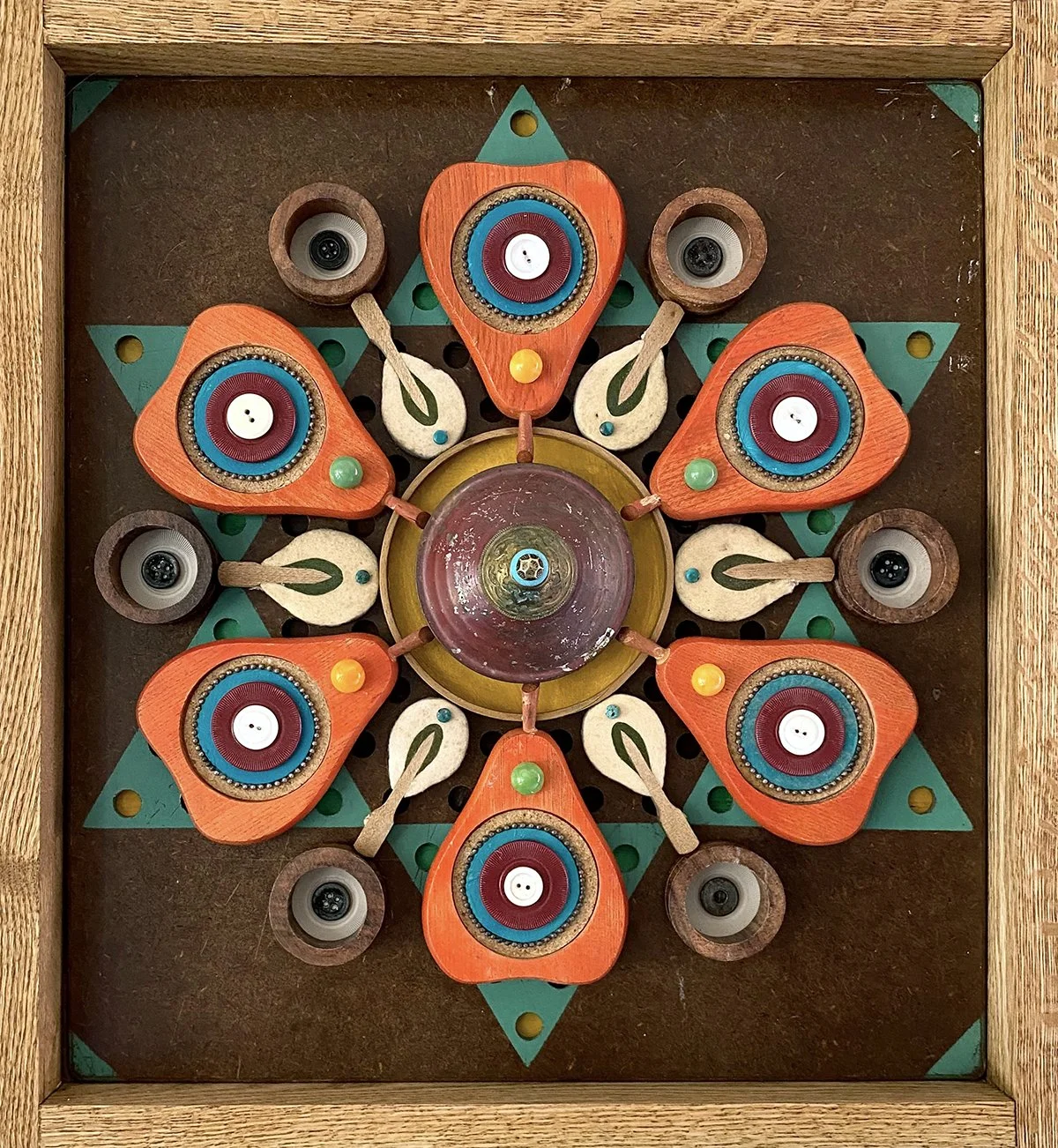
Kylee Covili, Fruitful Strategy #1, vintage Chinese checkerboard, vintage 1970s pear-shaped coasters, piano hammers, vintage wooden napkin rings, vintage poker chips, depression-era metal buttons, vintage watering can head, chain, embroidery hoop, vintage marbles, turquoise beads, acrylic paint, and wood stain. Image by Paloma Jimenez.
Fruitful Strategy #1 also blooms in radial symmetry. Atop a Chinese checkerboard base, white buttons pollinate the orange wood and cork leaves of 1970s pear-shaped coasters. Napkin rings hold poker chips and metal buttons in lieu of dining cloths. Checking the materials list is key to experiencing Covili’s work; outside of the clarity provided by knowing the source of each texture and shape, it also offers a sense of wonderment at what she is able to do with the disparate shapes.
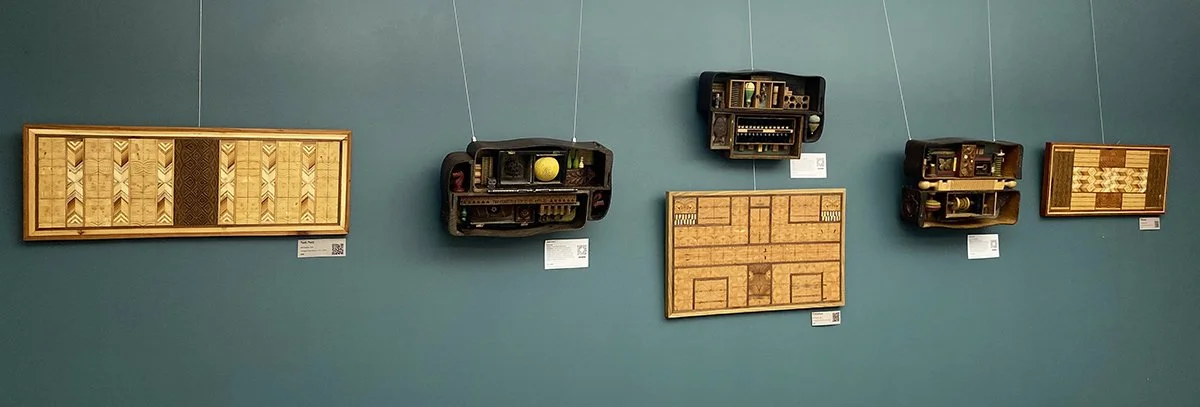
An installation view of works by Kylie Covili and Jim Kearns in the Reconstructing Perspectives exhibition at the Lyons Community Library. Image by Paloma Jimenez.
Jim Kearns finds his own brand of harmonious wonder, and a fair number of glitches, in the woodgrain of various trees. Eschewing the “rustic log” aesthetic often found in Colorado cabins, Kearns uses salvaged wood to create intricate mosaics. The intensity of Kearns’s perceptual focus reveals psychedelic patterns not normally expressed by the average woodworker.
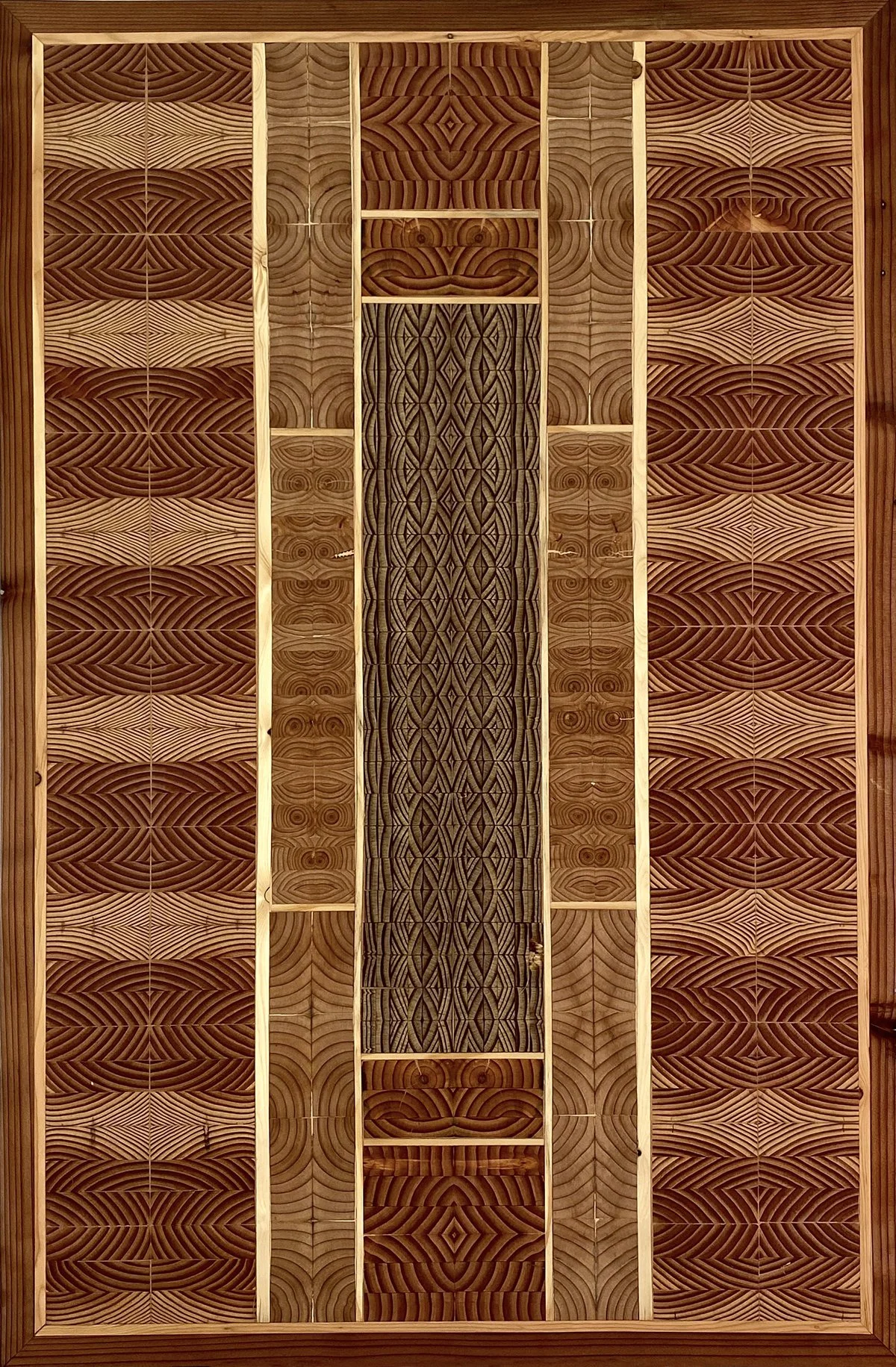
Jim Kearns, Cheshire, 2025, salvaged wood mosaic, 40 x 26 inches. Image by Paloma Jimenez.
The enigmatic Cheshire bends time through its curving patterns of contrasting tree rings. Bookending the central rattlesnake skin pattern, two Cheshire grins emerge from the woodgrain, as if inviting you to contemplate the uncertainty of perception and the morphing nature of life. The work begins to pulse if you stare at it long enough.
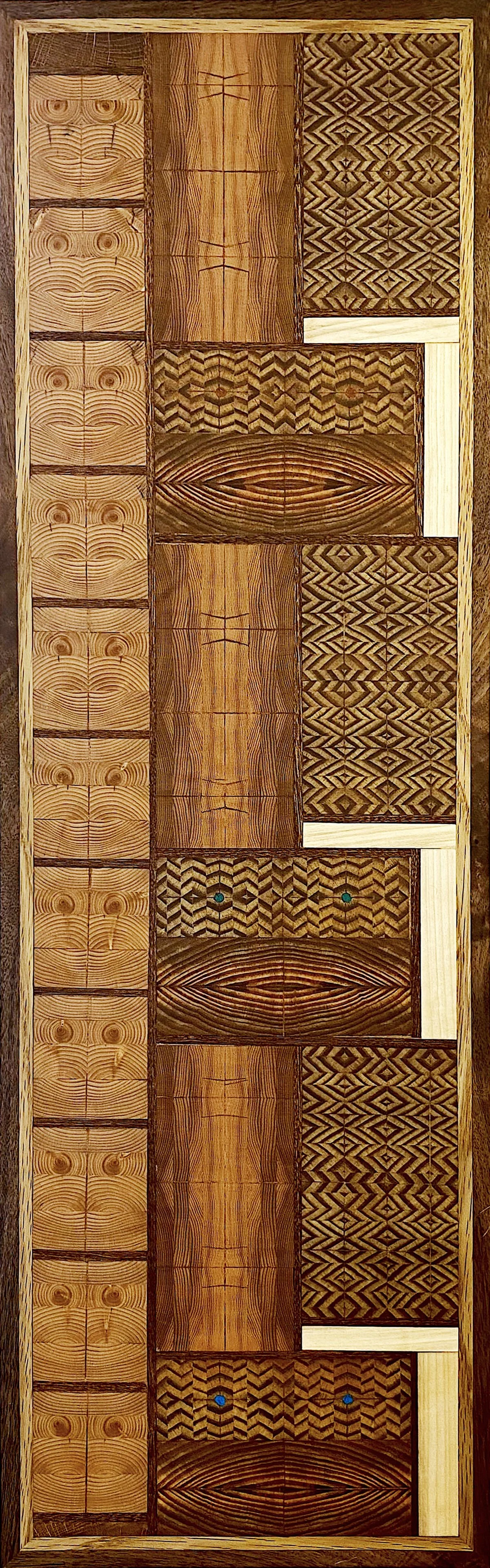
Jim Kearns, The Great Fade, 2026, salvaged wood mosaic, 34 x 10 inches. Image by Paloma Jimenez.
Kearns embeds some more covert faces and ancient life in The Great Fade, but he is not interested in pictorial storytelling. Rectangles stacked on the left side of the work contain the preternaturally wise gaze of the tree-dwelling chimpanzee, drawn by the lines of wood grain. The faces slowly fade away as you move down the column. On the right, zig-zagging grains and blue dots vaguely delineate three more faces. Time and growth are inherent to trees. Kearns’s arrangement of the wood pieces also reminds us of how much all life depends on them.
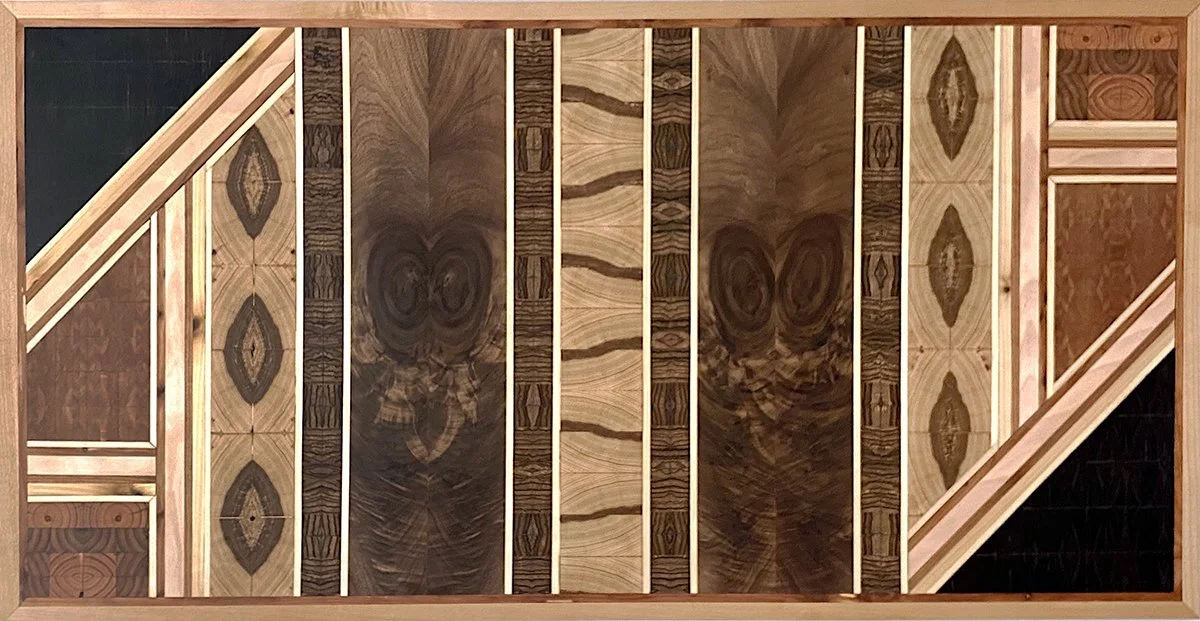
Jim Kearns, Penumbra, 2026, salvaged wood mosaic, 25 x 49 inches. Image by Paloma Jimenez.
In some of the mosaics, deep brown and inky black wood create bolder moments of contrast. Penumbra stretches horizontally across the wall with dark triangles occupying opposite corners. Conjoined knots and darker-toned grain create the feeling of shadows moving through a forest at dusk. By changing the scale and size of the lines, Kearns establishes a visual depth that reaches beyond the beguiling surface of exotic wood.
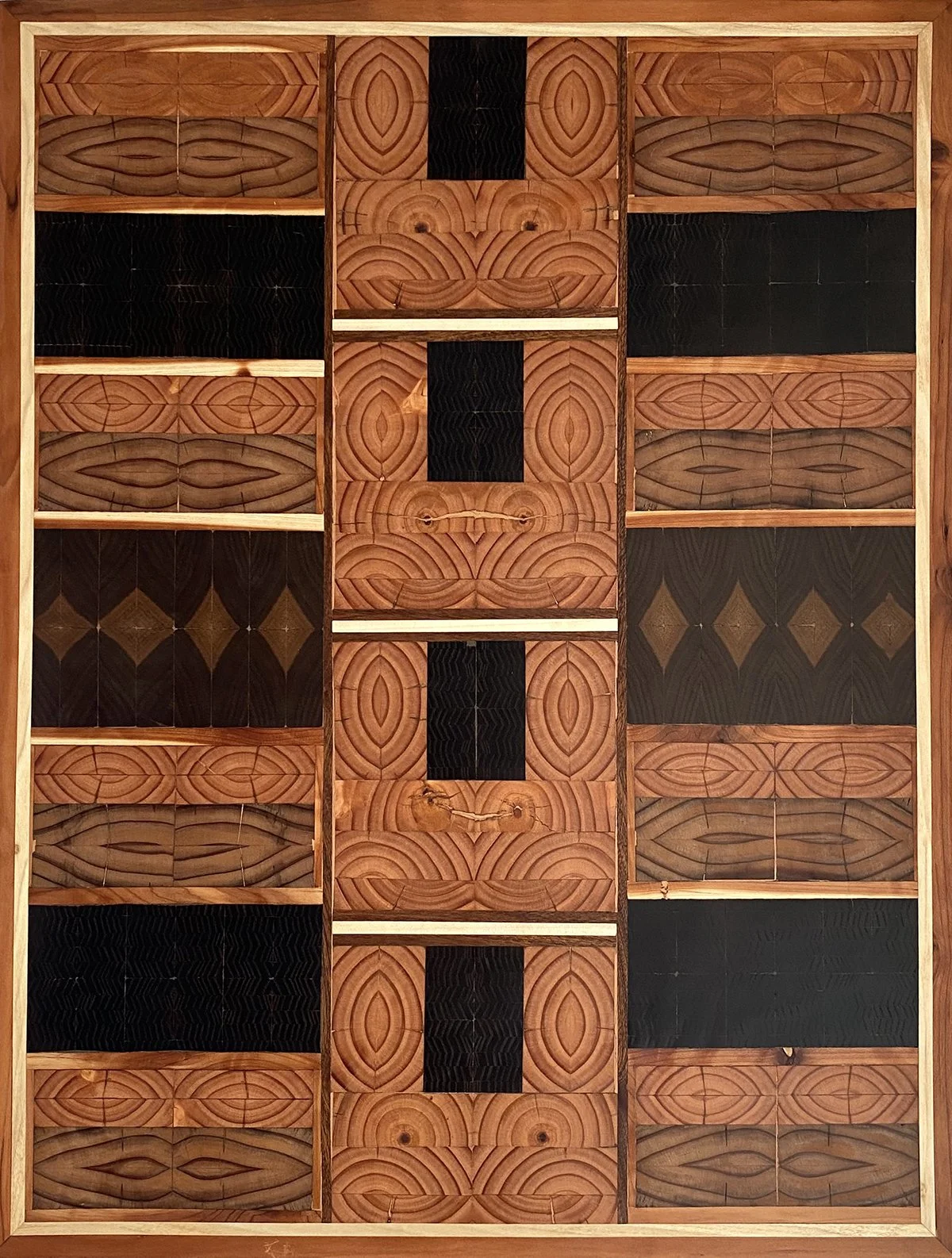
Jim Kearns, Hidden in Darkness, 2025, salvaged wood mosaic, 25 x 19 inches. Image by Paloma Jimenez.
Hidden in Darkness also mobilizes darker woods into a flickering abstract vision. Repeated black rectangles keep the eye searching across the surface, like hunting for a usable image in a sprocketed sheet of film negatives.
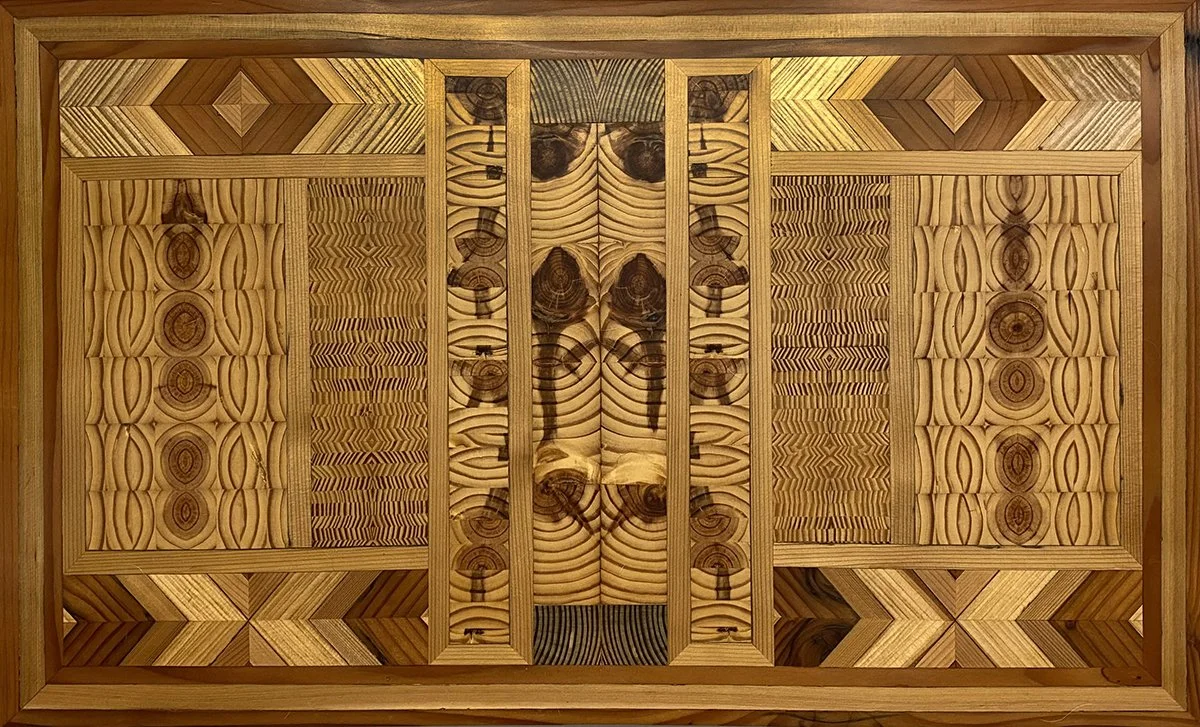
Jim Kearns, Insight, 2023, salvaged wood mosaic, 16 x 26 inches. Image by Paloma Jimenez.
The Rorschach quality of Kearns’s work is even more apparent in the compositions that largely feature wood knots; they are disruptively beautiful. Imperfection is a main character in Insight. Knotty slices cluster together and create new signs of life in the central panel.
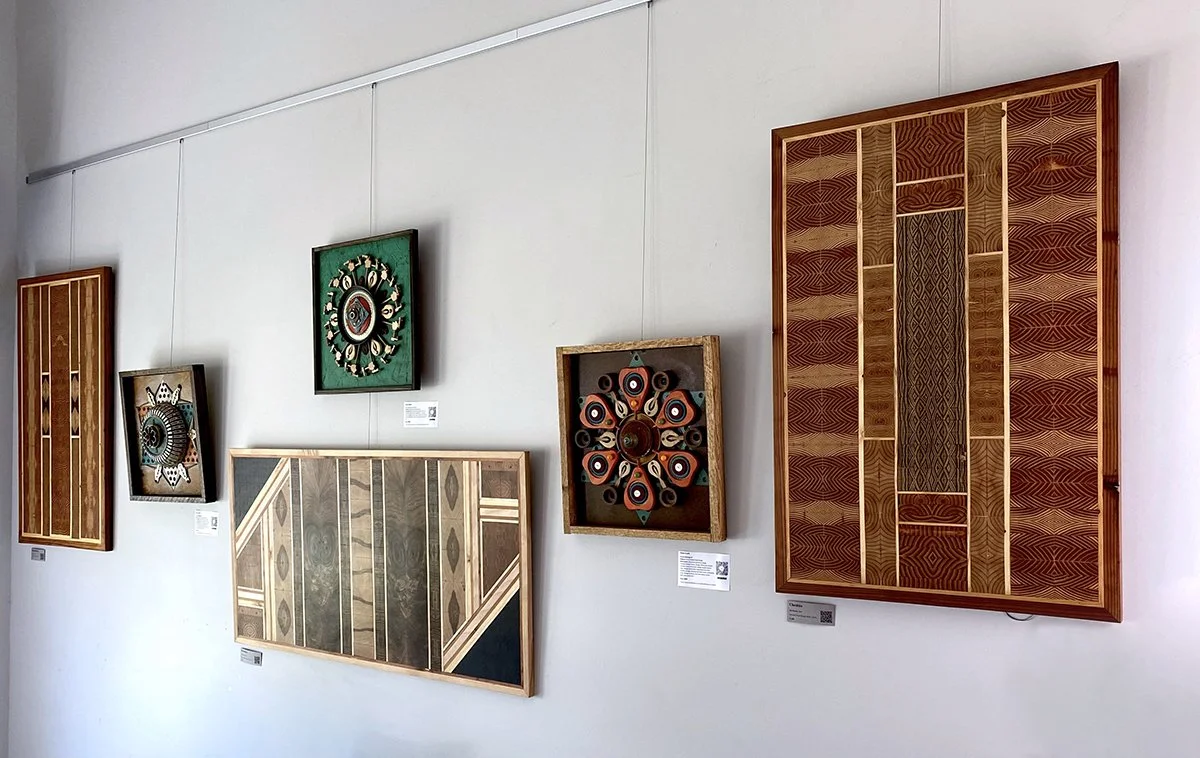
An installation view of works by Kylie Covili and Jim Kearns in the Reconstructing Perspectives exhibition at the Lyons Community Library. Image by Paloma Jimenez.
Choosing to work with found objects and salvaged wood inevitably brings the element of time into the mix. Jim Kearns and Kylee Covili understand this well. They are able to regenerate and abstract their source material without extracting the soul from it.
Paloma Jimenez (she/her) is an artist and writer. Her work has been exhibited throughout the United States and has been featured in international publications. She received her BA from Vassar College and her MFA from Parsons School of Design.