
The Source Never Diminishes
Nina Elder: The Source Never Diminishes
GOCA: Marie Walsh Sharpe Gallery of Contemporary Art @ Ent Center for the Arts
5225 N. Nevada Avenue, Colorado Springs, CO 80918
November 6, 2025–March 7, 2026
Curator: Dr. Joy Armstrong
Admission: free
Review by Dani/elle Cunningham
In her exhibition The Source Never Diminishes at the Marie Walsh Sharpe Gallery of Contemporary Art, Nina Elder mounts a punk-inflected rebellion against artistic conventions. She also delves into the inky blackness of Victorian mourning aesthetics and shows a deep reverence for nature shaped by memory in her mixed-media sculptures—her first works in this medium. [1]
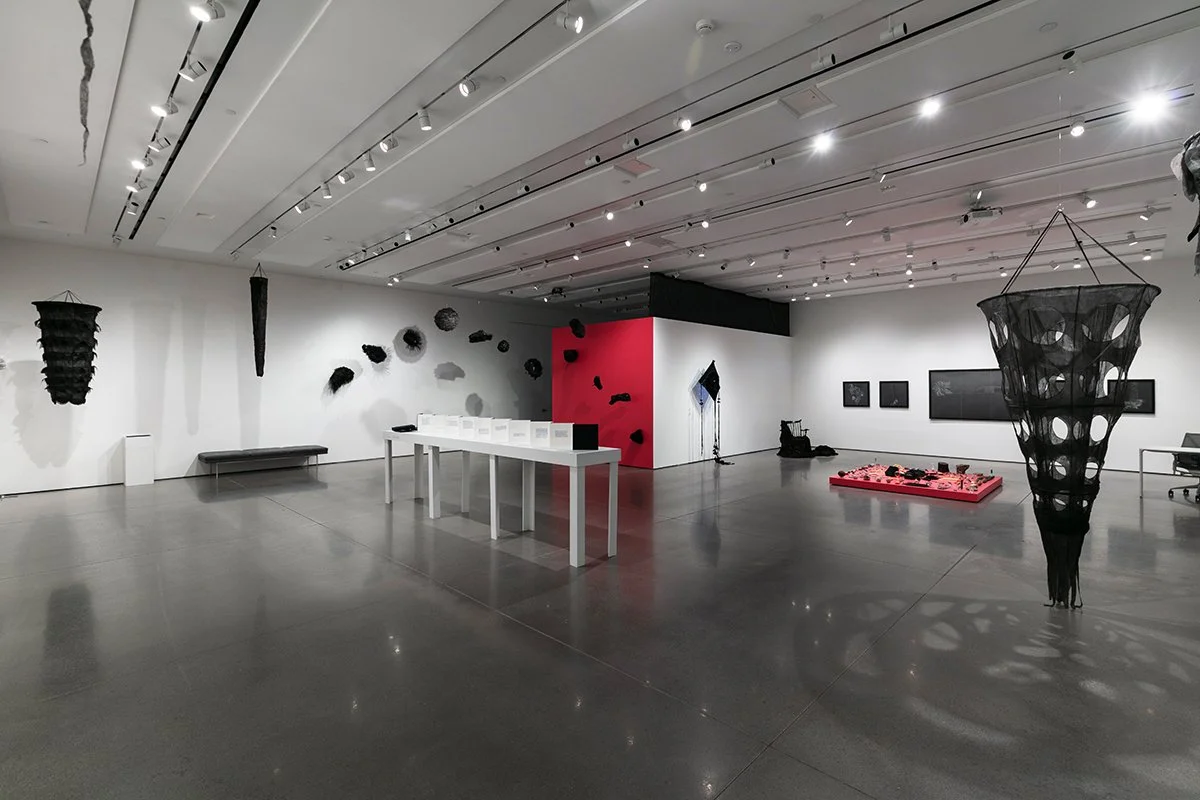
An installation view of Nina Elder’s exhibition The Source Never Diminishes at the Marie Walsh Sharpe Gallery of Contemporary Art. Image courtesy of the Marie Walsh Sharpe Gallery of Contemporary Art.
Presenting this new work alongside the wildfire-salvaged charcoal drawings for which she is known, as well as colorful watercolor and gouache paintings and two meditative videos, Elder’s exhibition reads less as a thematic exploration of transformation and more as the retrospective of an artist inexplicably seasoned in both experimentation and refinement.
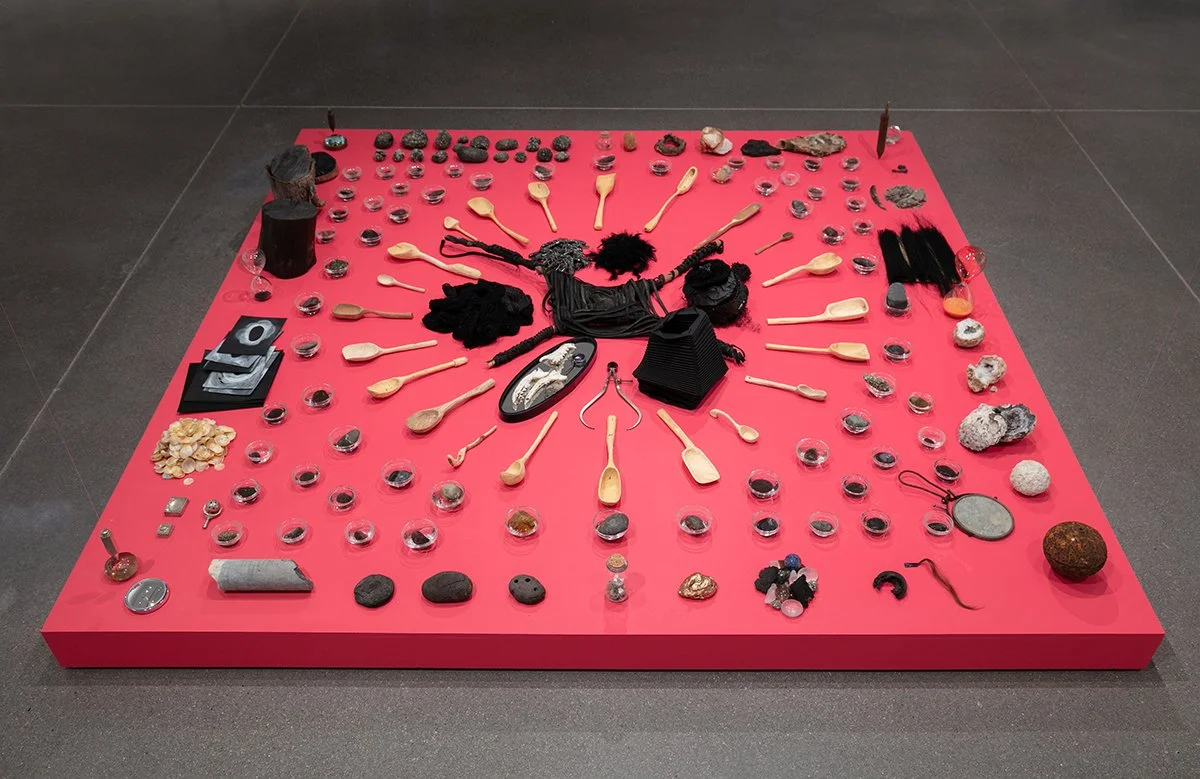
Nina Elder, Black Hole Sketches, ongoing, found objects and research materials. Image courtesy of the Marie Walsh Sharpe Gallery of Contemporary Art.
Across media, Elder uses repetition and meditation as strategies for holding grief at bay and even beautifying loss through creativity. An installation titled Black Hole Sketches at the exhibition’s entrance demonstrates this with its arrangement of various objects, created and found, on a brightly colored plinth placed on the floor. These items illustrate memory as much as they reflect the artist’s curiosity, displaying how matter can both accumulate and be annihilated, as in black holes, functioning as “ritualistic reminders of the great expanse beyond us.” [2]
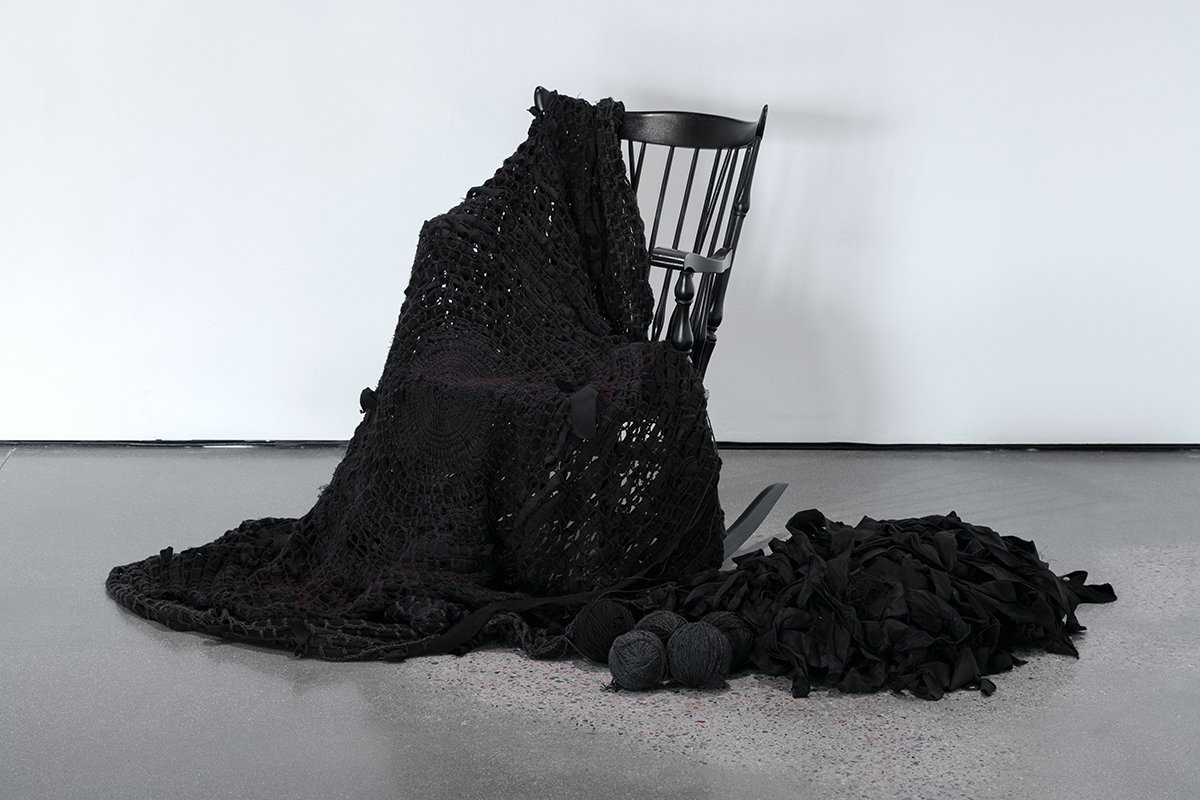
Nina Elder, Crochet Black Hole, 2022-present, coffin silk offcuts and black sheep wool from nuclear downwinder communities. Image courtesy of the Marie Walsh Sharpe Gallery of Contemporary Art.
The artist’s use of black holes as metaphors extends into Crochet Black Hole, another installation near the gallery entrance. Featuring a charred-looking rocking chair surrounded by black crocheted sheep’s wool sourced from downwind nuclear communities and coffin silk, this “black hole”—a theme that recurs throughout the exhibition—frames knitting as a meditative practice.
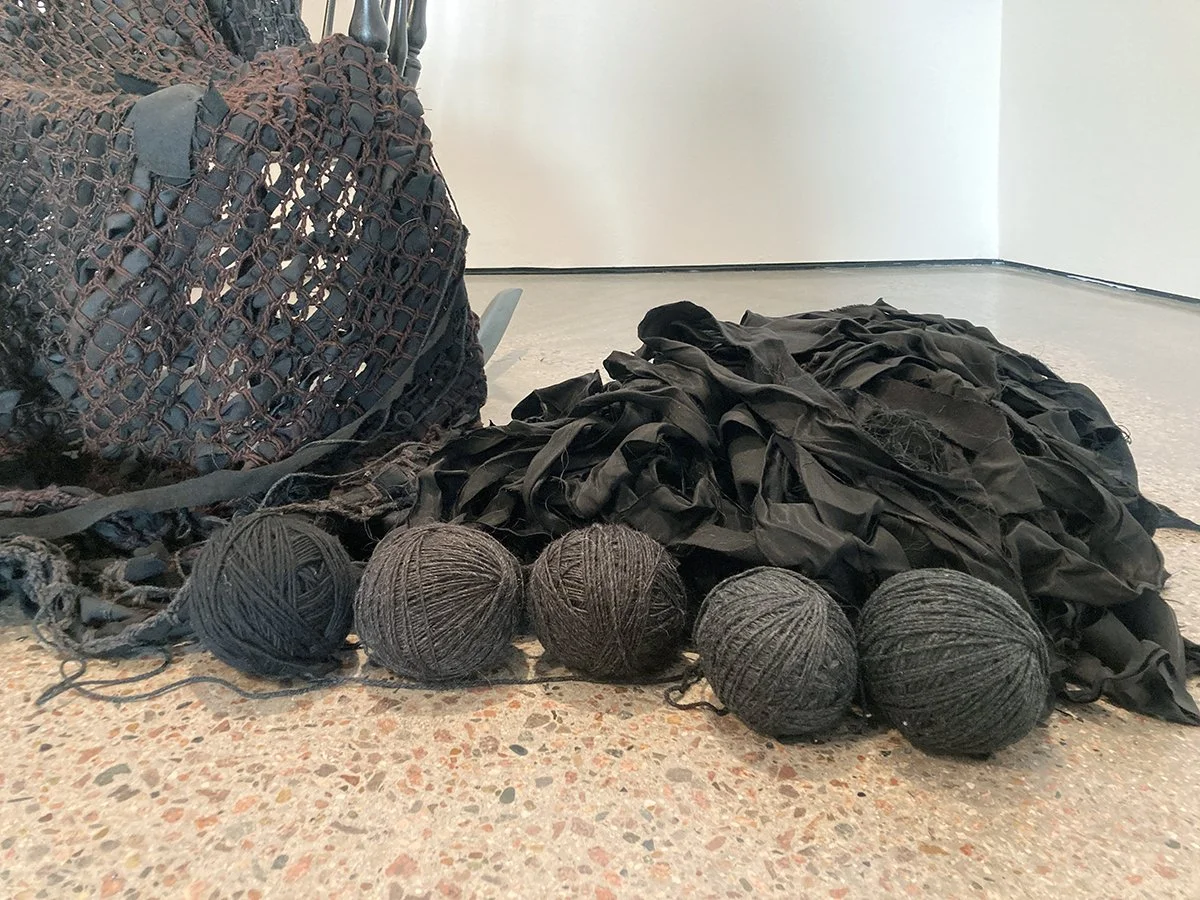
Nina Elder, Crochet Black Hole, 2022-present, coffin silk offcuts and black sheep wool from nuclear downwinder communities. Image by Dani/elle Cunningham.
This kind of work occupies the hands and offloads the mind, transforming grief into an ever-growing act of memorialization. The artist has been adding to the crocheted element since 2022, signifying the ongoing emotional impact of nuclear power as well as its physical impact on the land, people, and animals.
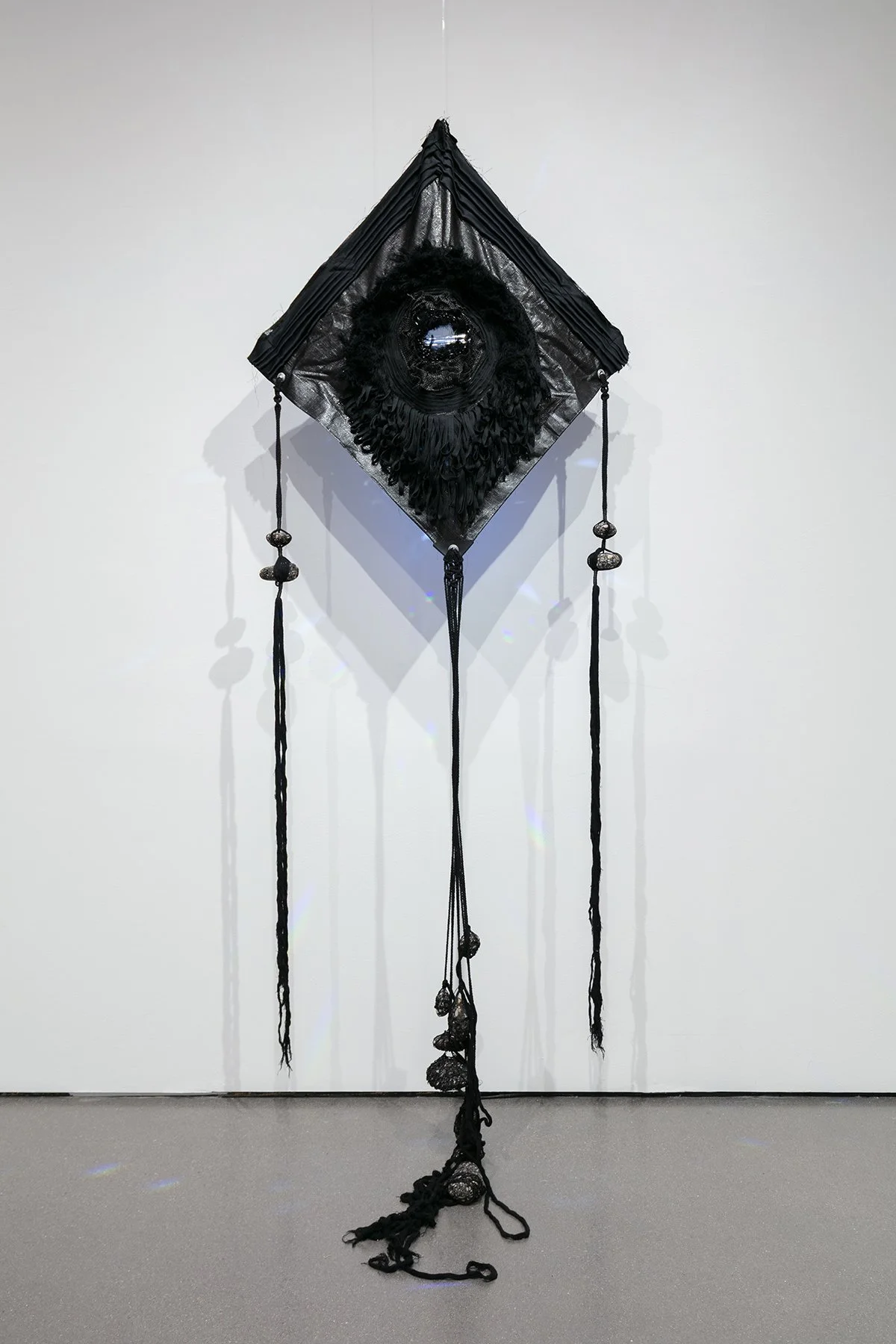
Nina Elder, War Kite, 2024, Kevlar, satin, coffin silk, ribbons, polished asphalt, and glass prism. Image courtesy of the Marie Walsh Sharpe Gallery of Contemporary Art.
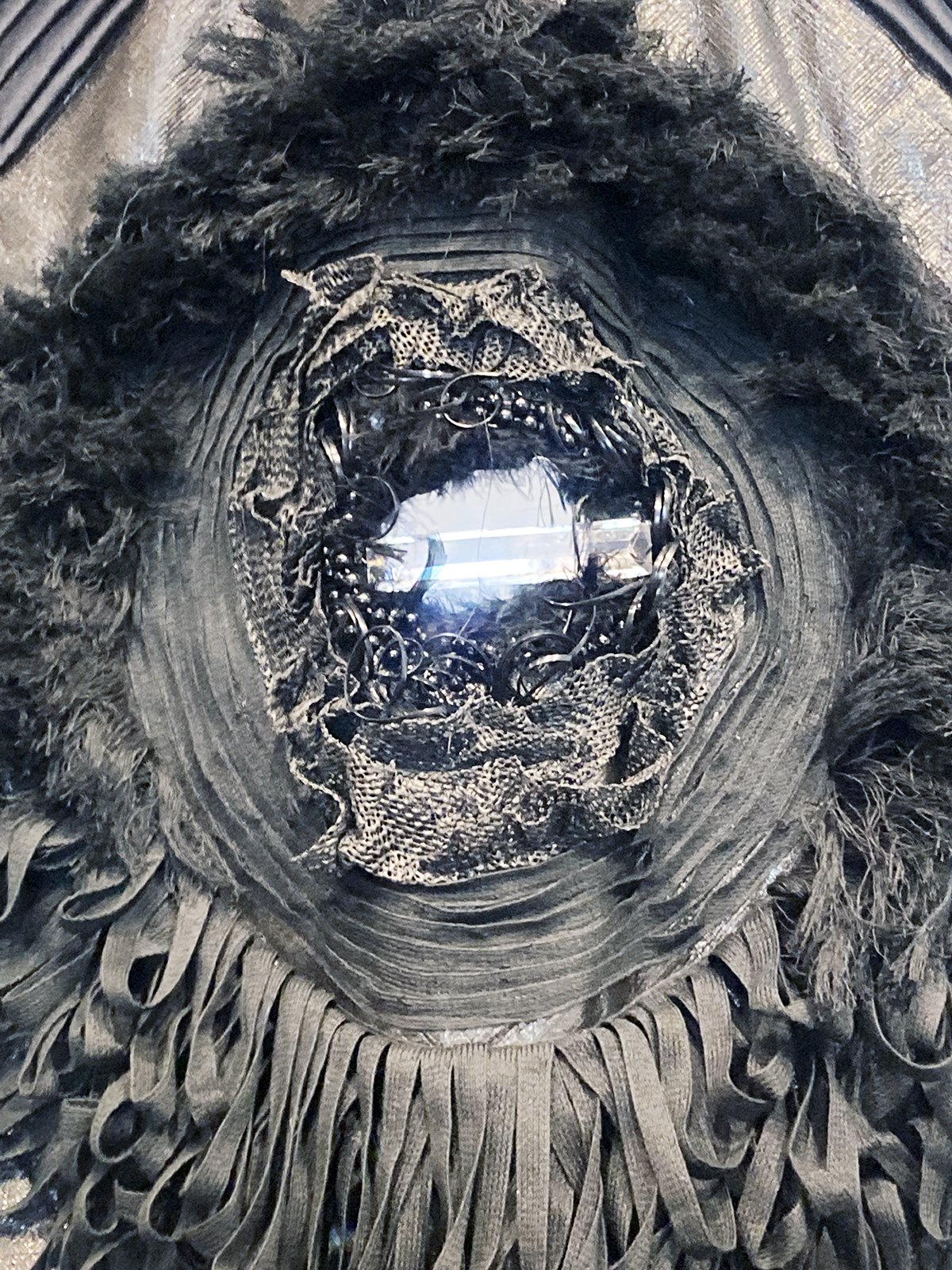
A detail view of Nina Elder’s War Kite, 2024, Kevlar, satin, coffin silk, ribbons, polished asphalt, and glass prism. Image by Dani/elle Cunningham.
War Kite, a kite made from multiple fabrics, Kevlar, and an embedded crystal prism, hangs near Elder’s crochet work. Its beaded silk tassels hang heavily from its sides, with one extending from its middle and piling onto the floor in a coiled mass that delicately balances the stark angles of the kite’s body. By repurposing Kevlar into an art object, this sculpture—while tinged with sorrow through its materiality—also functions as a kind of memento mori, reminding viewers that even as war looms persistently in human history, its materials and ravages can be transformed into something beautiful.
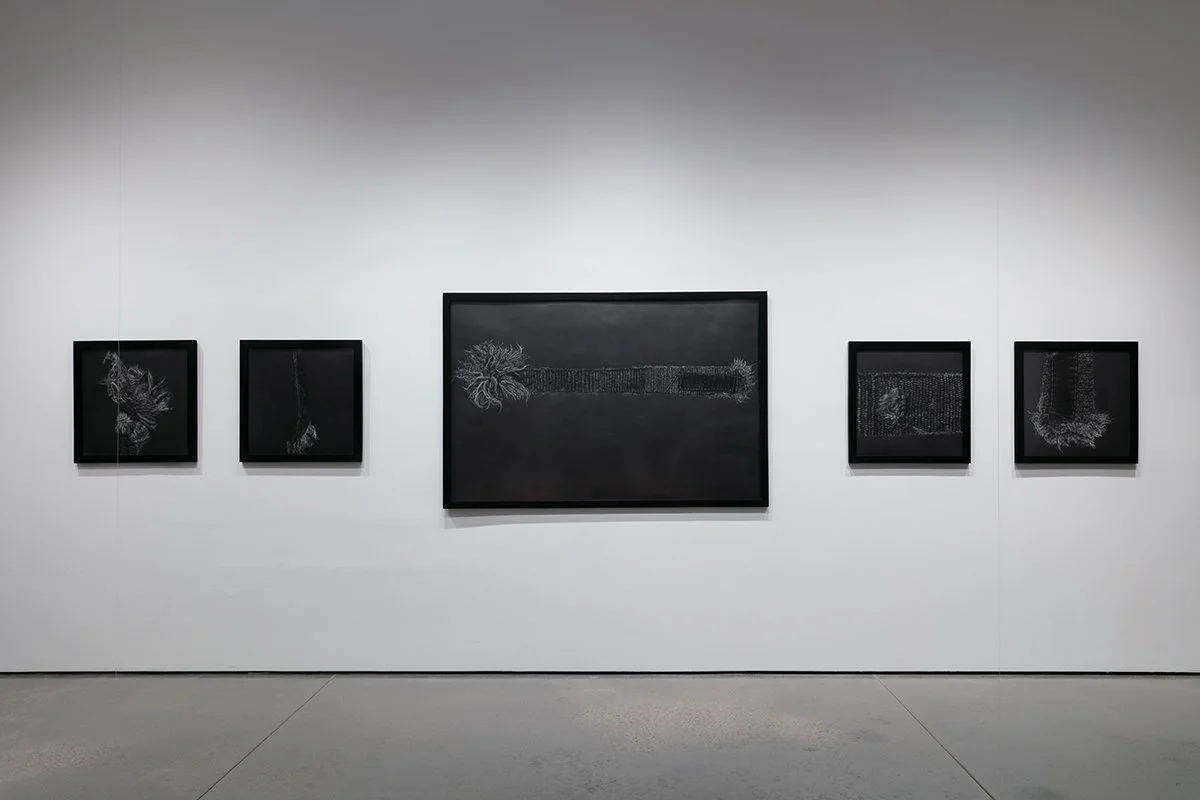
Nina Elder, Fray Series, 2020, wildfire charcoal and chainsaw grease on paper. Image courtesy of the Marie Walsh Sharpe Gallery of Contemporary Art.
Also on view in the first room of the gallery is the Fray series—Elder’s hyper-realistic drawings of an unraveling strap, seemingly made from burlap, which she discovered during her research residency at the Sagehen Creek Field Station at the University of California, Berkeley.
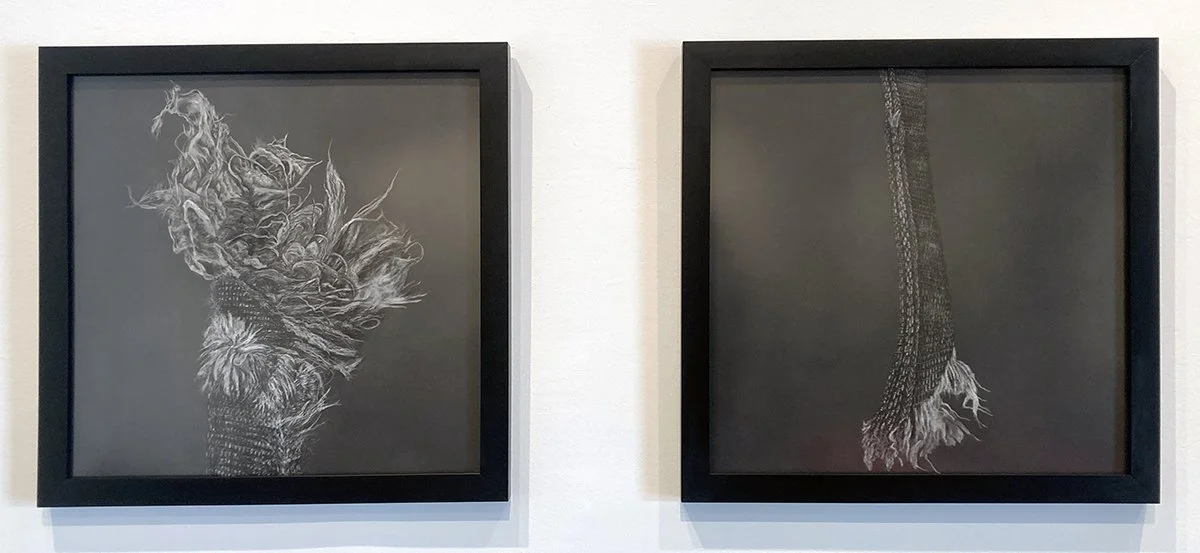
Nina Elder, Fray Series, 1 and 2, 2020, wildfire charcoal and chainsaw grease on paper. Image by Dani/elle Cunningham.
These five drawings exemplify Elder’s signature style: meticulous and tender works made from natural materials—here, charcoal gathered from wildfire sites and chainsaw grease—that speak to her interest in the disappearing natural world, humanity’s complicity in its loss, and the infinitely creative possibilities that arise from destruction. [3]
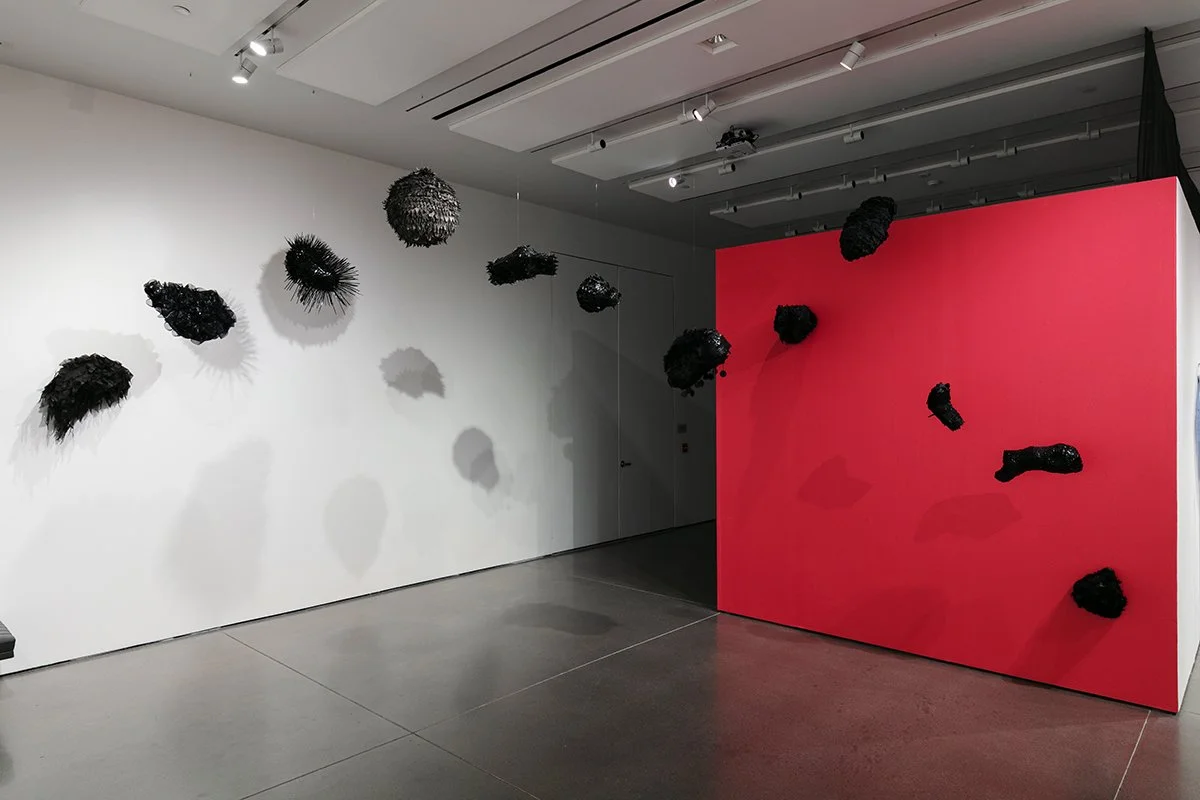
Nina Elder, Asteroids Series, 2025, trash, duct tape, sequins, feathers, hot glue, silk, trash bags, pipe cleaners, zip ties, papier mâché, and balloons. Image courtesy of the Marie Walsh Sharpe Gallery of Contemporary Art.
Elder’s two series of entirely black airborne sculptures, Asteroids and Windsocks, fill the corners of the gallery and the space in front of the walls. Many asteroids shimmer atop their embellished skins, which Elder made from a range of materials including hot glue dots and sequins, though this detail only reveals itself upon close inspection of their blackened surfaces. These decorative elements build a rigorous surface texture, lending the forms a palpable sense of weight. Some, such as Asteroid With Anus, are endowed with what the artist refers to as “buttholes,” an exemplification of the idea that “what goes in must come out the other side, irrevocably altered.” [4]
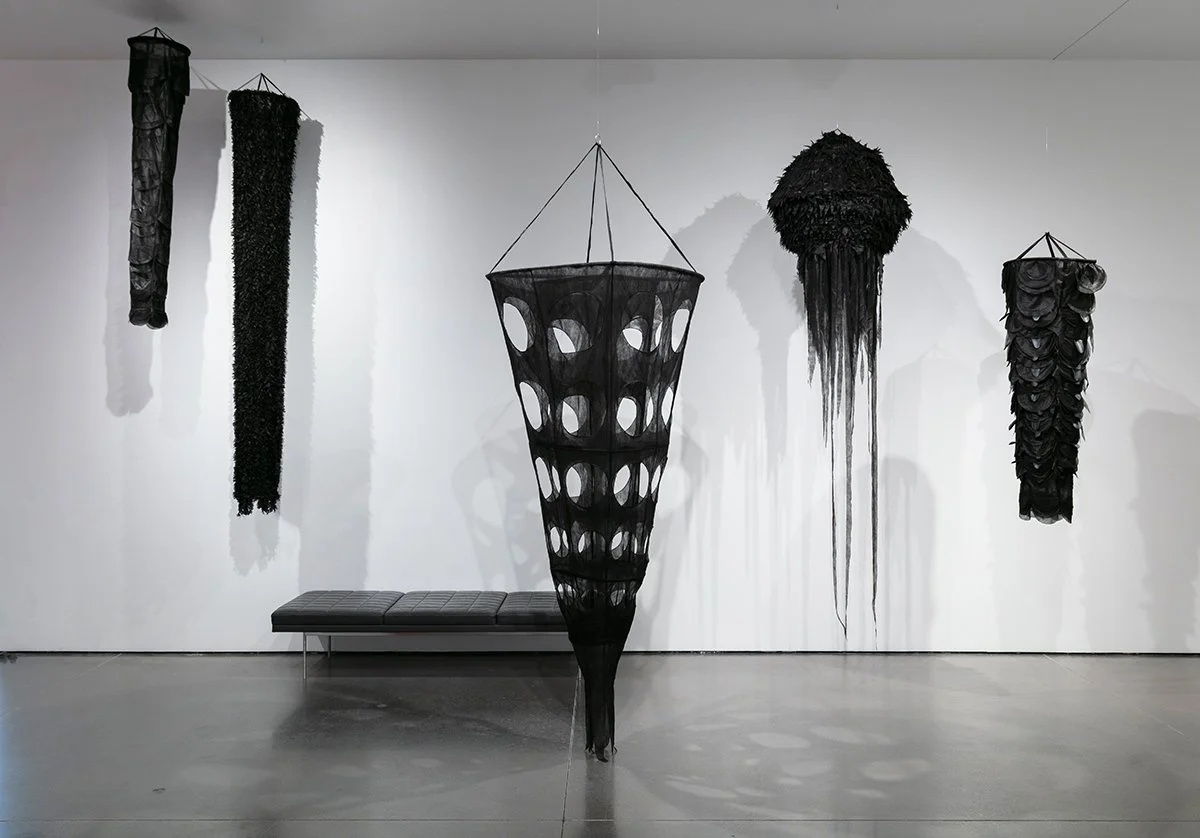
Nina Elder, Windsocks Series, 2025, erosion control fabric sourced from the Utah Department of Transportation, PVC, wire, and satin. Image courtesy of the Marie Walsh Sharpe Gallery of Contemporary Art.
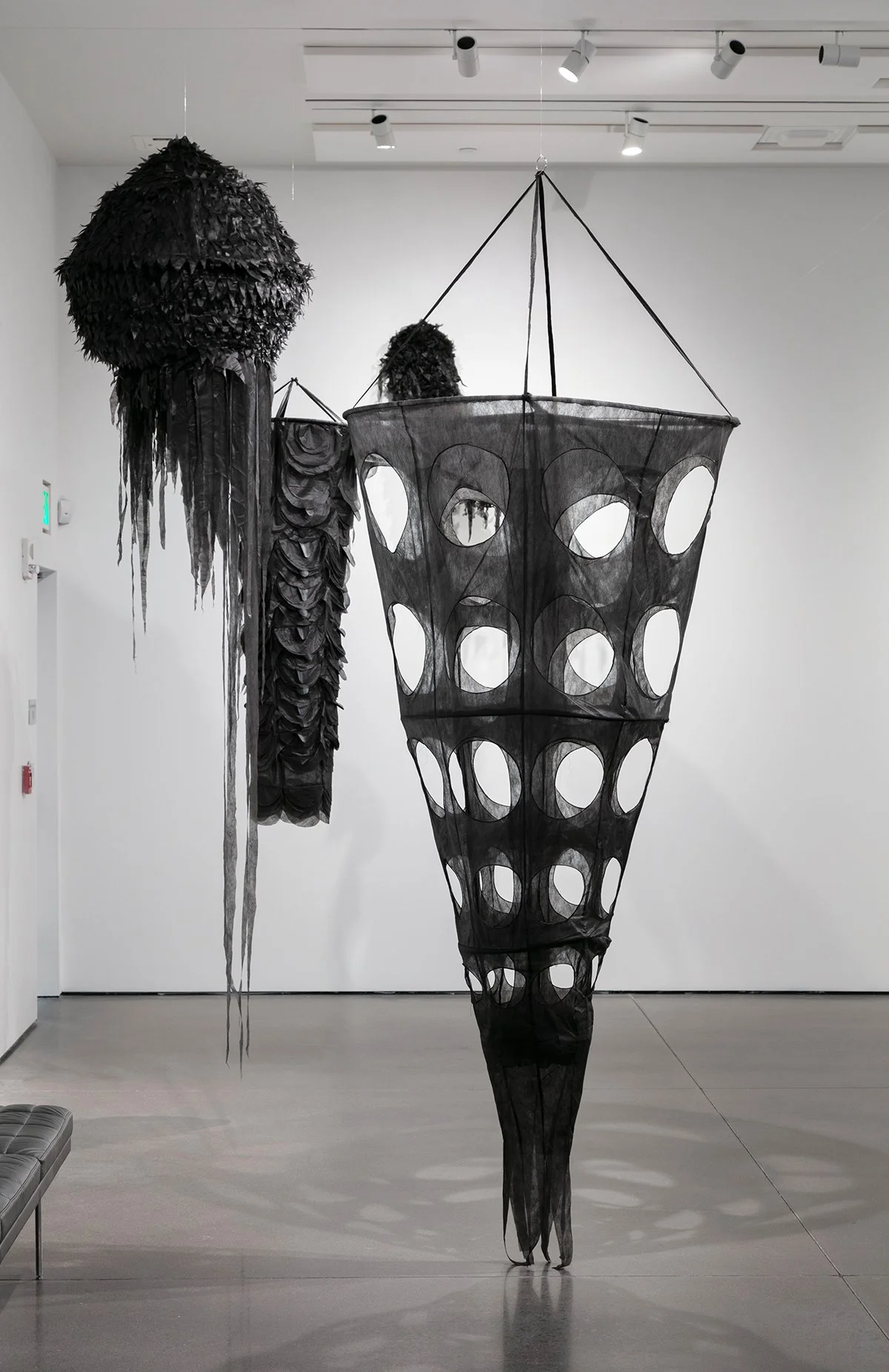
The Windsocks series carries a similar gravity, though here it is scale rather than material density that produces the effect; the works appear light and suspended yet assert a physical heaviness. They are conceptually heavy as well, deriving primarily from the artist’s use of erosion-control fabrics obtained from the Utah Department of Transportation.
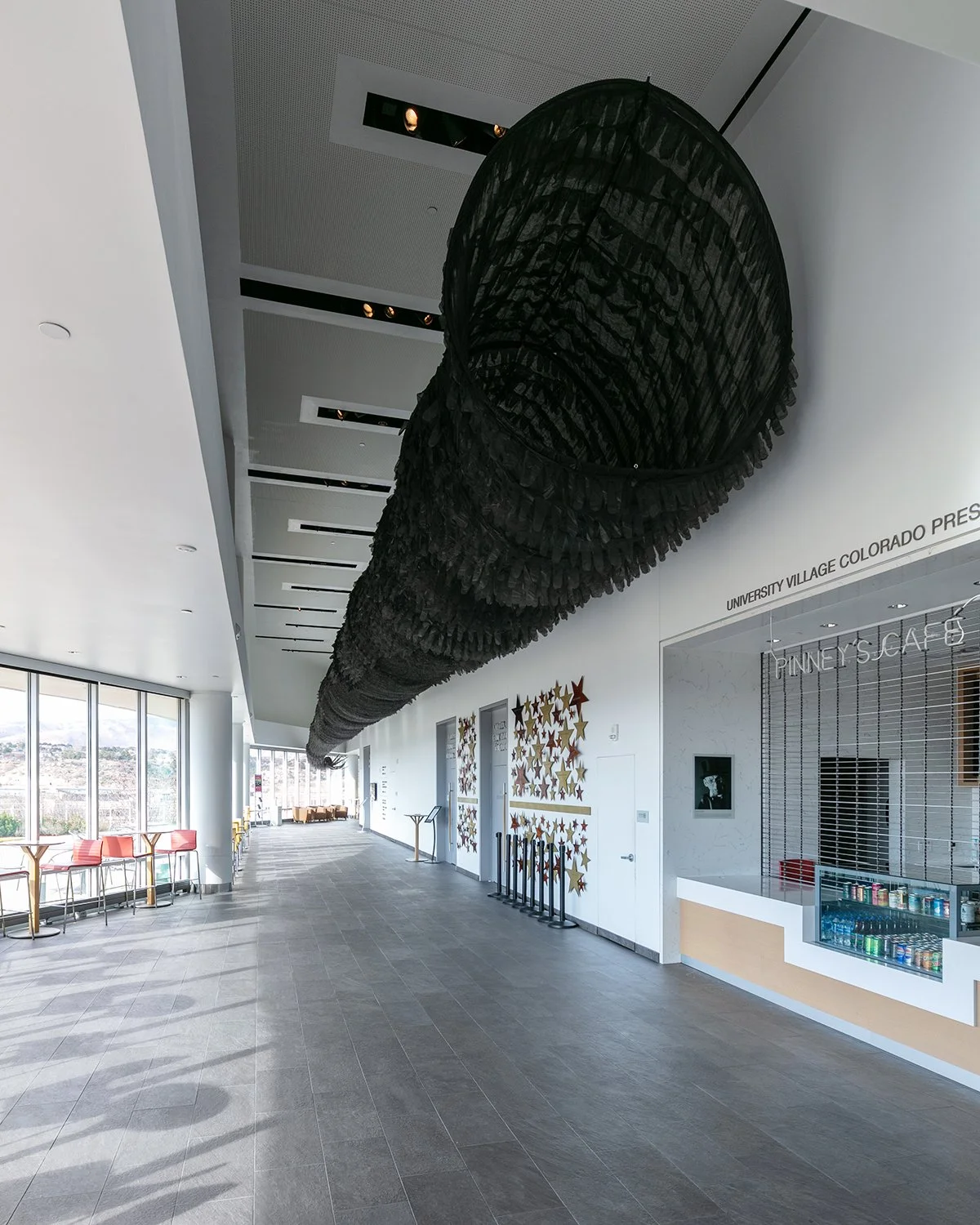
Nina Elder, The Source Never Diminishes, 2025, erosion control fabric sourced from the Utah Department of Transportation, PVC, wire, and satin. Image courtesy of the Marie Walsh Sharpe Gallery of Contemporary Art.
Though fixed in a moment of stilled flight, these objects quietly redirect attention to concerns unfolding on the ground. This is especially true of the monolithic windsock named after the exhibition and installed outside the gallery, which creates a tunnel that soars over a nearby hallway.
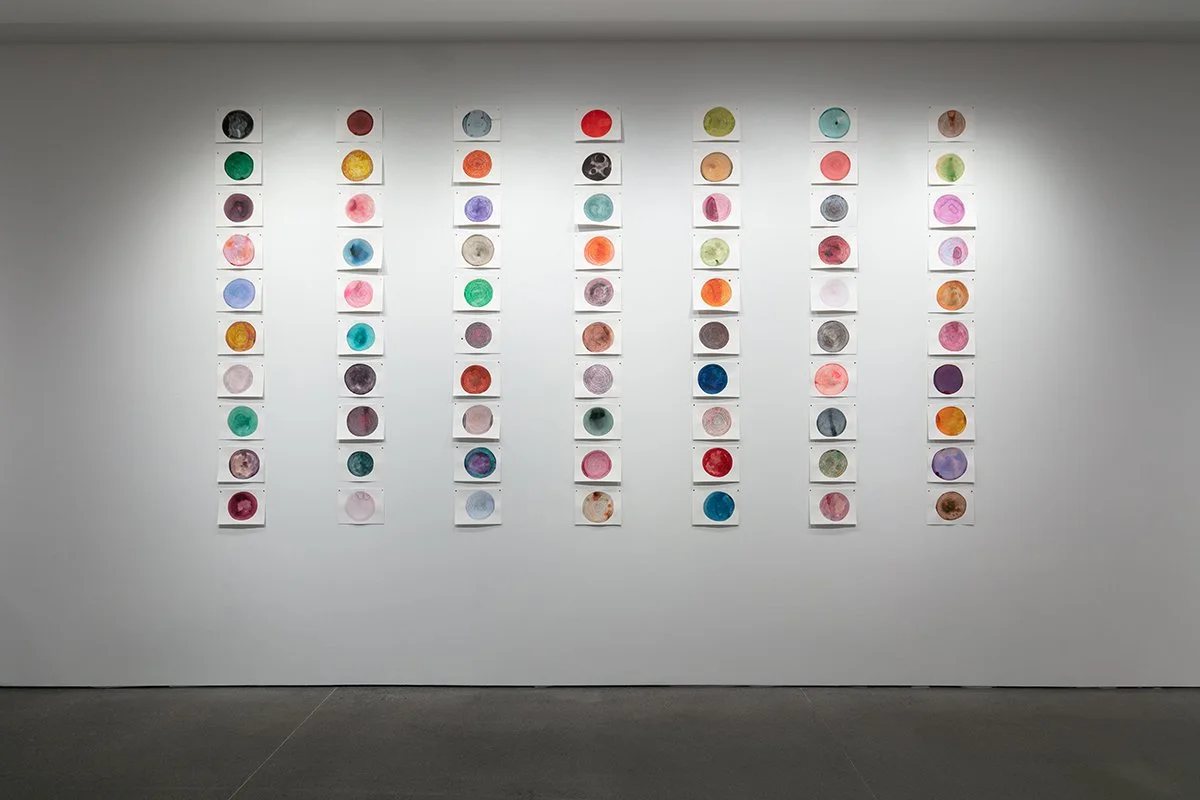
Nina Elder, To the Center, From the Center, 2025, watercolor, gouache, natural pigment, and ink on paper. Image courtesy of the Marie Walsh Sharpe Gallery of Contemporary Art.
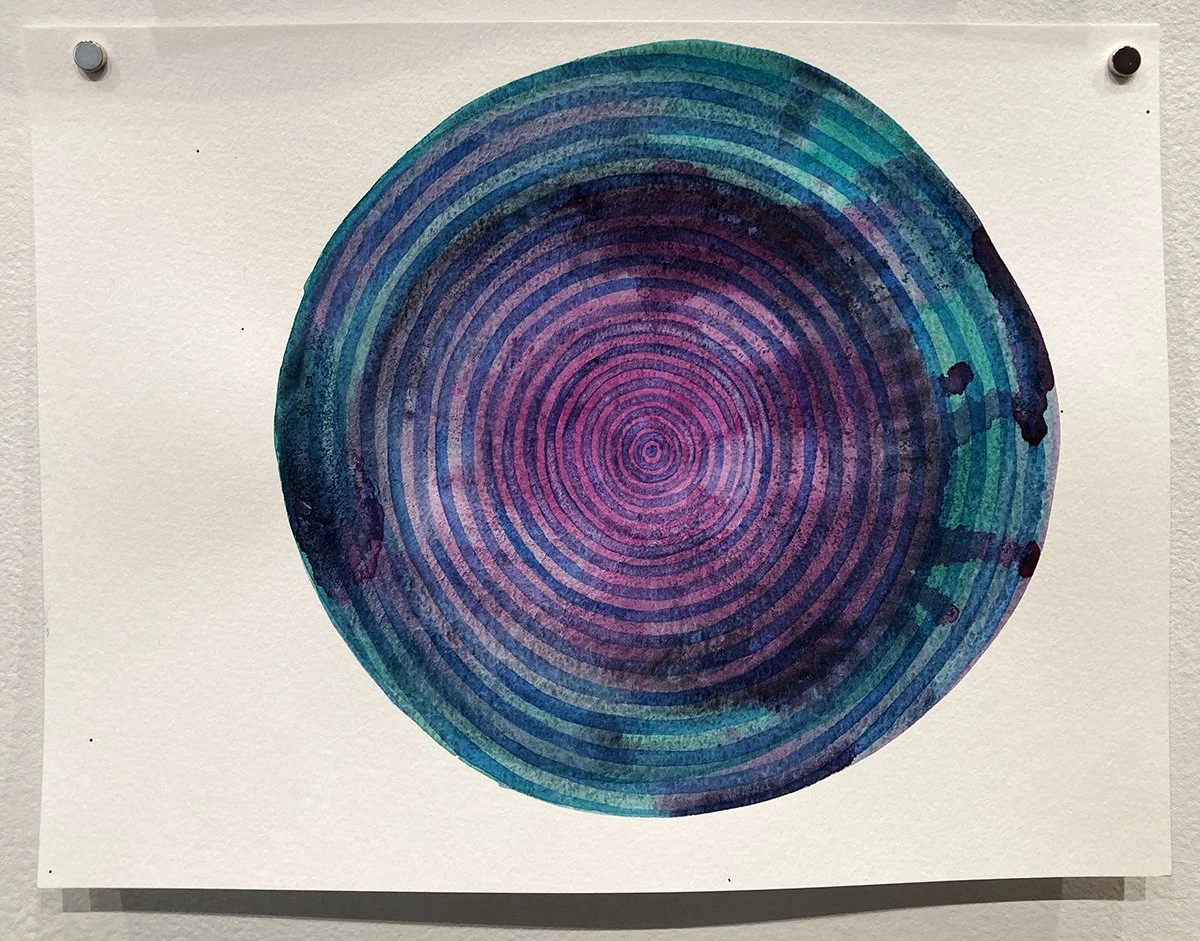
An individual painting in Nina Elder’s To the Center, From the Center, 2025, watercolor, gouache, natural pigment, and ink on paper. Image by Dani/elle Cunningham.
Offering a visual vacation from the darkness of Elder’s other work, a brightly colored grid of seventy watercolor, gouache, ink, and natural pigment paintings address topics consistent with the exhibition’s heady themes. Titled To the Center, From the Center, these repeated circular forms feature inner rings mirroring the rings of a tree while also evoking planets, ultimately functioning as a universal motif that reflects the artist’s exploration of meditation, infinity, and repetition across both micro and macro scales in nature.
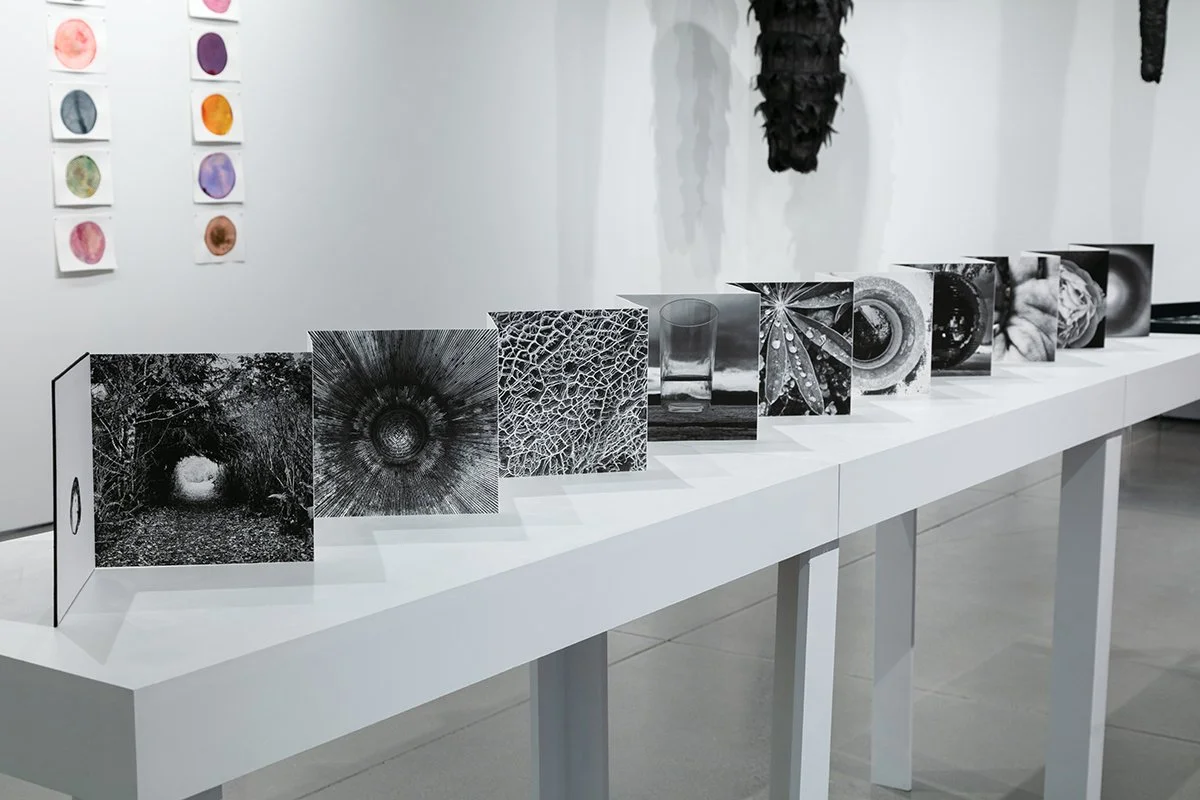
Nina Elder, Apop Epoch, 2023, handmade accordion book of 41 original prints and mirror-lined box, edition of 10. Image courtesy of the Marie Walsh Sharpe Gallery of Contemporary Art.
Apop Epoch, Elder’s thirteen-foot-long artist book, similarly reflects these themes, with its size as well as its images of naturally occurring patterns shot close-up and wide.
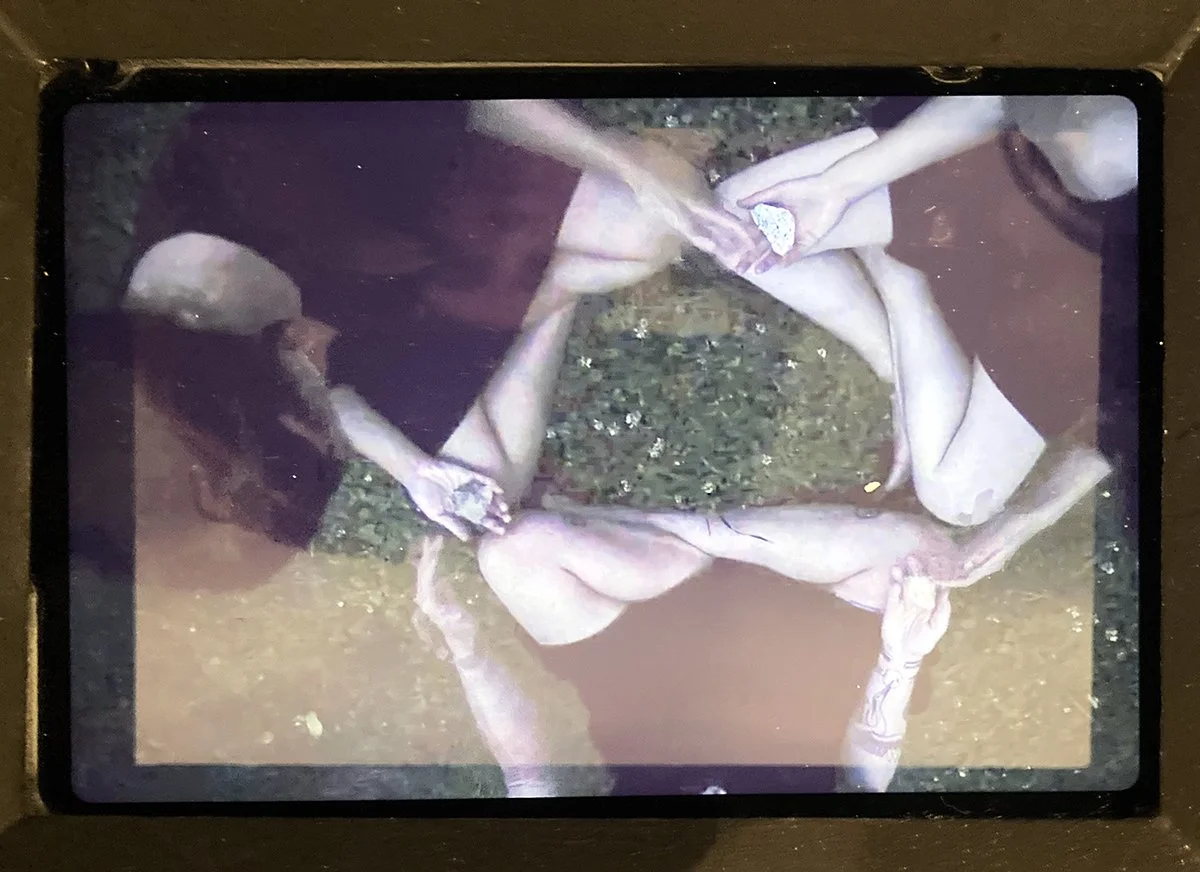
Nina Elder, Doing and Undoing, 2023, video with sound, 13-minute loop, featuring Connie Zheng, Esy Casey, and Nina Elder; sound: Darius Holbert. Image by Dani/elle Cunningham.
The exhibition’s videos further deepen Elder’s contemplative register: a small-scale video, Doing and Undoing, requires viewers to peer downward into a pedestal, as if witnessing a fleeting moment from another realm—a quiet snapshot of touch, exchange, and ritual between friends. Seated cross-legged in grass, the three figures pass an object rhythmically while slapping their hands on their legs, summoning for an unknown purpose.
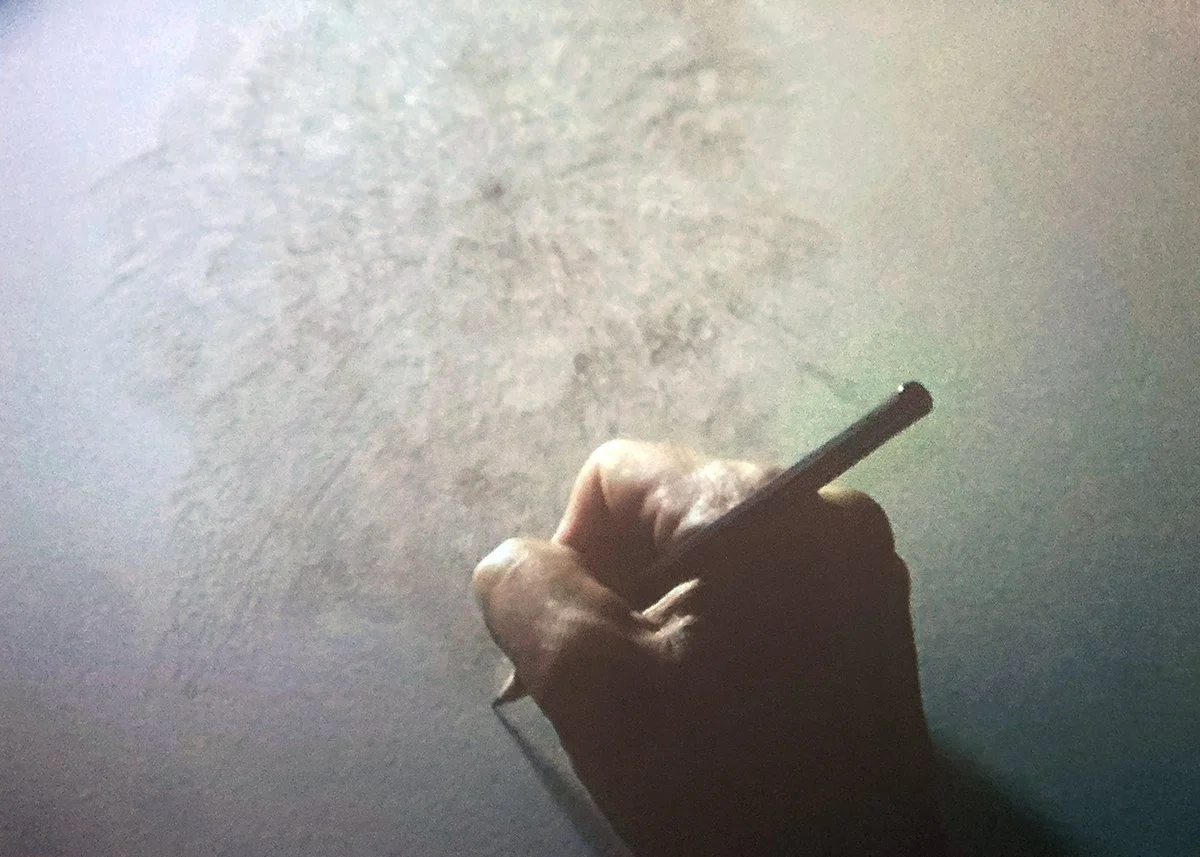
Nina Elder, Until It Is Done, video with sound, duration 30 minutes, featuring Ebony Frison, Genesis Turris, Laura Quintero Anton, Lucas Cantoni Jose, and Nina Elder; sound: Brian Amsterdam. Image by Dani/elle Cunningham.
Extending from this, the longer video, titled Until It Is Done, documents a meditative drawing practice, capturing the repeated construction of marks as individual parts that slowly become a whole.
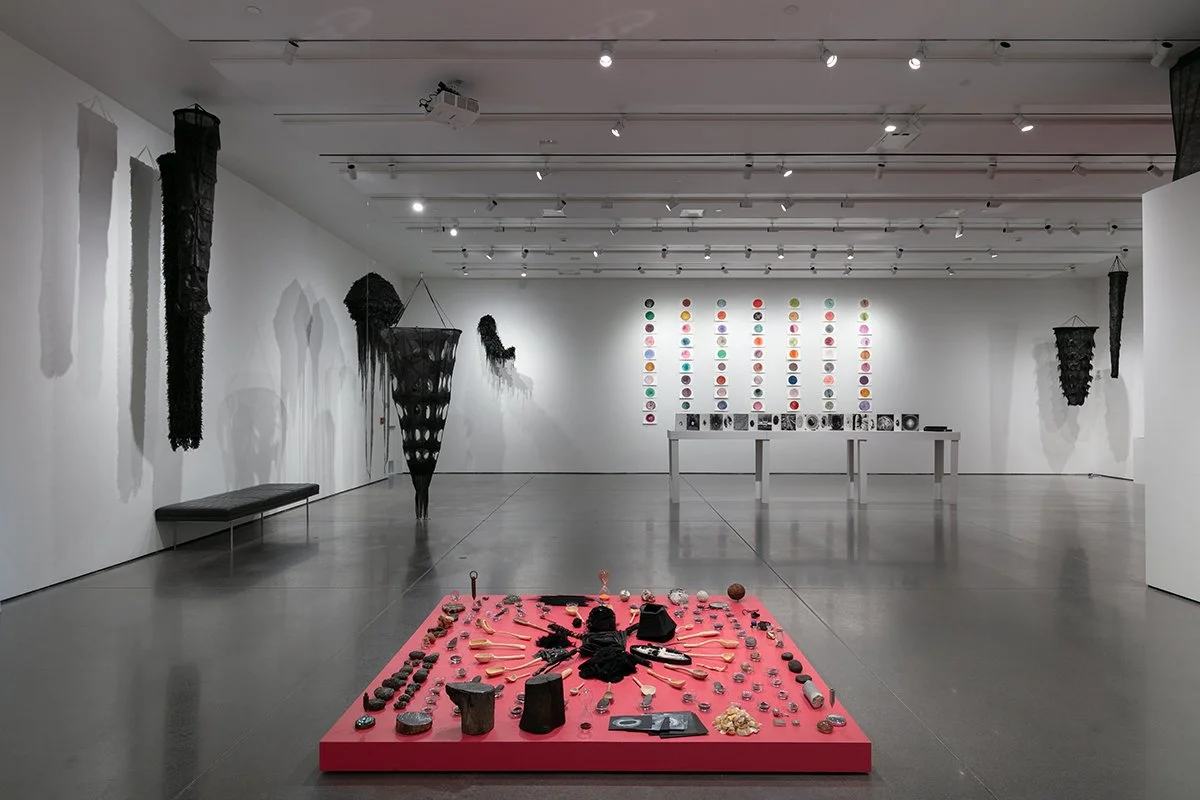
An installation view of Nina Elder’s exhibition The Source Never Diminishes at the Marie Walsh Sharpe Gallery of Contemporary Art. Image courtesy of the Marie Walsh Sharpe Gallery of Contemporary Art.
Across her first foray into sculpture and her established practices in drawing, painting, and video, Nina Elder’s exhibition demonstrates the profound interweaving of grief, memory, and transformation. Whether through destructive yet transformative objects like black holes, repetitive gestures that spin loss into creation through ritual, or perspectives that reveal the fragility and scale of the natural world, Elder consistently engages the viewer in acts of reflection and attentiveness.
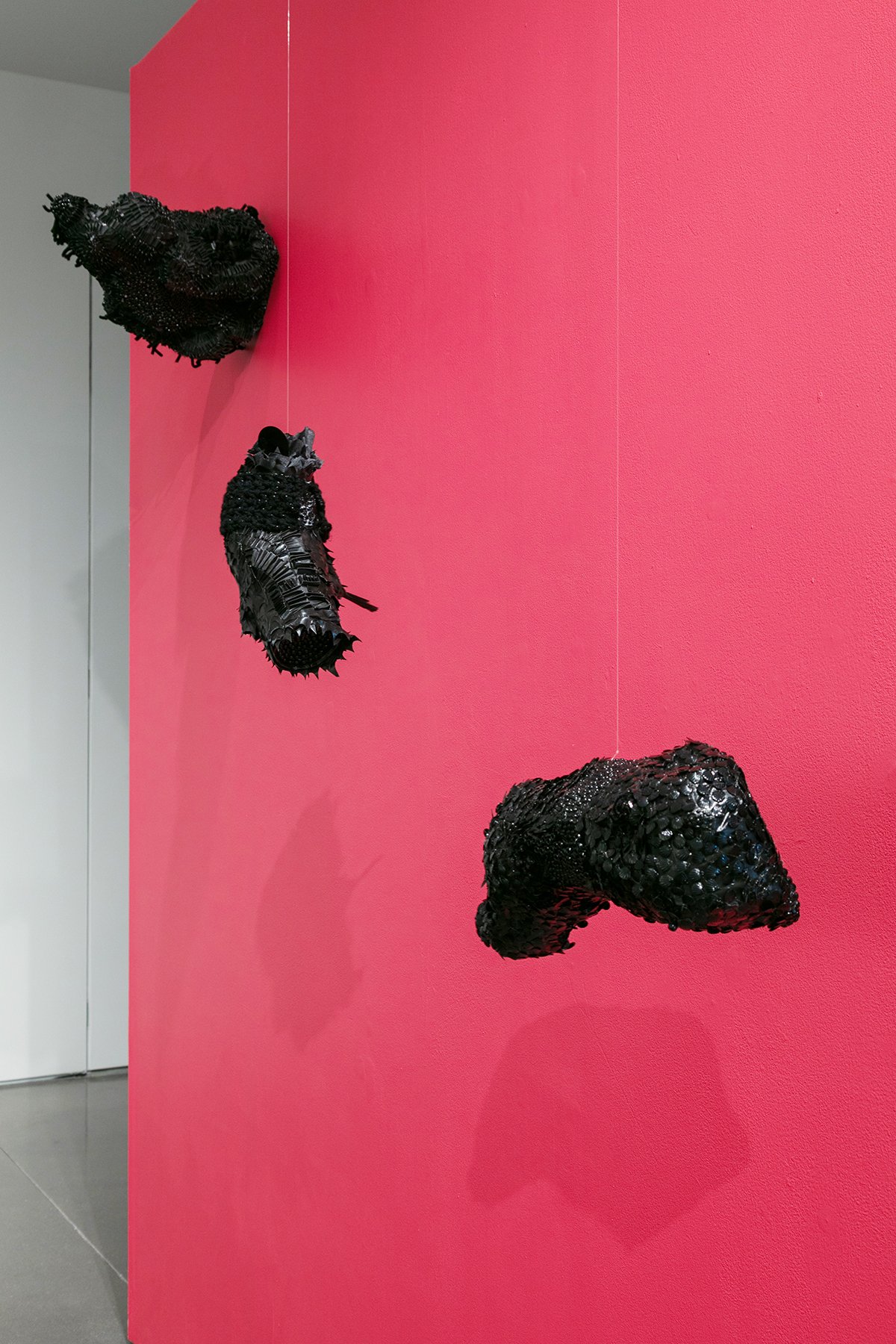
Nina Elder, Asteroids Series, 2025, trash, duct tape, sequins, feathers, hot glue, silk, trash bags, pipe cleaners, zip ties, papier mâché, and balloons. Image courtesy of the Marie Walsh Sharpe Gallery of Contemporary Art.
Her work balances material rigor with conceptual subtlety, showing how even the darkest subjects—nuclear impact, war, environmental degradation—can be rendered as spaces for growth, meditation, and unexpected beauty. Ultimately, the exhibition is a portrait of an artist fully attuned to the cyclical forces of destruction and regeneration, inviting audiences to witness the weighty and luminous traces of life all around us, and urging us to grow rather than recede or succumb to grief.
Dani/elle Cunningham (she/her) is an artist, scholar, and independent curator. She writes about science fiction, gender, sexuality, and disability, with an emphasis on mental illness. The co-founder of chant cooperative, an artist co-op, she holds a master’s degree in art history and museum studies from the University of Denver.
[1] Joy L. Armstrong, Ph.D., exhibition booklet, University of Colorado-Colorado Springs, Galleries of Contemporary Art.
[2] Ibid.
[3] Ibid.
[4] Ibid.