
Slopmaxxxing
Kyle Vincent Singer: Slopmaxxxing
Friend of a Friend
3575 Chestnut Place, Suite 112, Denver, CO 80216
September 12–October 18, 2026
Admission: free
Review by Kamden Hilliard
Kyle Vincent Singer’s work has appeared at Burning Man, Meow Wolf, and now his first solo exhibition, Slopmaxxxing, is up at Friend of a Friend gallery in Denver’s RiNo district. Singer's practice spans furniture, sculpture, painting, and wall-mounted works. The show articulates a "metabolic" art that consumes anything from McDonald's packaging to commercial-grade expandable foam as resources, ultimately suggesting possible methods of care under American hyper-consumption.
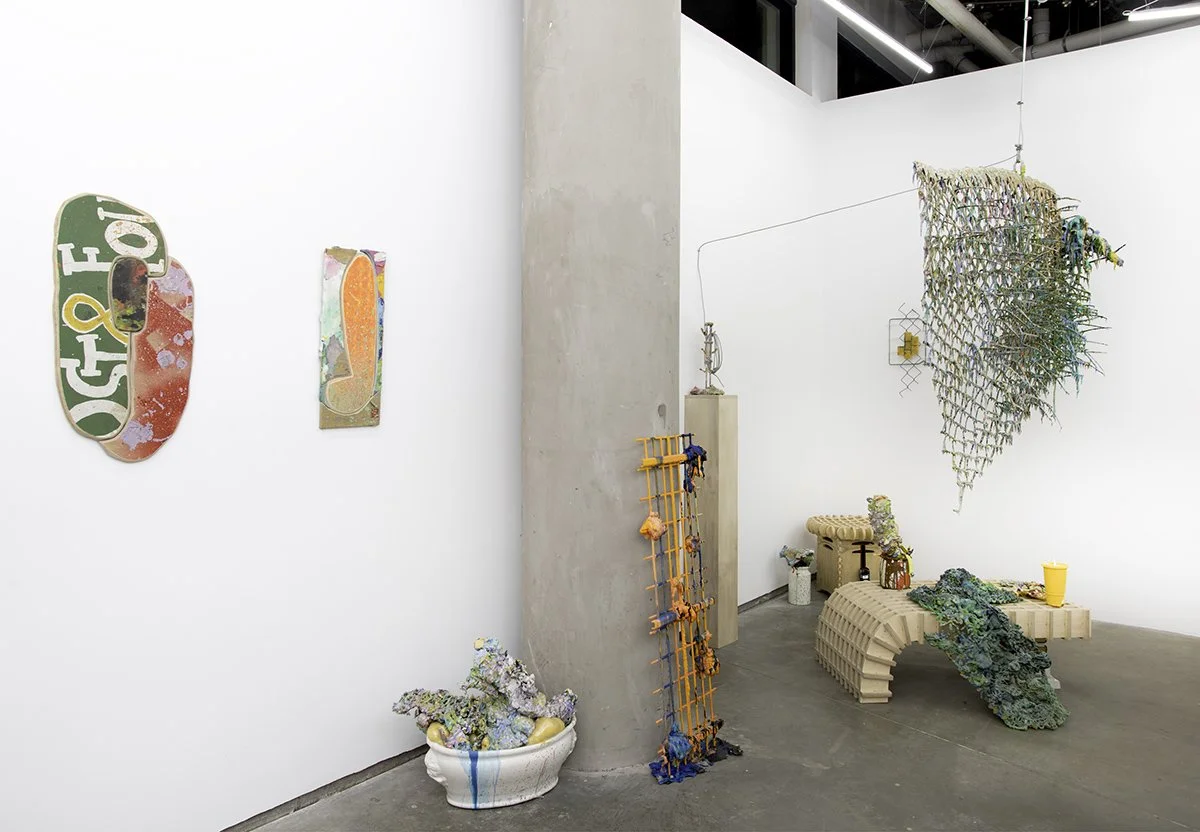
An installation view of Kyle Vincent Singer’s exhibition Slopmaxxing at Friend of a Friend gallery in Denver’s RiNo district. Image courtesy of Friend of a Friend.
Singer transforms Friend of a Friend with playful, aggressive, synthetic colors and additive, organic forms. A humor radiates from the show, suggesting that there is something funny, but that something is complicated by the show’s forms: by turns blob-like, geologic, ice-swept, staccato, functional, organic, sad, and entirely otherworldly.
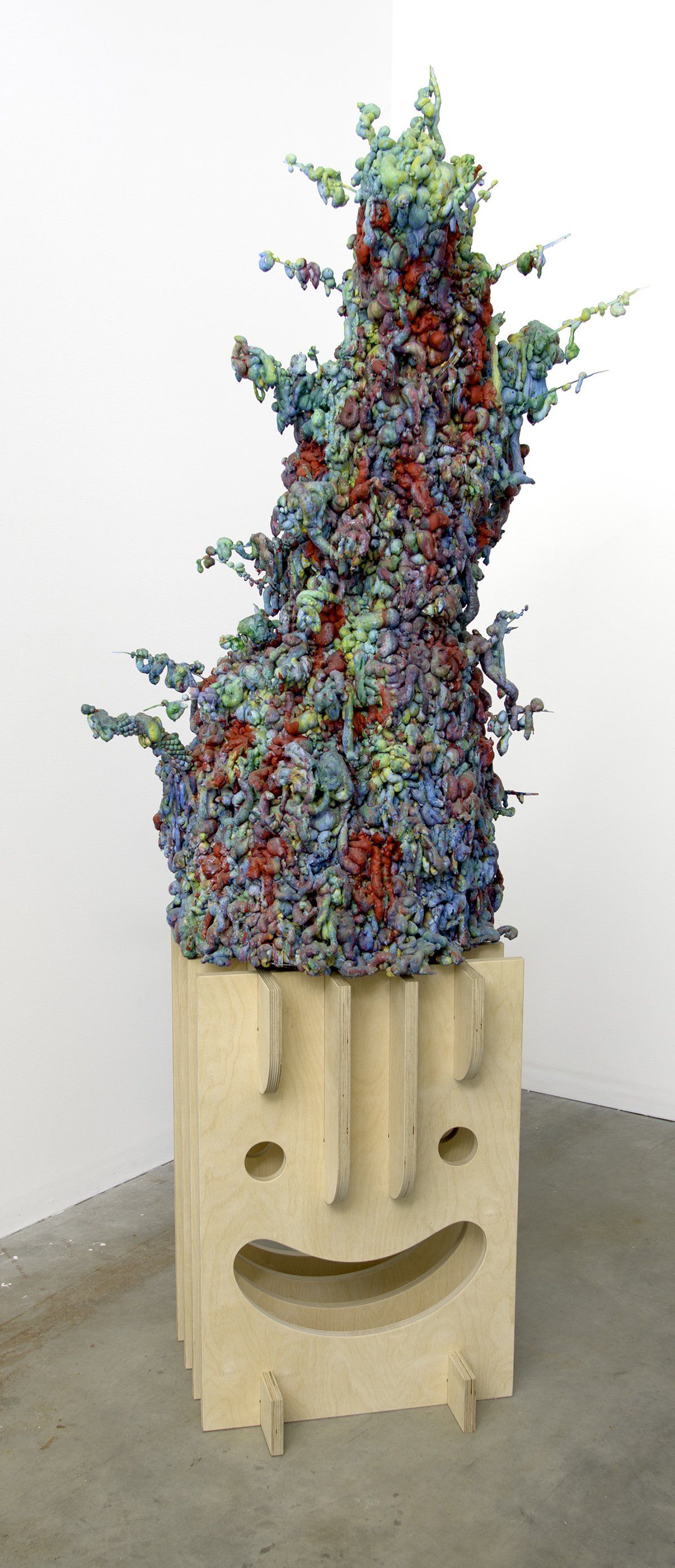
An installation view of two works by Kyle Vincent Singer, below: Standing Piece with Waffle Cone Club, foam, paint, and plywood, 60 x 24 x 24 inches; above: Untitled Foam Piece, foam and paint. Image courtesy of Friend of a Friend.
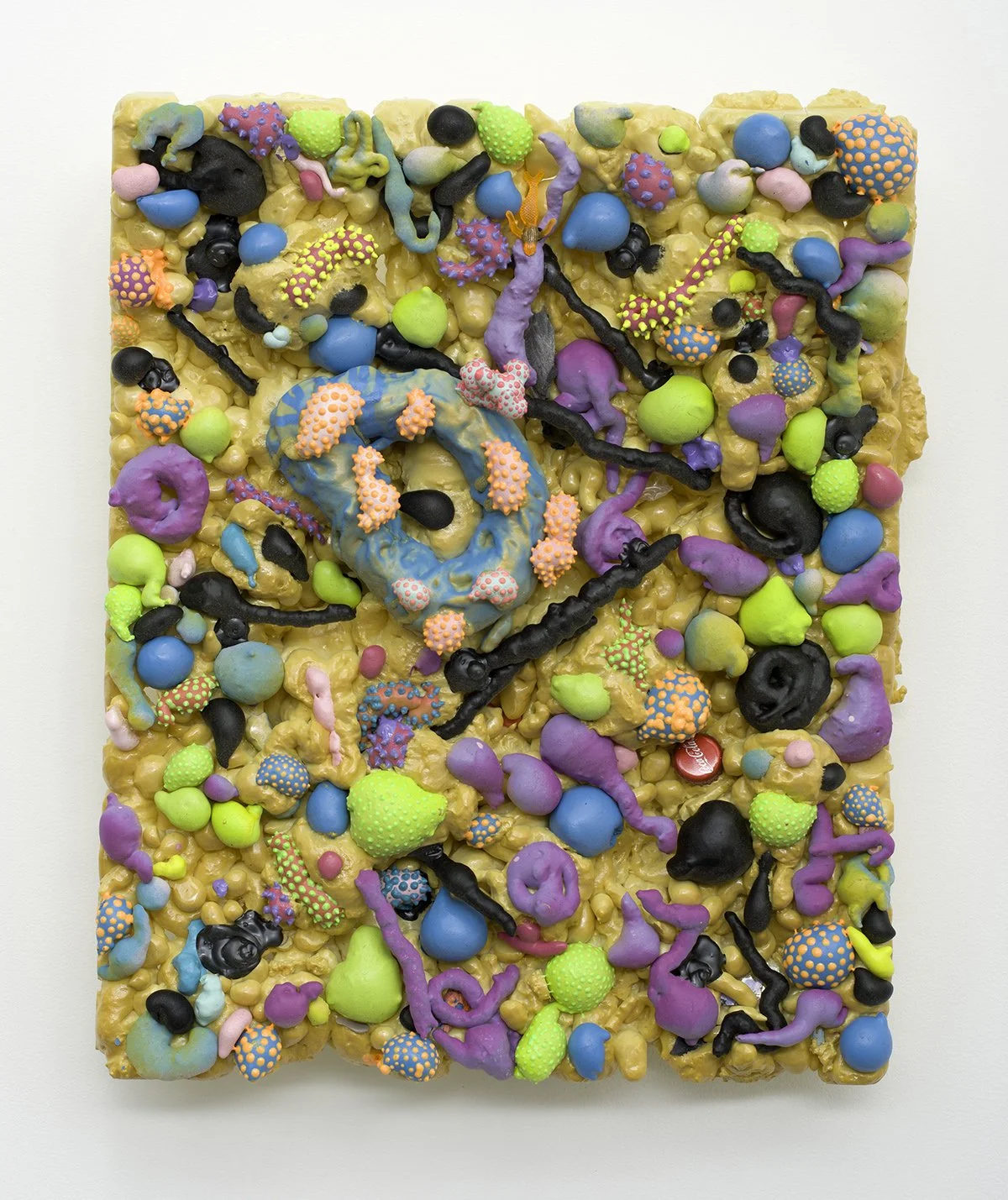
Untitled Foam Piece is a slug-like, topiary/cone-shaped form of Good Stuff and acrylic paints that look like a toxic, artificial croquembouche. The work suggests delectability, but it might be poison.
What, after all, is yellow, blue, red, green with bauble-shaped growths alongside stiff multicolor peaks and whiskers? Maybe something from novelist Jeff Vandermeer's Southern Reach Trilogy, a scene from filmmaker Tim Burton’s Alice in Wonderland, a Wonka factory reject, or an actual extraterrestrial? This organo-industrial mound sits atop Standing Piece with Waffle Cone Club, a plywood, CNC-cut, tongue and groove stand. The simple joinery and natural wood contrast with the piece above.
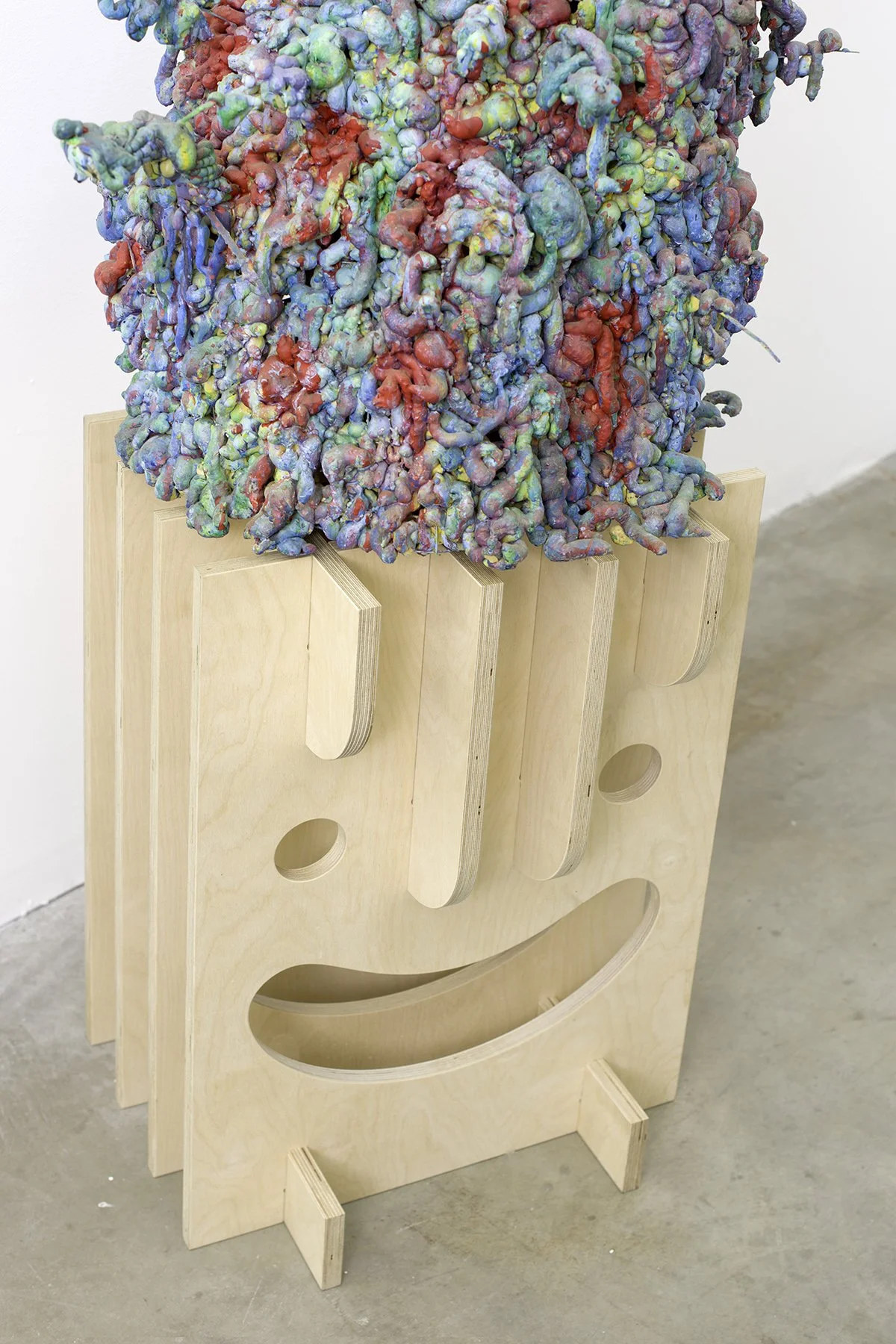
A detail view of two works by Kyle Vincent Singer, below: Standing Piece with Waffle Cone Club, foam, paint, and plywood, 60 x 24 x 24 inches; above: Untitled Foam Piece, foam and paint. Image courtesy of Friend of a Friend.
If Untitled Foam Piece speaks to the contemporary fusion between the natural and the industrial, Standing Piece with Waffle Cone Club speaks to the complementary natures of structure and play. This piece is durable and exacting, but it also has a silly smile cut-out on all four bottom panels. This fusion of projects is a well-placed welcome to the show, and the show is welcoming.
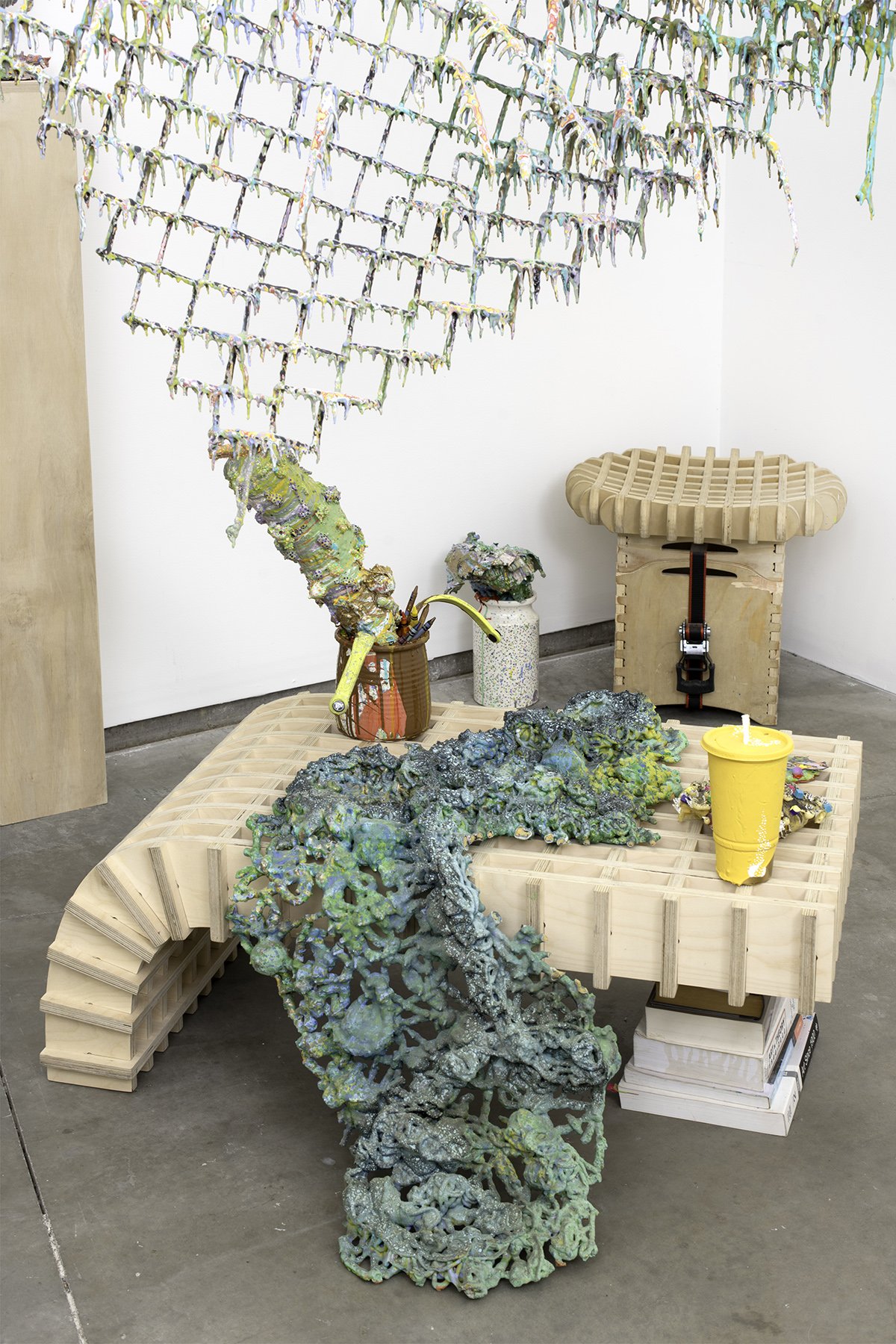
A view of multiple works in Kyle Vincent Singer’s exhibition Slopmaxxing. Image courtesy of Friend of a Friend.
Slopmaxxxing is homey, den-like, in its installation. The space feels occupied not just by art, but by life. Even the composition here suggests a coffee table and sitting area. A cup on the table, a centerpiece, a kind of chandelier, and all of them are complicated by Singer's playful sense of repetition and hyper-consumption. The cup is made of layers and layers of acrylic paint, the centerpiece burbles and slouches right off the table, and the artist has dipped a section of fence in an incredible number of coats of acrylic paint. The setting continues to complicate with Waffle Table and Waffle Stool.
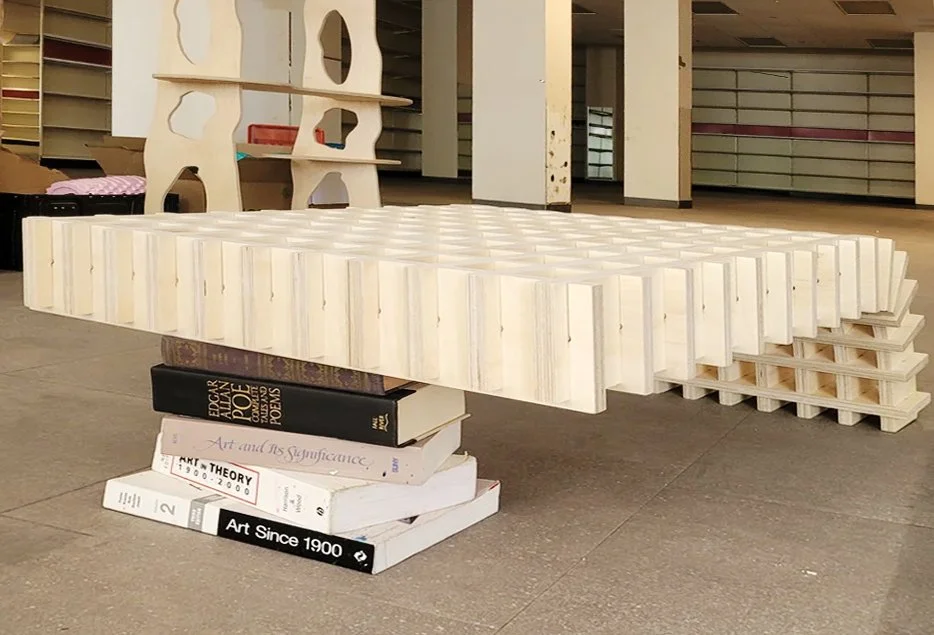
A view of Kyle Vincent Singer's Waffle Table, plywood and art history books, 48 x 24 x 18 inches. Image courtesy of the artist.
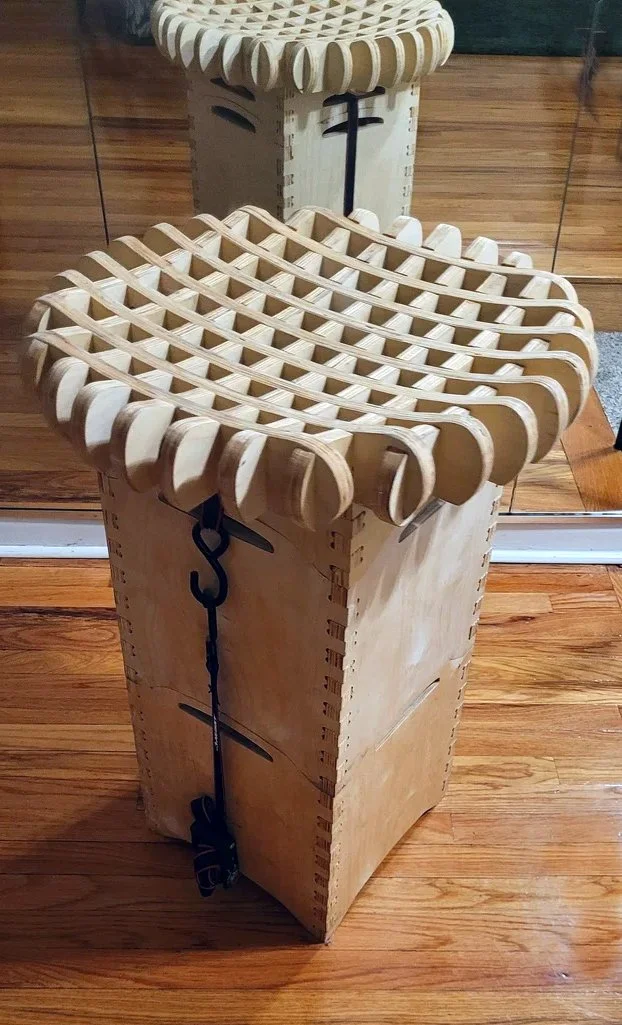
A view of Kyle Vincent Singer's Waffle Stool, plywood and strap clamp, 24 x 18 x 18 inches. Image courtesy of the artist.
Singer produced these pieces through his Waffle Cone Club. Unlike the rest of the exhibition, which focuses on the playful elements of the work, the furniture is functional, but funky. Waffle Table and Waffle Stool are curvy, voluptuous, plain, and perfectly cut. They help to ground the show with displays of technical knowledge and craftspersonship; also, they make a charming argument for the practicality of play, of beauty, and of joy in design.
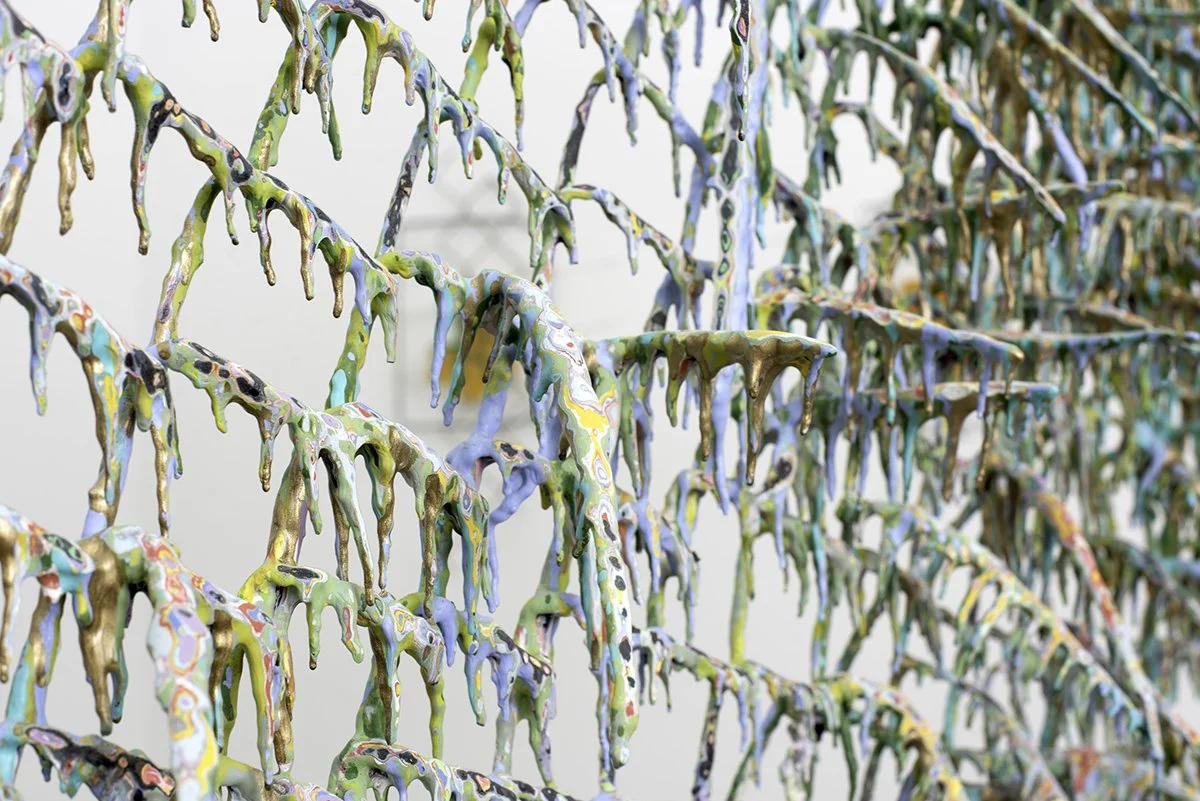
A detail view of Kyle Vincent Singer's BIG Fence, zip ties, foam, acrylic paint, and chain link fence. Image courtesy of Friend of a Friend.
In BIG Fence, the artist creates psychedelic, icicle-like quills through repeated applications of acrylic paint. The labor and time required to apply paint, wait for it to dry, and do it again could feel aimless, but by offering it an embodied form, that time and labor become part of beauty's arrival in the world. And how can that time and labor feel? Well, the Lisa Frank-level of enthusiasm speaks to the possibility of daily joy, while the accumulation of time, material, and color speak to the overwhelming and concerning volume of life there is to live. Singer's tragicomic tone could be exhausting, but it is grounded by questions of editing, skill, and beauty.
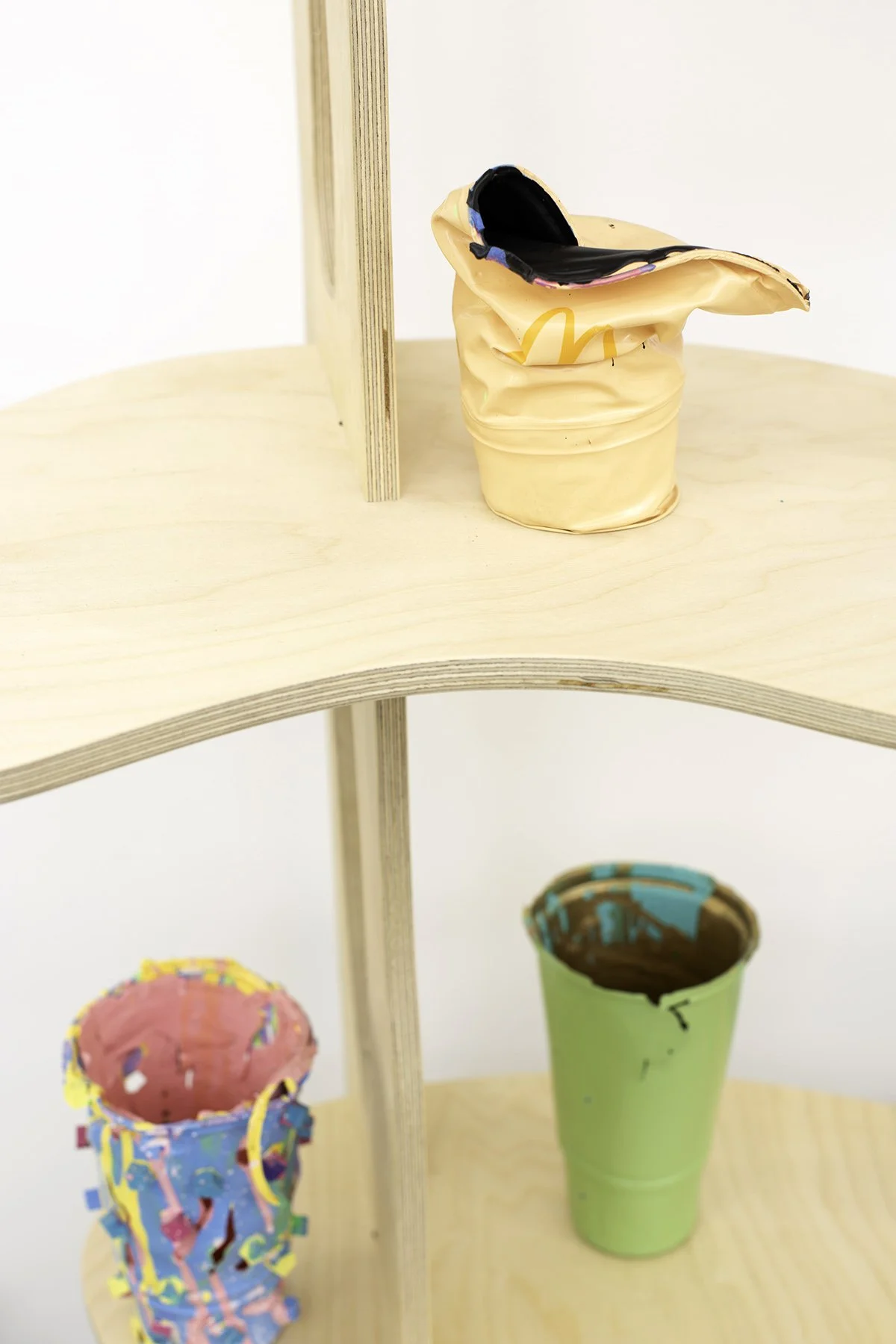
Kyle Vincent Singer, Cups, acrylic paint, dimensions variable. Image courtesy of Friend of a Friend.
Cups is a series of McDonald's cups made of acrylic paint pours using the original cup as a mold. Most of the time, the cups are semi-solid, with a bit of bend, but in warmer conditions, those same cups melt, frown, and fall like broken accordions. They are charming as replicas, as branding devices (some of the branding on the cup transfers to the final pieces), but also speak to the waste, repetition, pleasure, and outcomes related to consumption.
As Singer states in press materials for the show, "Each neon dot is a bicep curl. Every squeeze of the Great Stuff can is a deadlift. And each paint pour a calf raise." [1] To take his word for it is to understand his art not as just evidence of action, but a kind of safety valve for the contradictions, difficulties, and other confusions of contemporary life.
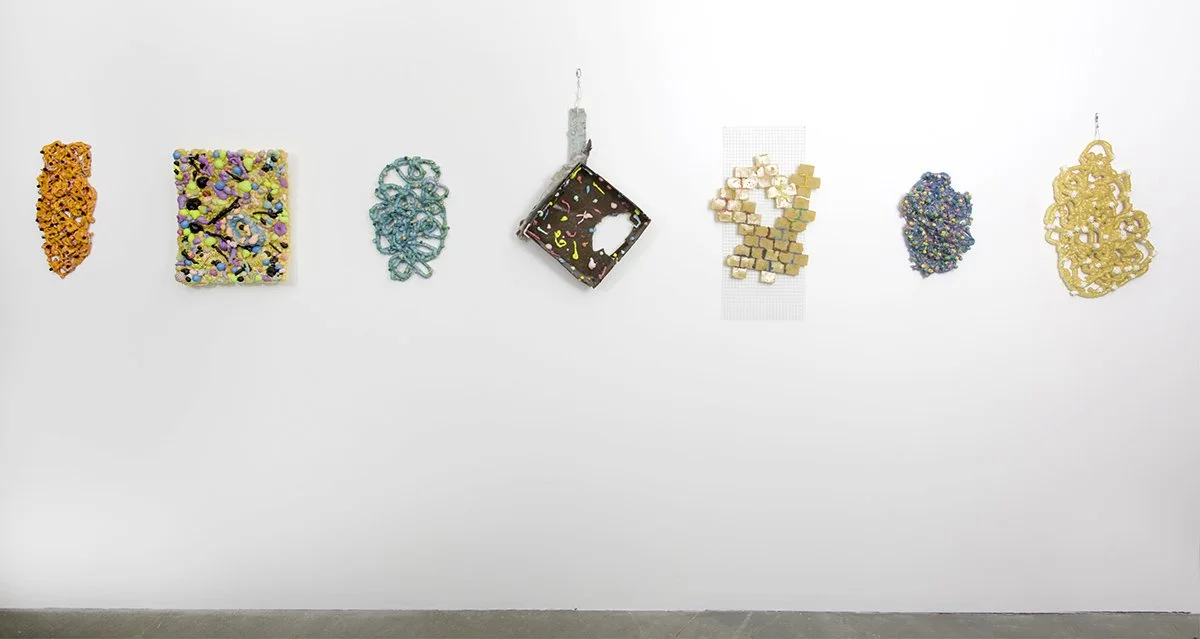
An installation view of Kyle Vincent Singer’s long wall series, various materials, each approximately 24 x 15 inches. Image courtesy of Friend of a Friend.
In more composed works, such as the long wall series, Singer's maximalist instincts align with more traditional compositional ideas. The wall-mounted pieces have a more customary sense of balance and color, allowing for a lower energy engagement that makes clear Singer's rejoinder to the questions of hyper-consumerism. If the work becomes a place to articulate the maximalism of a culture capable of printing hundreds of billions of standardized McDonald's bags, it also becomes a place to rehearse disidentification, stoppage, and editorial control.
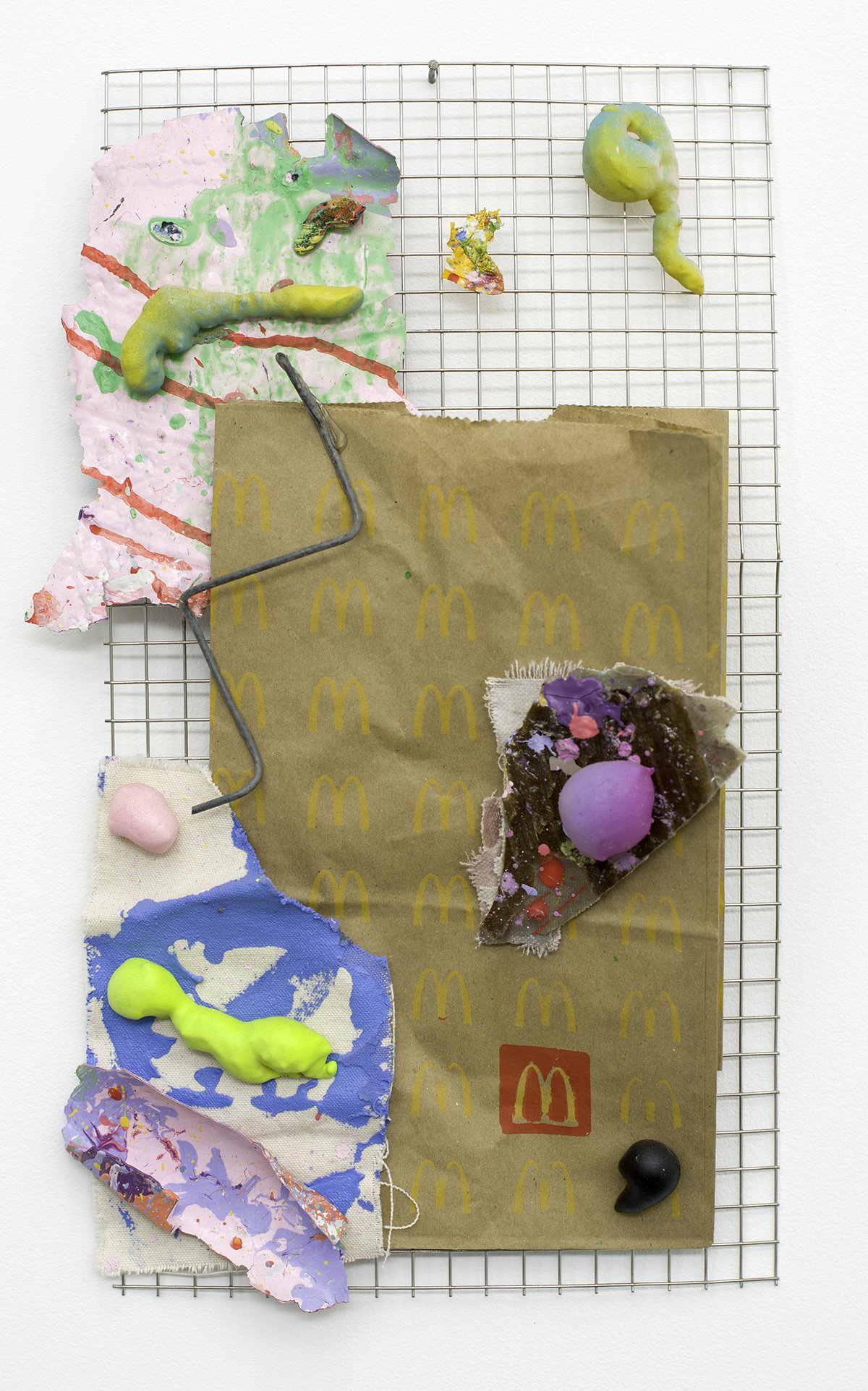
Kyle Vincent Singer, Wire and McDonald’s Bag, wire mesh, canvas, McDonald’s bag, paint, foam, and chain link fence fragment, 16 x 12 inches. Image courtesy of Friend of a Friend.
For Wire and McDonald’s Bag, collage invokes questions of juxtaposition, color, and form, which Singer answers with that same editorial eye mentioned above. He attaches the found McDonald's packaging somewhat haphazardly, allowing the bag to hang forward and shudder with whatever winds may come. The wire backing involves the gallery space in the composition. The white coming through balances and unites the tonal ecstatics of the piece.
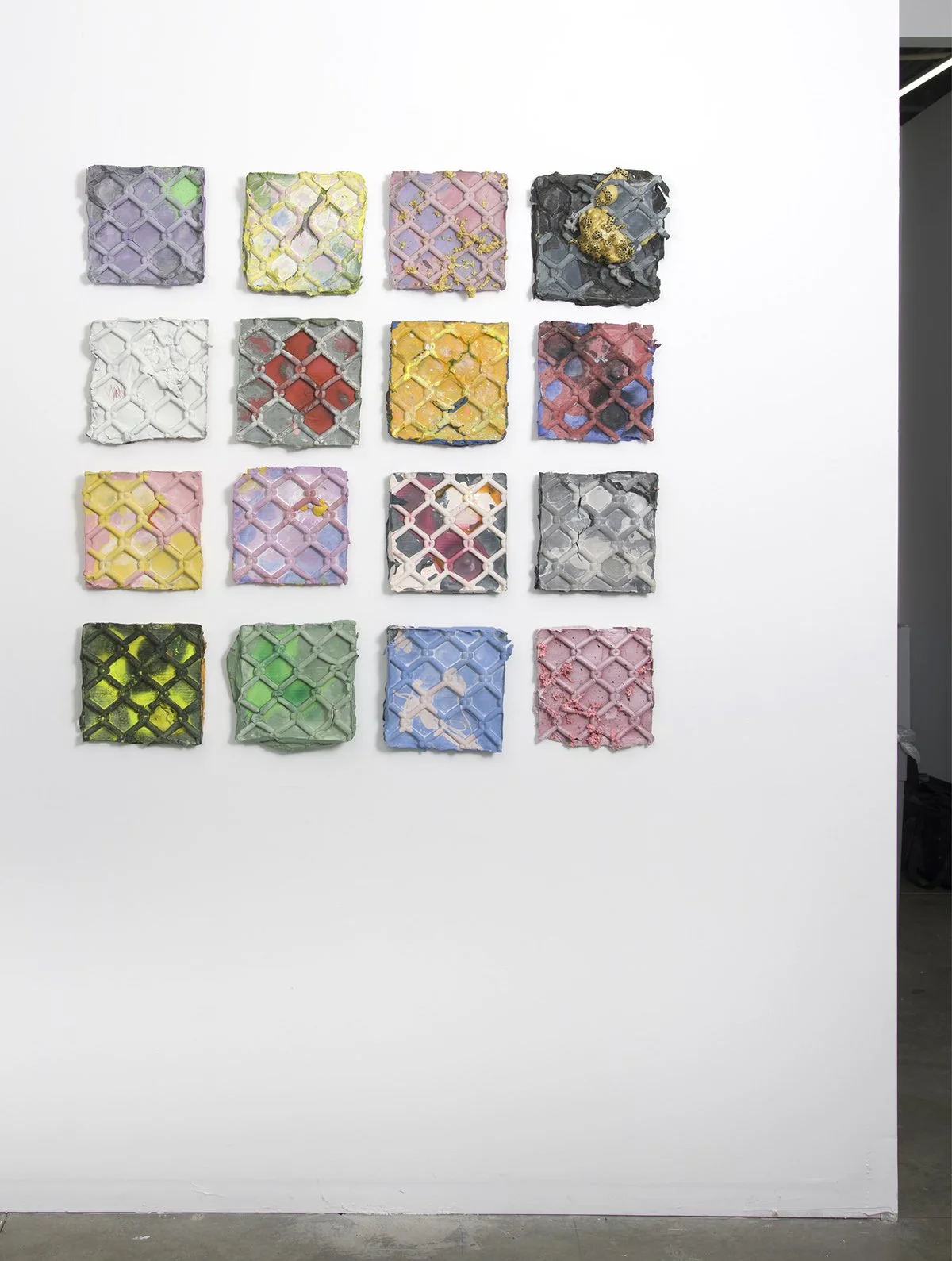
Kyle Vincent Singer, fence bricks, acrylic paint, 10 x 10 inches each. Image courtesy of Friend of a Friend.
Repetition structures the fence bricks series. Singer made paint after paint pour to produce the wall-hung relief sculptures. The variation in color, the physical bricks themselves, and the repetition at work start to suggest one way out of dehumanization: to try again, to reiterate, or to get back on the proverbial horse.
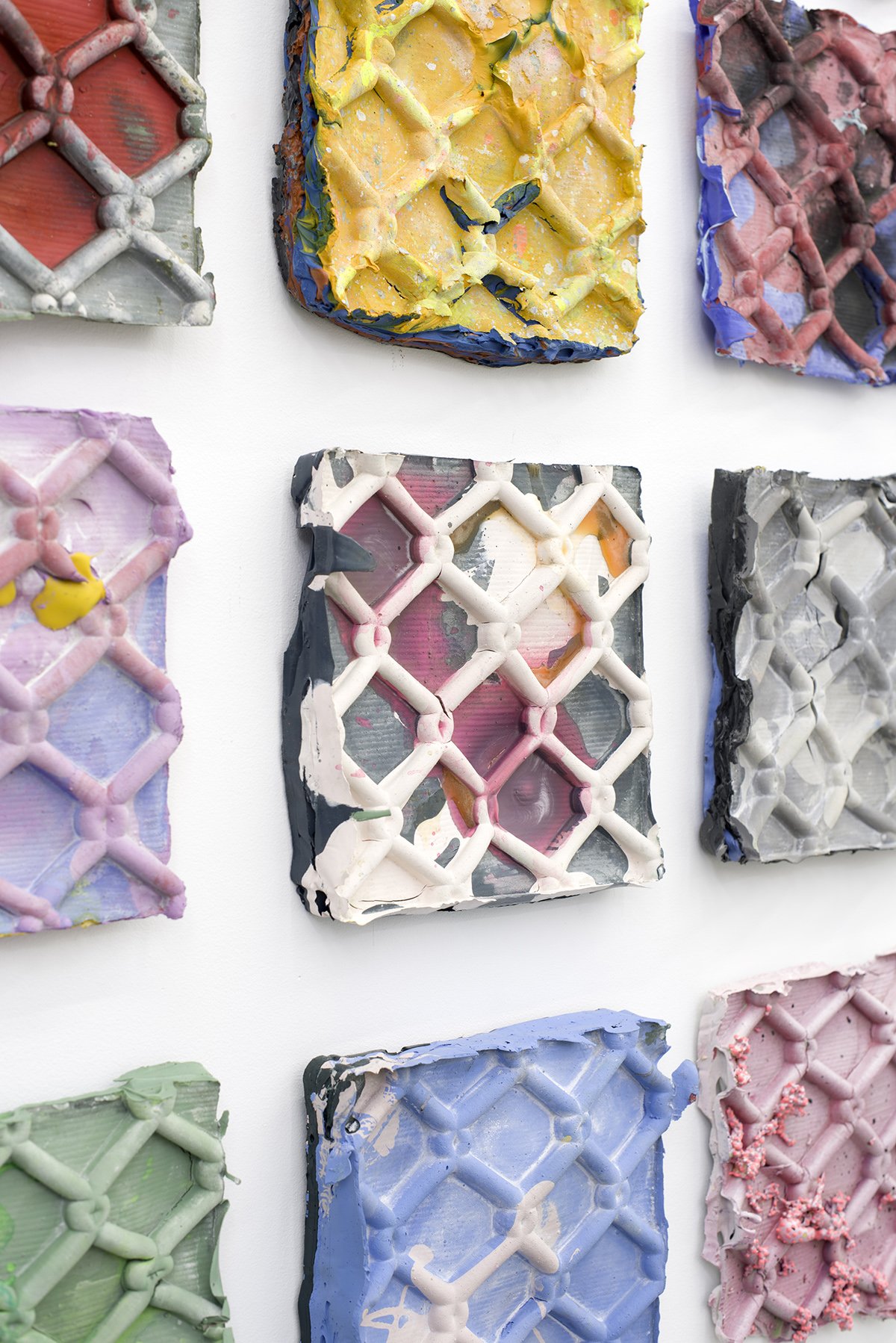
A detail view of Kyle Vincent Singer, fence bricks, acrylic paint, 10 x 10 inches each. Image courtesy of Friend of a Friend.
Singer's repetitions become a rehearsal for life under these conditions, and their multiplicity speaks to the fruitful possibility of having just one more shot to get it right, to say it again, to focus on the technique of the next rep, or find the place to stop.
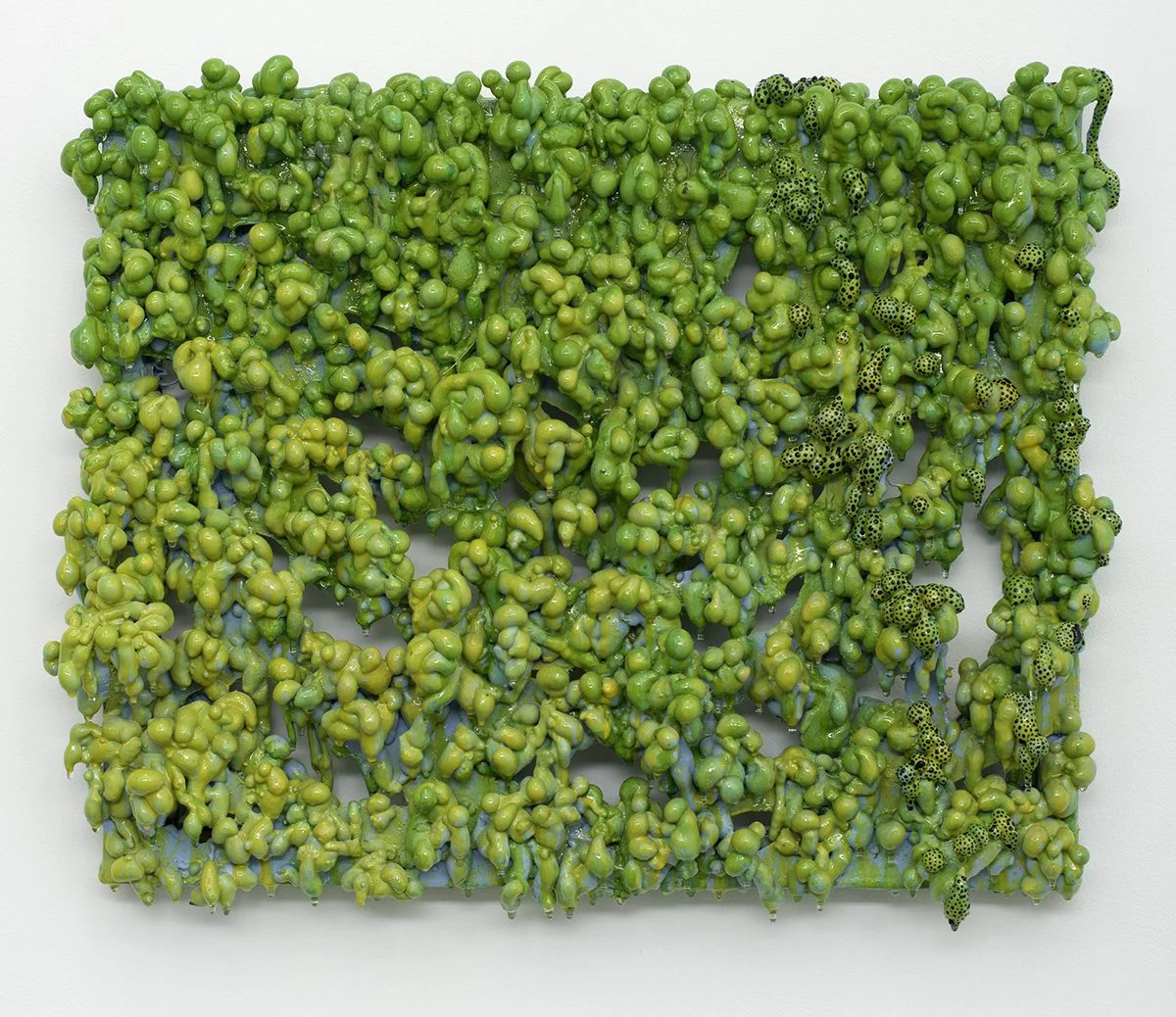
A detail view of one work in Kyle Vincent Singer’s long wall, various materials, approximately 24 x 15 inches. Image courtesy of Friend of a Friend.
Inversely, maybe there is an "ultimate question" for each of us to answer in this world, and there is one answer to this question. For Douglas Adams in Hitchhiker’s Guide to the Galaxy, the answer is "42." [2] For Singer, his works feel like individual answers to the world: specific, strategic, material engagements that express one singular thought: say, blue. Or green. Or pockmarked. Or smooth. Even the structures of his repetition begin to suggest that each rep, each paint pour, is part of Singer's answer to this world.
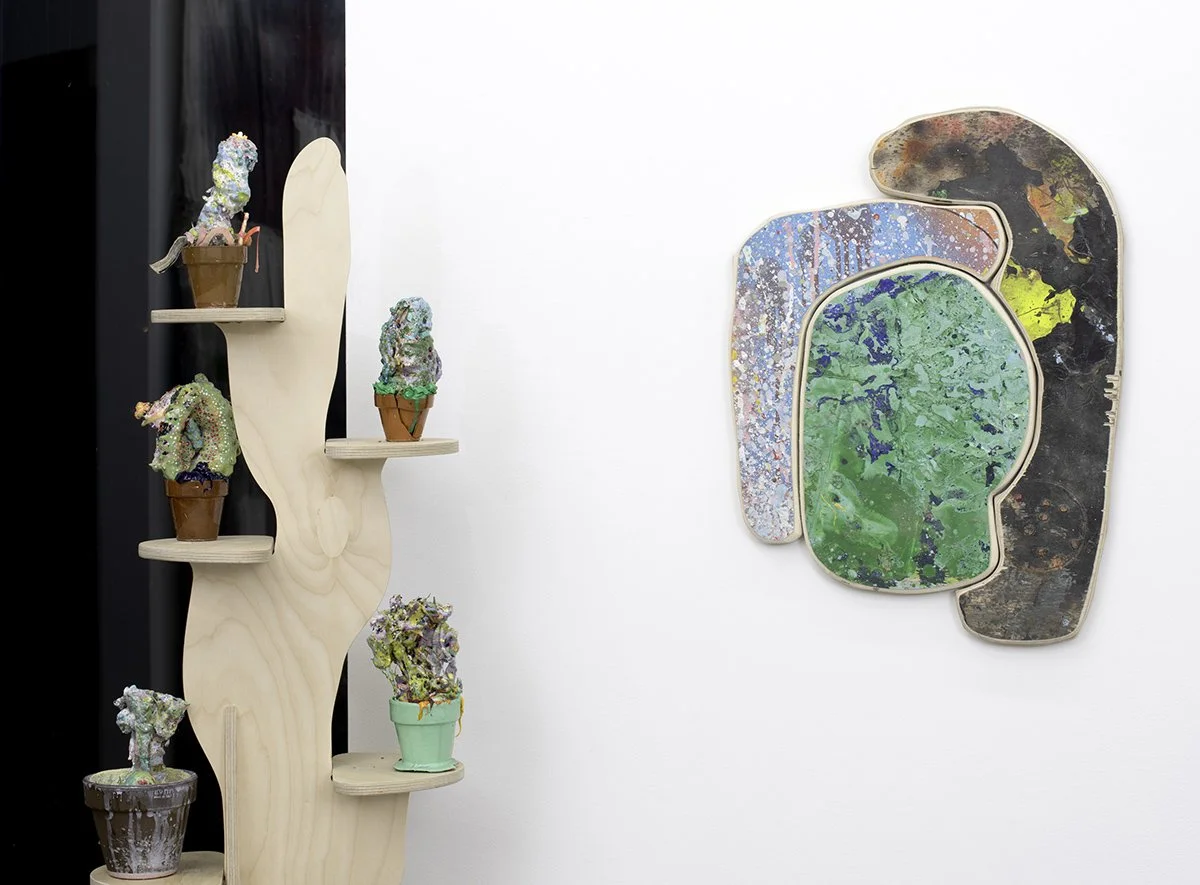
An installation view of Kyle Vincent Singer’s exhibition Slopmaxxing. Image courtesy of Friend of a Friend.
Singer's practice is not glob on glob, but rather a question of restraint. Ever iterative, never satisfied, desirous markets have infiltrated all other chambers of life and, if Singer's work is indicative of a potential response, perhaps one should reject consumerism and make a dignified life under its regime. Industrial food systems feed billions of people and create long-term health consequences.
On the theoretical end, Singer seems to exercise José Esteban Muñoz's edict: "The here and now is a prison house. We must strive, in the face of the here and now's totalizing rendering of reality, to think and feel a then and there" [3]. Singer's exhibition imagines and creates a "then and there" to explore how life feels, might eventually feel, and how to live in that thin in-between.
Kamden Hilliard is a Colorado-based trans writer and educator. Her second book of poetry, Lissonere, is forthcoming from Nightboat Books in 2027.
[1] From the Slopmaxxing press materials.
[2] Douglas Adams, The Hitchhiker’s Guide to the Galaxy (Harmony Books, 1979).
[3] José Esteban Munoz, Cruising Utopia: The Then and There of Queer Futurity (New York: New York University Press, 2009).