
Rhizome: Origins
The Artnauts: Rhizome: Origins
University of Colorado Art Museum
1085 18th Street, Boulder, CO 80309
September 4–December 12, 2026
Admission: free
Review by Dani/elle Cunningham
As a collective, the Artnauts embody the title of their exhibition Rhizome: Origins at the University of Colorado’s campus museum. For thirty years, the group has non-hierarchically deployed a network of artists to launch exhibitions across the globe, decentralized and infinitely expanding like the roots of aspen trees.
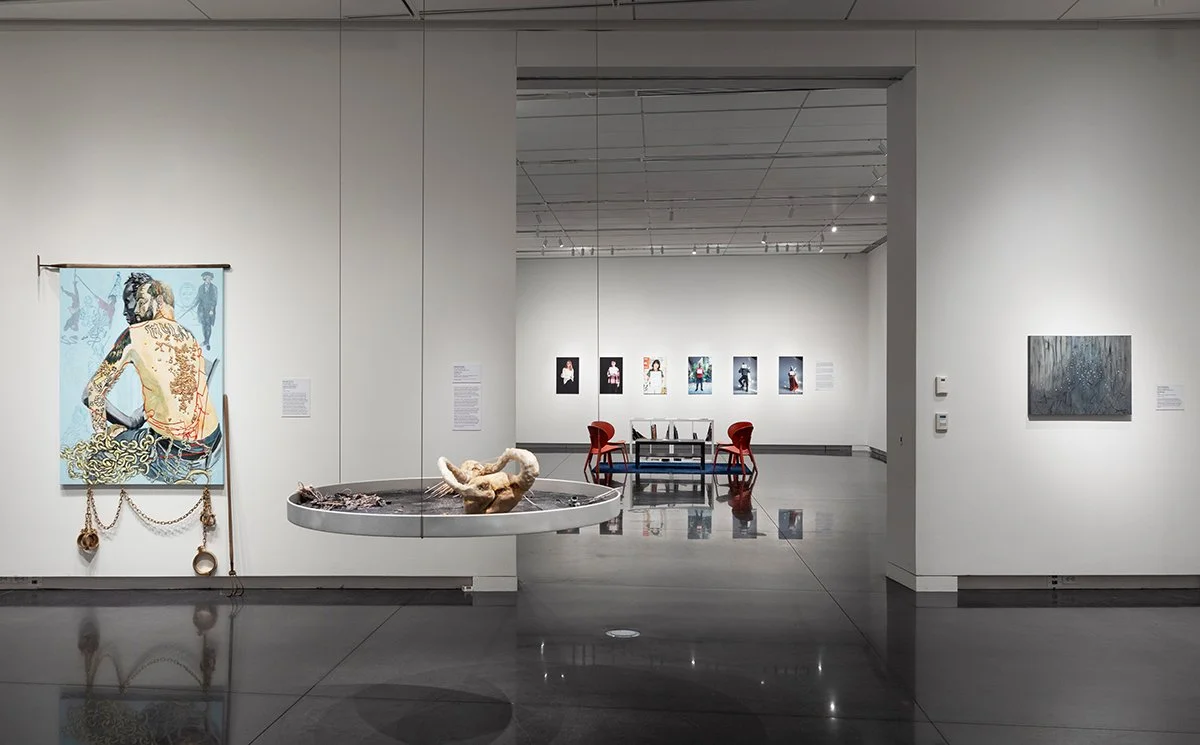
An installation view of the exhibition The Artnauts: Rhizome: Origins at the CU Art Museum. Image by Wes Magyar, courtesy of CU Art Museum, University of Colorado Boulder.
Founded while several members attended CU Boulder, the Artnauts present an exhibition that is equally an anniversary celebration, a homecoming, and an archive of their shared history, with a mix of new and old work on display. [1]
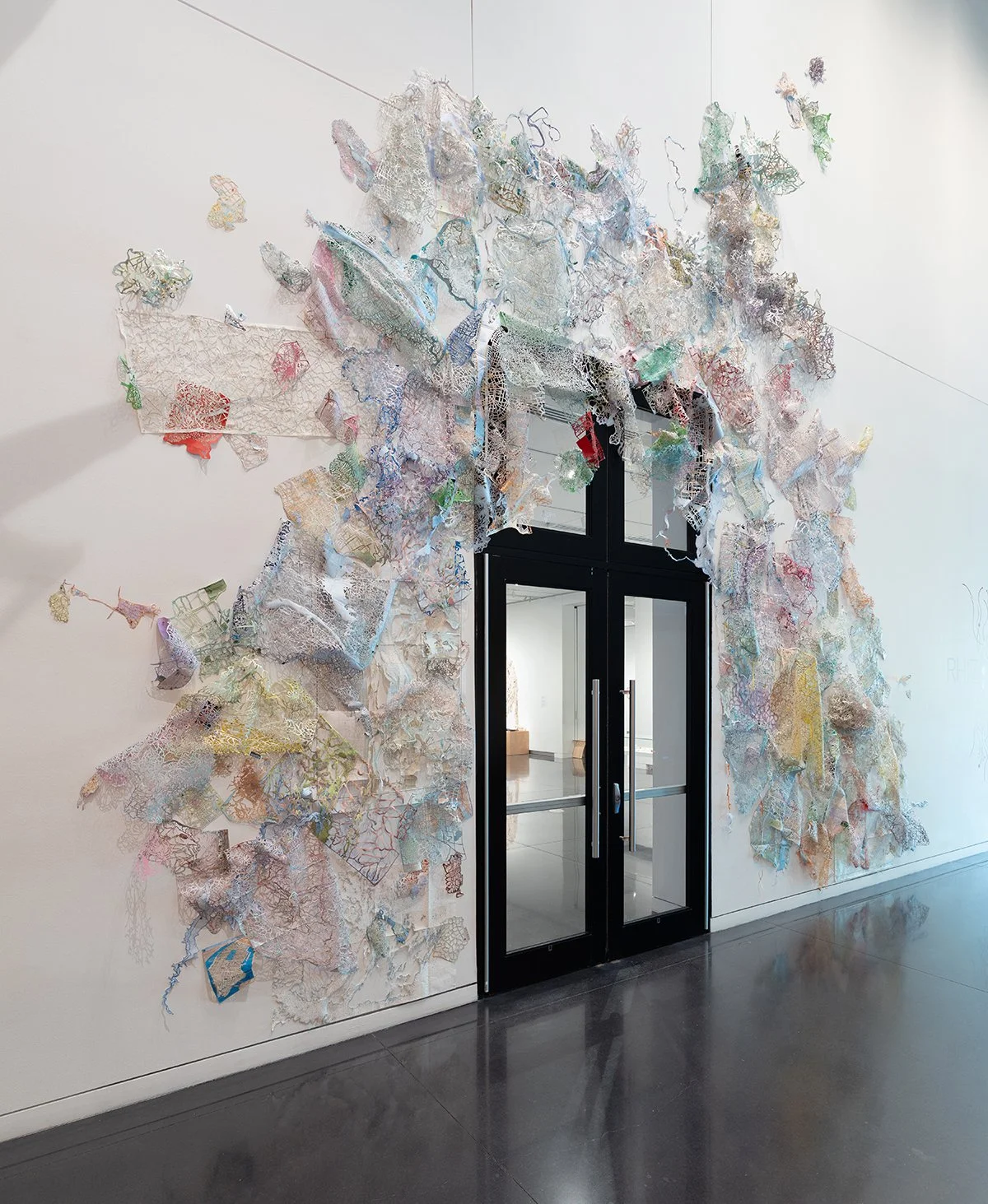
Rebecca DiDomenico, Emanate, 2016-2026, maps, vinyl, and map pins. Image by Wes Magyar, courtesy of CU Art Museum, University of Colorado Boulder.
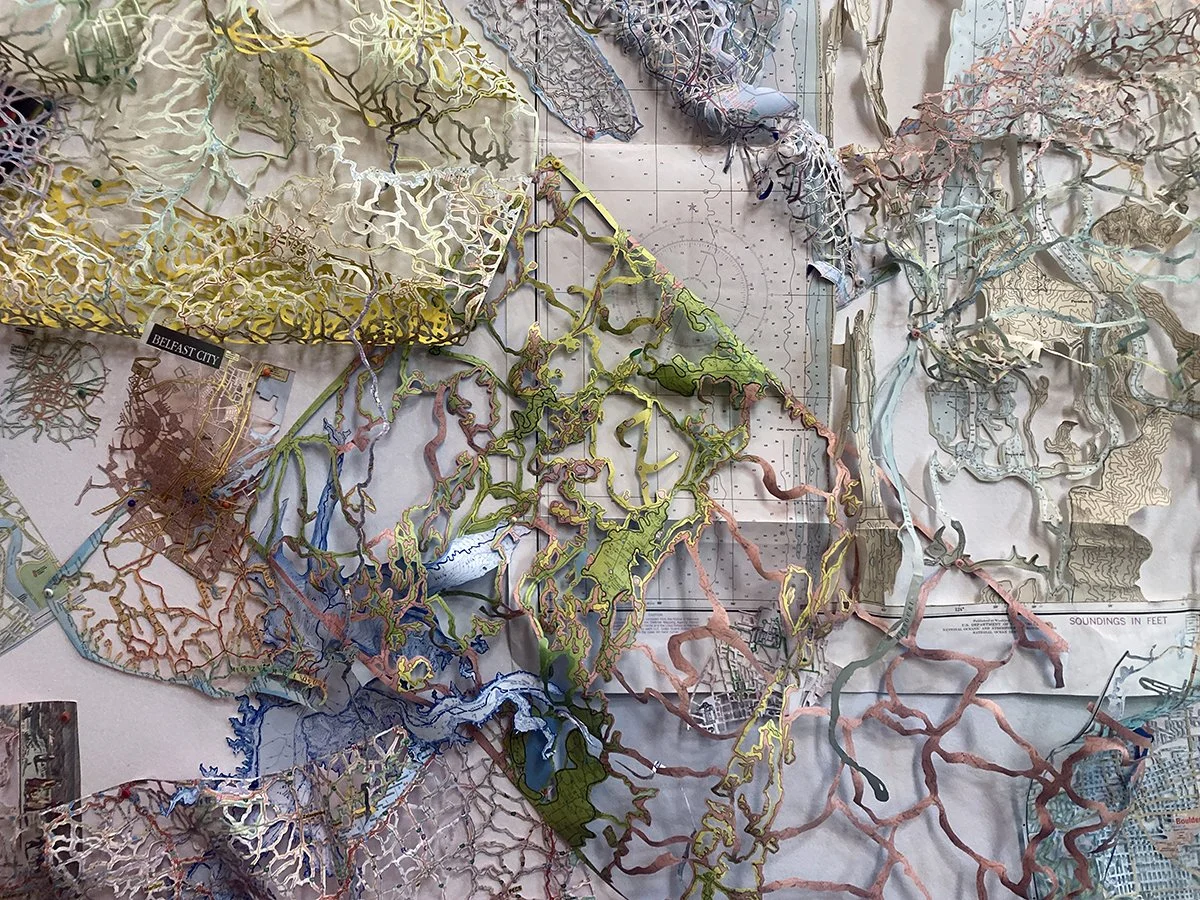
A detail view of Rebecca DiDomenico, Emanate, 2016-2026, maps, vinyl, and map pins. Image by Dani/elle Cunningham.
Rebecca DiDominco’s installation Emanate covers the wall above and surrounding the gallery's entrance with lacey, layered remnants of maps. The land areas are cut away, revealing only bodies of water and roadways—fragments that illustrate human interconnectedness. By removing the territories and borders typically fought over, the artist leaves behind pathways that resemble veins or rhizomatic systems, reinforcing the exhibition’s theme while echoing the Artnaut’s mission to globally disseminate art and messages of concern for humanity.
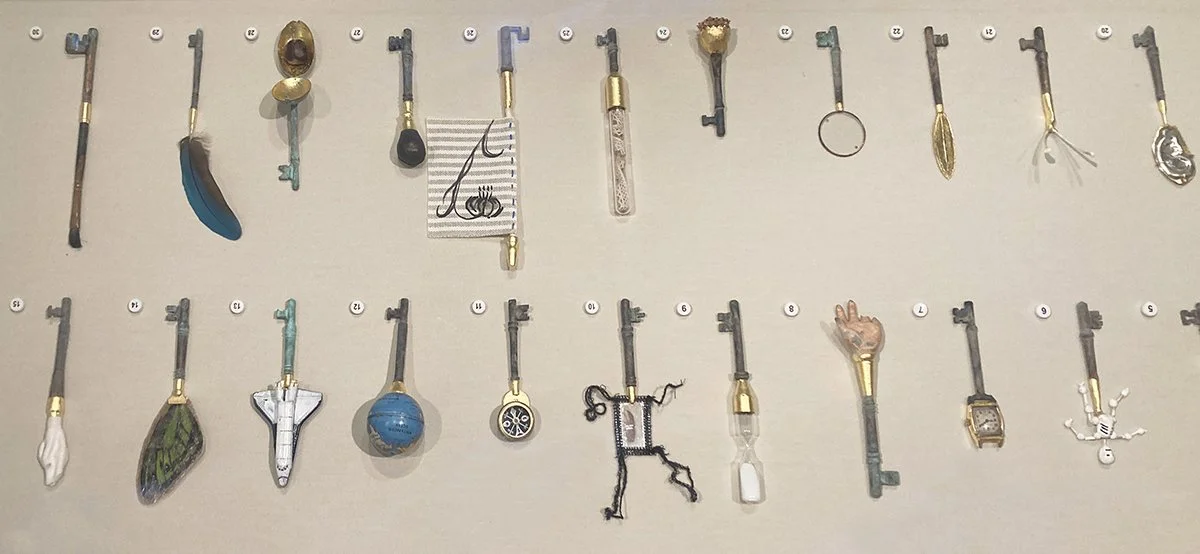
Beth Krensky, Keys to Open the Beginning Before the End, 2026, mixed media, electroplated copper, and 24k gold leaf. Image by Dani/elle Cunningham.
Inside the gallery, a glass case displays dozens of keys modified by the addition of various materials including 24-karat gold and electroplated copper. Created by founding member Beth Krensky, Keys to Open the Beginning Before the End forges keys with objects the artist found or created while working with the Artnauts. A range of familiar signs and symbols replaces the heads of each key, from a leaf and a skeleton to a globe and an airplane, creating a metaphorical rhizome that memorializes the diverse locations touched by the Artnauts.
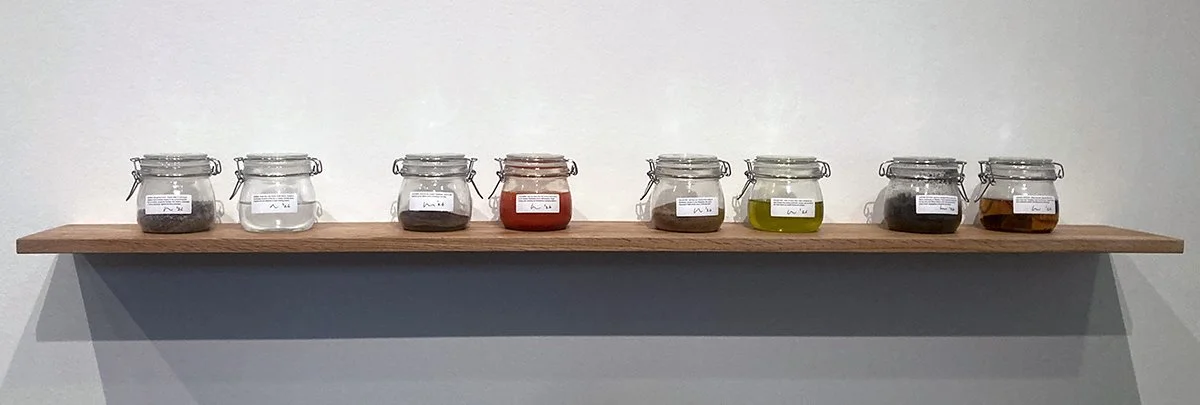
George Rivera, Soil & Substance (After Joseph Beuys), 2025, glass jars, soil, substance, and oak shelf. Image by Dani/elle Cunningham.
George Rivera, another founding member, has a similarly rhizomatic and archival installation reflecting on the group’s history and global presence with a literality that mirrors Krensky’s keys. Atop a long shelf, Rivera displays jars grouped in pairs containing soil and “substances” from Bosnia, Colombia, Palestine, and the United States—several of the locations the Artnauts have traversed—confined within glass jars. [2]
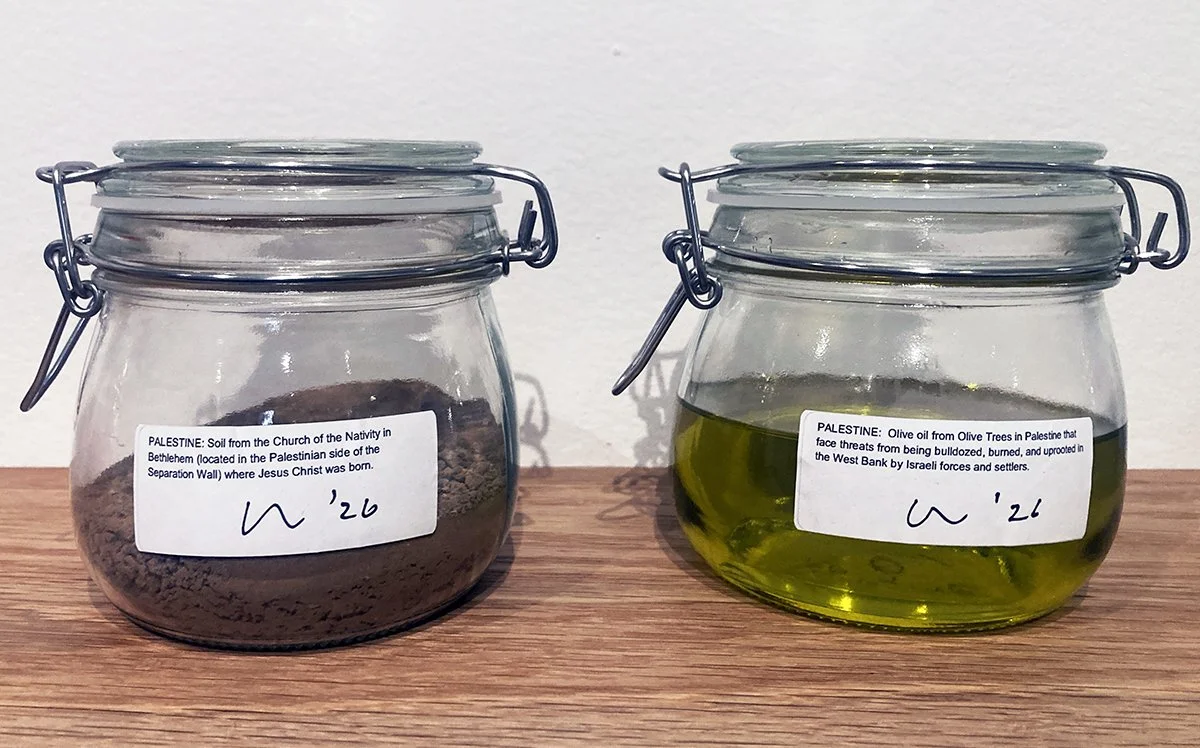
A detail view of a jar of soil and a jar of olive oil from Palestine in George Rivera’s Soil & Substance (After Joseph Beuys), 2025, glass jars, soil, substance, and oak shelf. Image by Dani/elle Cunningham.
Accompanying the jars are descriptions of the soils and substances they contain: soil from “Sniper Alley” in Bosnia and water from a source believed to possess healing properties; soil from the Amazon Rainforest and red ink made from the sap of an Amazonian tree threatened by deforestation; soil from the Church of the Nativity in Bethlehem, Palestine, and an olive tree from the West Bank, where olive trees face threats from Israeli military forces and settlers; and soil from Rivera’s childhood home in a Black community in Texas where his non-Black family lived during segregation, along with water from the nearby Colorado River, where two Black boys were lynched.
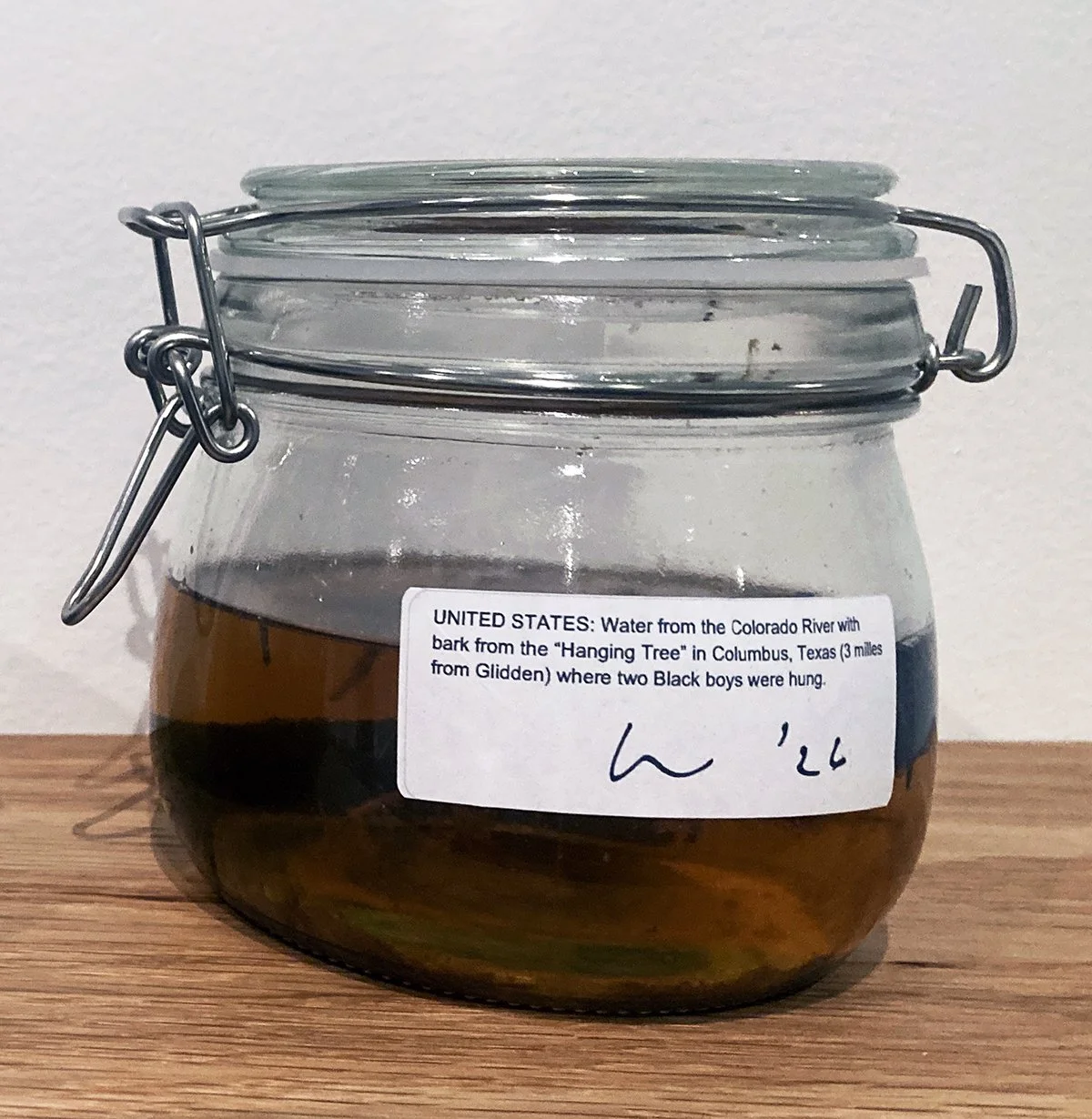
A jar of water from the Colorado River and bark from a hanging tree in Columbus, Texas, from George Rivera’s Soil & Substance (After Joseph Beuys), 2025, glass jars, soil, substance, and oak shelf. Image by Dani/elle Cunningham.
A tremendous emotional weight comes across in this collection despite its relative simplicity. Because Rivera does not attempt to represent objects, but instead depicts material substances, he generates an immediate physical connection to memory and place that confronts the viewer.
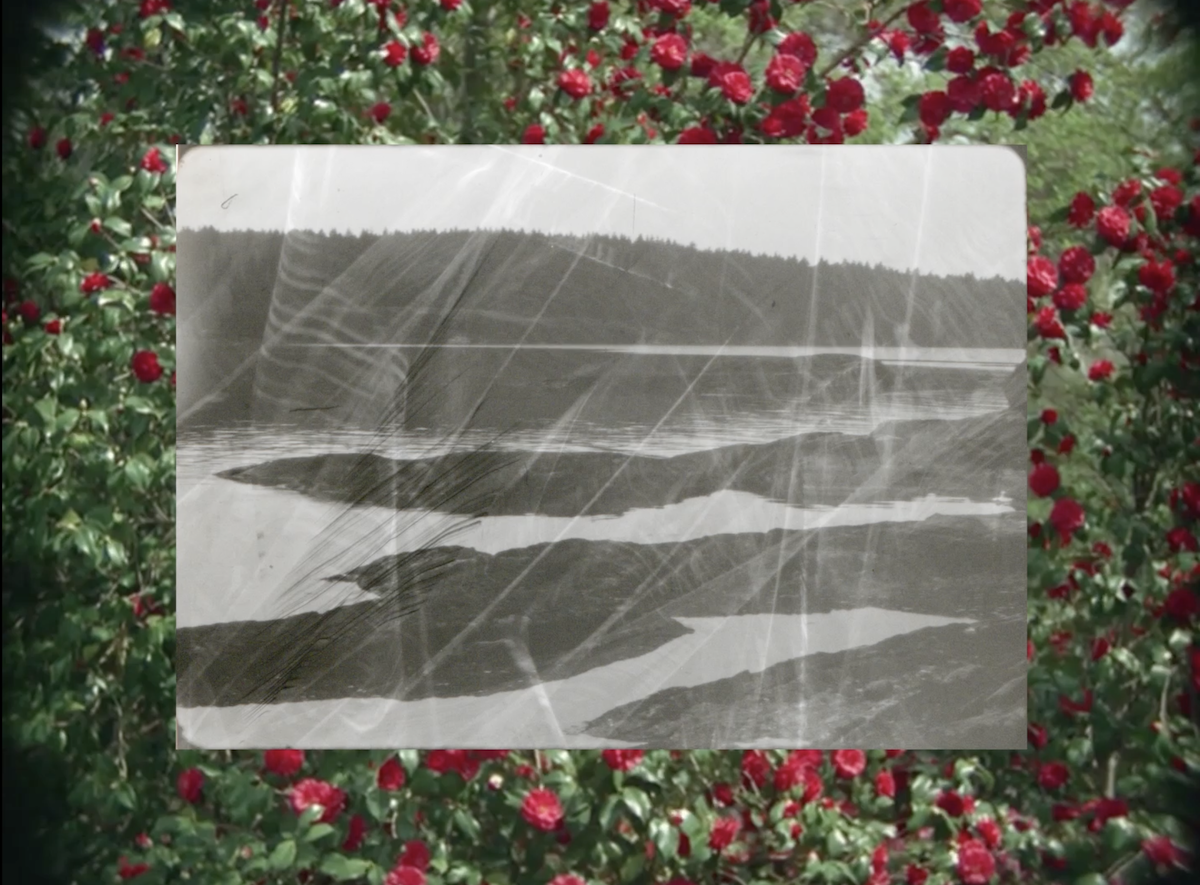
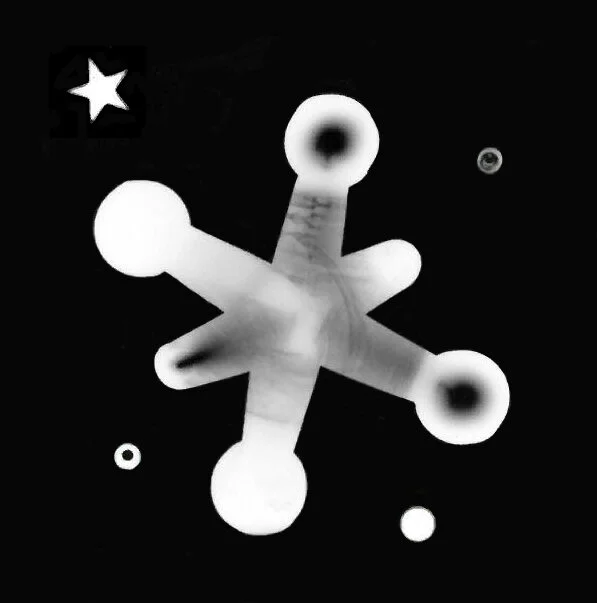
Eileen Roscina, Radix, 2026, digital scan of 16mm film. Image courtesy of the artist.
The exhibition’s only two video works, by Eileen Roscina and Luis Valdovino, respectively, offer contrasting approaches to film, and provide balance in the material-heavy exhibition. Roscina’s experimental work, Radix, is a digital scan of 16mm film featuring spheres emerging suspensefully from varying degrees of shadow. Preserving the warmth and flaws of analog film strips, the artist binds her content to the rhizome and the collective, suggesting that growth can emerge from darkness.
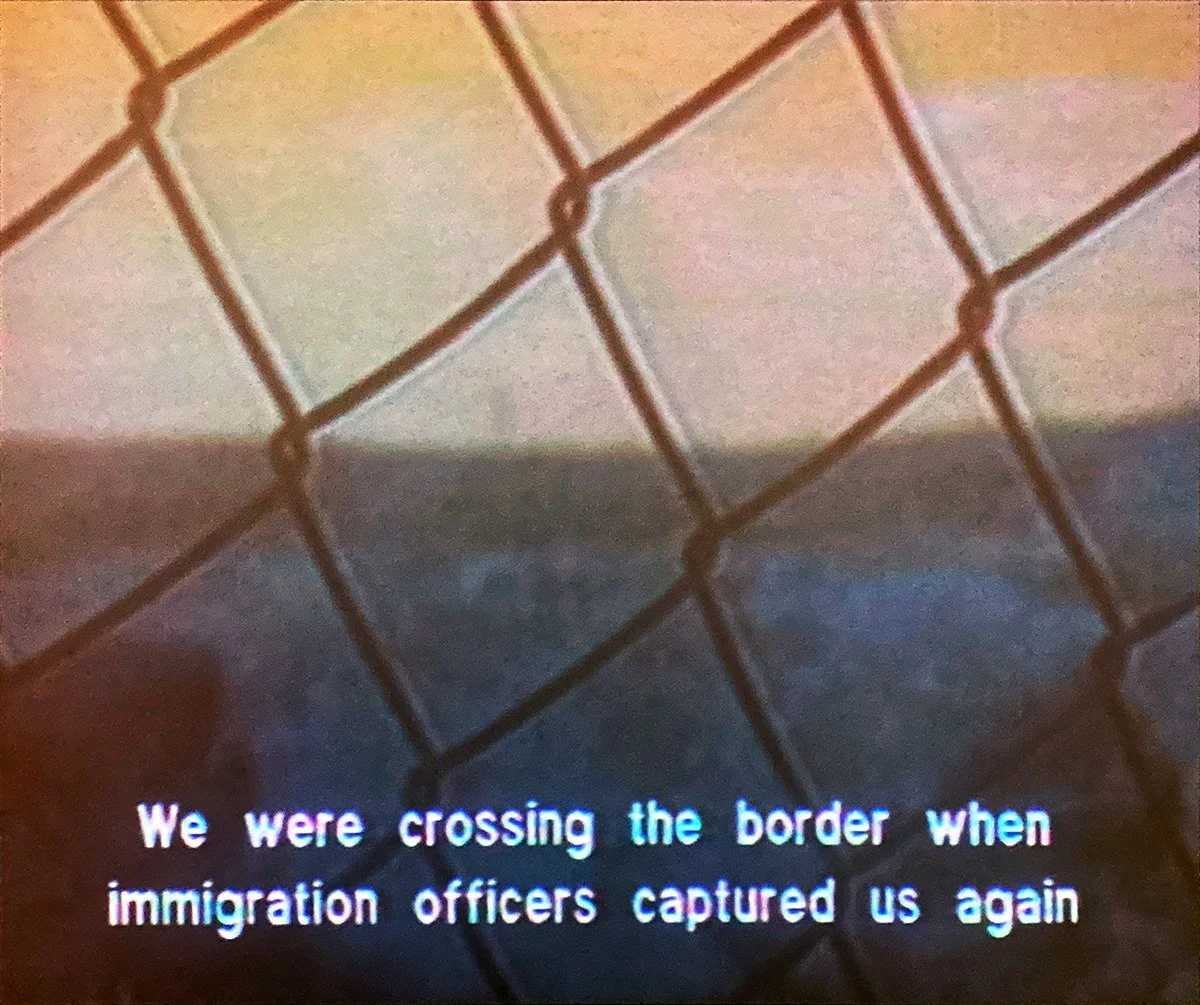
A still from Luis Valdovino’s Work in Progress, 1990, standard definition video and sound. Image by Dani/elle Cunningham.
Valdovino, by contrast, combines interviews and archival footage in an experimental documentary, Work in Progress, that examines attitudes toward immigrants. Employing first-person immigrant narratives and historical figures’ statements such as “If you catch an illegal, you ought to skin him and fry him yourself” laid onto historical imagery, Valdovino links the past and present. Furthermore, this process underscores that hostility toward immigrants persists in American and global societies today.
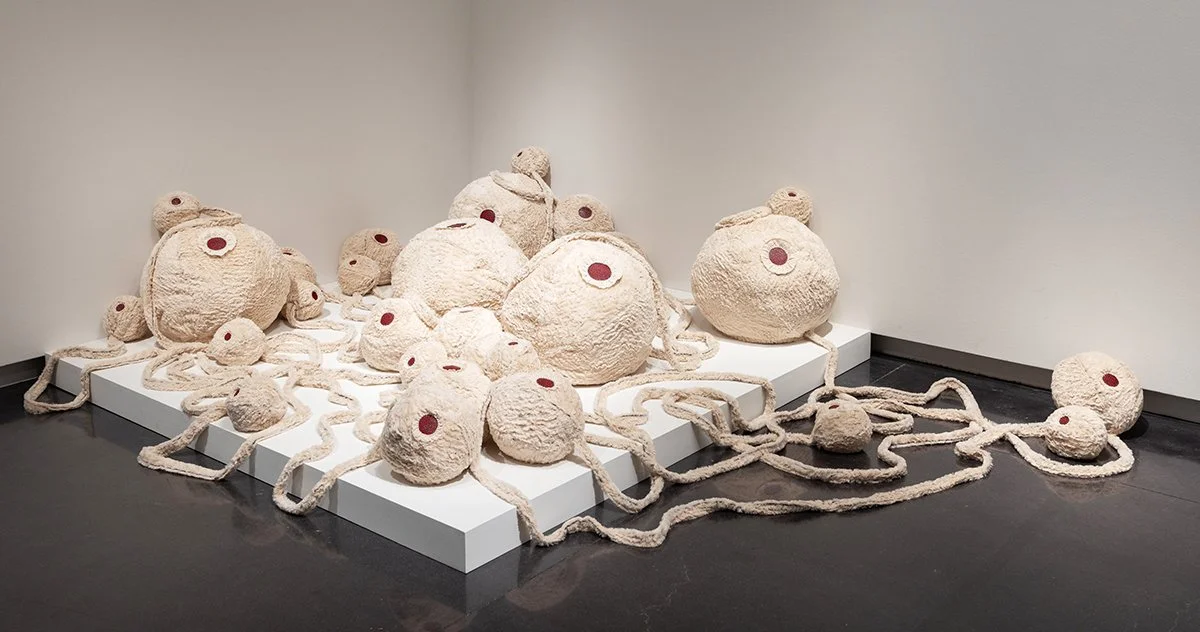
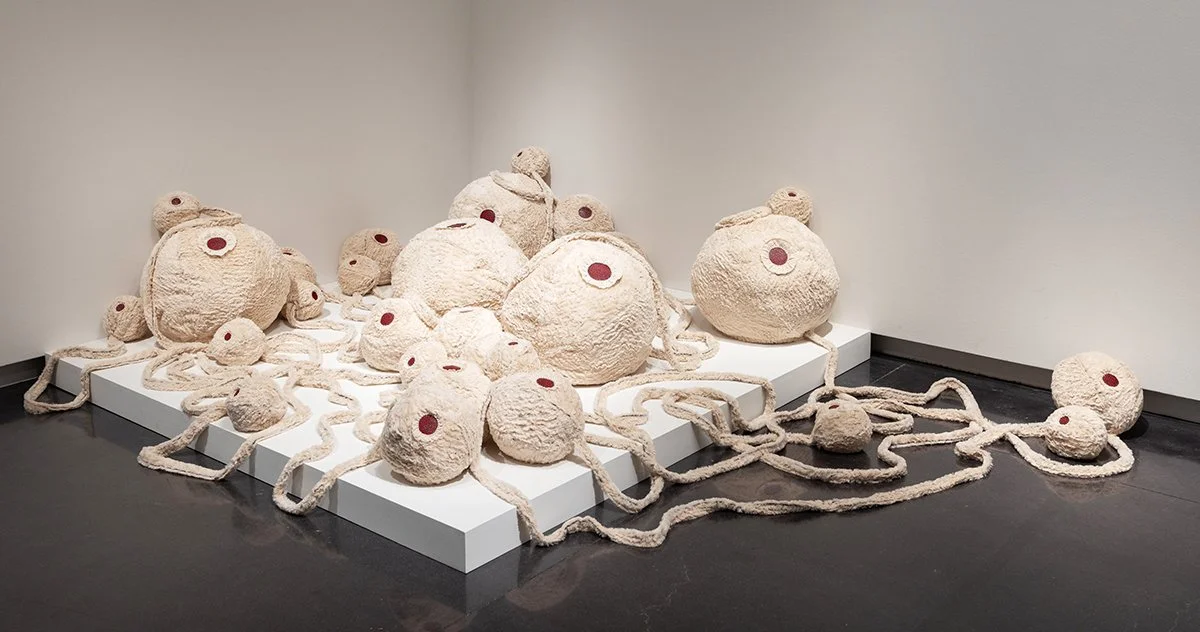
Suzanne Faris, Raw Spots, 2026, fabric, vinyl, beads, and thread. Image by Wes Magyar, courtesy of CU Art Museum, University of Colorado Boulder.
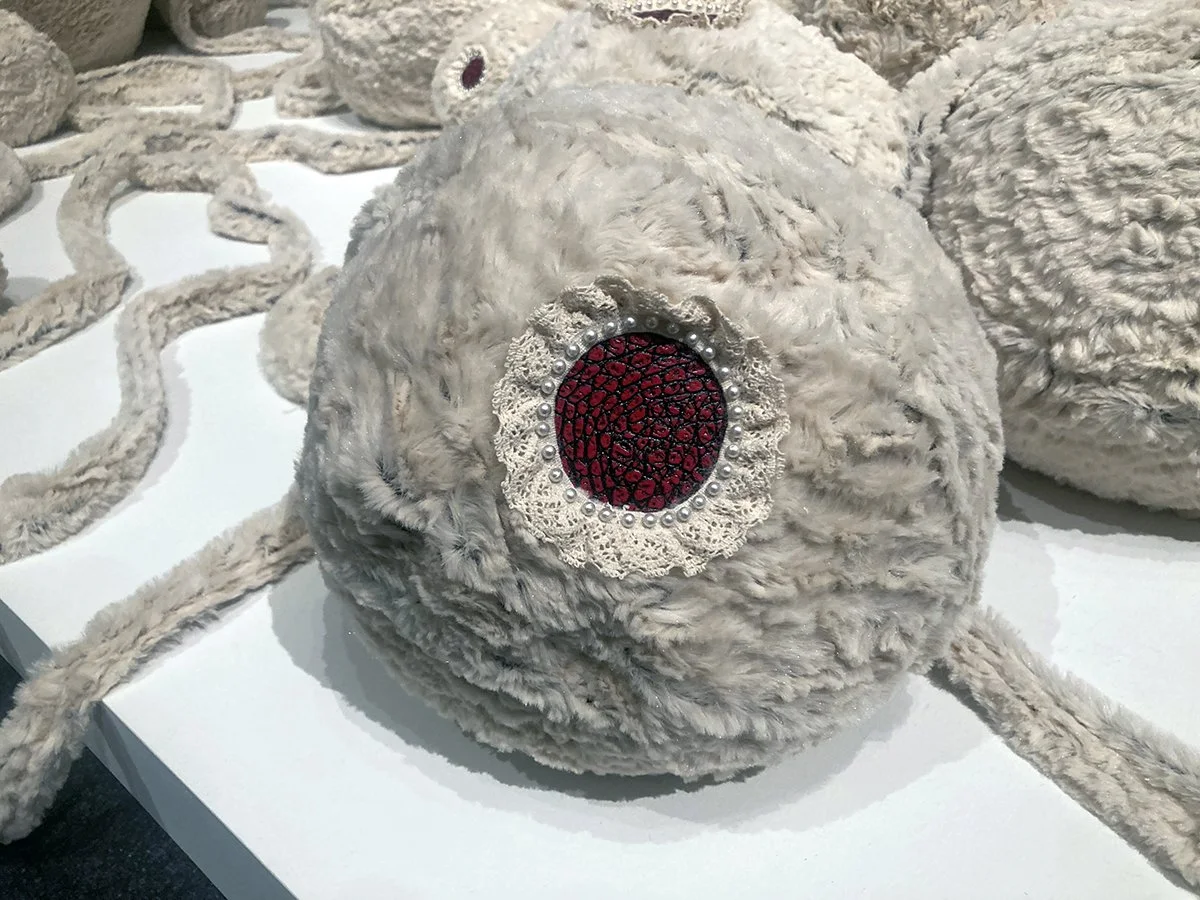
A detail view of Suzanne Faris’s Raw Spots, 2026, fabric, vinyl, beads, and thread. Image by Dani/elle Cunningham.
Profoundly illustrating the rhizome, Suzanne Faris’s Raw Spots is a network of plush and beaded tendrils joining large fabric orbs, each one containing a red center. These core elements reflect that when left untreated, physical and psychological wounds never heal, remaining inflamed and noticeable. The artist’s observation denotes the realization that pain is a universal human experience, and that when healing occurs, relationships across networks increase, reminding us of one another’s humanity. [3]
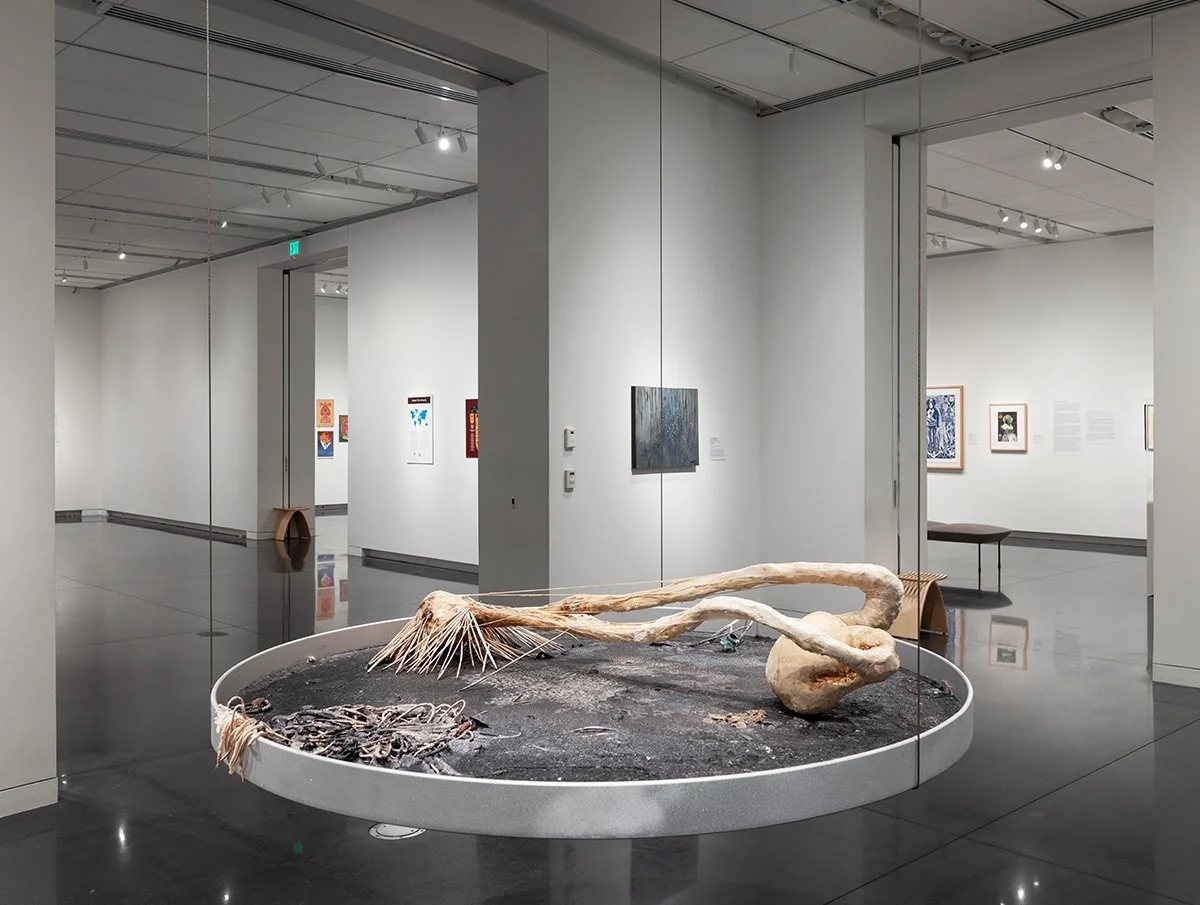
Martha Russo, orbital pull, 1996 and 2026, porcelain, sculpture clay, glaze, pig intestine, fruit, vellum, aluminum, bronze, salt, glass, and dye. Image by Wes Magyar, courtesy of CU Art Museum, University of Colorado Boulder.
Transitioning from the emphatically rhizomatic themes of the other artists, the poetic orbital pull by Martha Russo features an assortment of elements: pig intestines, porcelain, clay, fruit, salt, and other media, resulting in a visceral, earthy assemblage that speaks to our collective human origins. Russo created the first iteration of the work as a CU Boulder student in 1996, leading to this version, which pays homage to the Artnauts’ 225 exhibitions with its porcelain tendrils of the same number. [4]
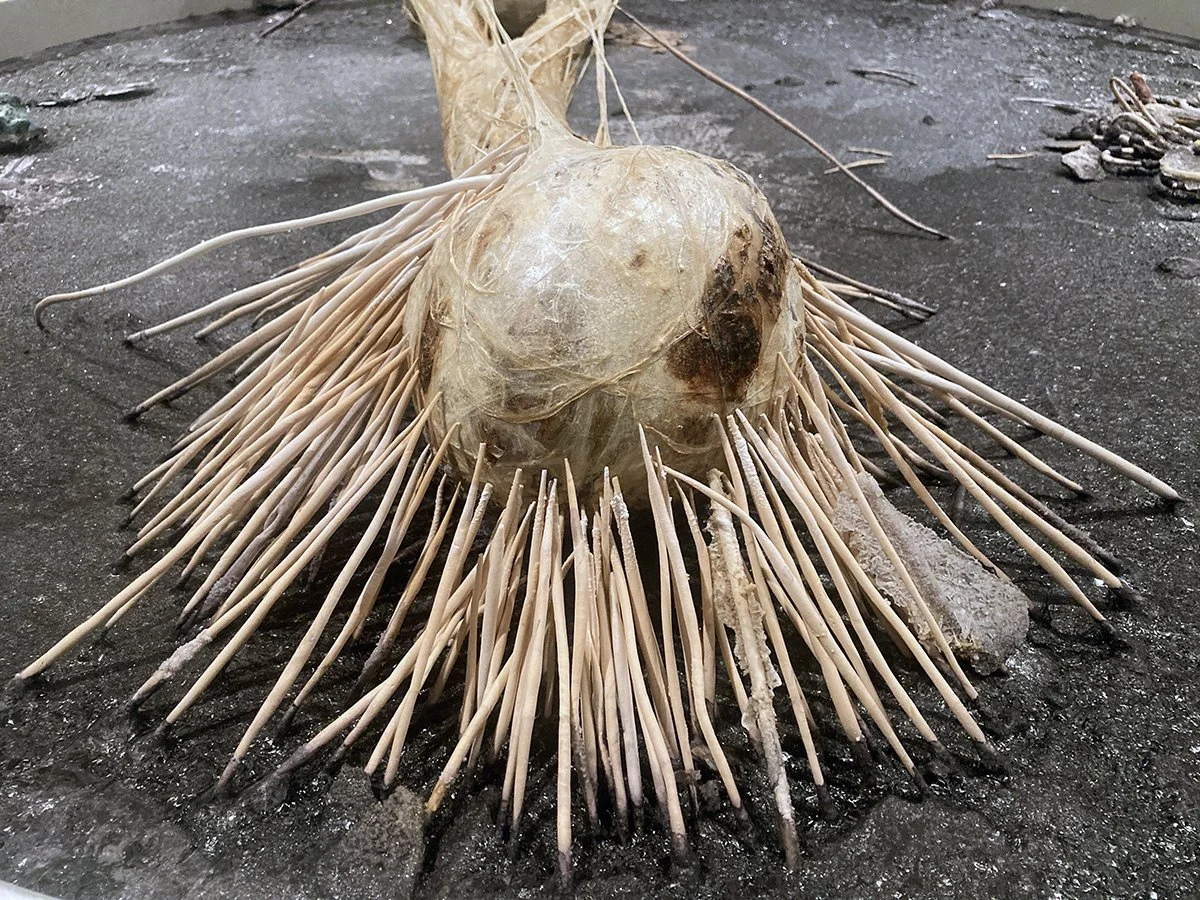
A detail view of Martha Russo’s orbital pull, 1996 and 2026, porcelain, sculpture clay, glaze, pig intestine, fruit, vellum, aluminum, bronze, salt, glass, and dye. Image by Dani/elle Cunningham.
At the center of the work is a natural-looking, gourd-like form wrapped in those tendrils, resting atop a glossy black disk that evokes a pool of water. Suspended from the ceiling, the work appears to float in space, its disparate materials gathered into a strange, cosmic arrangement. The artist herself describes the sculpture as “primordial,” and it certainly evokes the soup from which life emerged—a reminder of our own beginnings and the ancient assortment of matter from which we are made. [5] With her materials, Russo subtly makes visible the exhibition’s message of relationality and shared experience.
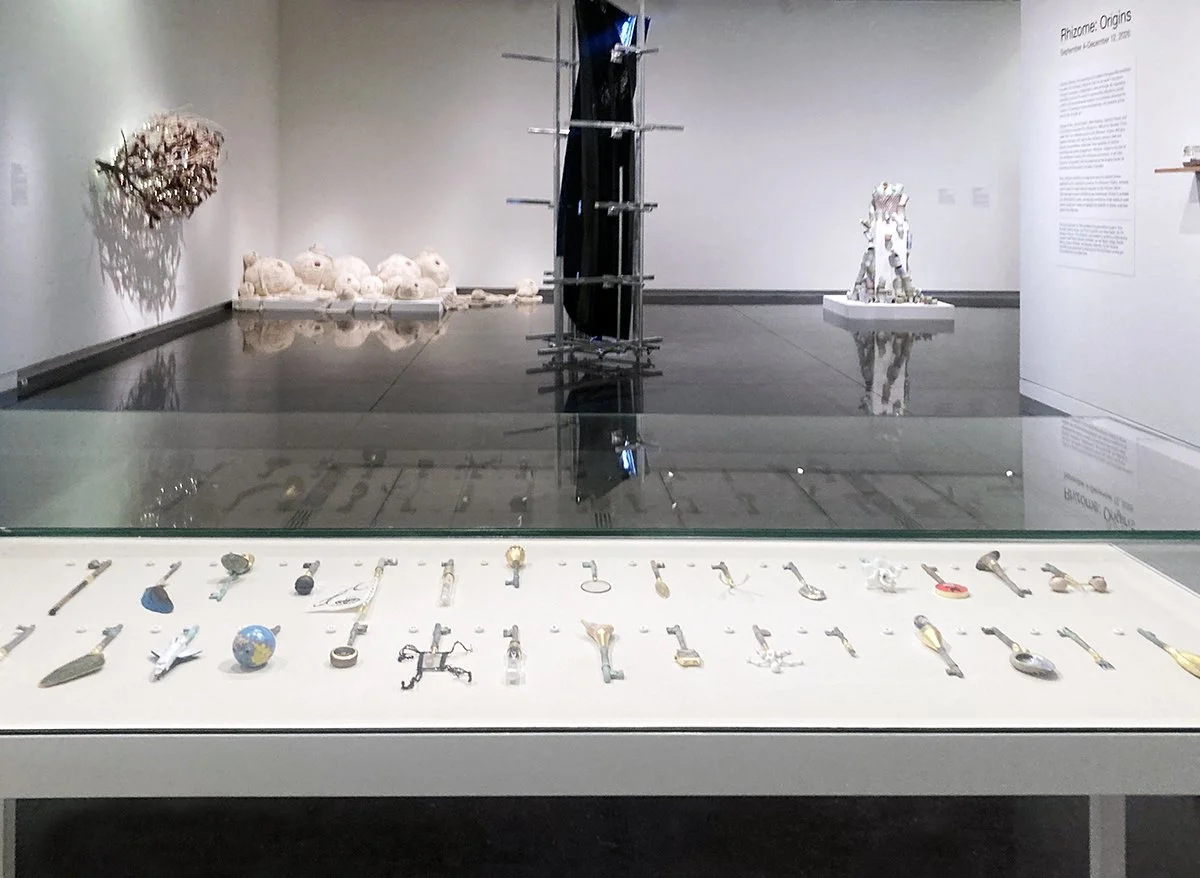
An installation view of the exhibition The Artnauts: Rhizome: Origins at the CU Art Museum. Image by Dani/elle Cunningham.
Ultimately, Rhizome: Origins demonstrates how the Artnauts’ three decades of collaboration have created an artistic global network rooted in shared experience, memory, intersection, and the desire to reveal the lives of people in vulnerable situations through art. Across the exhibition, artists use diverse materials to explore how people remain enduringly tethered despite geographic and cultural boundaries. While each work approaches the concept of the rhizome differently, together they emphasize that origins are not singular or fixed, but infinitely expansive, acting as a reflection on where the Artnauts began and how far they will continue to go, literally and conceptually.
Dani/elle Cunningham (she/her) is an artist, writer, and independent curator. She writes about the intersection of science fiction, gender, sexuality, and disability, with an emphasis on mental illness. The co-founder of chant cooperative, an artist co-op, she holds a master’s degree in art history and museum studies from the University of Denver.
[1] From the exhibition text.
[2] George Rivera, artist statement.
[3] Suzanne Faris, artist statement.
[4] Martha Russo, artist statement.
[5] Ibid.