Montgomery | Adams
Michele Montgomery and Grant Adams: Montgomery | Adams
Valkarie Gallery & Studio
445 S. Saulsbury Street, Lakewood, CO 80226
November 5–30, 2026
Admission: free
Review by Madeleine Boyson
I have been thinking about time loops. About how history either repeats itself—as the adage goes—or else rhymes. Blame it on my reading list: Solvej Balle’s On the Calculation of Volume series follows a woman perpetually reliving a November day, and critic Peter Schjeldahl’s work in Hot, Cold, Heavy, Light: 100 Art Writings 1988–2018 reveals that current artistic preoccupations stretch back far into the twentieth century. [1] Blame it also on a clip of Irish Capuchin Franciscan priest-friar Brother Richard describing time and grief as a spiral, not a line. [2] If I had seen the exhibition Montgomery | Adams at Valkarie Gallery & Studio—now on view through November 30—before the Democratic blue wave earlier this month, would I have experienced it differently? [3] Maybe. But then again, maybe not.
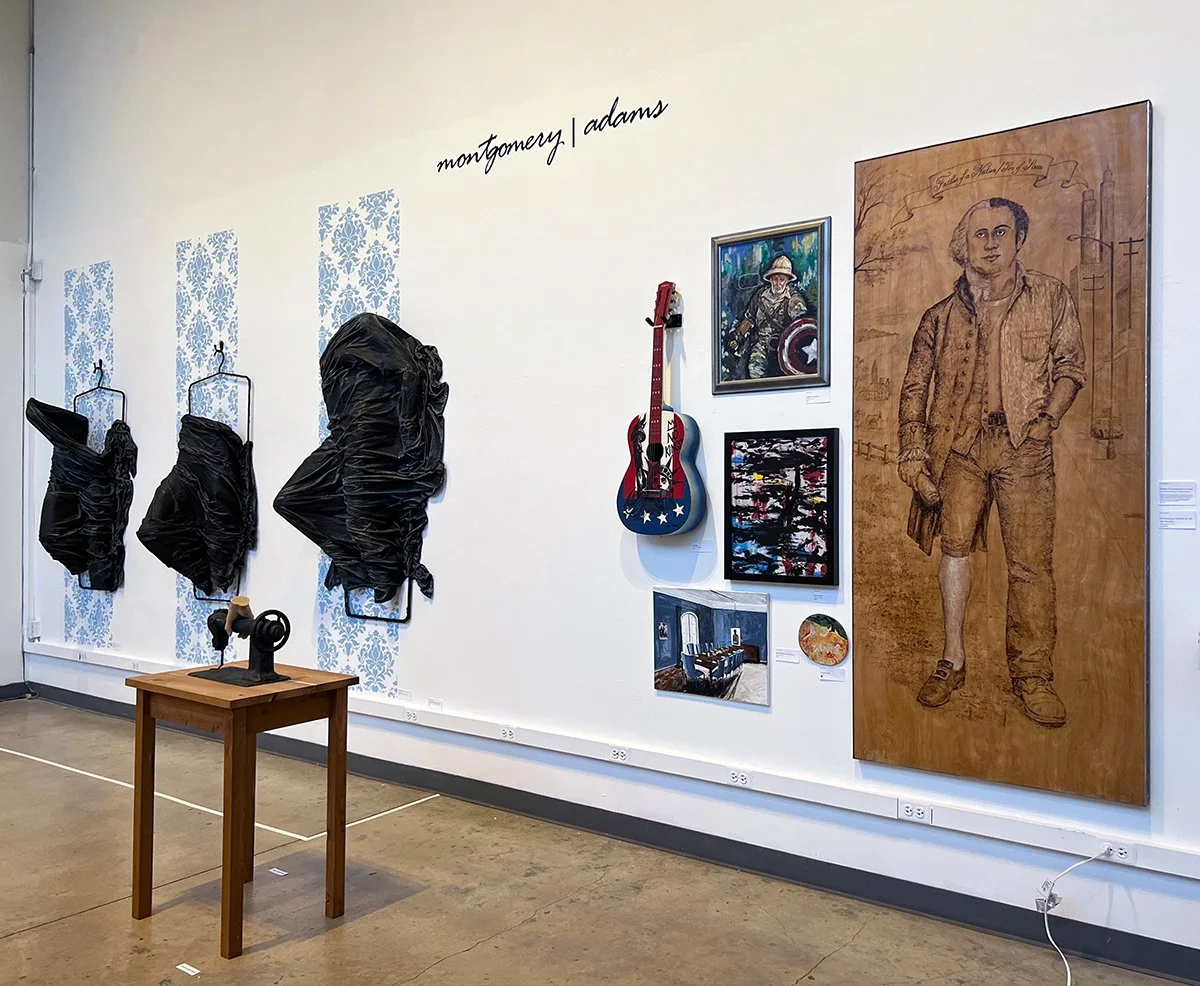
An installation view of works by Michele Montgomery (left) and Grant Adams (right) at Valkarie Gallery & Studio in Denver. Image by Madeleine Boyson.
Montgomery | Adams splits Valkarie’s high-windowed space in halves, featuring mostly sculptures by Michele Montgomery to the left and a crowded multimedia mix by Grant Adams to the right. The exhibition is best experienced in its own infinity loop: pick a direction and wend around a false wall towards the front door before mirroring your route on the opposite side. Rinse. Repeat.
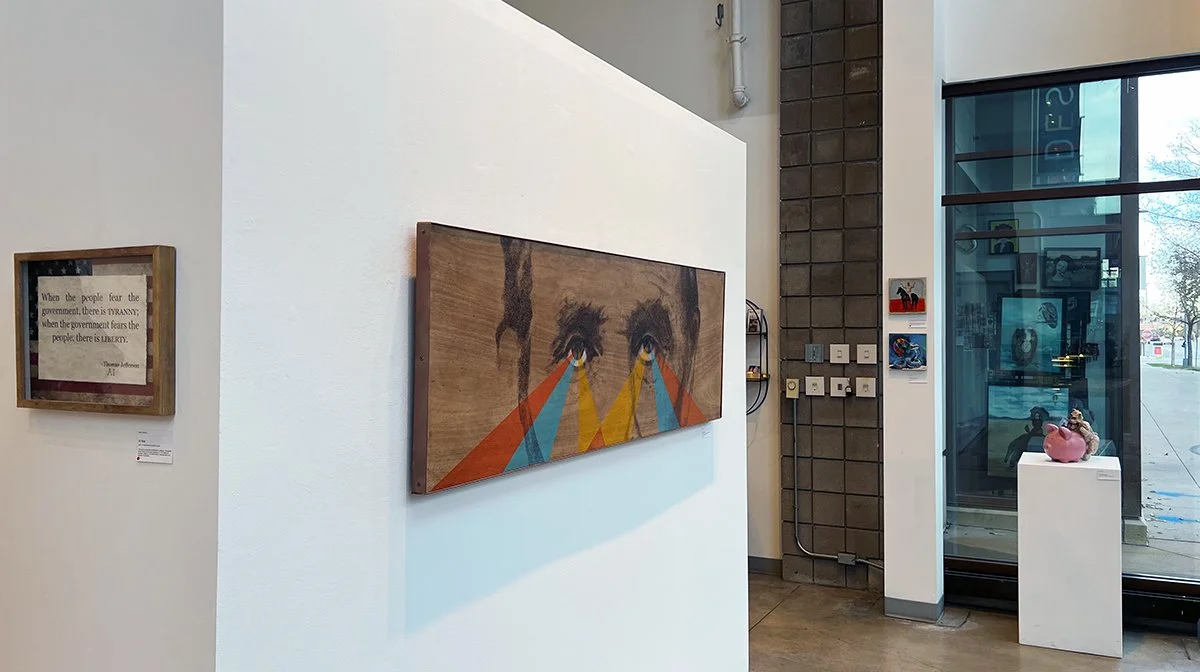
An installation view of Grant Adams’s work at Valkarie Gallery & Studio. Image by Madeleine Boyson.
Instinct drives me towards Adams first, perhaps because his work is legible even from the street. Here is an artist who is laughing, who is annoyed and righteous for it, and who is ready to pounce. Adams describes his work as “navigating modern life” through a mix of irony and curiosity, humor and unease, embodying the ambivalences that keep Americans (relatively) sane throughout numerous “unprecedented” events. [4]
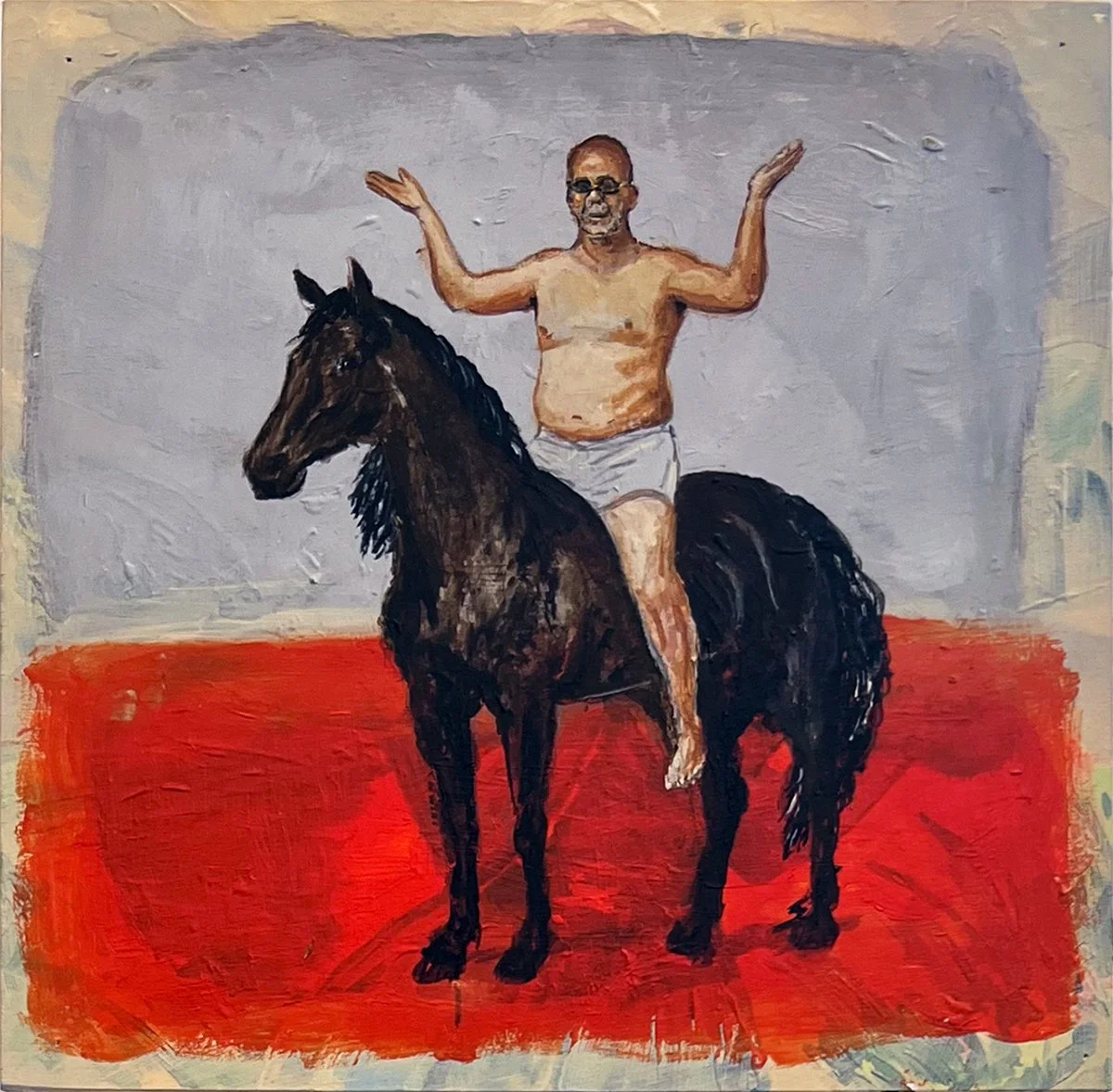
Grant Adams, The Suburban Mystery, after Monkman, no date, acrylic on panel. Image by Madeleine Boyson.
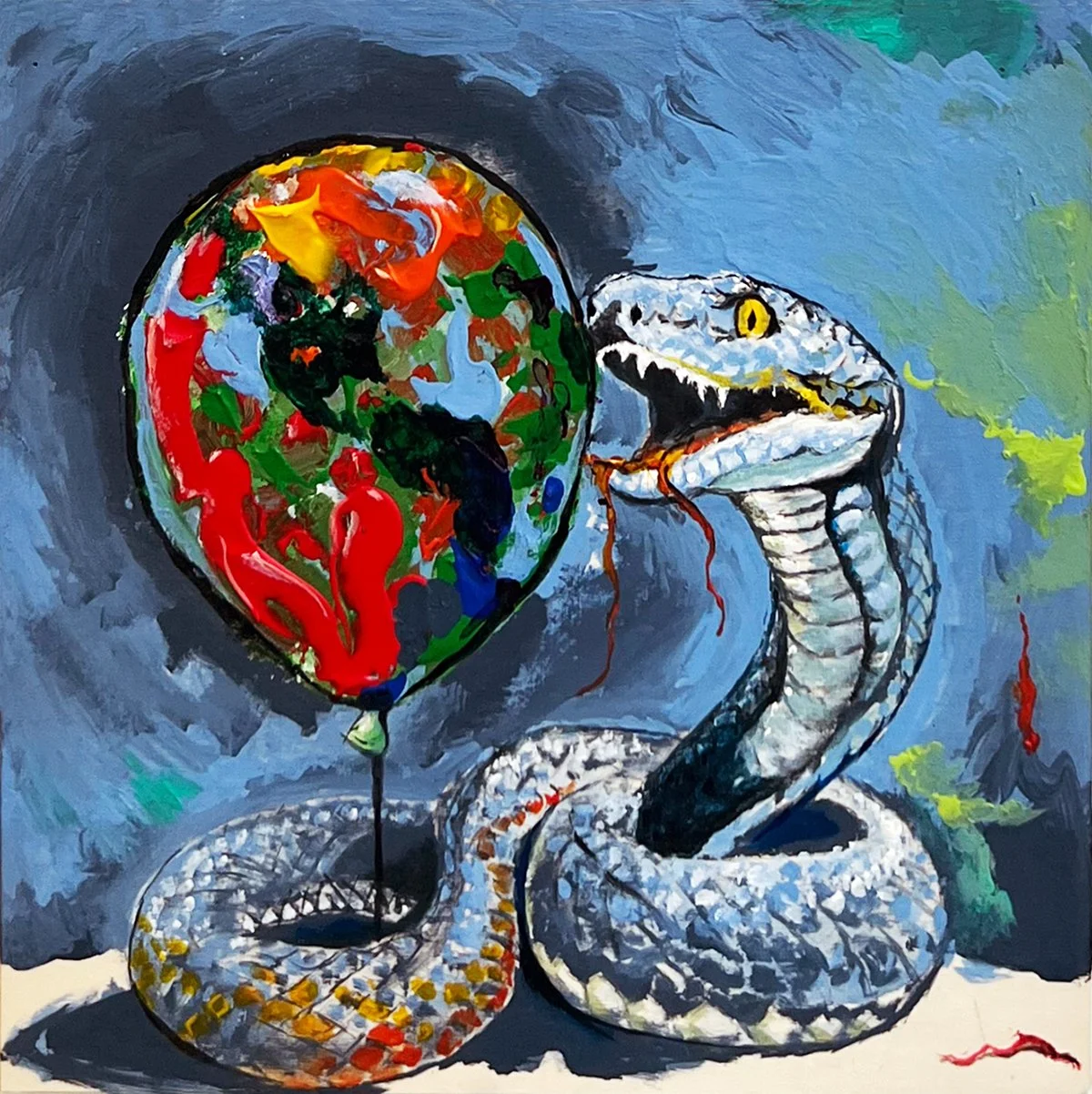
Grant Adams, The Party’s Over, no date, acrylic on panel. Image by Madeleine Boyson.
And it’s true. The eyes of Perception draw in viewers before tossing them towards Adams’s more stimulating offerings The Suburban Mystery, after Monkman and The Party’s Over, both of which parody abstraction’s true artistic offerings.
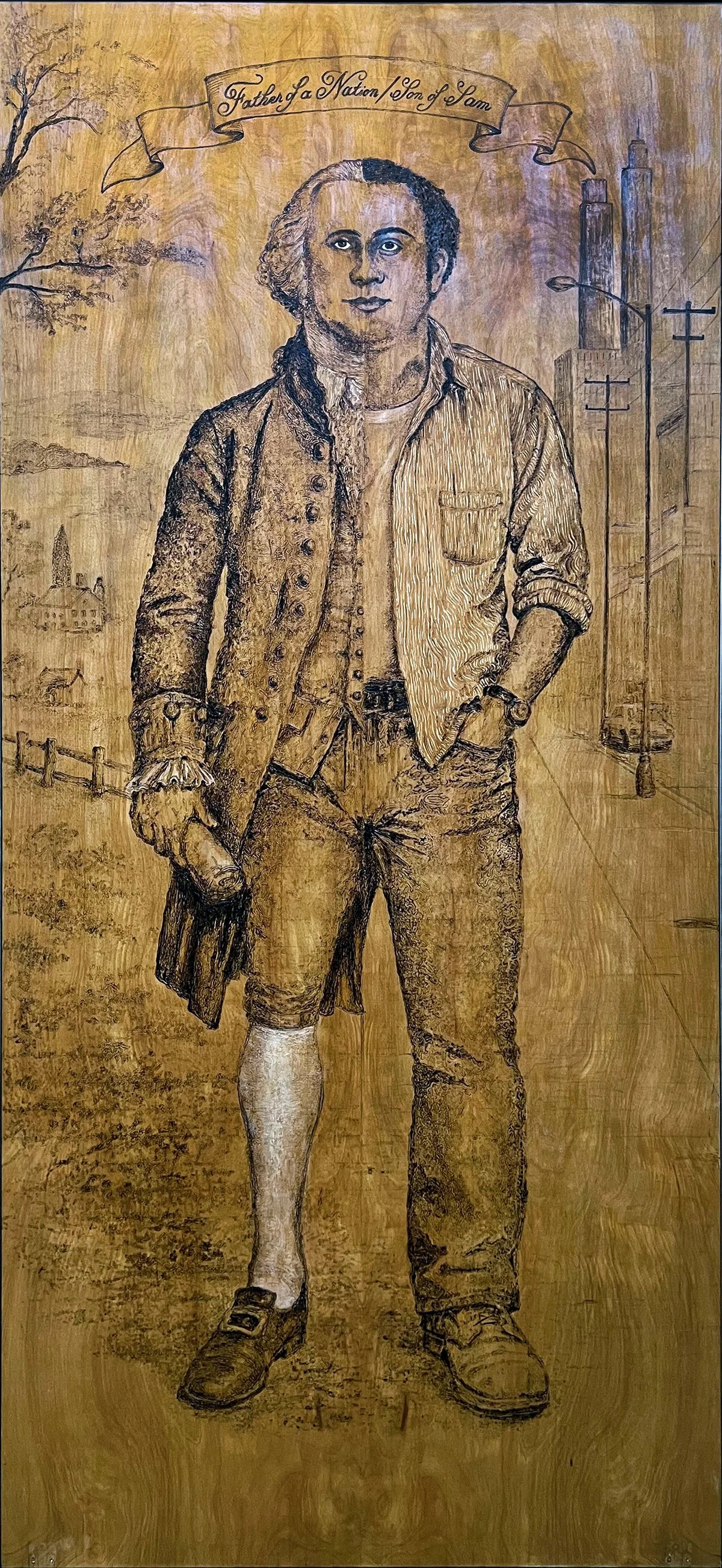
Grant Adams, Father of a Nation/Son of Sam, no date, acrylic and pyrography on repurposed wood. Image by Madeleine Boyson.
Elsewhere, Adams’s trenchant, humoresque realism pops from the wall in Father of a Nation/Son of Sam, a large pyrographic work that couples George Washington’s salient failures (namely, the enslavement of 317 people at Mount Vernon) with New York City serial killer David Berkowitz.
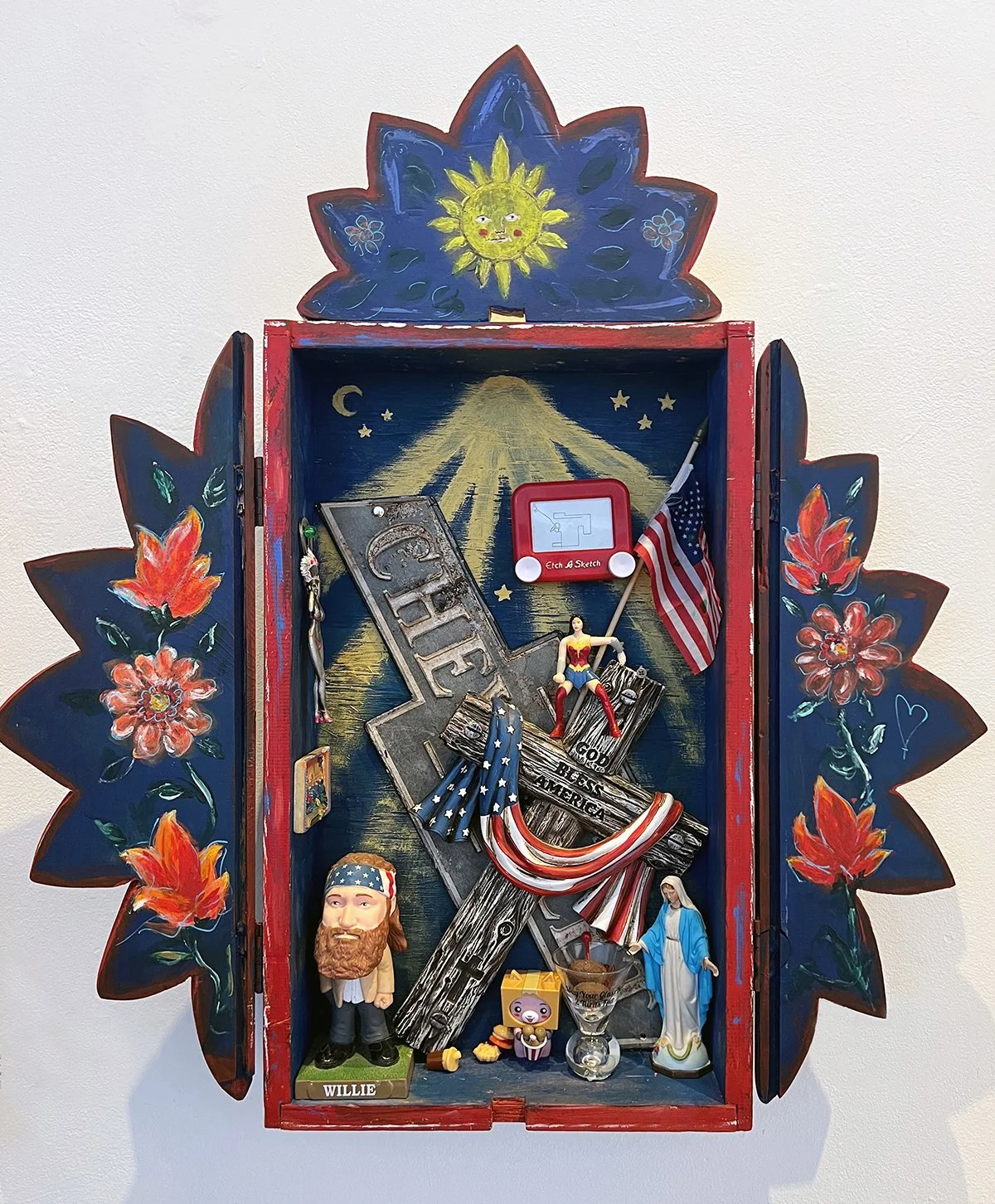
Grant Adams, Shrine #7: Americana, no date, paint and found objects. Image by Madeleine Boyson.
Twelve other works populate Adams’s portion of the back wall, satirizing disaster, war crimes, myths, and pieties. But the artist’s most persuasive works are his found object shrines. Shrine #7: Americana, for instance, gathers fast food toys, a Willie Nelson bobble head and Madonna, and a vintage Chevrolet sign, in a red and blue floral niche. An Etch-A-Sketch lords over all, figuring a hangman’s noose, while turds in a shot glass offer something like the inevitable results of mixing church and state.
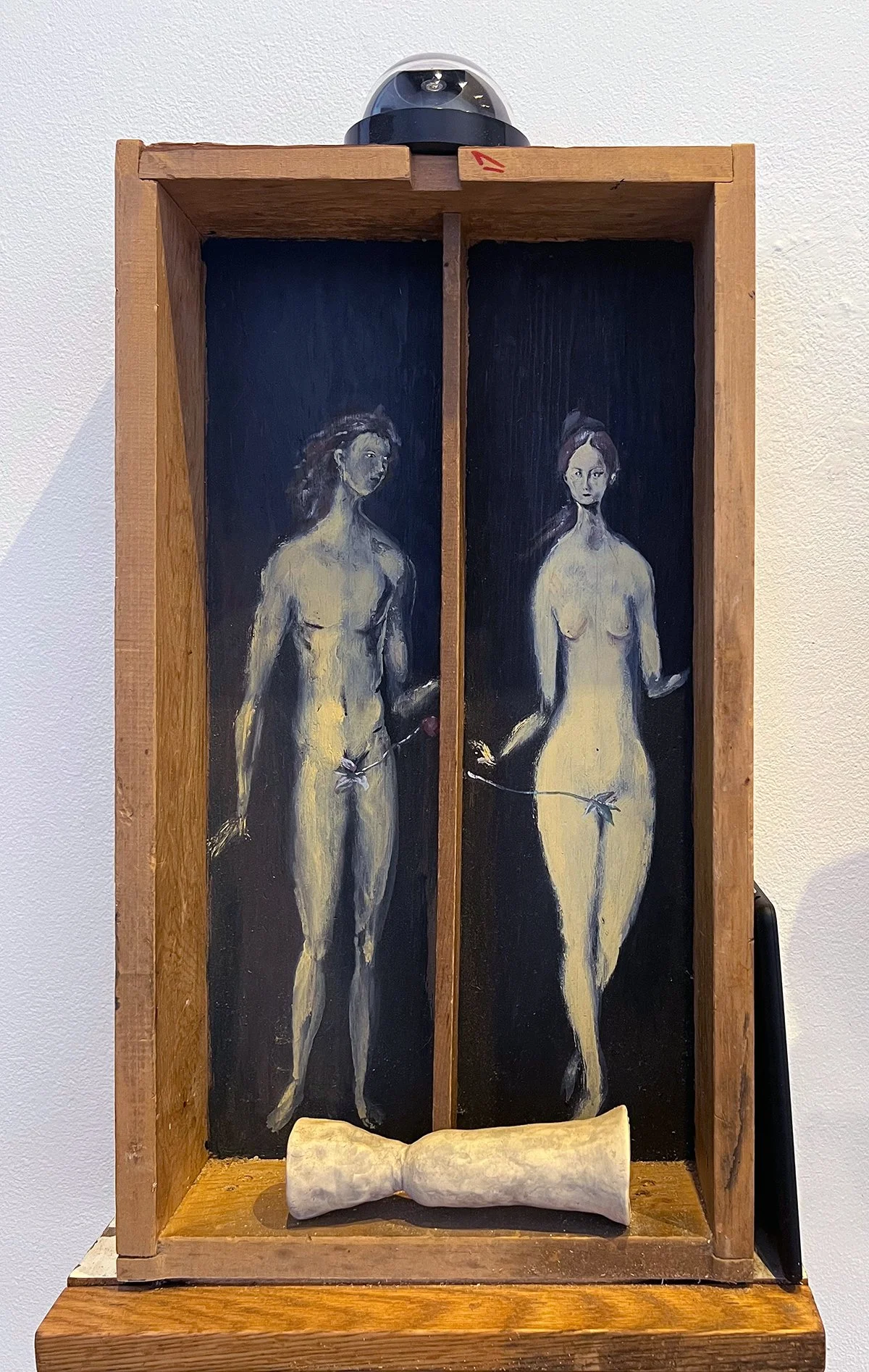
Grant Adams, Shrine #5: Adam and Eve (Under Watchful Care), no date, ceramics, paint, camera, and trashed tablet. Image by Madeleine Boyson.
Shrine #5: Adam and Eve (Under Watchful Care) by contrast, offers a subtler, if more multivalent take on the Garden of Eden story. A 270° multi-sensor camera (hello God) tops this spare reliquary of biblical characters, who are accompanied by a tablet (the fruit of good and evil?) and crude ceramic chalice.
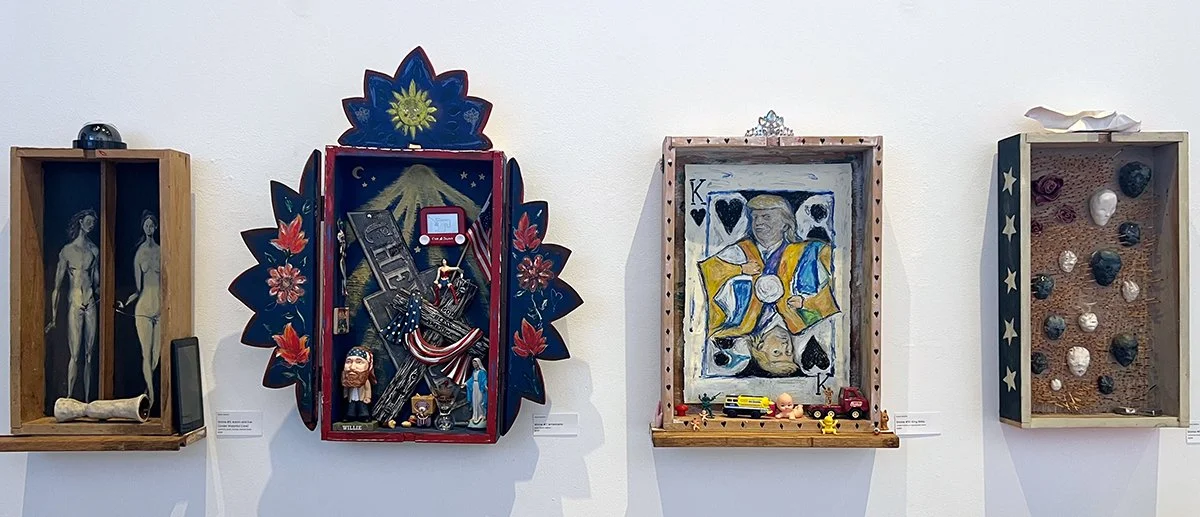
Grant Adams, left to right: Shrine #5: Adam and Eve (Under Watchful Care), no date, ceramics, paint, camera, and trashed tablet; Shrine #7: Americana, no date, paint and found objects; Shrine #10: King Baby, no date, mixed media on repurposed wood; Shrine #8: Take Everything, no date, ceramics, matches, handmade paper, and Zippo lighter. Image by Madeleine Boyson.
Nearby, Shrine #10: King Baby calls out Donald Trump’s half-assed attempts at monarchy, while Shrine #8: Take Everything presents shrunken heads in a flood of matches, primed for burning. These shrines demand close looking, humor, and stamina for the bullshit that dominates our algorithmic feeds.
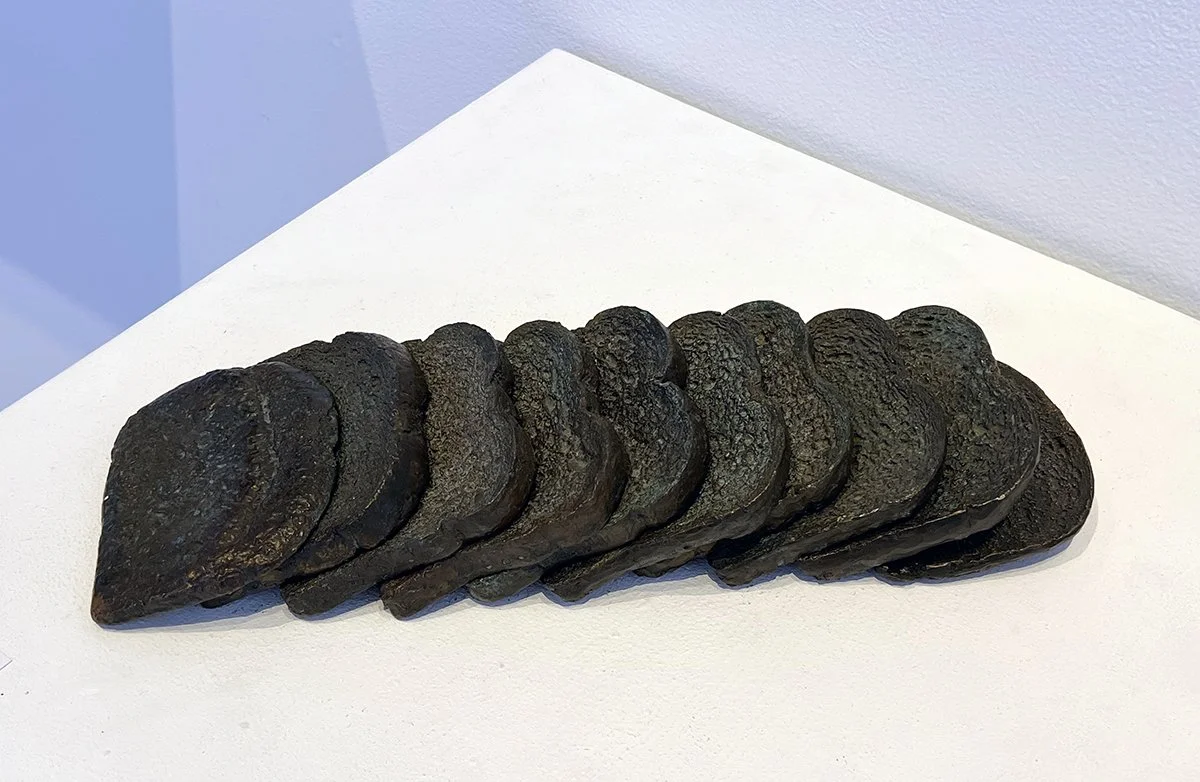
Michele Montgomery, Toast, no date, bronze sculpture. Image by Madeleine Boyson.
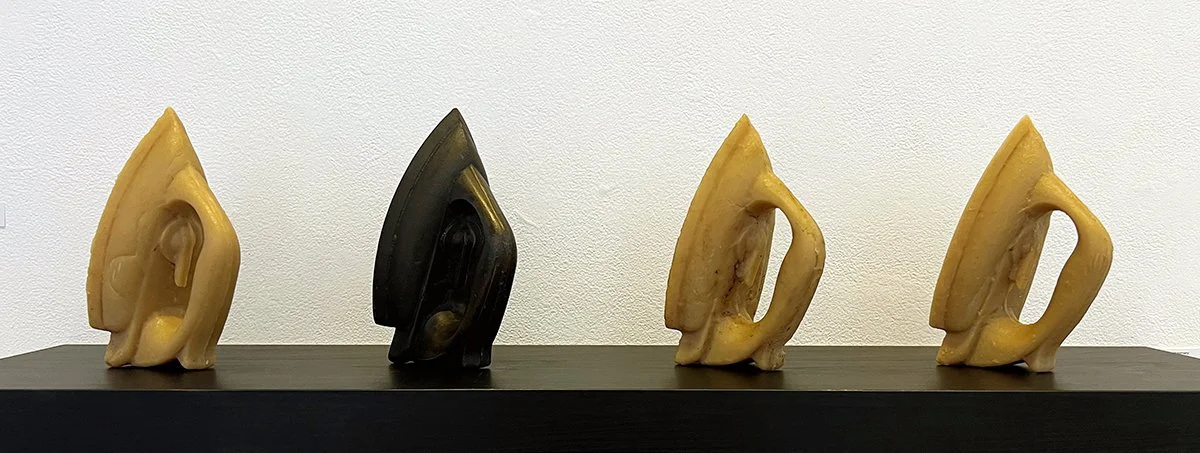
Michele Montgomery, Irons, no date, sculpture in unfiltered beeswax and bronze. Image by Madeleine Boyson.
And then, Montgomery to the left. If Adams revels in plenitude and offal, then Montgomery “draws from the domestic landscape” and holds a tight rein on the wild head of patriarchy. [5] Here Montgomery presents sculptures in multiple: Toast spreads a burned loaf while Irons offers domestic tools sculpted in unfiltered beeswax and bronze, a nod to Janine Antoni’s 1993 chocolate and soap Lick and Lather. Whether bronze or beeswax, either medium renders Montgomery’s objects unfit for the work they are designed, even as their heft makes me either want to chew one or to chuck one at the nearest unsuspecting man.
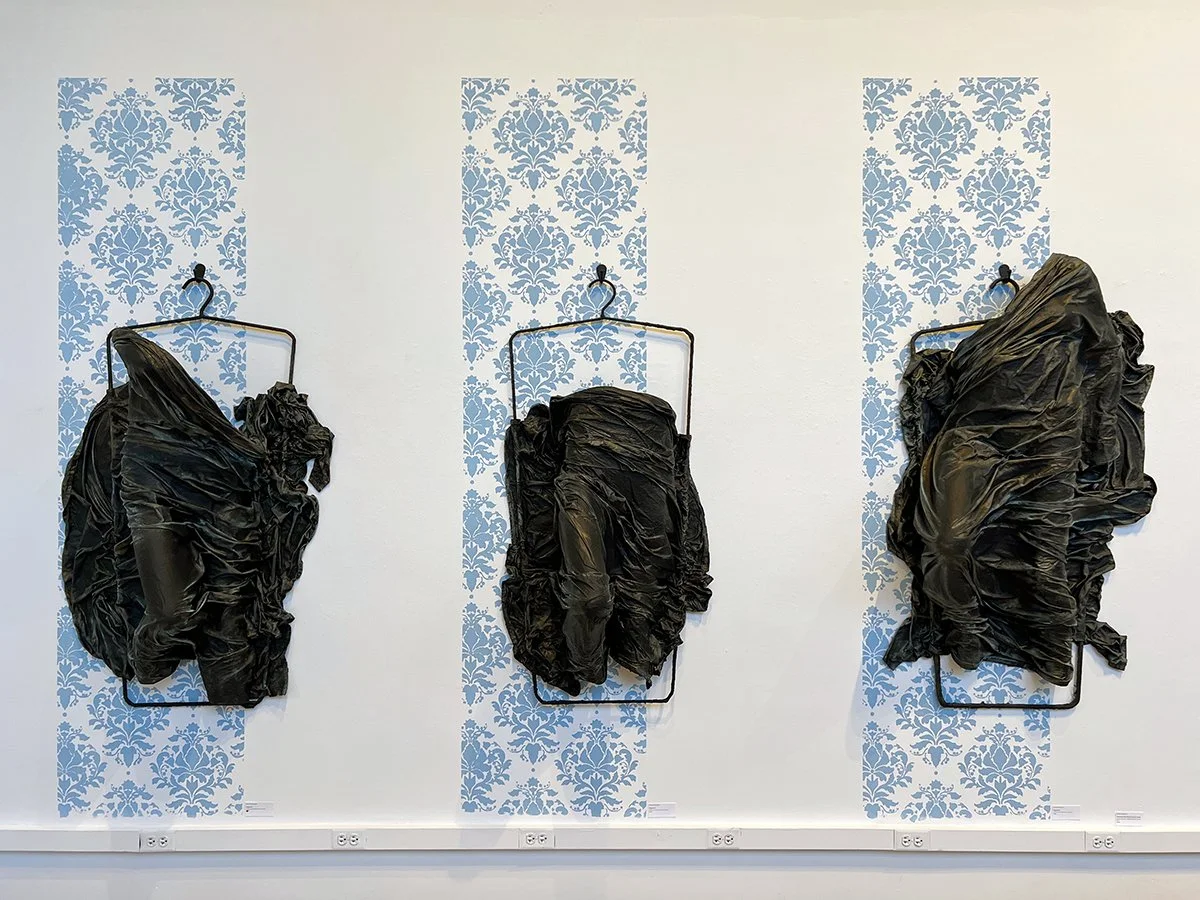
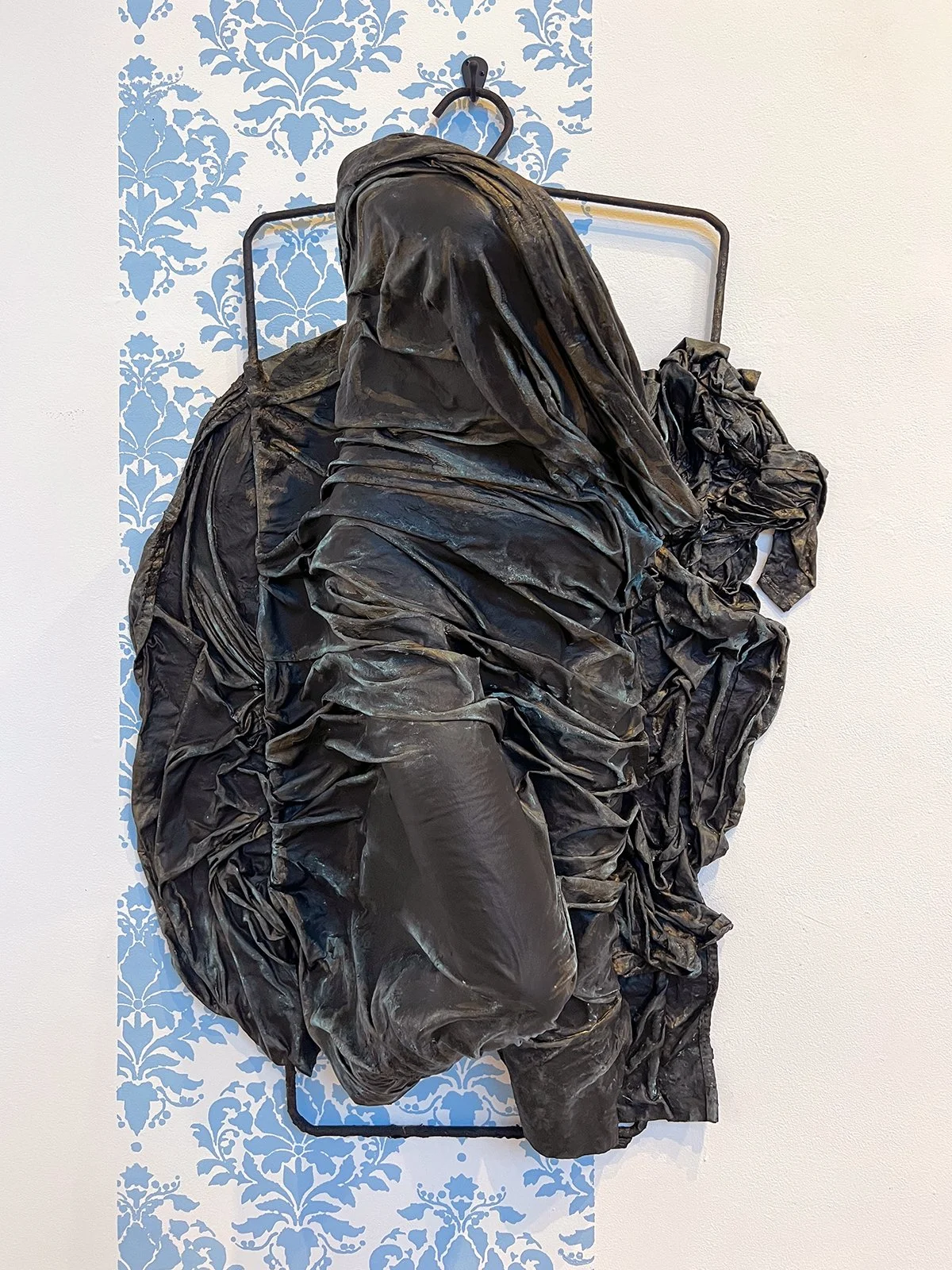
Michele Montgomery, left to right: Figure I, Figure II, and Figure III, no date, cloth, hydrocal, steel, acrylic, and pastel. Image by Madeleine Boyson.
Montgomery’s other sculptural series dominate her side of the gallery, however, with life-size hydrocal and steel draped figures on wire hangers. These neo-classical figures retain the interior shape of a person but remain hollow inside, resisting gravity’s pull to the floor and flying off the wall.
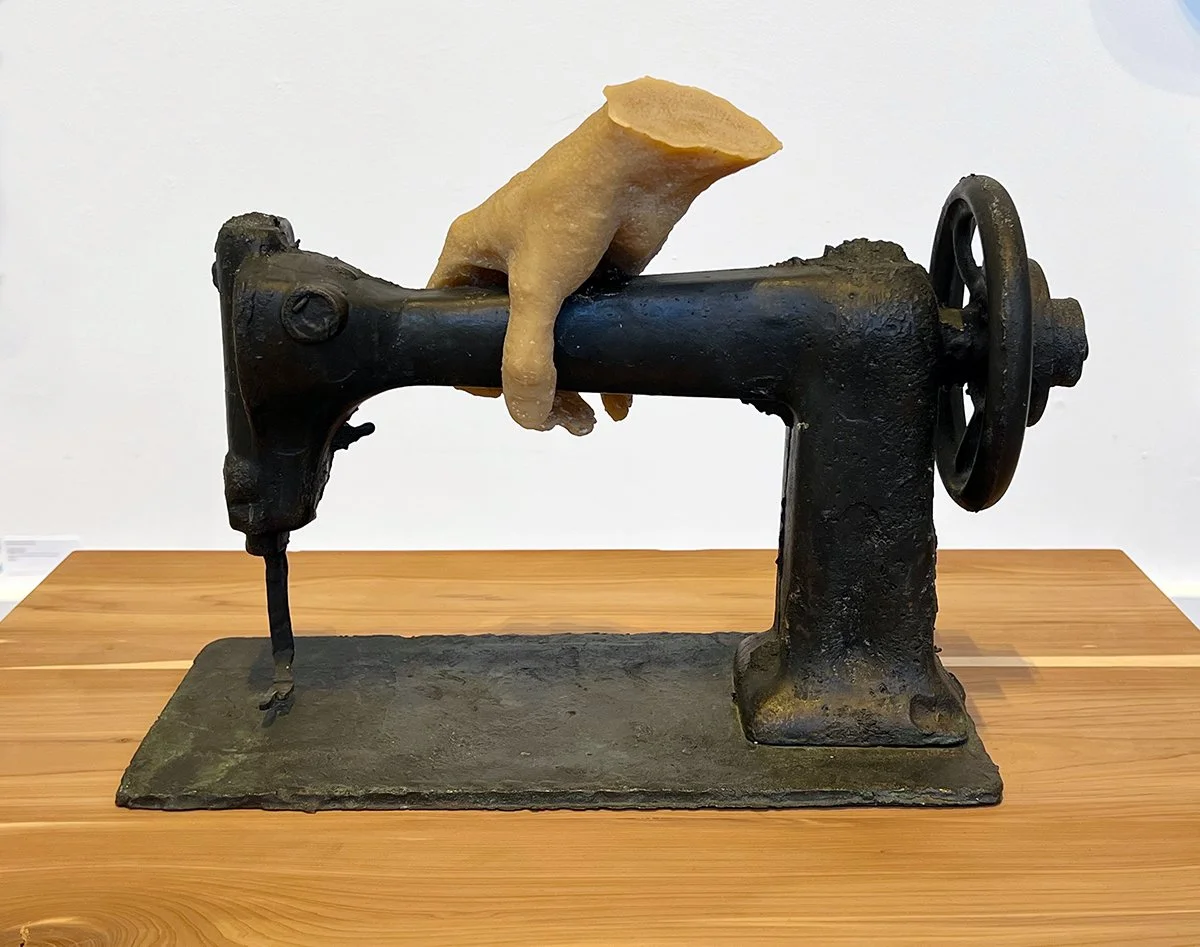
Michele Montgomery, Sewing Machine/Hand/Table, no date, bronze, unfiltered beeswax, and aromatic cedar. Image by Madeleine Boyson.
Nearby, Sewing Machine / Hand / Table severs labor from humans, pairing a beautiful beeswax hand with a bronze machine. Connotations of sweatshops, matriarchal fiber work, arguments about art versus craft, and other implications spring to mind.
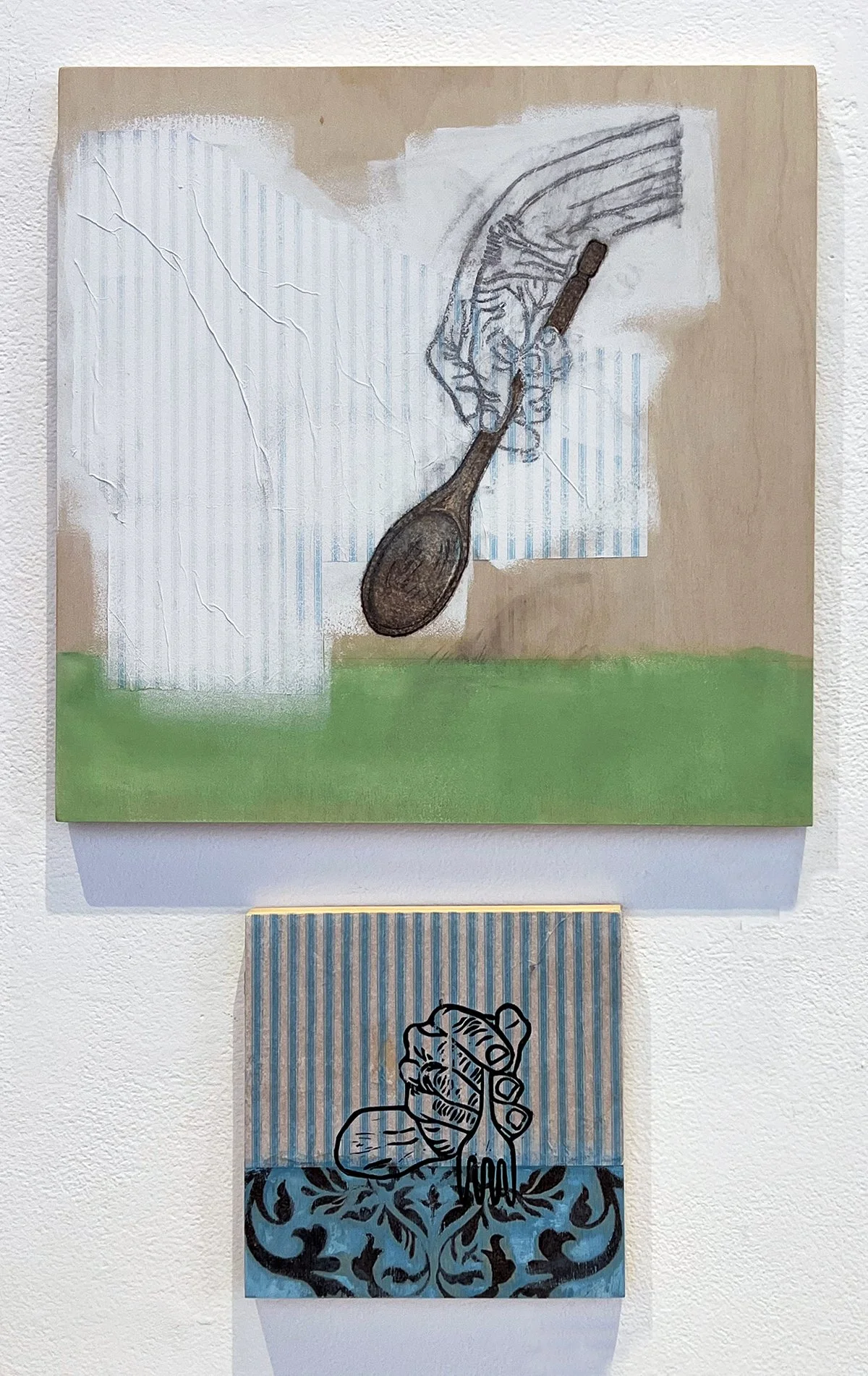
Top: Michele Montgomery, Green Bowl with Spoon, no date, mixed media, linocut, wood burning, and ink. Bottom: Michele Montgomery, Feed Me, no date, mixed media, linocut, wood burning, and ink. Image by Madeleine Boyson.
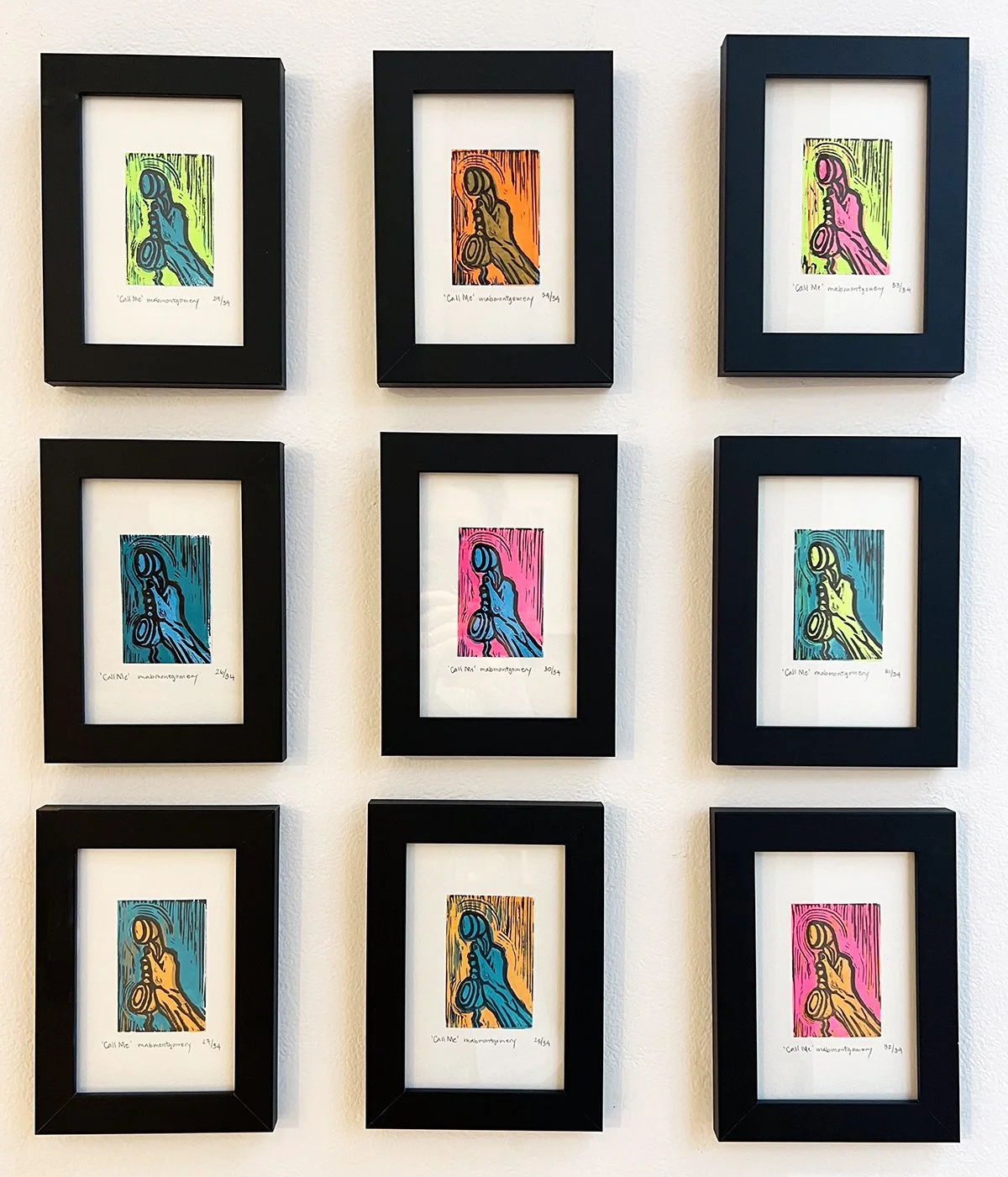
Michele Montgomery, Call Me 1–9, no date, three-block and three-color linocuts. Image by Madeleine Boyson.
Accompanying Montgomery’s sculptures are several two-dimensional sets in linework that elicit 1952 and 2012. Green Bowl with Spoon, Feed Me, and Wooden Spoon I and II offer a new take on the “Live Laugh Love” decor phenomenon of the last decade while the neon corded phones in the Call Me series produce a frenetic, if resolute, wish for connection through a medium other than the computer in our pockets.
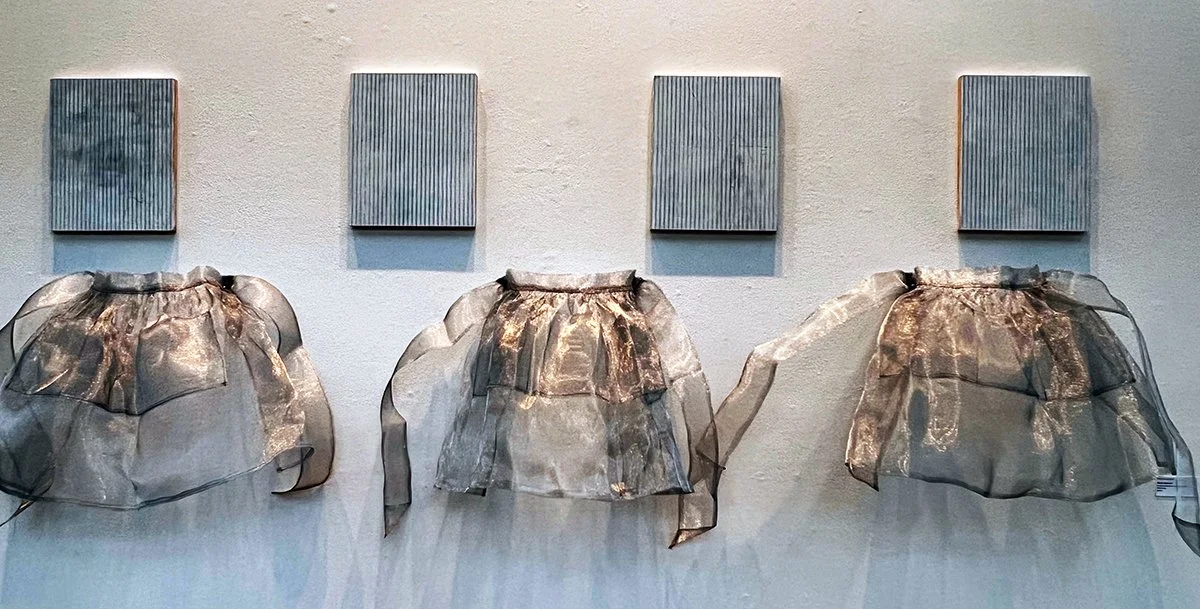
Michele Montgomery, Wire Aprons, no date, aluminum wire sculpture. Image by Madeleine Boyson.
Wire Aprons brings the exhibition home, offering a feathery alternative to the bronze Figures series. Here Montgomery pins half aprons made from aluminum wire to the walls. The mesh is porous and prickly, deceptively light and strangely gendered. Valkarie’s wall texts present little by way of explanation, but offer all of Montgomery’s sculptures as sold separately. Yet the power behind the artist’s aprons, irons, and figures are, like most things in this world, more effective in numbers. I hope collectors appreciate them as sets rather than discrete objects.
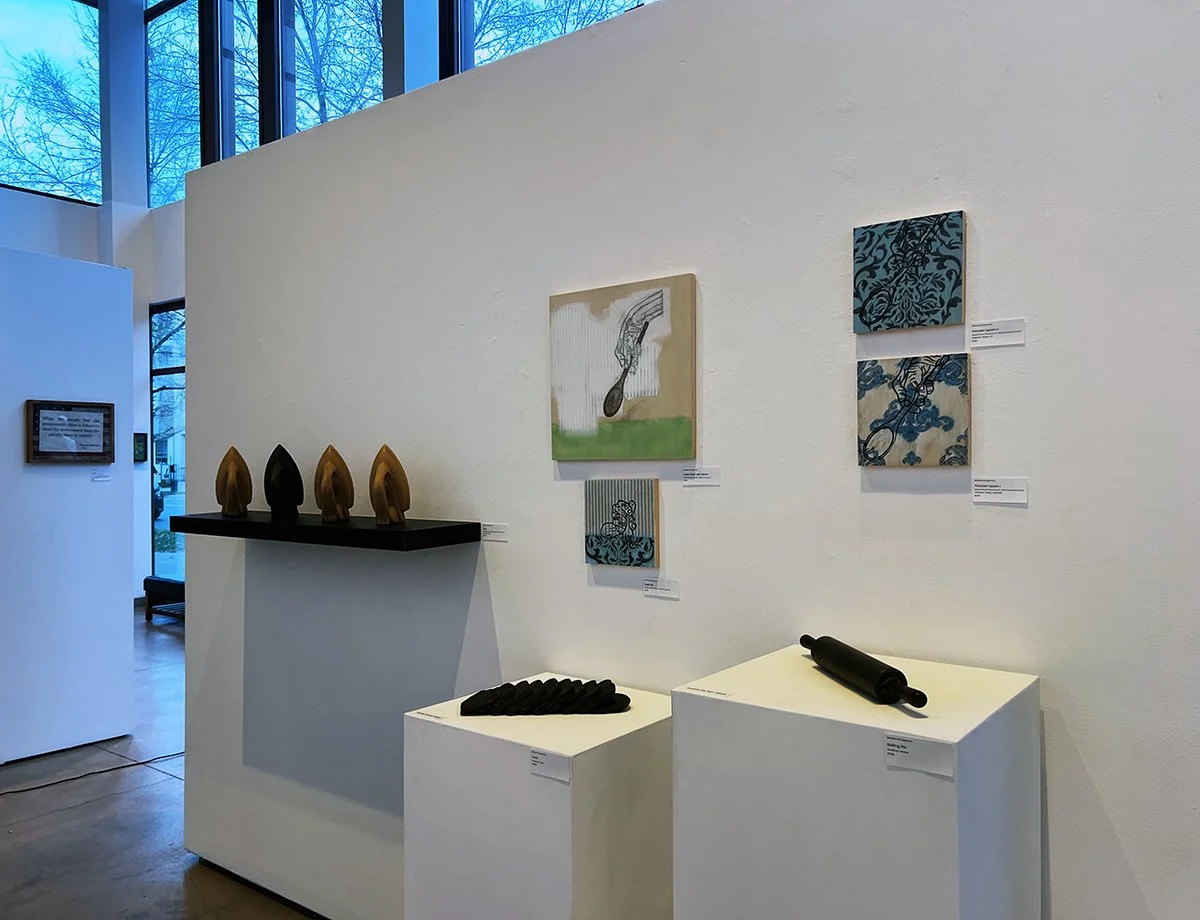
An installation view of Michele Montgomery’s work at Valkarie Gallery & Studio. Image by Madeleine Boyson.
Montgomery | Adams feels caught in 2016, suited perhaps to that other timeline in which American voters sided with their better angels and jerked the country from the precipice of the last ten years. But the works remain steadfastly of this moment. No dates accompany the exhibition, but the fact of the art’s relevancy betrays history’s long loops. The thematic white ribbon that ties Montgomery and Adams’s work may be obvious, even crude, but the show is an honest response to a political climate dominated by, as U.S. Senator-Elect Abdul El-Sayed says, “an unserious fool.” [6] The difference is that today I feel hope.
Madeleine Boyson (she/her) is an Editorial Coordinator at DARIA and a Denver-based writer, poet, and artist. She holds a BA in art history and history from the University of Denver.
[1] “She has taken 30 years to Write a 7-Part Novel About 1 Day. It’s a Sensation,” New York Times, accessed November 11, 2026, https://www.nytimes.com/2025/11/18/magazine/solvej-balle-calculation-of-volume.html. https://www.abramsbooks.com/product/hot-cold-heavy-light-100-art-writings-1988-2018_9781419735264/.
[2] Find the clip here: https://www.instagram.com/p/DfC-vHwixOh/.
[3] “The biggest blue wave in 50 years, explained in 7 charts,” Vox, accessed November 11, 2026, https://www.vox.com/politics/510050/midterm-elections-2026-blue-wave-democratic-landslide-charts.
[4] From the artist’s statement on the Valkarie Gallery website: https://www.valkariegallery.org/grant-adams.
[5] From the artist’s statement on the Valkarie Gallery website: https://www.valkariegallery.org/michelemontgomery.
[6] Abdul El-Sayed in conversation with Jon Favreau for Pod Save America, https://www.instagram.com/p/DfZZZcUh4aN.