
Gathering Place: Permanent Collection Reinstallation
Gathering Place: Permanent Collection Reinstallation
Colorado Springs Fine Arts Center at Colorado College
30 W. Dale Street, Colorado Springs, CO 80903
Ongoing
Admission: Adults: $10, Seniors, Military, and Teachers: $8, K-12 Students: $5, College students and Children 5 and Under: free
Review by José Antonio Arellano
Museums’ permanent collections can be simultaneously generative and limiting: a rich source for exhibitions, but too often reflective of wealthy collectors' idiosyncratic tastes. As the historian Gretchen Sullivan Sorin observes, because “the objects available for exhibition often reflect a fairly narrow demographic,” collection-based exhibitions might only circulate “the history of people of great wealth.” [1]
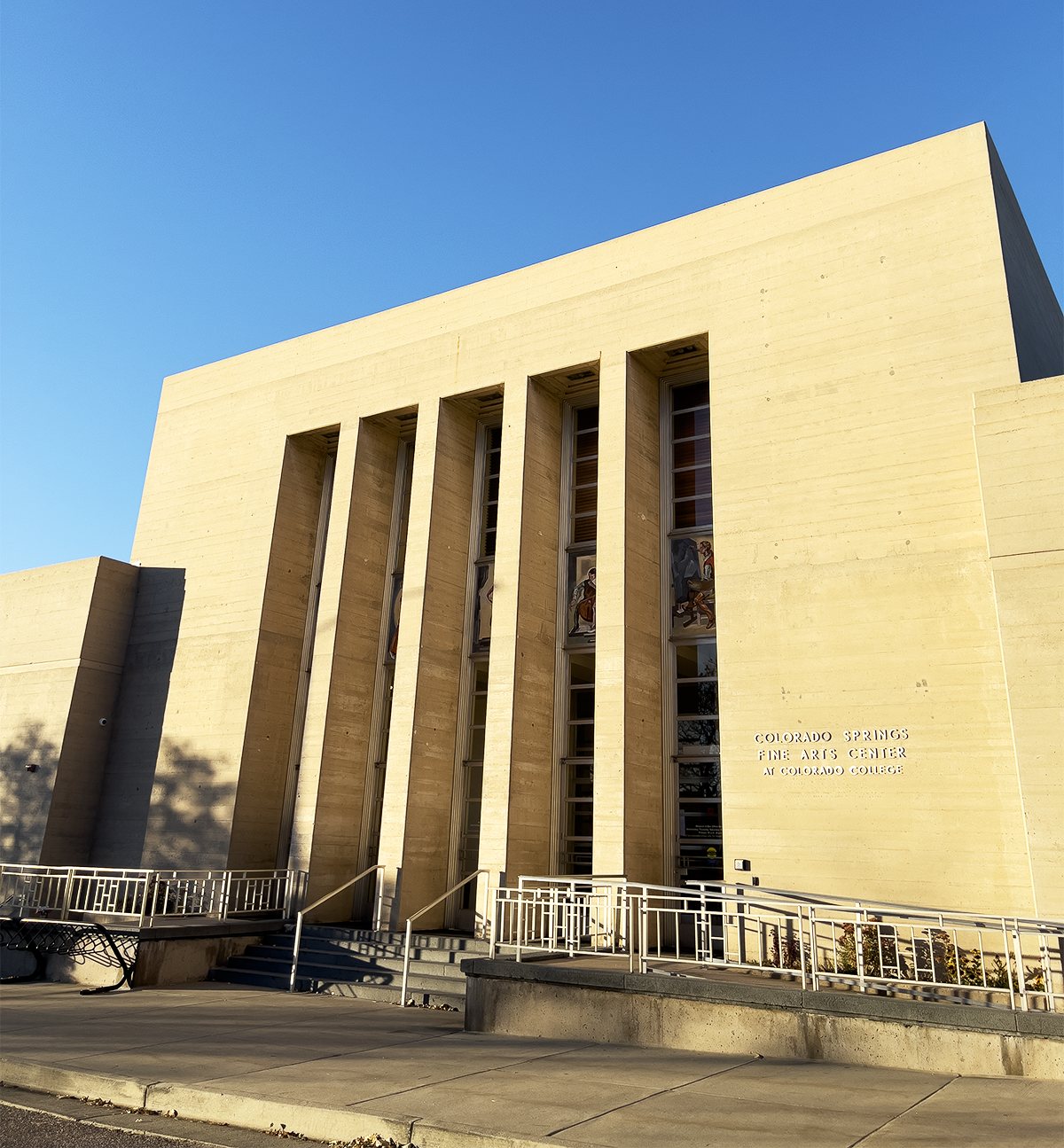
A view of the Colorado Springs Fine Arts Center designed by John Gaw Meem. Image by José Antonio Arellano.
The Colorado Springs Fine Arts Center (FAC) began as the Broadmoor Art Academy in 1919, when Julie Penrose donated her home and property to establish an art school. In the 1930s, another wealthy benefactor, Alice Bemis Taylor, proposed constructing a small museum on a portion of the Academy’s property to house her collections of Native American and Hispanic artifacts.
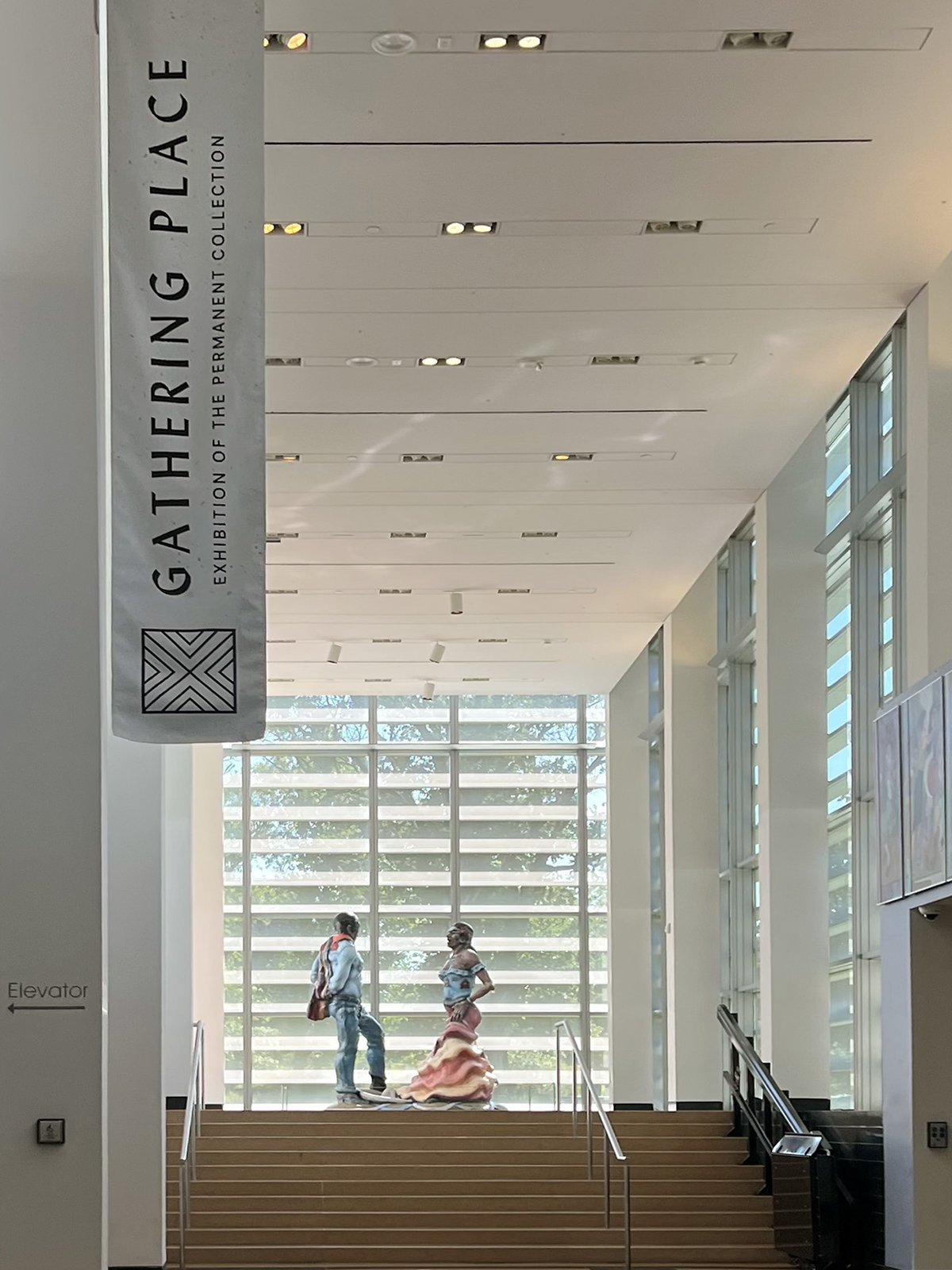
A view of the entry hall of Colorado Springs Fine Arts Center designed by John Gaw Meem. Image by José Antonio Arellano.
The plans gradually developed into an ambitious arts complex that included a museum, an art school, a library, and a performance arts center. Another strong voice and founder, Elizabeth Sage Hare, brought her interests in European and American modernism to bear on the permanent collection. This convergence of modernism and Southwest art has grown into a renowned collection.
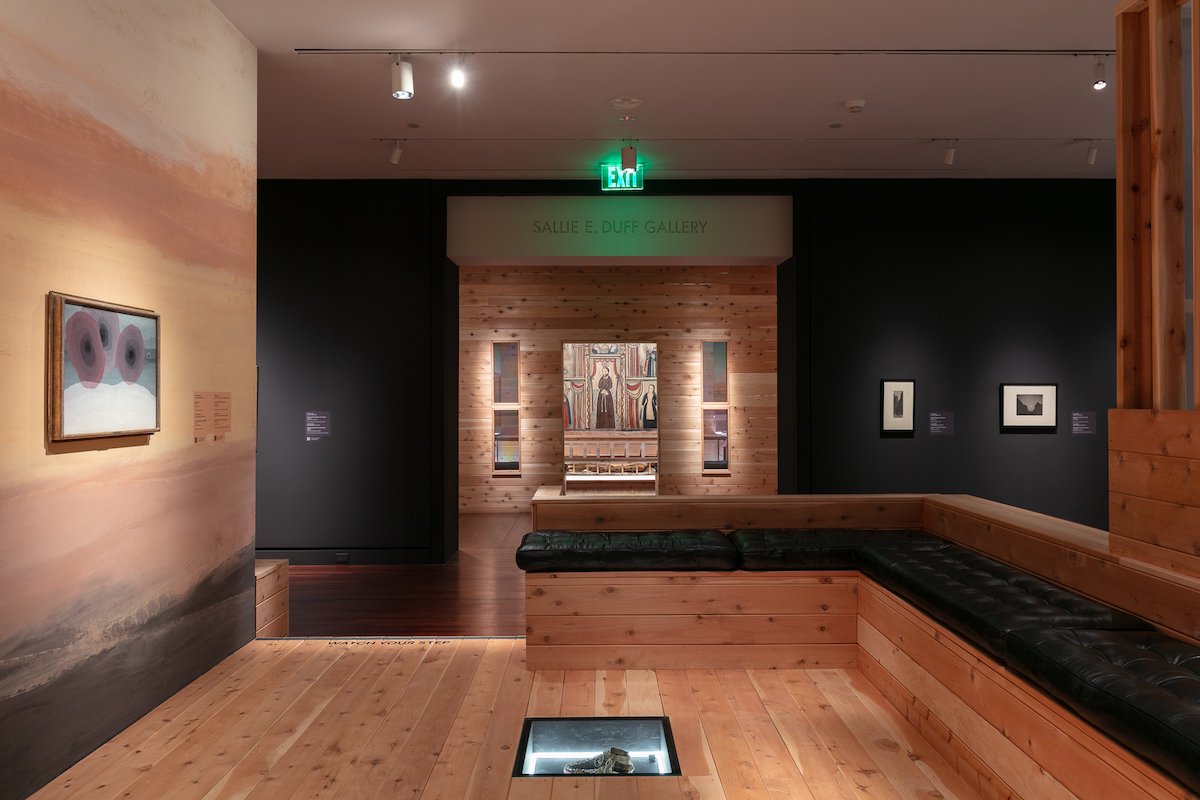
An installation view of the Blessing Gallery, co-curated by Cassandra Atencio and Josh T. Franco. Image by Wes Magyar.
In a collaborative effort to tell a more complex story of this collection and the institution, the FAC invited four guest curators—selected from a diverse set of community stakeholders—to reimagine its exhibition spaces. The historian Bill Bryans describes how such a collaborative practice enables public history, “doing history for and with the public,” often with “non-academic partners.” [2]
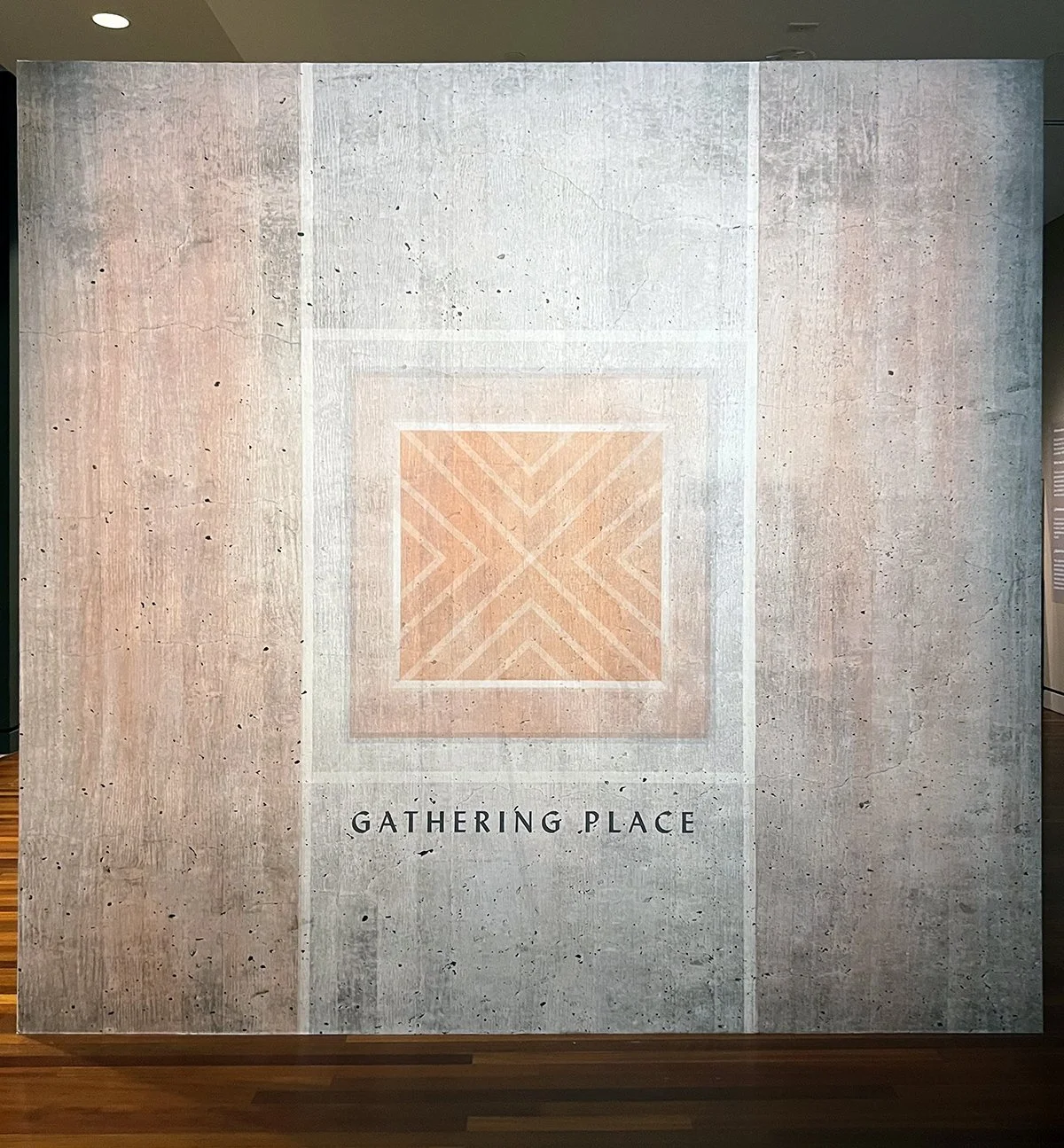
A view of the title wall for the Gathering Place exhibition at the Colorado Springs Fine Arts Center at Colorado College. Image by José Antonio Arellano.
The exhibition’s title, Gathering Place, resonates throughout the reconceptualized galleries, which feature newly constructed seating that invites visitors to pause and inhabit the spaces. The galleries gather the public and a diverse array of artworks across media.
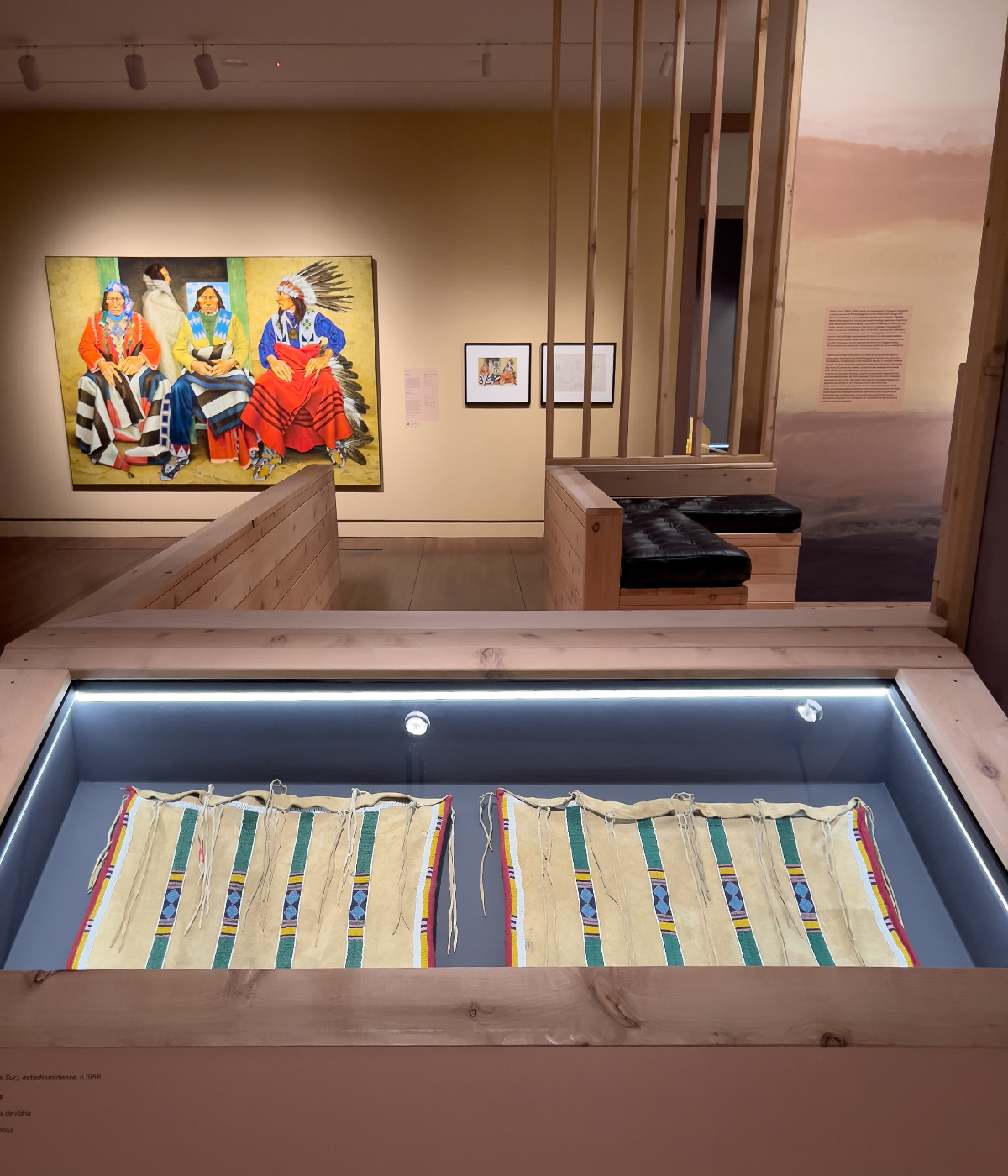
An installation view of the Blessing Gallery, co-curated by Cassandra Atencio and Josh T. Franco. Image by José Antonio Arellano.
The first gallery of the exhibition interrogates the concept of place as a contested definition and physical site. Co-curated by Josh T. Franco, an art historian and artist, and Cassandra Atencio, an elder of the Southern Ute Indian Tribe, the space features landscape photographs of the Colorado Springs region displayed alongside articles of Ute clothing and works by the artist Debra K. Box (Southern Ute).
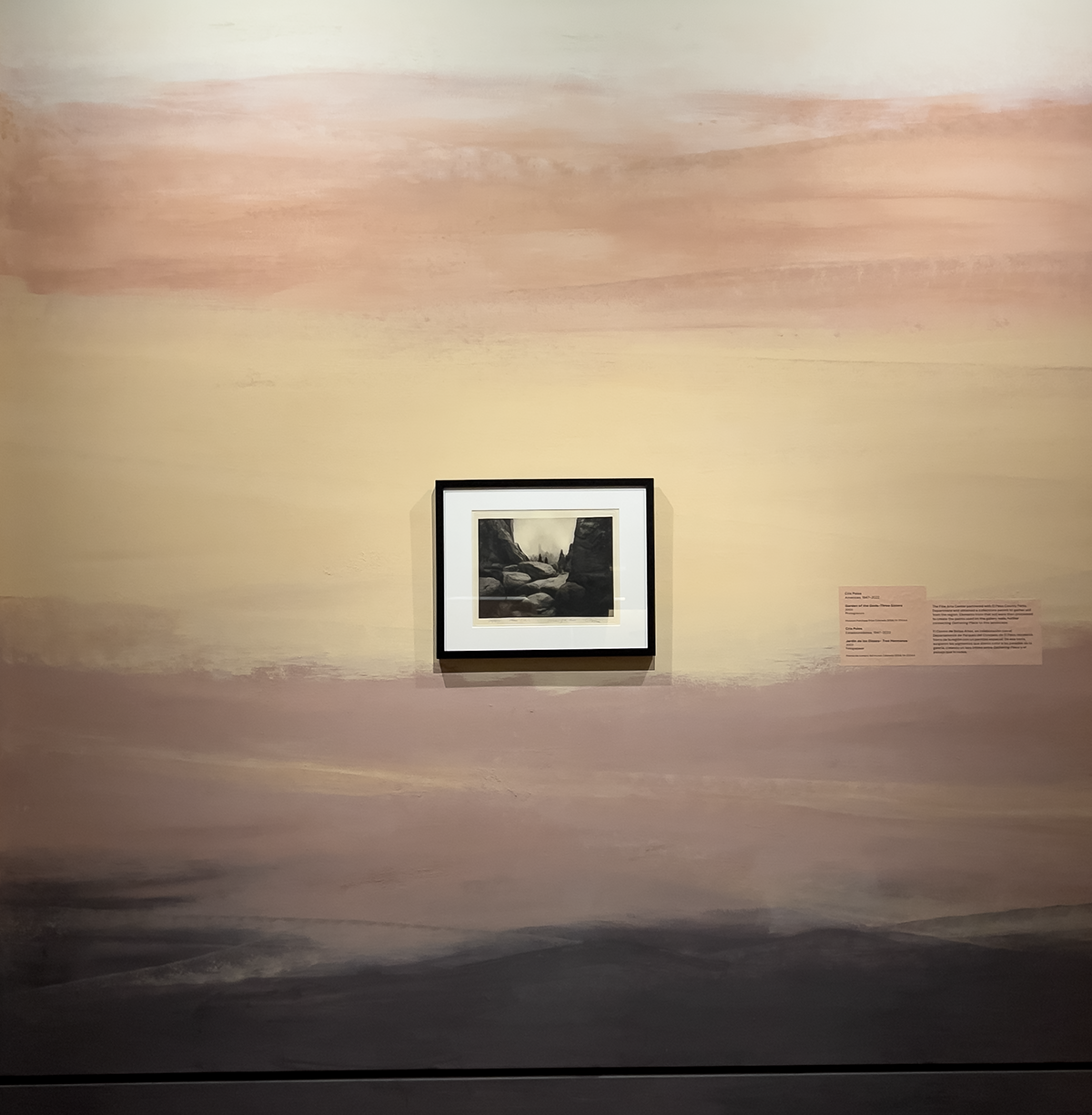
An installation view of one wall in the Blessing Gallery that was painted with pigments created using local soil. Image by José Antonio Arellano.
As visitors enter the gallery, they encounter a wall painted with pigments derived from local soil. In collaboration with El Paso County Parks, the FAC obtained a permit to collect soil samples, which they processed to create the paint. This approach highlights the material sense of the landscape represented in the gallery as well as the artistic practices that produced the pigments used in the art of the region.
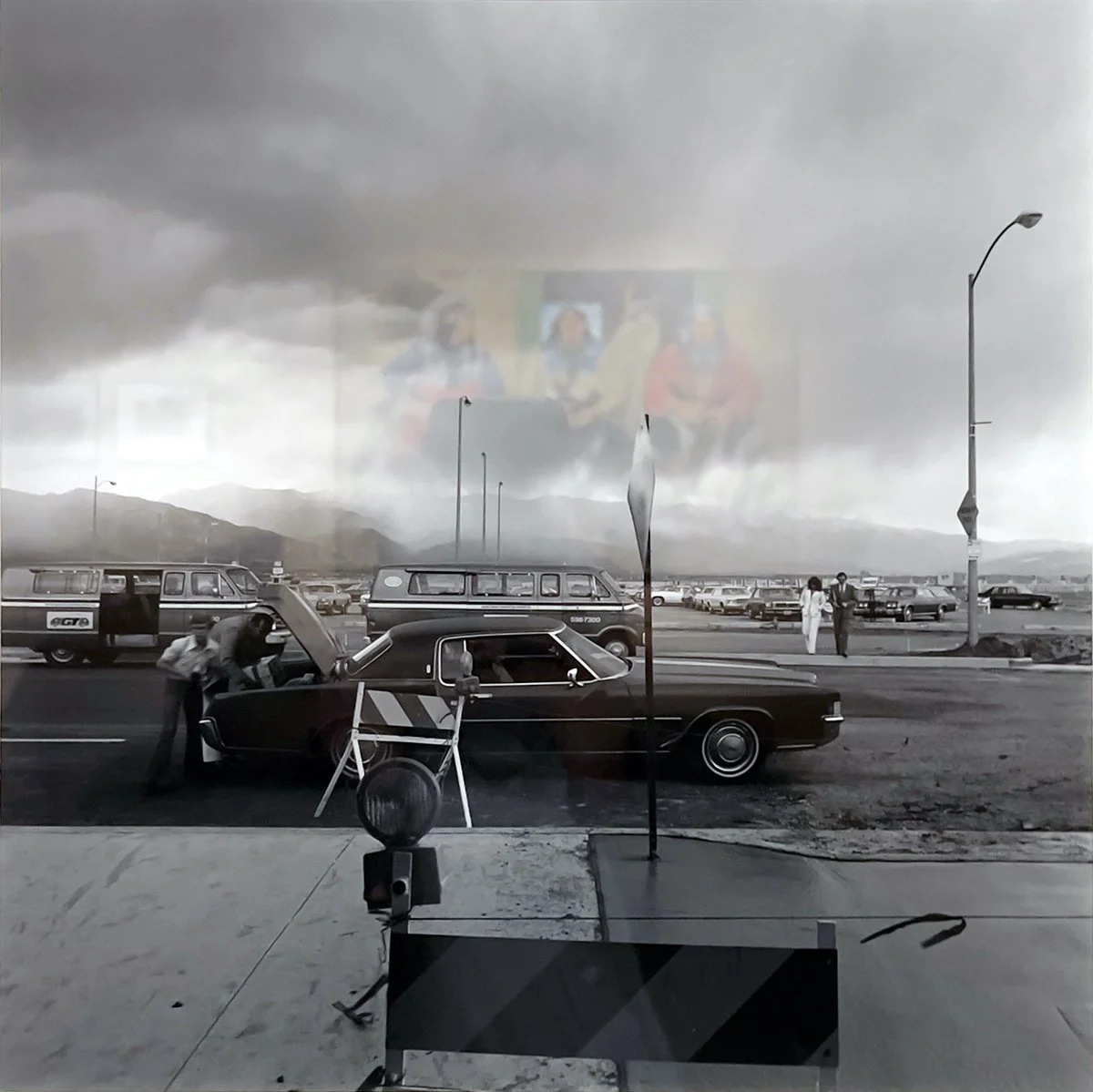
A view of Frank Gohlke’s Impending Storm, Colorado Springs Colorado 1977, gelatin silver print, with Paul Pletka’s painting Ute Agency,1995, acrylic on canvas, reflected on the glass. Image by José Antonio Arellano.
I tried to take a picture of Frank Gohlke’s photograph Impending Storm (1977), which documents a sliver of life in Colorado from the 1970s. The reflection of Paul Pletka’s painting Ute Agency (1995), though, disrupted my attempt, as if purposefully. The painting’s reflection prompted me to consider the continued presence of the symbolized Indigenous agency and how this agency is represented.
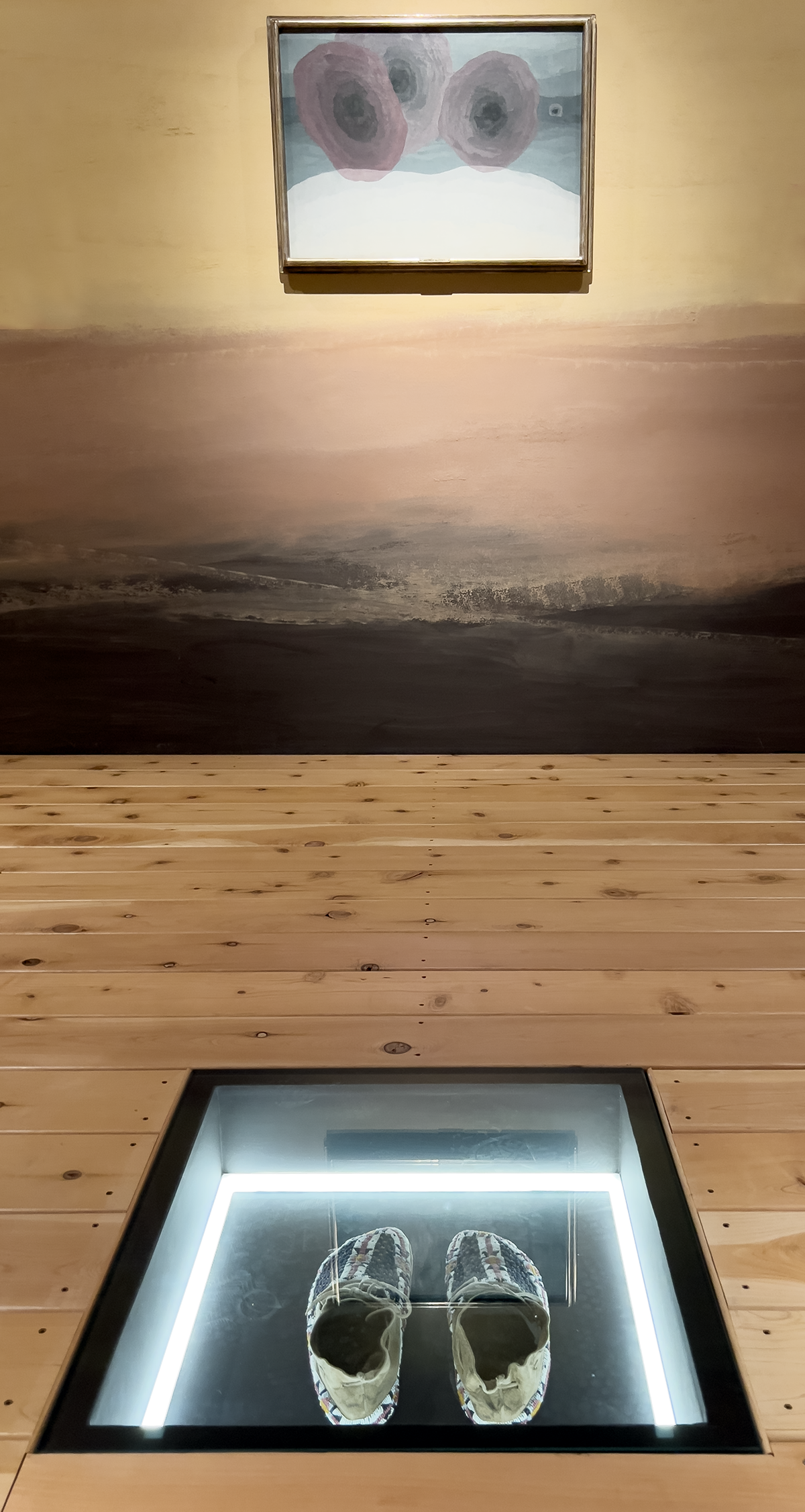
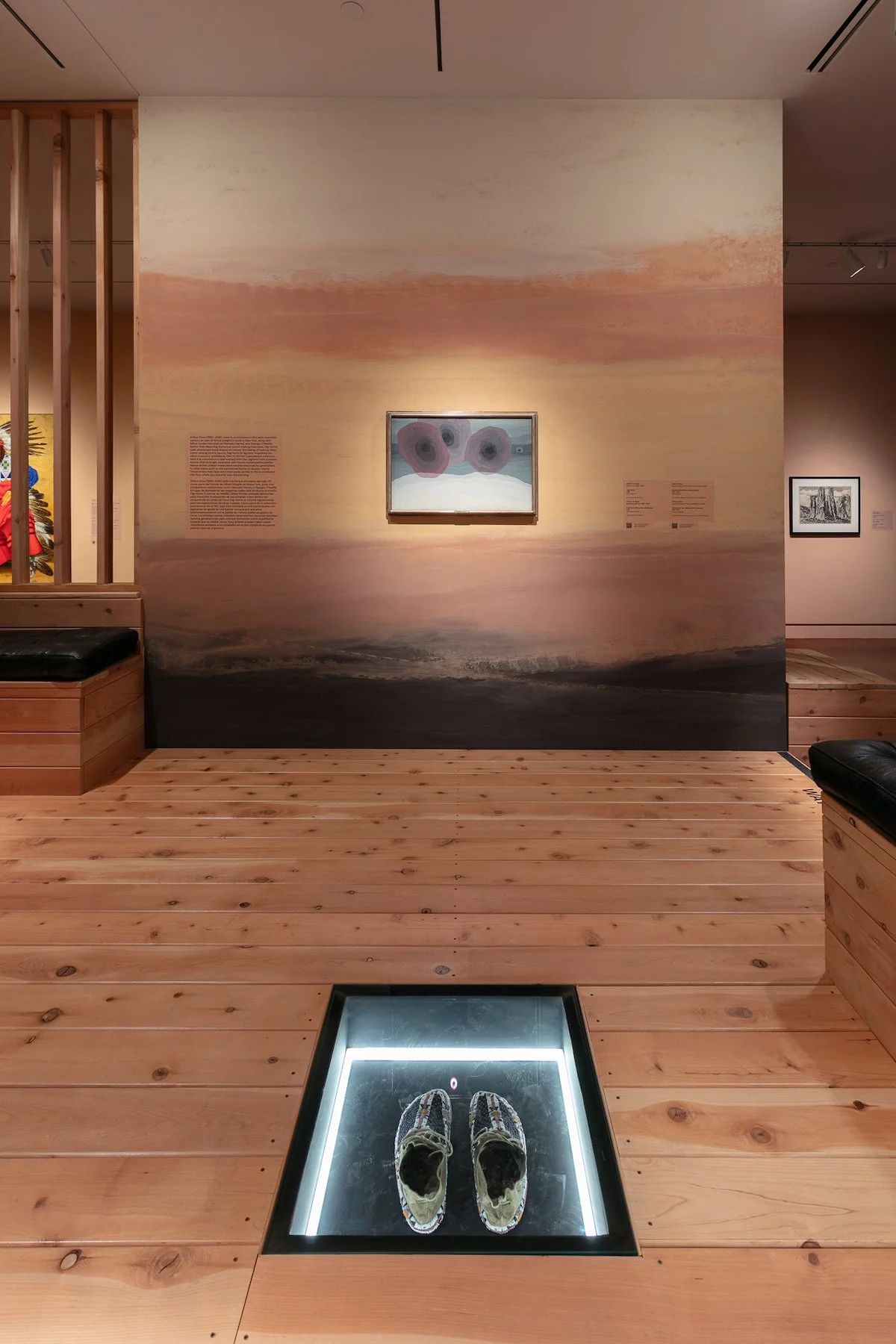
A view of moccasins by Debra K. Box (Southern Ute) and Arthur Dove’s Foghorns, 1929, oil on canvas, 18 × 26 inches. Image by Wes Magyar, courtesy of the Colorado Springs Fine Arts Center at Colorado College.
Franco and Atencio’s co-curation enables such literal and metaphorical reflection. They pair Arthur Dove’s abstract painting Foghorns (1929) with moccasins made by Debra K. Box. The moccasins invoke the Ute presence in this region, which persists despite attempts to erase it from (art) history. It is as if a ghostly Ute figure stands before Dove’s painting as a beholder. The display case is sturdy enough for gallery visitors to stand on top of it, momentarily and imaginatively inhabiting this gaze.
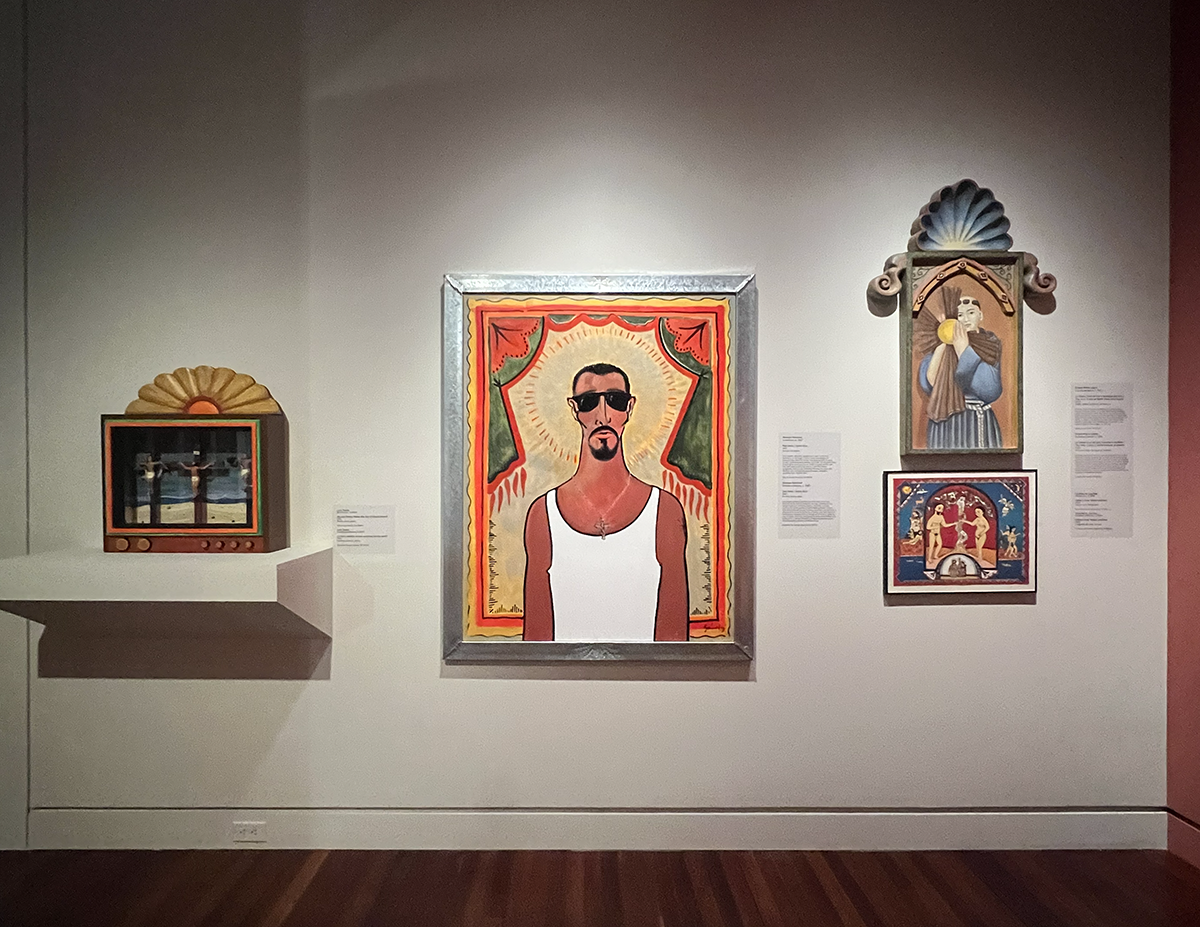
An installation view of the Duff Gallery, curated by James M. Córdova. Image by José Antonio Arellano.
The FAC invited a practicing santero—a maker of carved and painted wooden saints in the New Mexican tradition—and Associate Professor of Art History at the University of Colorado Boulder, James M. Córdova, to reinstall the Duff Gallery. Córdova drew from the renowned Taylor Collection of New Mexican santos and chose to display the Hispano handiwork alongside Indigenous pottery.
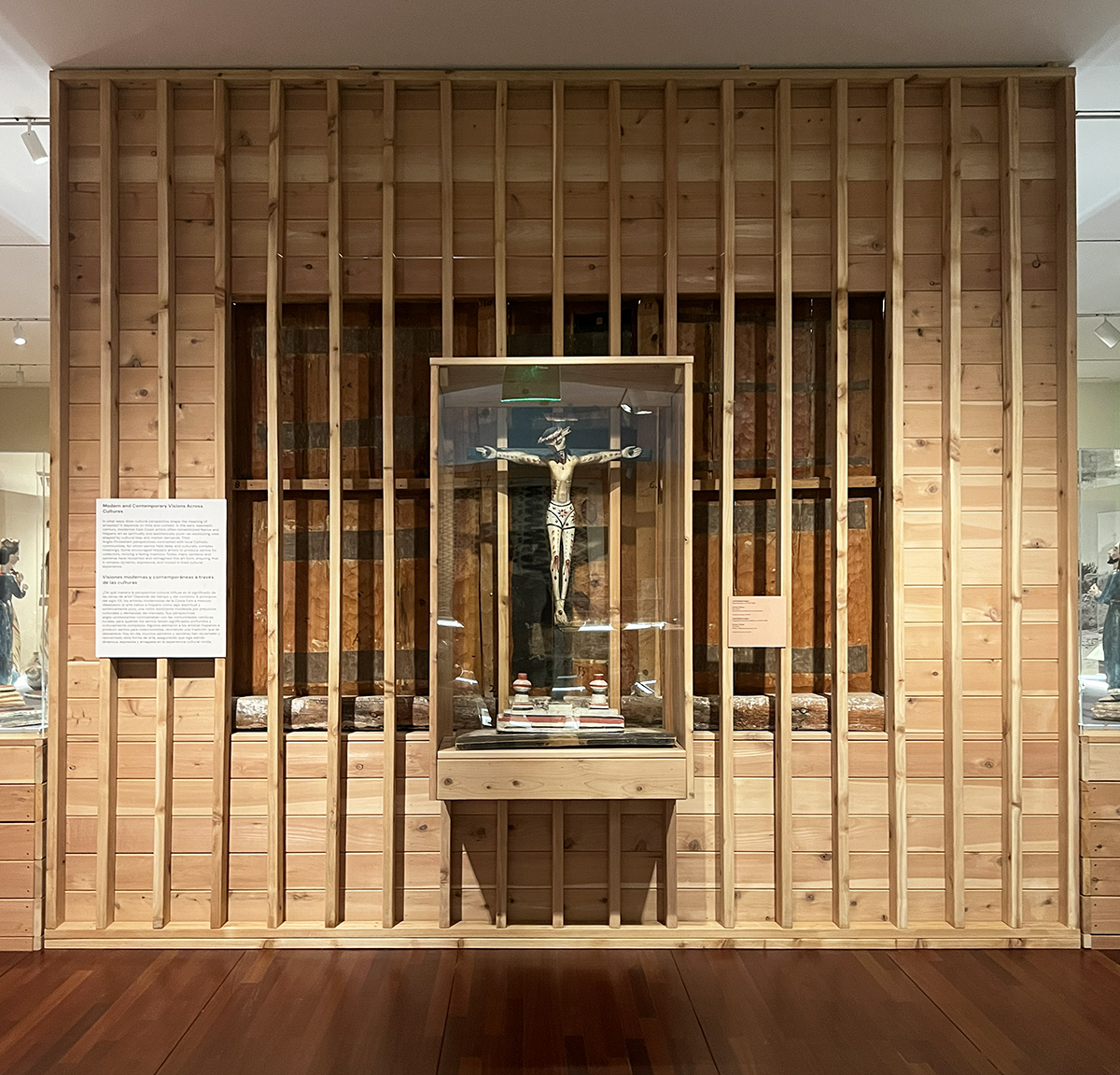
An installation view of the Duff Gallery, curated by James M. Córdova. Image by José Antonio Arellano.
The exhibitions staff built wooden façades from locally sourced red cedar to create a feeling of intimacy and reverence within the gallery. The red cedar emits a sweet, resinous aroma that delicately suffuses the gallery. As visitors cross the wooden threshold, they hear recordings of New Mexican alabados, Spanish-language hymns of praise and lament that developed in colonial New Mexico. Córdova displays the santos (the carved wooden saints) reverently, alluding to their original devotional use in chapels and homes.
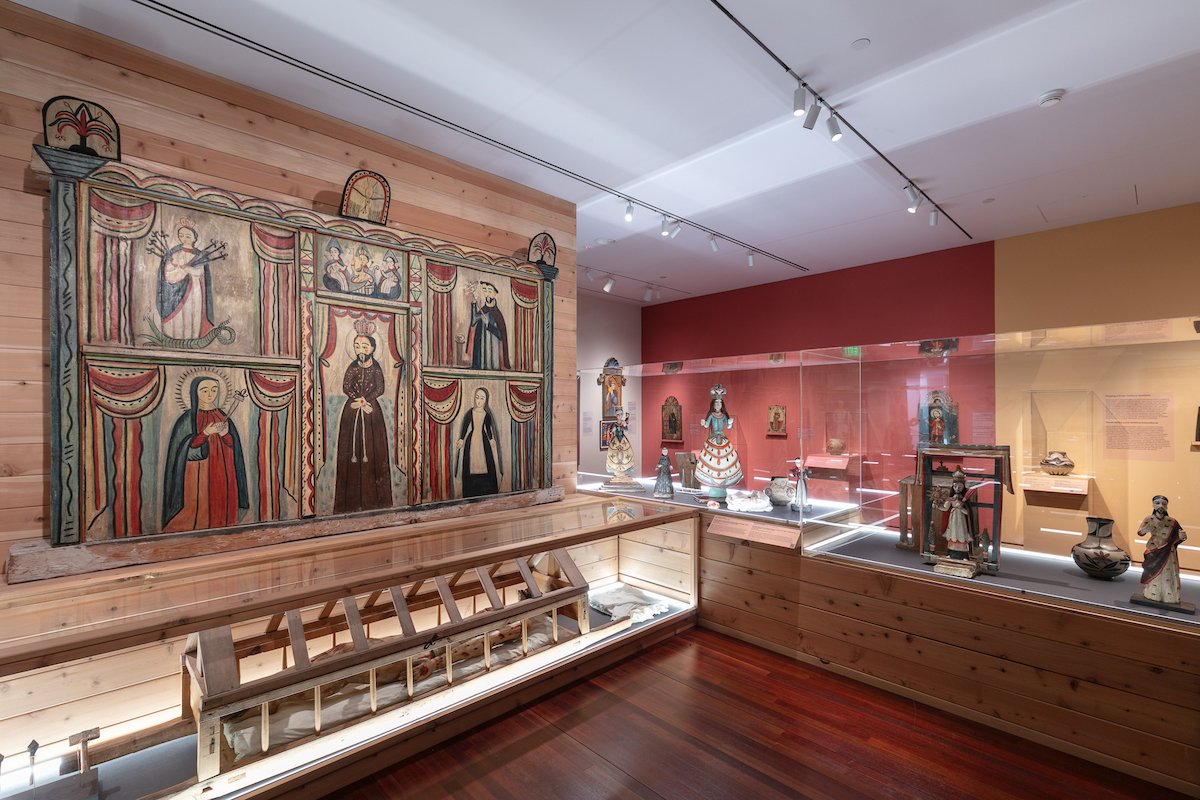
An installation view of the Duff Gallery, curated by James M. Córdova. Image by Wes Magyar, courtesy of the Colorado Springs Fine Arts Center at Colorado College.
Listening to the alabados, sung by Narciso Arellano, reminded me of the New Mexican oral historian and poet Nasario García’s work. García describes the shock of recognition upon hearing Andalusian Gitanos singing cante jondos, “deep songs,” in Granada. [3] The alabados contain sonic traces of Arabic, Jewish, and Gitano oral traditions. The Spanish language itself carries these traces, in expressions such as ojalá. According to the linguist Rubén Cobos, however, New Mexican Spanish includes fewer words of the “Río Grande Indians,” because of “the lack of extended social contact between the Spaniards and their Indian neighbors.” [4]
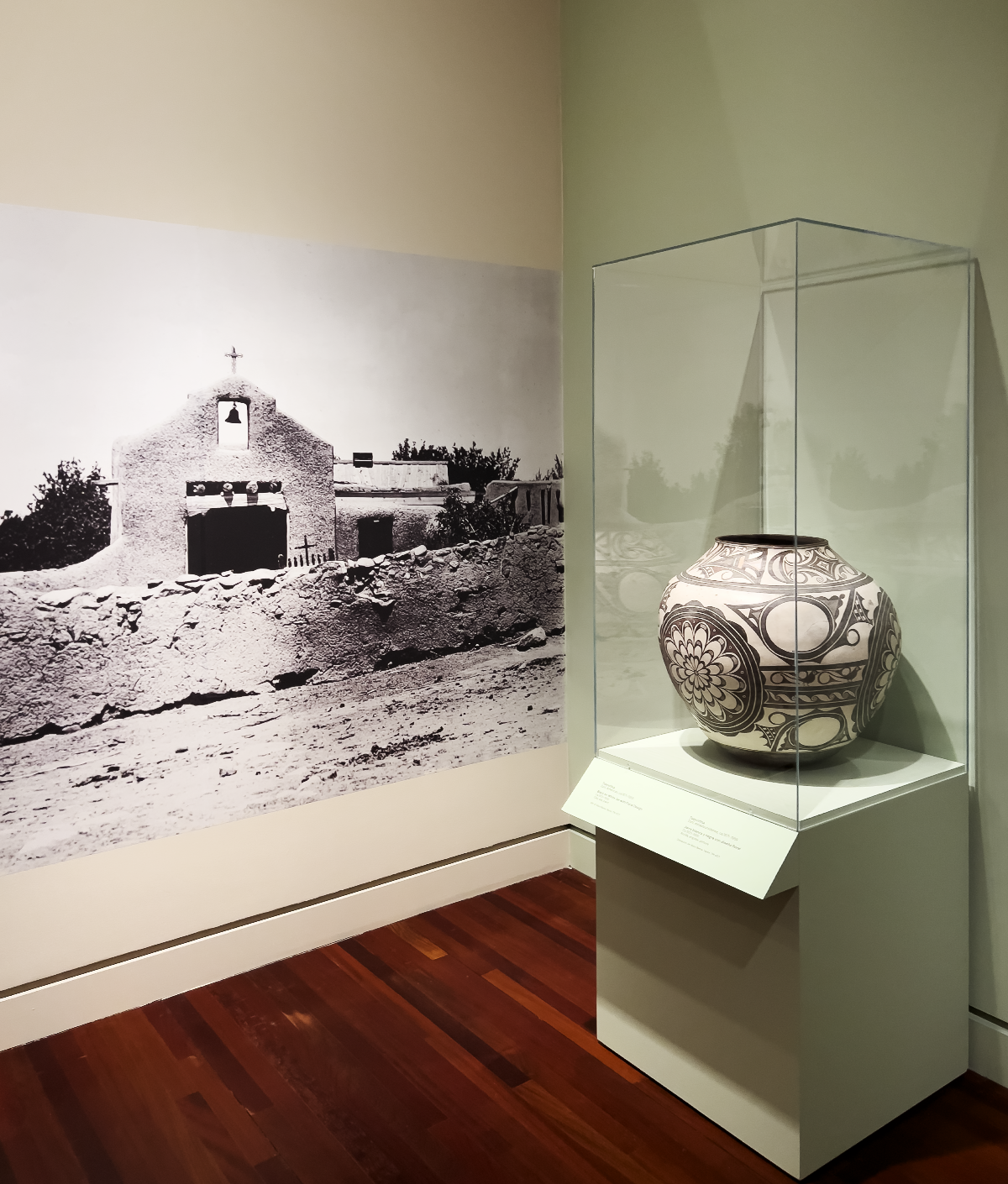
An installation view of the Duff Gallery, curated by James M. Córdova. Image by José Antonio Arellano.
Córdova’s pairings of New Mexican santos with Indigenous ceramics, though, show a visual resonance, including shared maíz motifs.
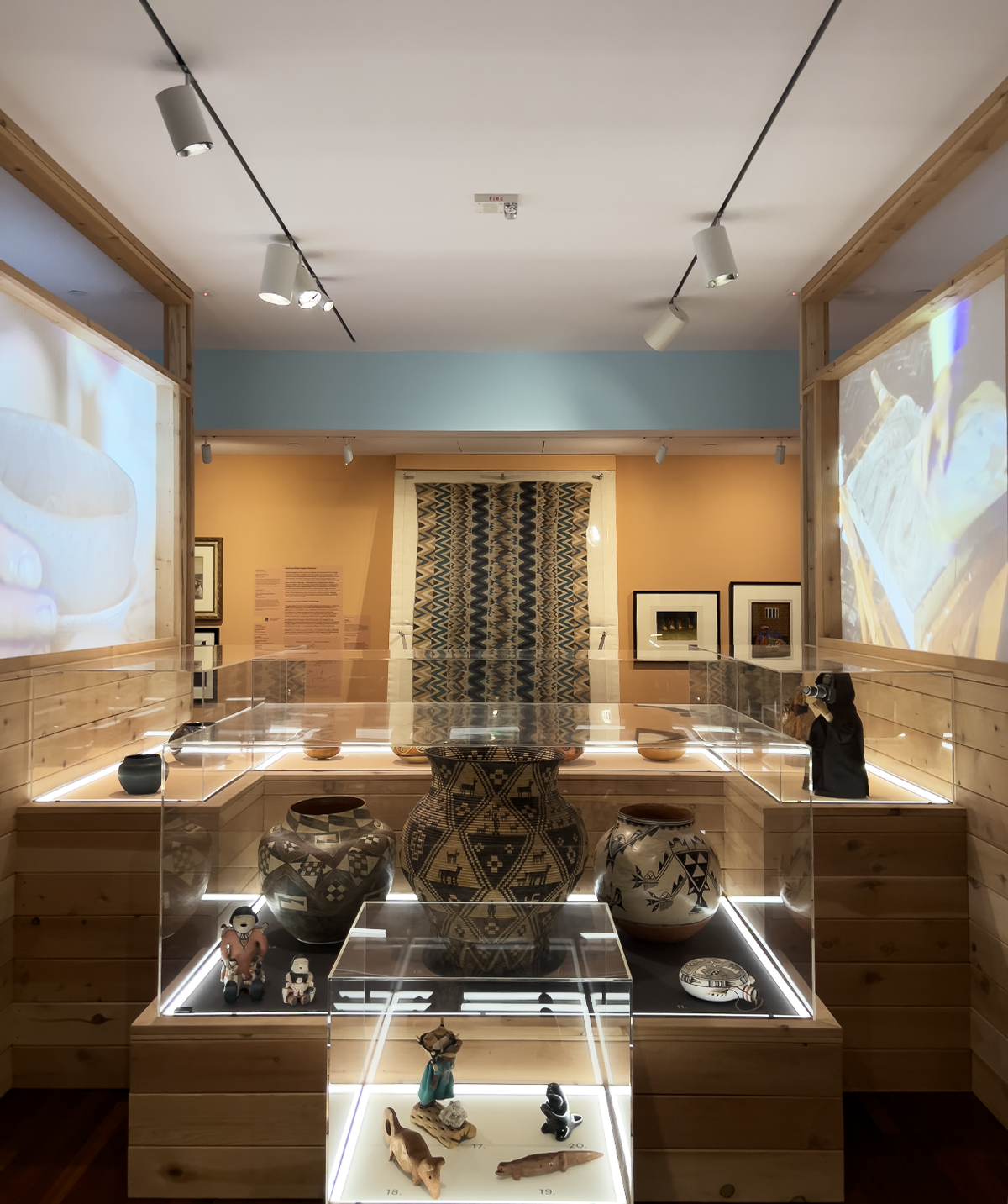
An installation view of the Manley Gallery, curated by Pat Musick. Image by José Antonio Arellano.
The Manley Gallery was curated by a long-time resident of Colorado Springs: the artist and scholar Pat Musick. Musick has deep roots in the Fine Arts Center. Her father, Archie Musick, was a student at the Broadmoor Art Academy in the 1920s before studying with Thomas Hart Benton at the Art Students League in New York. Archie Musick returned to the FAC during the 1930s to teach and work as a painter and muralist.
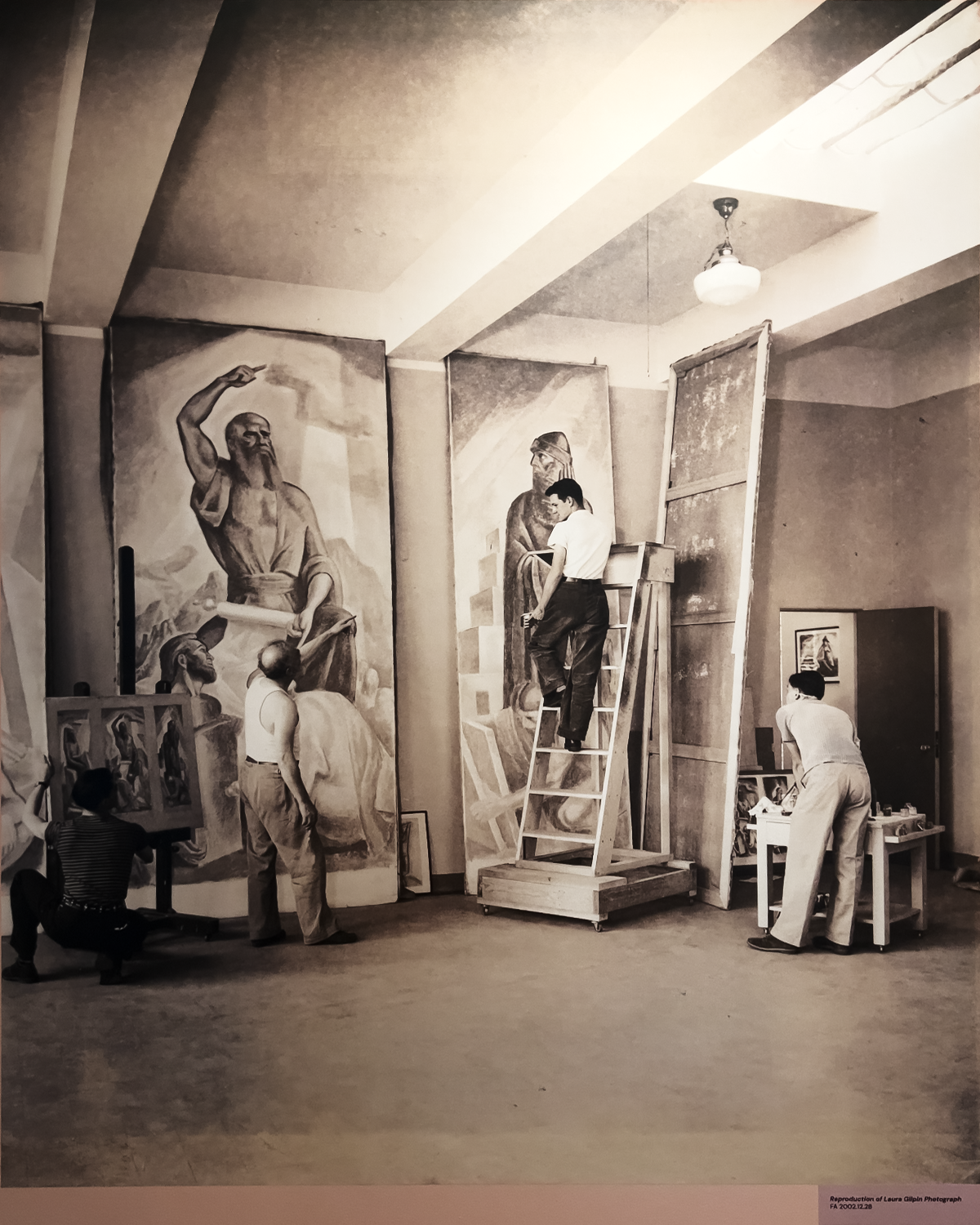
Laura Gilpin’s photograph of Boardman Robinson’s students, including Archie Musick, at the School of the Colorado Springs Fine Arts Center as they assist him in the mid-1930s with his murals titled Great Events and Figures of Law, displayed as part of the FAC timeline in the Manley Gallery, curated by Pat Musick. Image by José Antonio Arellano.
Pat Musick, who had worked with the FAC to create a “living timeline” of the institution’s history, drew on her extensive research and family history to curate the FAC’s Manley Gallery. Musick invokes the ecological concept of the “ecotone” as a metaphor to describe the institution as a site where different terrains converge.
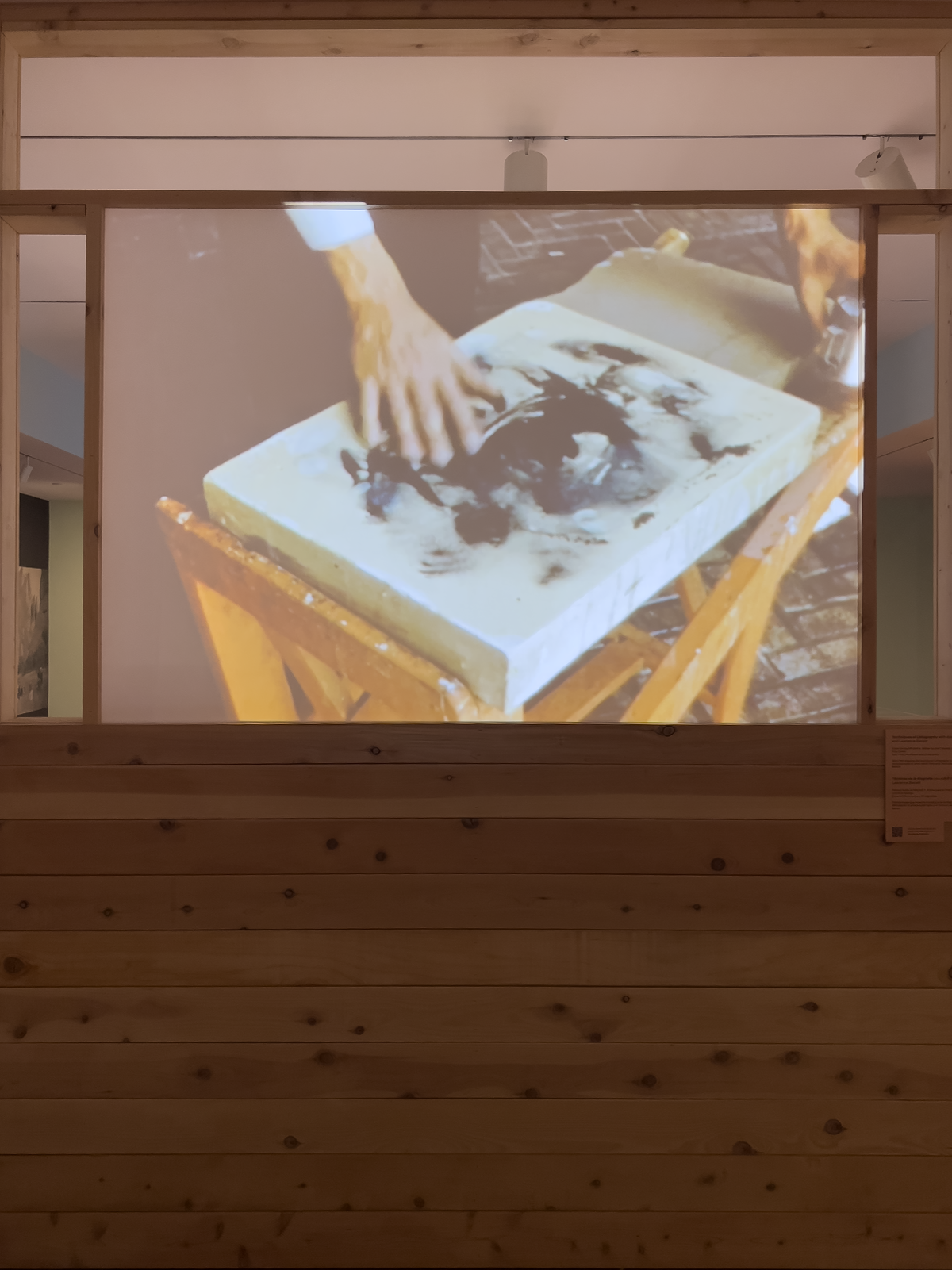
A view of a video demonstrating the lithography process in the Manley Gallery, curated by Pat Musick. Image by José Antonio Arellano.
The gallery visually represents the ecotone metaphor, converging artifacts from the Taylor Collection of Southwest Art and impressionist paintings created by FAC staff from the 1930s and 1940s. A documentary film titled The Sacred Land: Three Southwest Vignettes is projected on one side of the newly-constructed wooden panels in the space, depicting the artistic practices of Indigenous and Latinx cultures of the Southwest.
On the other side of the central vignette, another video demonstrates the lithography process that brought the FAC national recognition. A gallery wall centers a complexly stitched nineteenth-century colcha embroidery made of naturally dyed yarn. Such light-sensitive work will be rotated out every few months to protect the objects and provide an opportunity to display new artifacts.
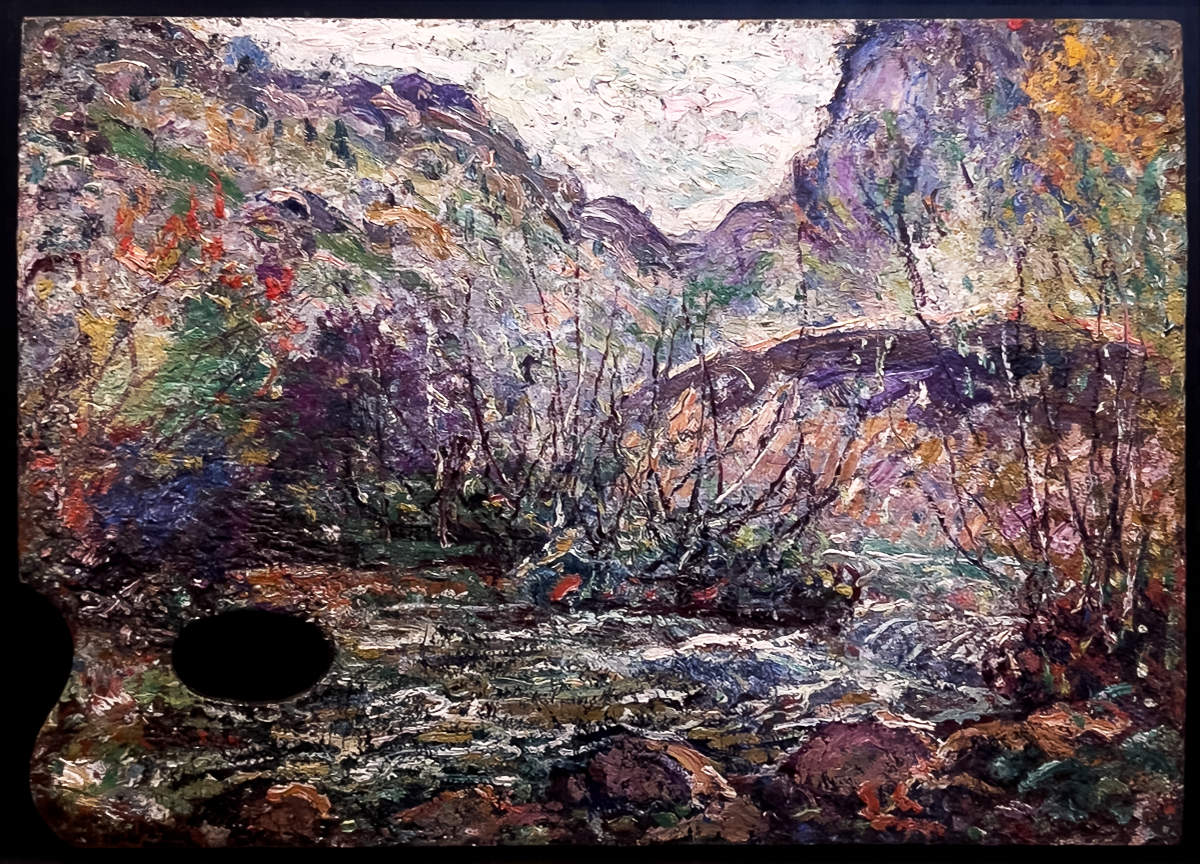
Ernest Lawson, Cripple Creek, Colorado, not dated, oil on palette. Image by José Antonio Arellano.
Musick offers visitors a visual lesson in the FAC’s history. Almost every painting in the gallery is by a FAC instructor, many of whom were trained in New York City, including the Art Students League. The instructors changed their color palettes as they began to depict the Colorado landscape, adapting the skills they honed in New York to their adopted locale. This adaptation appears literalized in an impressionist painting of Cripple Creek, Colorado by Ernest Lawson, created directly on a palette.
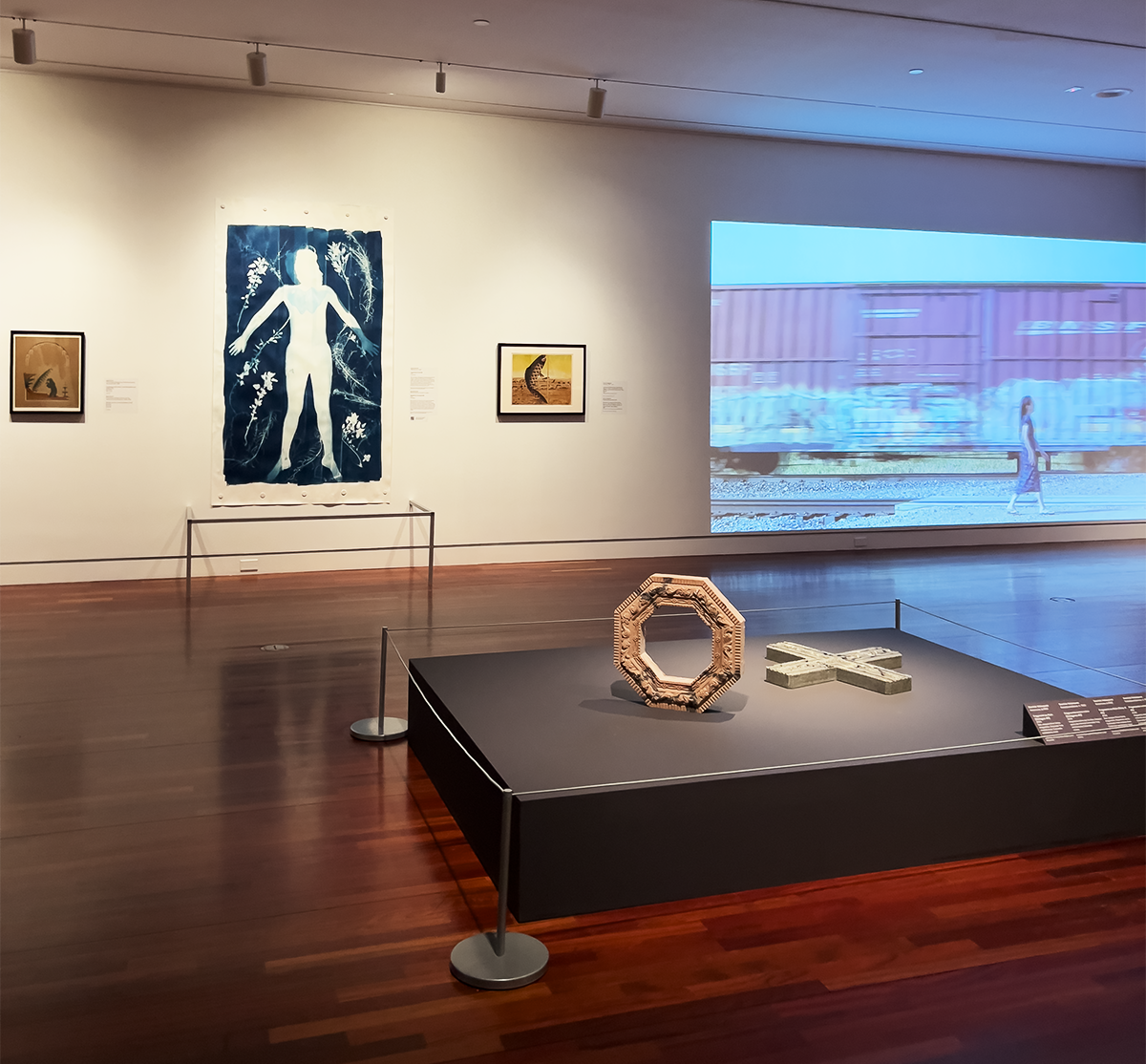
An installation view of the Loo Gallery, curated by Michael Christiano, Katja Rivera, and Alana Adams. Image by José Antonio Arellano.
The FAC curatorial staff, Michael Christiano, Katja Rivera, and Alana Adams, collaborated to reinstall the Loo Gallery, which displays contemporary art. They used the concept of “movement” to guide their efforts and serve as an organizing principle, rather than a chronology to be followed. This generative metaphor undermines the constraining authority of rigid art-historical timelines, enabling the curators to show how “contemporary” works remain in dialogue with “traditional” visual cultures and practices.
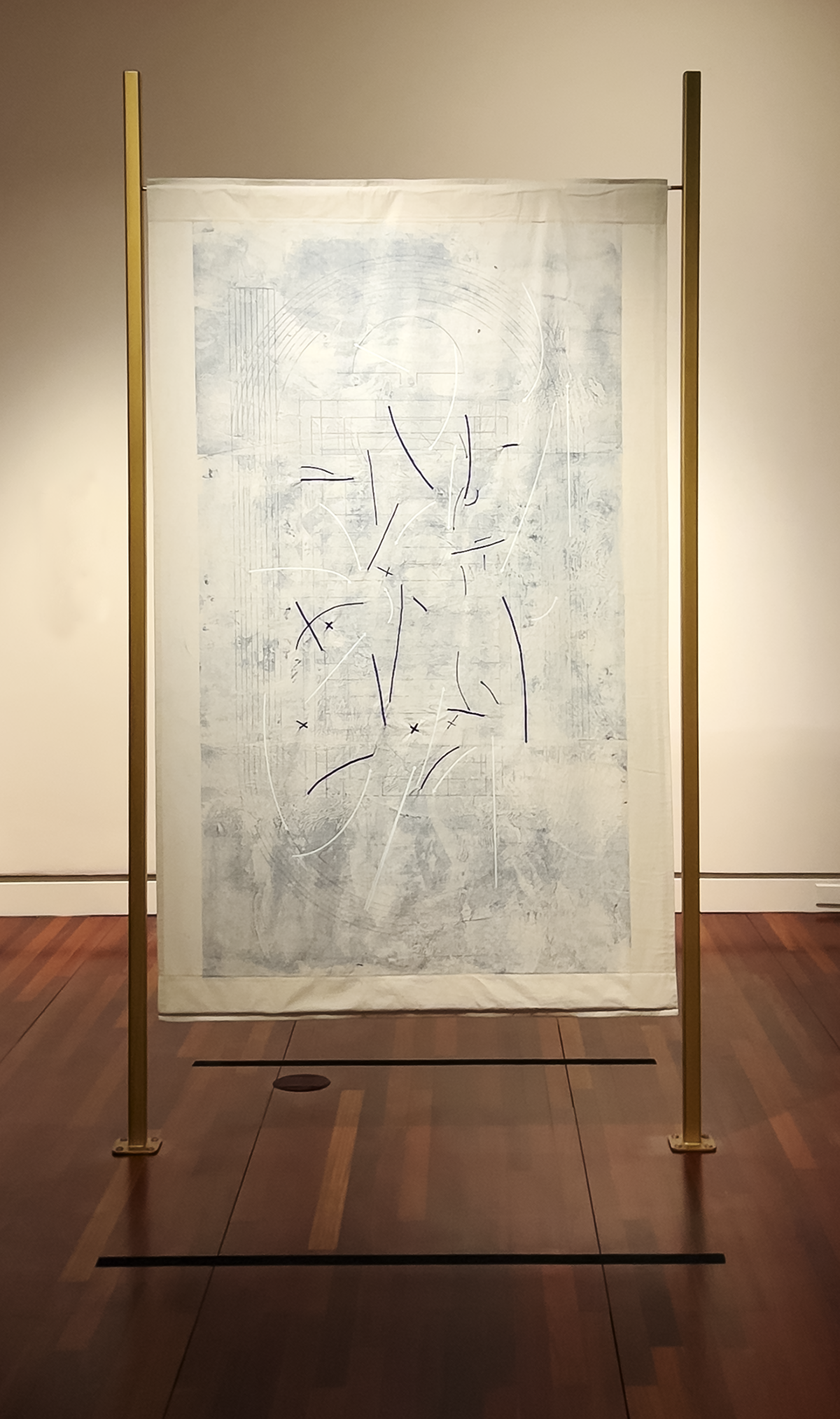
A view of Ronny Quevedo’s topografía lyr(ic)a, 2019, wax, screenprint, and thread on muslin. Image by José Antonio Arellano.
“Movement” constellates works that thematize the concept, such as Ronny Quevedo’s topografía lyr(ic)a, which represents the movement of bodies across an Ecuadorian Olympic stadium and alludes to the histories of migration. Quevedo’s practice engages with a history of abstract patterns made visible in Andean cultures. When displayed alongside Navajo textiles and parfleches (rawhide pouches), the concept of abstraction becomes detached from modernist narratives.
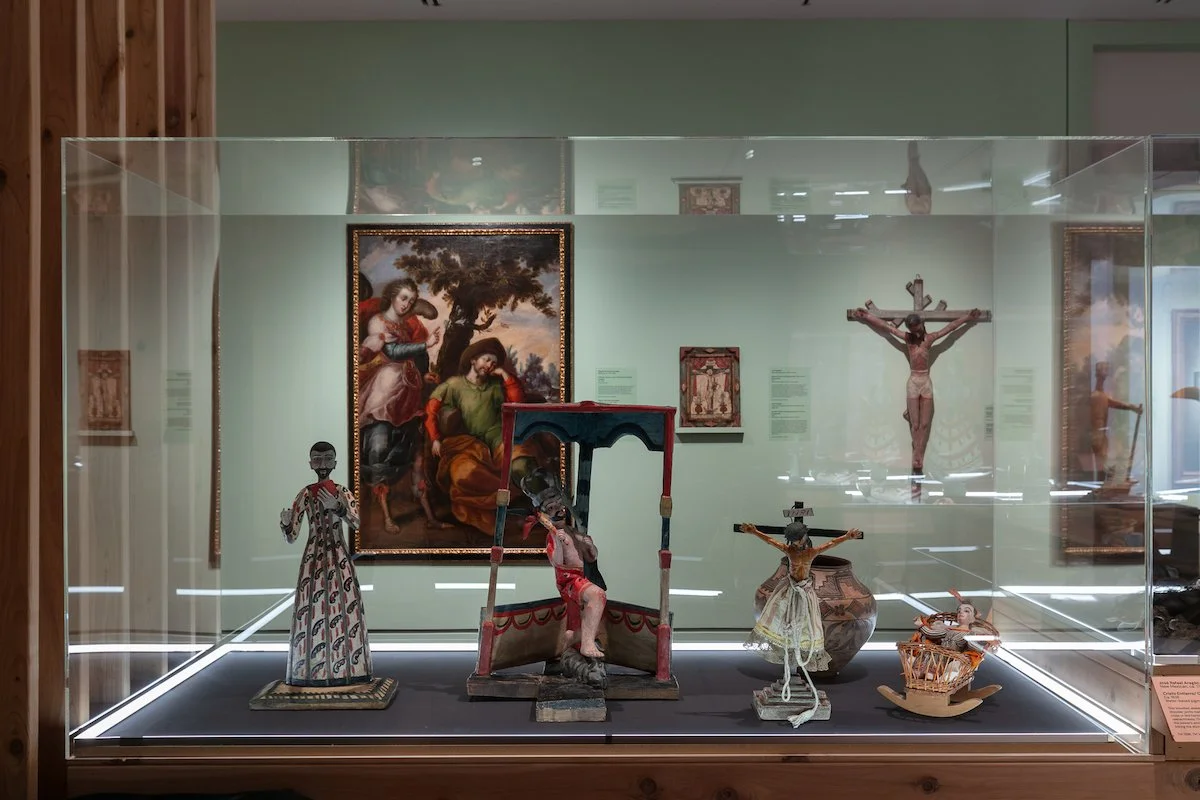
An installation view of the Duff Gallery, curated by James M. Córdova. Image by Wes Magyar, courtesy of the Colorado Springs Fine Arts Center at Colorado College.
By centering collaborative curation and conceptual resonance over chronology, the Fine Arts Center demonstrates how institutions might responsibly steward contested histories: by inviting multiple voices to reimagine how they're told.
José Antonio Arellano (he/him) is an Associate Professor of English and fine arts at the United States Air Force Academy. He holds a Ph.D. in English language and literature from the University of Chicago. He is the author of Race Class: Reading Mexican American Literature in the Era of Neoliberalism, 1981-1984, published by Cambridge University Press in 2025.
[1] Gretchen Sullivan Sorin, "Exhibitions," The Inclusive Historian's Handbook, American Association for State and Local History and National Council on Public History, 20 Dec. 2021, http://inclusivehistorian.com/exhibitions/.
[2] Bill Bryans, “Collaborative Practice,” The Inclusive Historian’s Handbook, American Association for State and Local History and National Council on Public History, 16 Sep. 2019, https://inclusivehistorian.com/collaborative-practice/.
[3] See José Antonio Arellano, “Silent Death Knell: Memorializing Rural New Mexico in Nasario García’s Poems,” Quarterly Horse: A Journal of (Brief) American Studies Vol. 4 (2020). The journal lost funding, unfortunately, so its website is no longer available, but the article is available online here: https://joseantonioarellano.com/gallery/2020%20Arellano%20%20Quarterly%20Horse_%20A%20Journal%20of%20brief%20American%20Studies.pdf.
[4] Rubén Cobos, A Dictionary of New Mexico and Southern Colorado Spanish. Santa Fe: Museum of New Mexico Press, 2003, xii.