Collective Nouns: MSU Denver Faculty and Staff Exhibition
Collective Nouns: MSU Denver Faculty and Staff Exhibition
Center for Visual Art
965 Santa Fe Drive, Denver, CO 80204
May 15–July 18, 2026
Admission: free
Review by Raymundo Muñoz
On view currently at Metropolitan State University’s Center for Visual Art (CVA), Collective Nouns is a biennial exhibition showcasing art from the staff and faculty members who support the institution’s visual art program. Student shows, of course (and rightly so), make up a large part of the CVA’s exhibition schedule (an impressive one is on display concurrently in the 965 Project Gallery, showcasing art from the CVA’s Art and Action Lab alumni). But it’s easy to forget that the educators—who teach, guide, mentor, and help students exhibit their work—are accomplished contemporary artists in their own right.
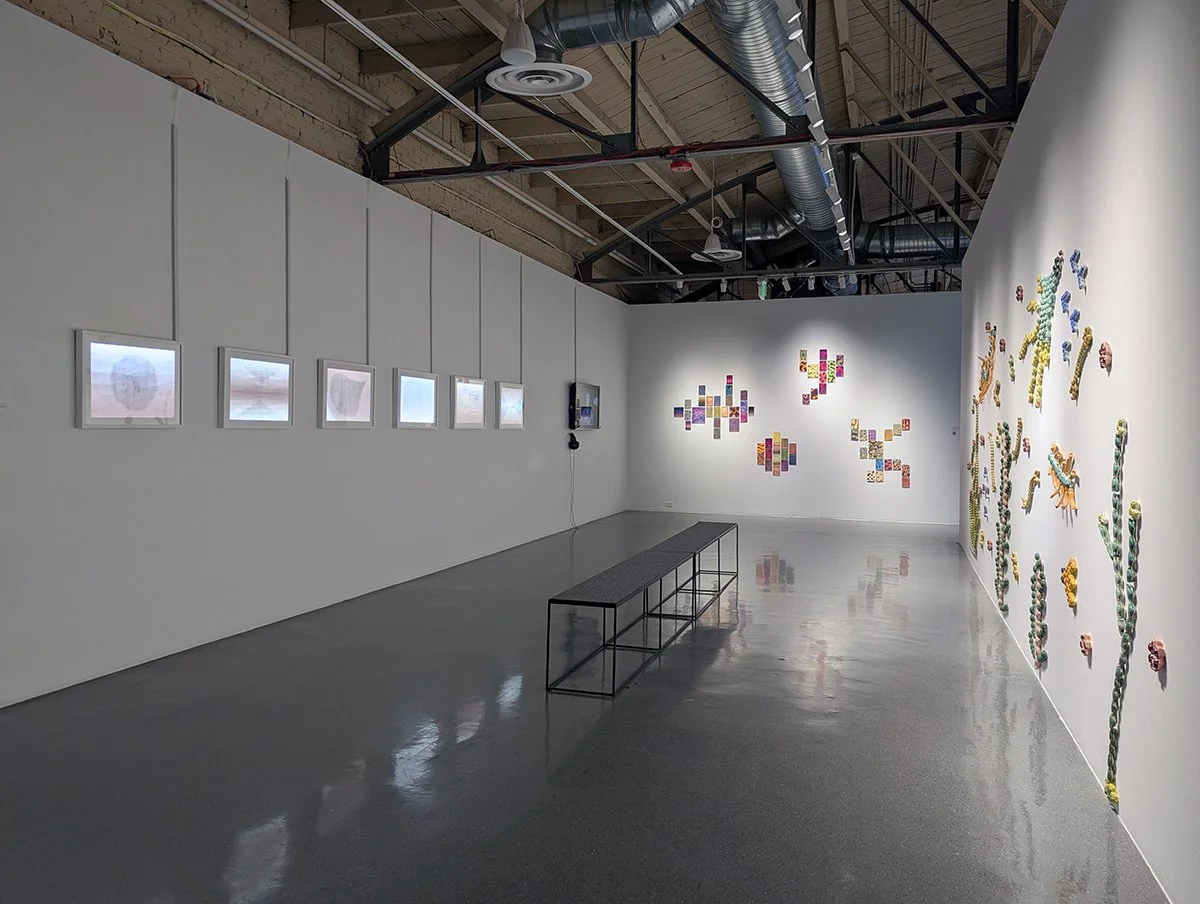
An installation view of the Collective Nouns exhibition at Metropolitan State University’s Center for Visual Art. Image by Raymundo Muñoz.
Collective Nouns is not held together by a cohesive theme, but rather (as the exhibition name implies) places emphasis on the individual artists. It encompasses a strong and eclectic range of artworks that highlights the quality, care, focus, and depth of MSU Denver’s art staff and faculty.
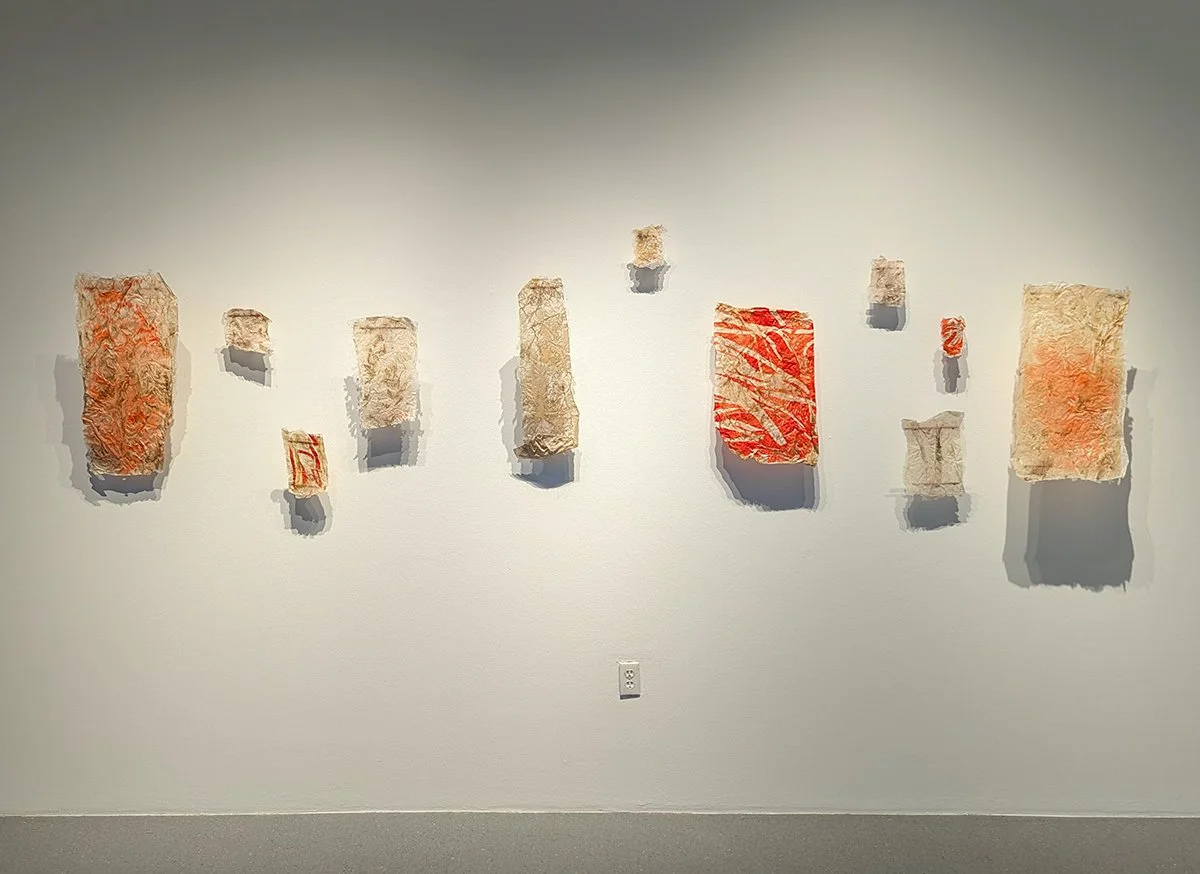
Anne Yoncha, Unstable Landscapes: 11 Tidal Castings from the Ware River, VA, 2026, silk, acrylic gel medium, oil, site-sourced plant-based ink, graphite, and powder-coated steel. Image by Raymundo Muñoz.
Consider Assistant Professor and Painting Area Coordinator Anne Yoncha’s Unstable Landscapes: 11 Tidal Castings from the Ware River, VA. In her practice, Yoncha merges science with art to highlight ecological issues, and in this case the artist chose an exact time and place to cast silk (with the aid of acrylic gel medium) on a riverbed in Virginia.
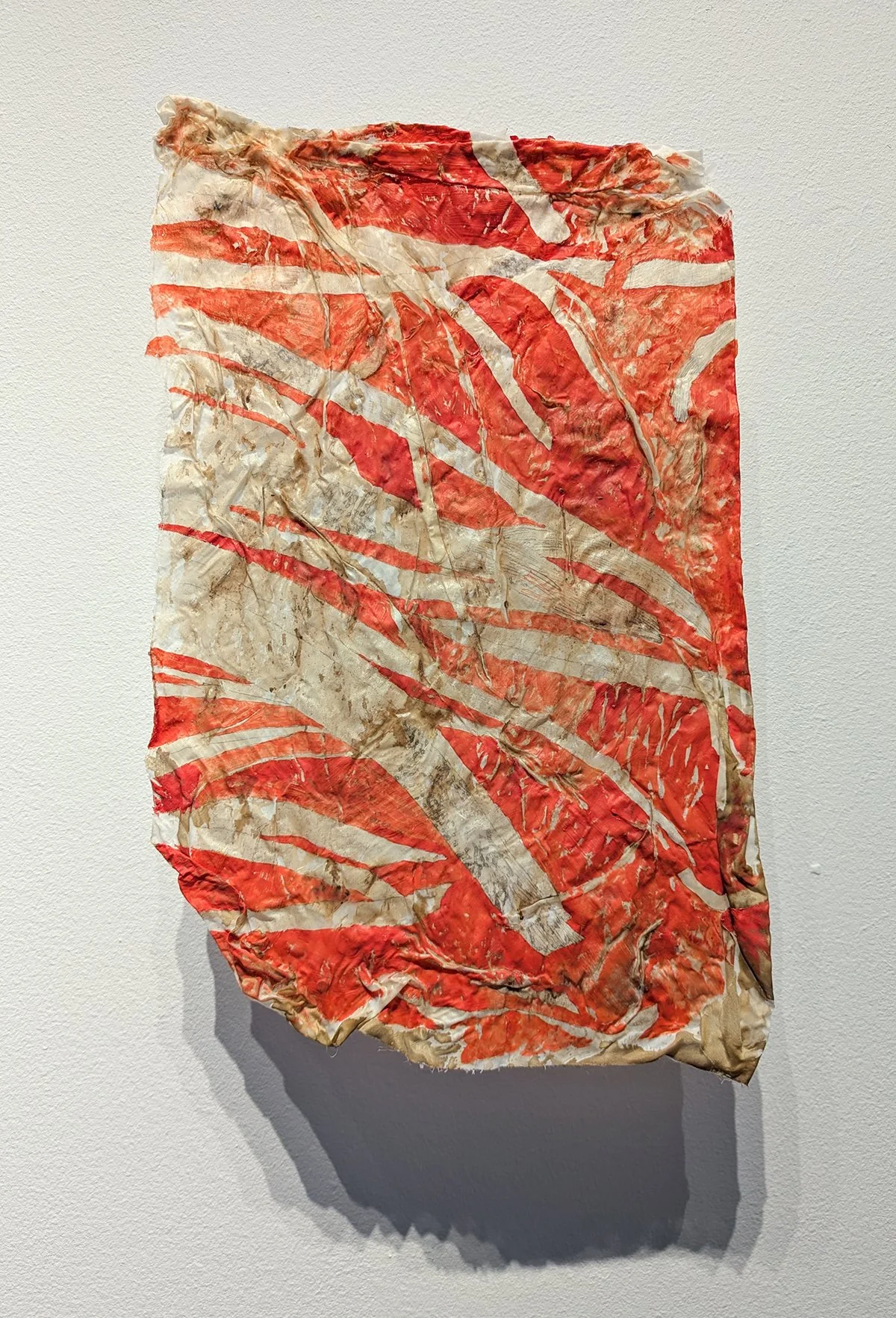
A detail view of Anne Yoncha’s Unstable Landscapes: 11 Tidal Castings from the Ware River, VA, 2026. Note the wrinkled textures, color saturation from plant-based ink, and organic form, working well as abstract piece. Image by Raymundo Muñoz.
It is not a process or story you can easily figure out by looking at the pieces alone. The works initially read as abstract expressionistic, gorgeous in their wrinkled textures, warm color saturation (derived from site-sourced plant-based ink), and organic forms that seem to float away from the wall on orange powder-coated hardware. The presentation is bold, confident, and thoughtful, informed by the series’ ecological context, referring to specific riverbed angles that improve soil erosion. The layers of meaning, process, and consideration are deep and idiosyncratic.
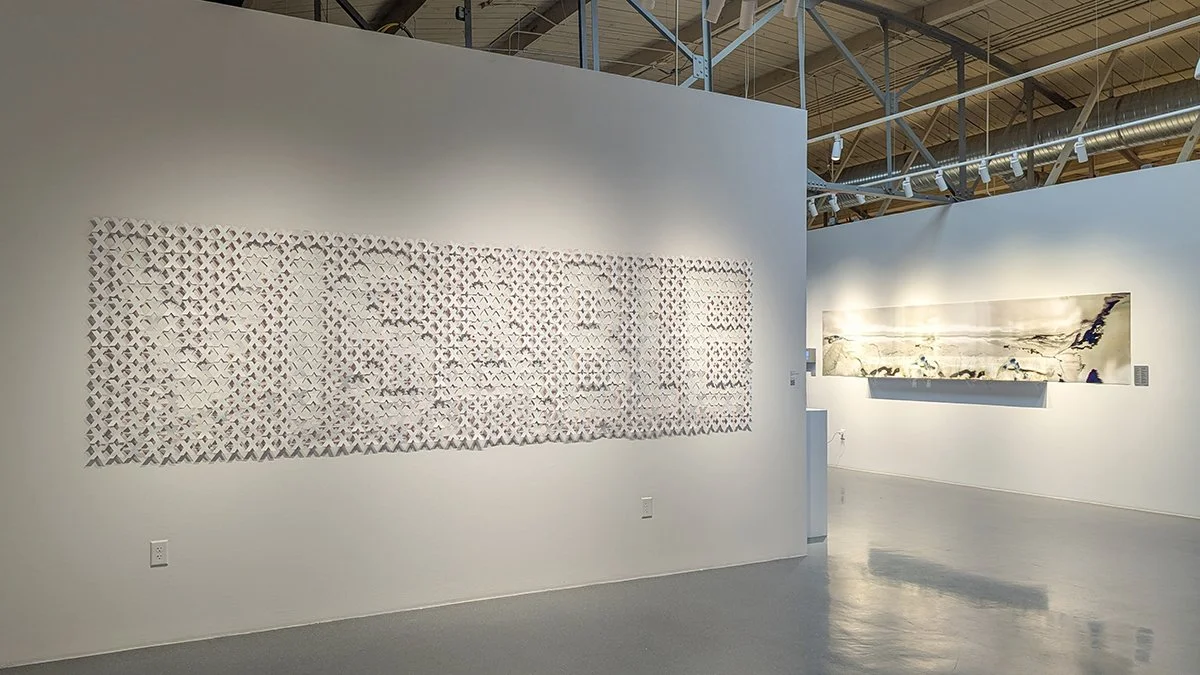
Melanie Finlayson, VIS ABLE, 2026, reclaimed vinyl text, chipboard, and acrylic paint. Image by Raymundo Muñoz.
Gallery Manager of Visual Arts at CVA Melanie Finlayson goes big with her impressive work VIS ABLE. Depending on the angle and distance from which you view it, the work might merely look like a wall of traditional white lattice, but only until its hidden message goes Magic Eye on you, revealing the title via slightly setback elements and shadow play.
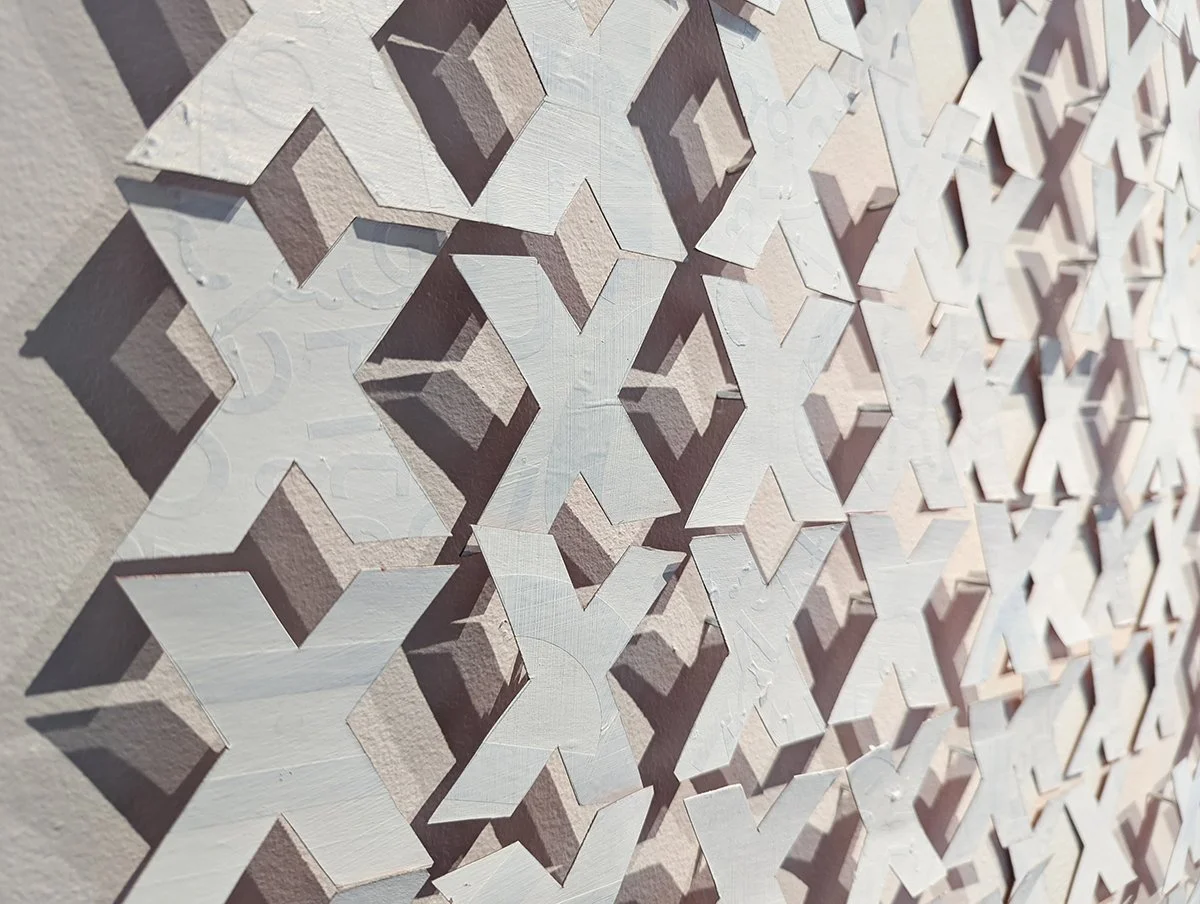
A detail view of Melanie Finlayson’s VIS ABLE, 2026. Note the ambiguous, textural quality of the reclaimed vinyl text pieces on the X-shaped elements. Image by Raymundo Muñoz.
By my count, over seven hundred X-shaped chipboard pieces make up this intense and meticulously installed text-based work. Covered in painted scraps of vinyl lettering from five years’ worth of CVA exhibitions, the nearly invisible letter jumbles lose their original clear meanings and purpose, gaining new life as a subtle, ambiguous, and textural background (which is technically in the foreground).
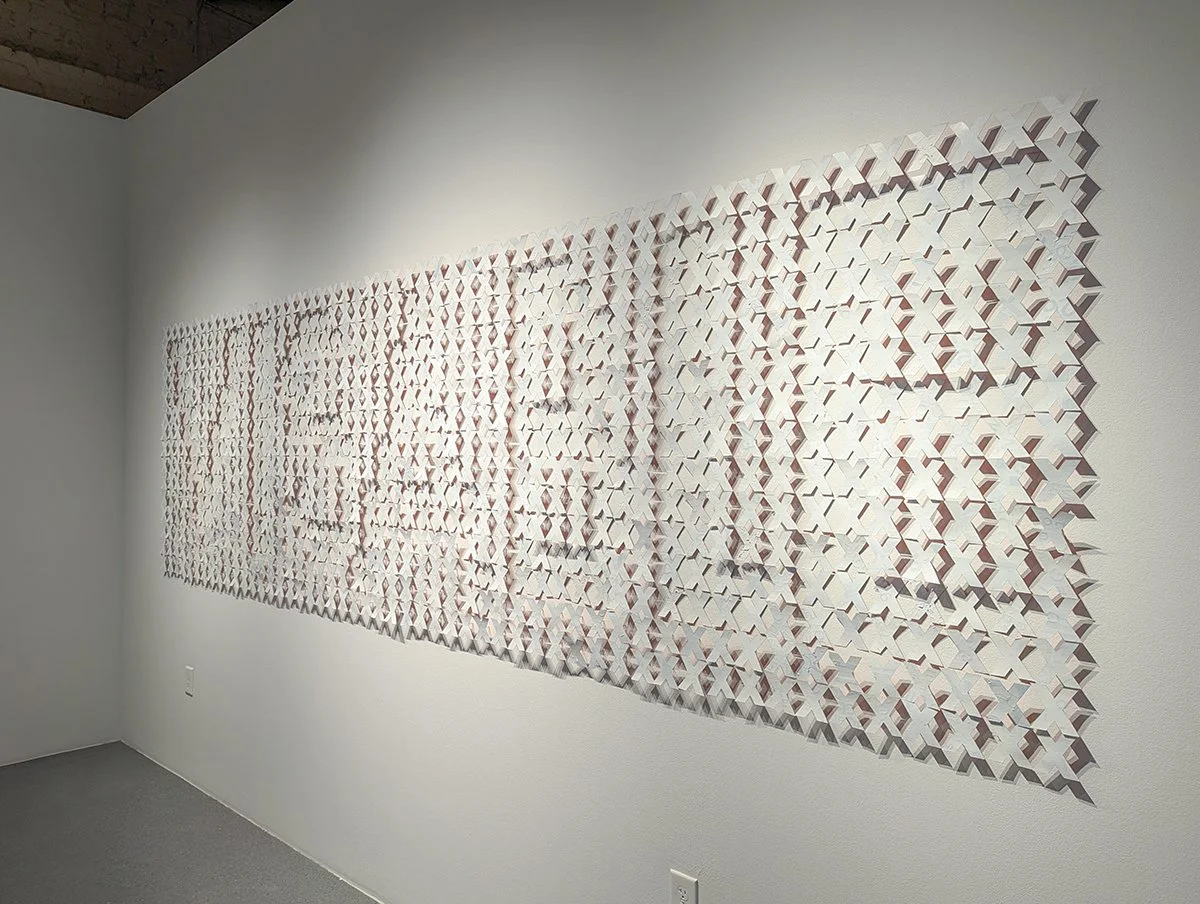
An installation view of Melanie Finlayson’s VIS ABLE, 2026, showing the setback elements and resulting shadows that outline the work’s title. Image by Raymundo Muñoz.
Combined with the near-hidden message, VIS ABLE powerfully alludes to the artist’s struggles with her own hidden disability, ableism in society, and the ultimate embrace of her own neurodivergence.
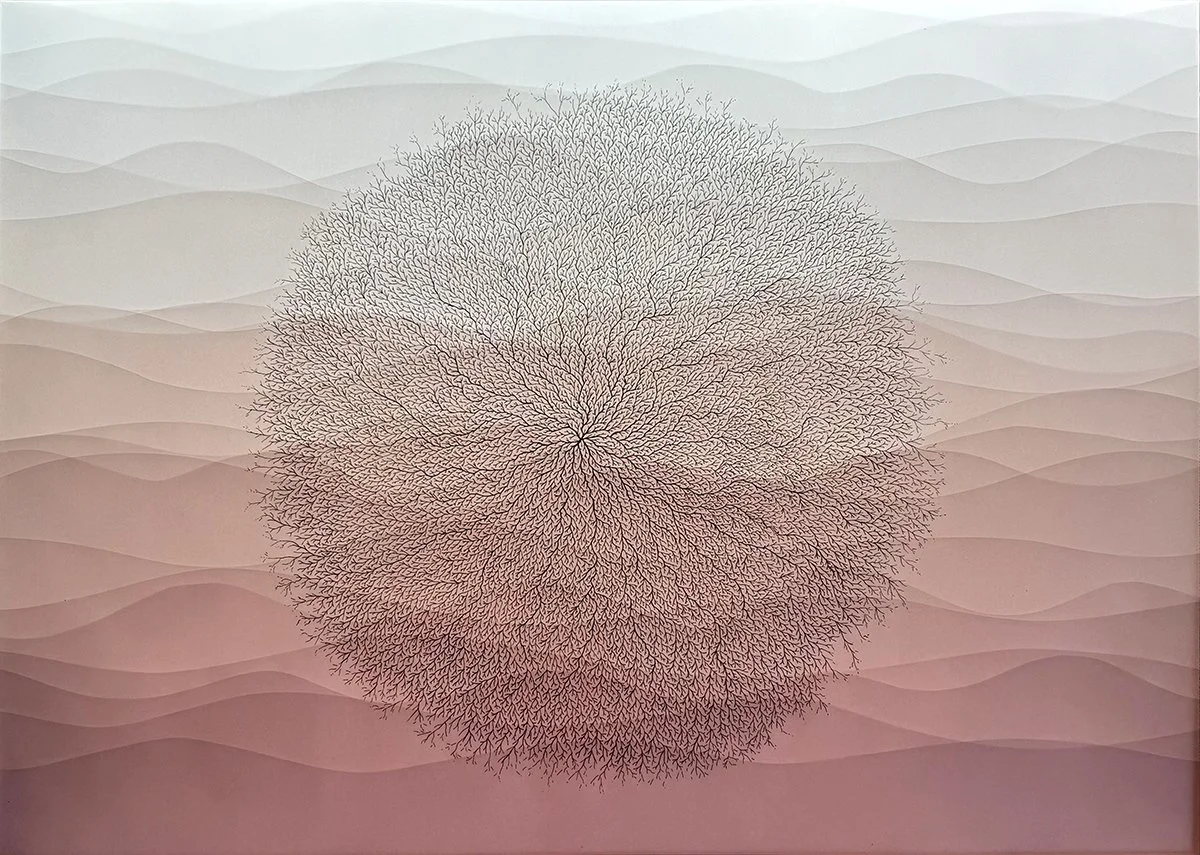
One drawing in Eileen Roscina’s Grow Slowly Toward the Light, 2025, lightboxes, vellum, pen and ink, and acrylic. Note the contrast of simple forms on a smoothly gradated background with the dense complexity of Roscina’s pen and ink drawings of mycelial growth patterns. Image courtesy of the artist.
Eileen Roscina (Affiliate Faculty in Art) achieves a similar level of intense focus in her mycelium-inspired series Grow Slowly Toward the Light. Roscina’s lightbox pieces depict the growth patterns of mycelial networks (the vegetative parts of fungi), painstakingly hand drawn in pen and ink on translucent and lightly painted vellum. The soothing, warm-toned and backlit backgrounds are sinusoidal, gentle, and softly gradated, reminding me of endless sand dunes. Meanwhile, thousands of tiny branching lines seem to float in the foreground, emanating from central points and edges, forming simple shapes and relationships.
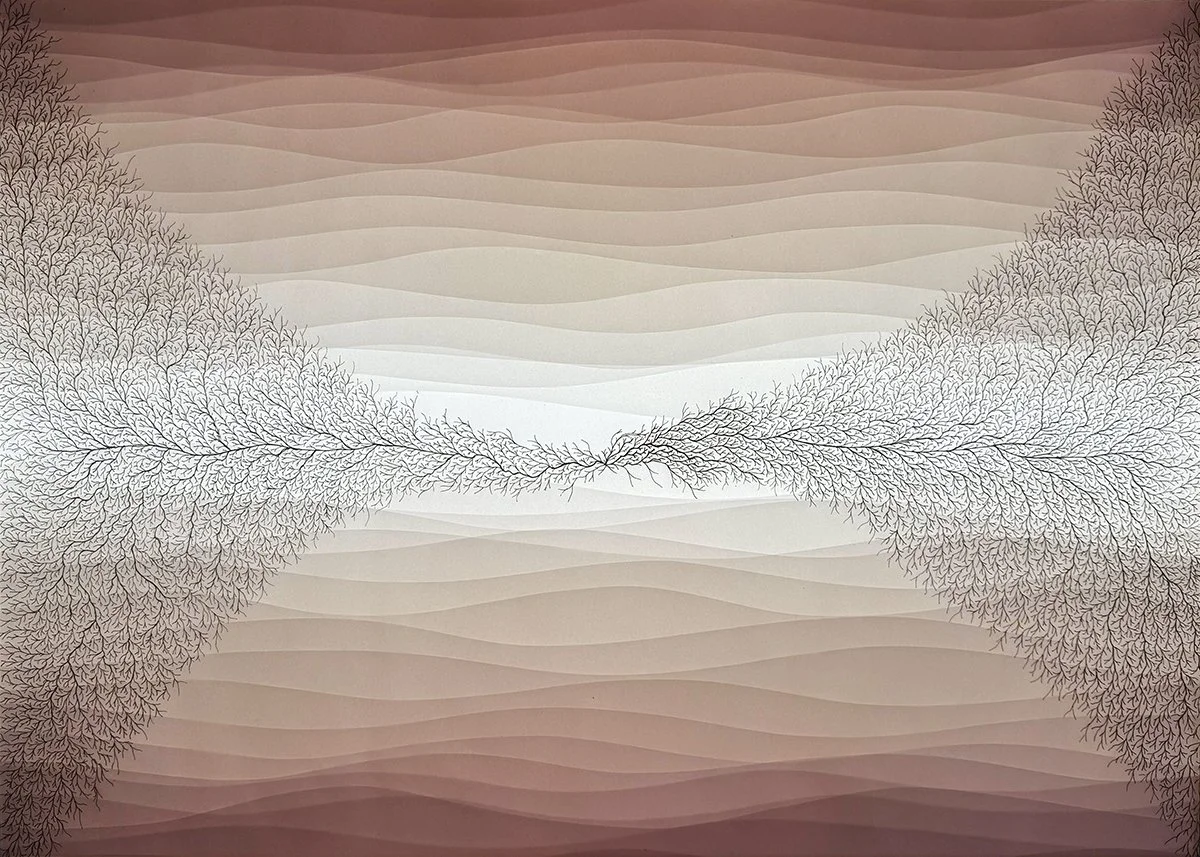
One drawing in Eileen Roscina’s Grow Slowly Toward the Light, 2025, lightboxes, vellum, pen and ink, and acrylic. Note the contrast of simple forms on a smoothly gradated background with the dense complexity of Roscina’s pen and ink drawings of mycelial growth patterns. Image courtesy of the artist.
A wonderful tension exists between the simplicity of the form and rules and the resulting staggering complexity, reflecting the nature of the organisms that form Earth's biological internet and suggesting themes of connection, loneliness, and interdependence. Presented in linear succession on an unlit wall, Roscina’s works are stunning and meditative, shining light on a vital yet largely hidden system existing in the dark beneath our feet.
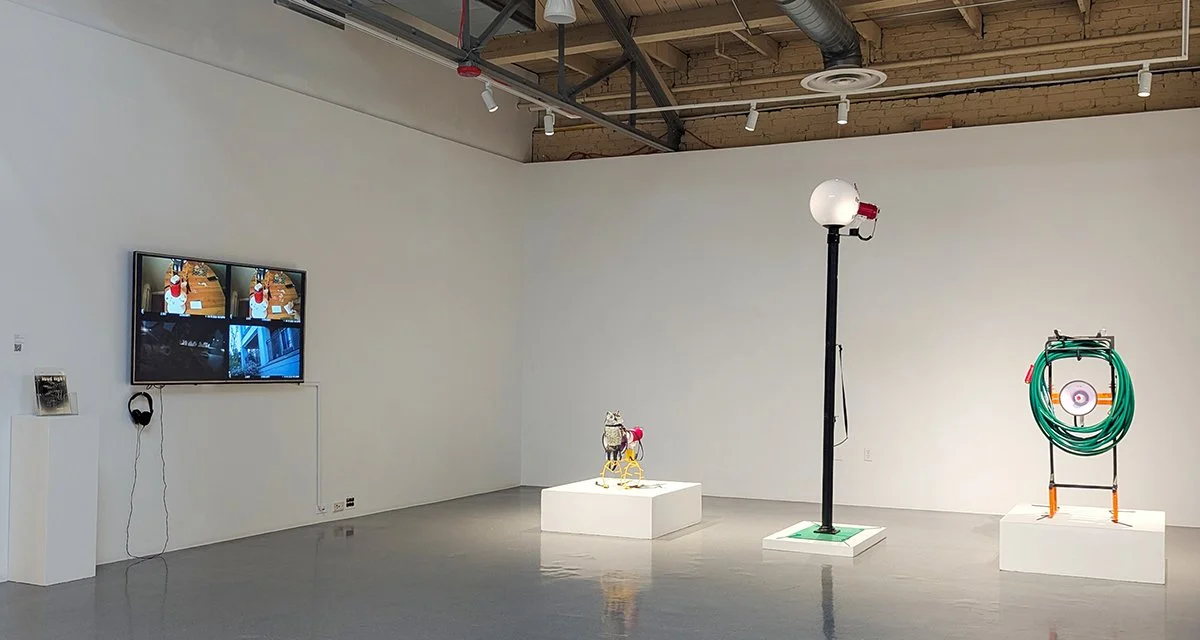
Marin Abell, Loud Light. 2026, mixed media. Image by Raymundo Muñoz.
Marin Abell (Associate Professor and Sculpture Area Coordinator) proves to be another kind of dark-dwelling creature in his hilarious and subversive mixed media work Loud Light. Inspired by the constant, all-hours noise pollution from a high tower of neighboring luxury condominiums, the artist fabricated his own objects of auditory dissent, in the innocuous guise of a plastic owl, lamp post, and garden hose.
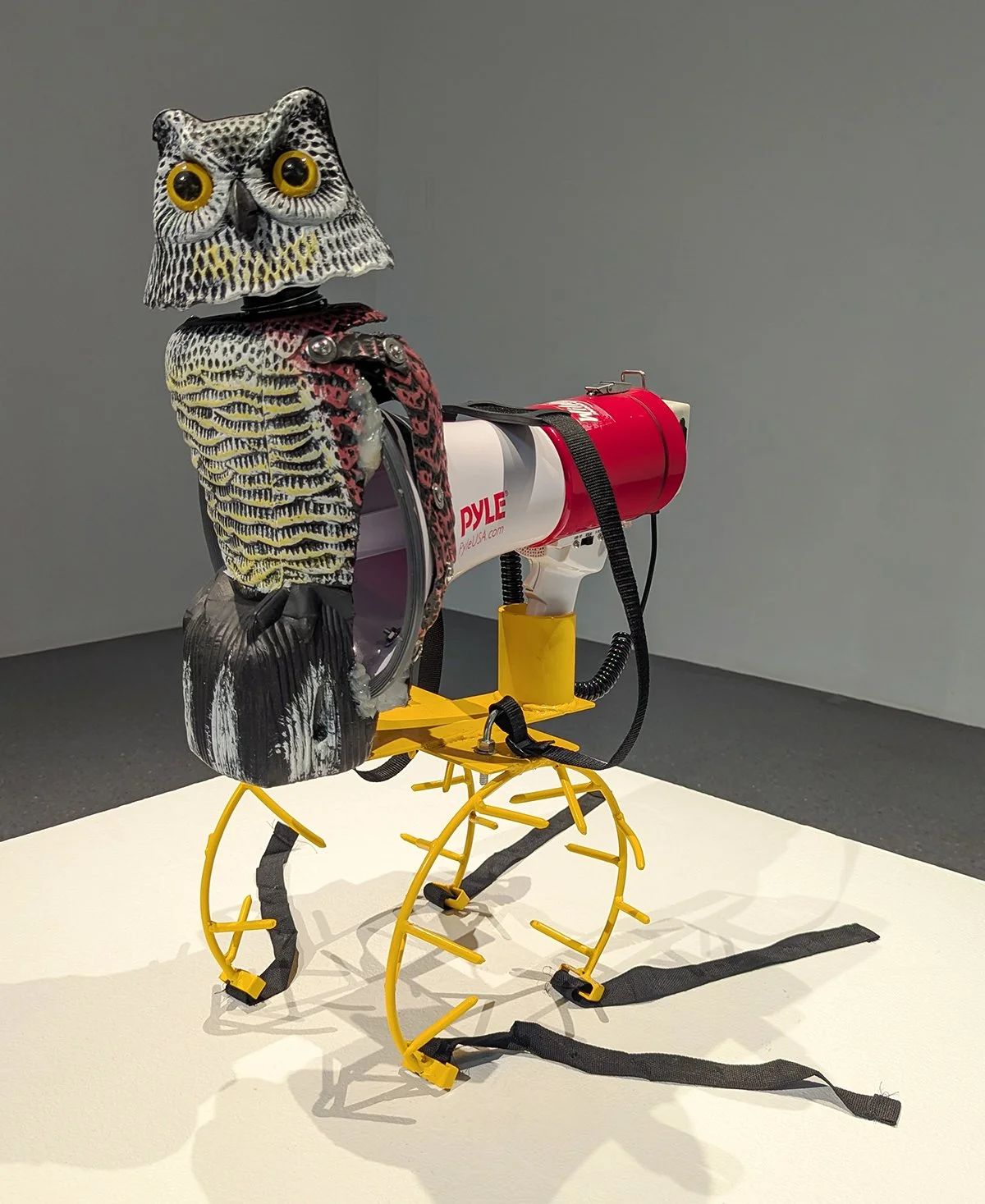
A detail view of Marin Abell’s Loud Light, 2026. Note the innocuous plastic owl, altered with an attached bullhorn and hardware for installing on fences or trees. Image by Raymundo Muñoz.
Each affixed with a bullhorn, they loudly play a variety of offensive noises: leaf blowers and mowers, parties, chainsaws and mulchers, garbage trucks, vehicles idling, repeated opening and closing of garage doors, moving trucks offloading freight, and sprinkler systems. Placed in the middle of the night in strategic locations around said condos, it’s a big middle finger to the hierarchies that allow precious few to hide behind sound-proof glass, living with little regard for their neighbors below.
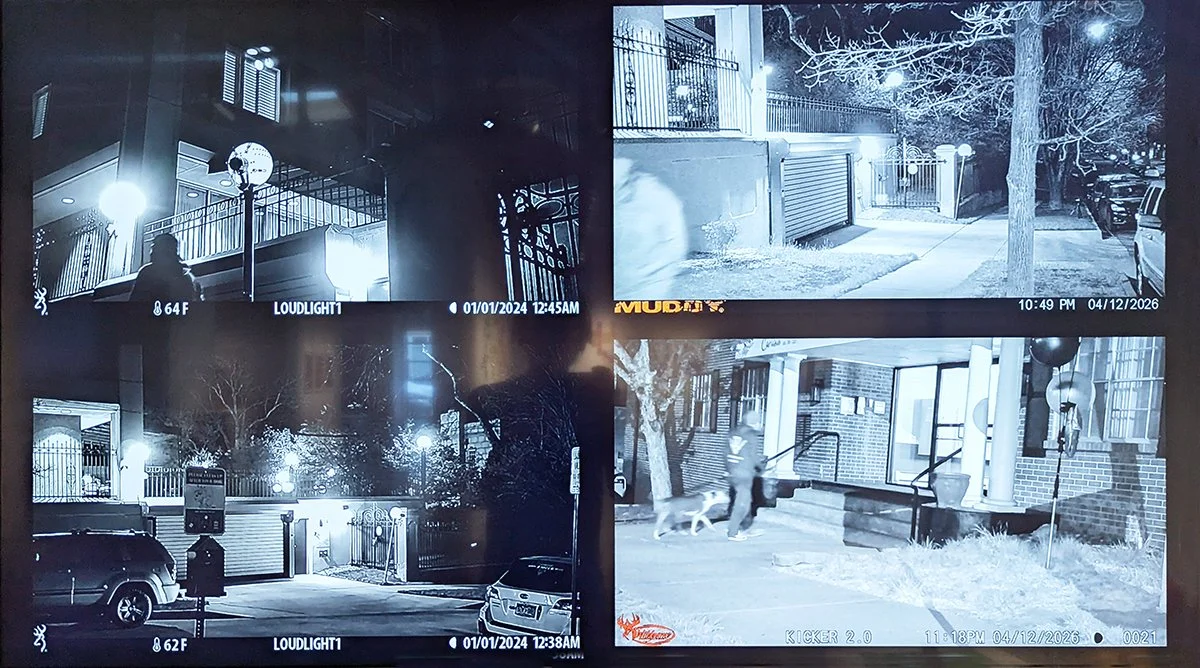
A detail view of video documentation of Marin Abell’s Loud Light, 2026, showing the artist installing his altered lamp post outside of security gate and garage door of neighboring lux condo building. Image by Raymundo Muñoz.
Abell documented his midnight missions with a video shot in a manner that mimics security camera footage. To minimize the offensive effect on his own apartment neighbors and security officers, the artist sent them ear plugs and invited them to a party to share his footage. Through his own cacophonous/cantankerous kind of street and performance art, Abell uses sound to make the invisible seen.
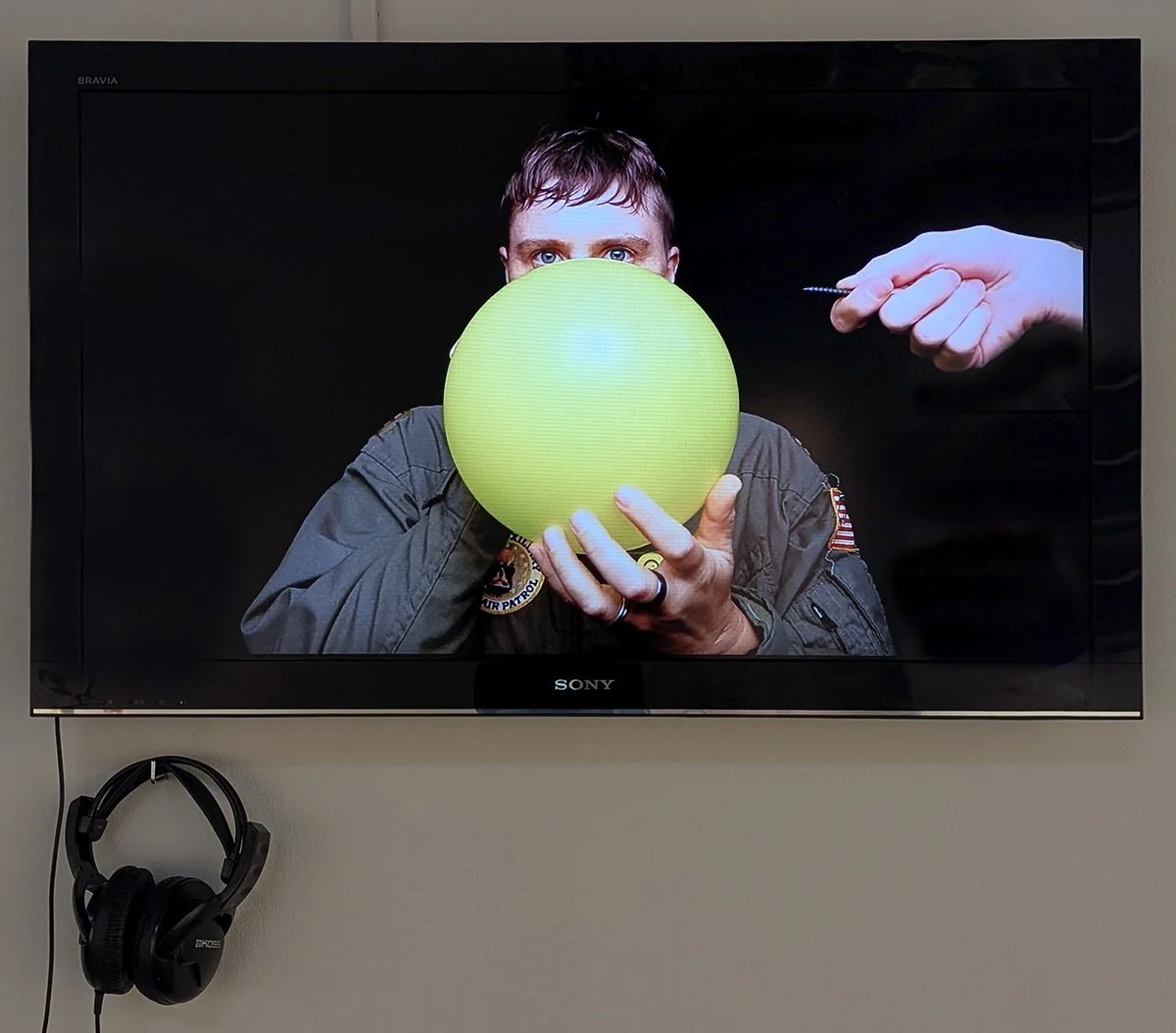
An installation view of Kenzie Sitterud’s We all Live in a Yellow Balloon, 2025, video performance, showing the video screen and accompanying headphones. While the visuals work well enough without sound, hearing the sequence of rapid breathing and the balloon popping repeatedly is key to the anxiety-inducing experience. Image by Raymundo Muñoz.
Kenzie Sitterud’s (Affiliate Faculty in Communication Design) video performance We All Live in a Yellow Balloon uses sound in a simpler way perhaps, but just as effectively. Calling to mind The Beatles’ classic, acid trip-inspired children’s tune “Yellow Submarine,” Sitterud’s piece is anything but carefree.
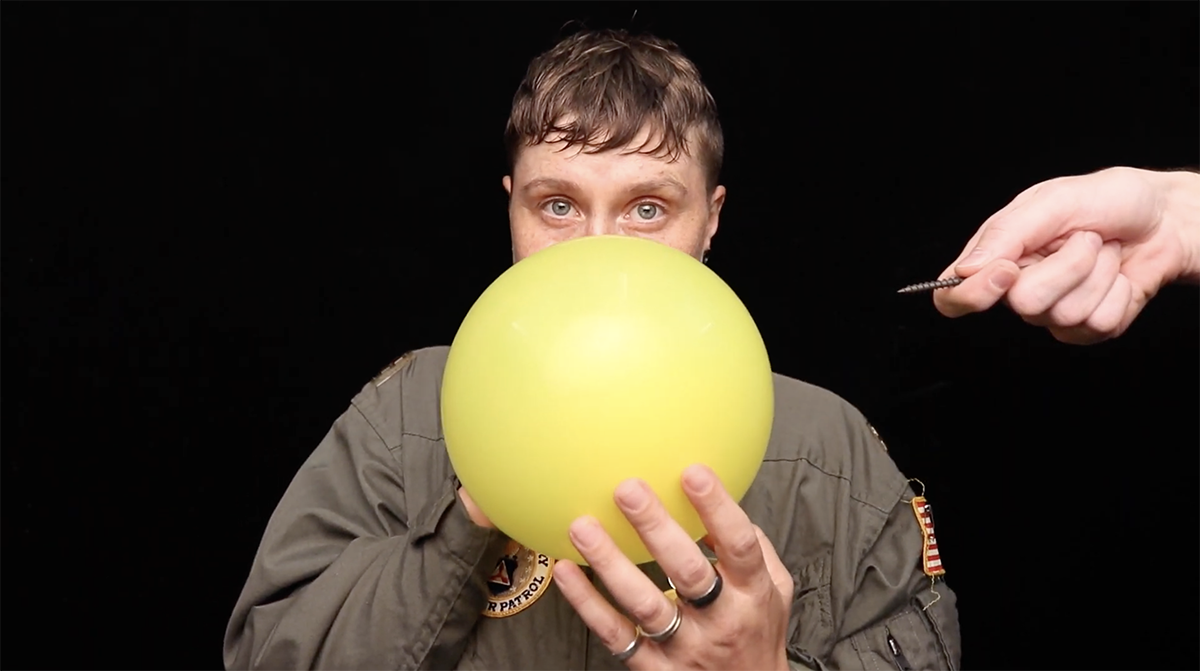
Kenzie Sitterud, We all Live in a Yellow Balloon, 2025, video performance. Image courtesy of the artist.
Over a few minutes, the artist (in a U.S. Air Force flight suit) blows up a yellow balloon—a symbol of childhood and festivities—to the point of bursting upon touching a sharp screw held by a white man’s hand. Again and again and again, just like the song’s increasingly cloying refrain.
Listening to the performance through the supplied headphones, with the artist’s rapid breathing and gasping for air around the surprising pop of the balloon, is an anxiety-inducing experience that grows with each alarmingly yellow balloon. Towards the end of the performance, Sitterud appears panicked, just maintaining consciousness. And then the video begins again.
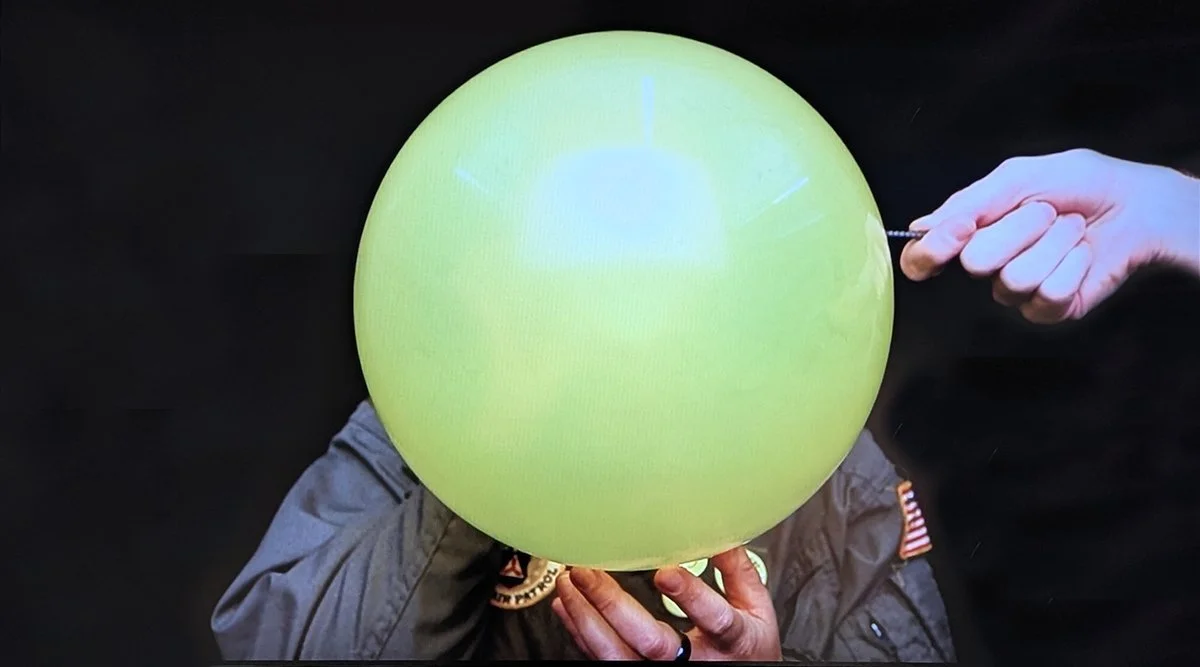
A still from Kenzie Sitterud’s We all Live in a Yellow Balloon, 2025, video performance. Image by Raymundo Muñoz.
While the piece lacks a written statement, the artist explained to me in an interview how this piece broadly relates to the sounds of war and how we are collectively waiting for the next balloon (i.e. global conflict) to burst. It’s simple, but effective.
Collective Nouns is a group show of over twenty artists, and there are too many works to touch on here.
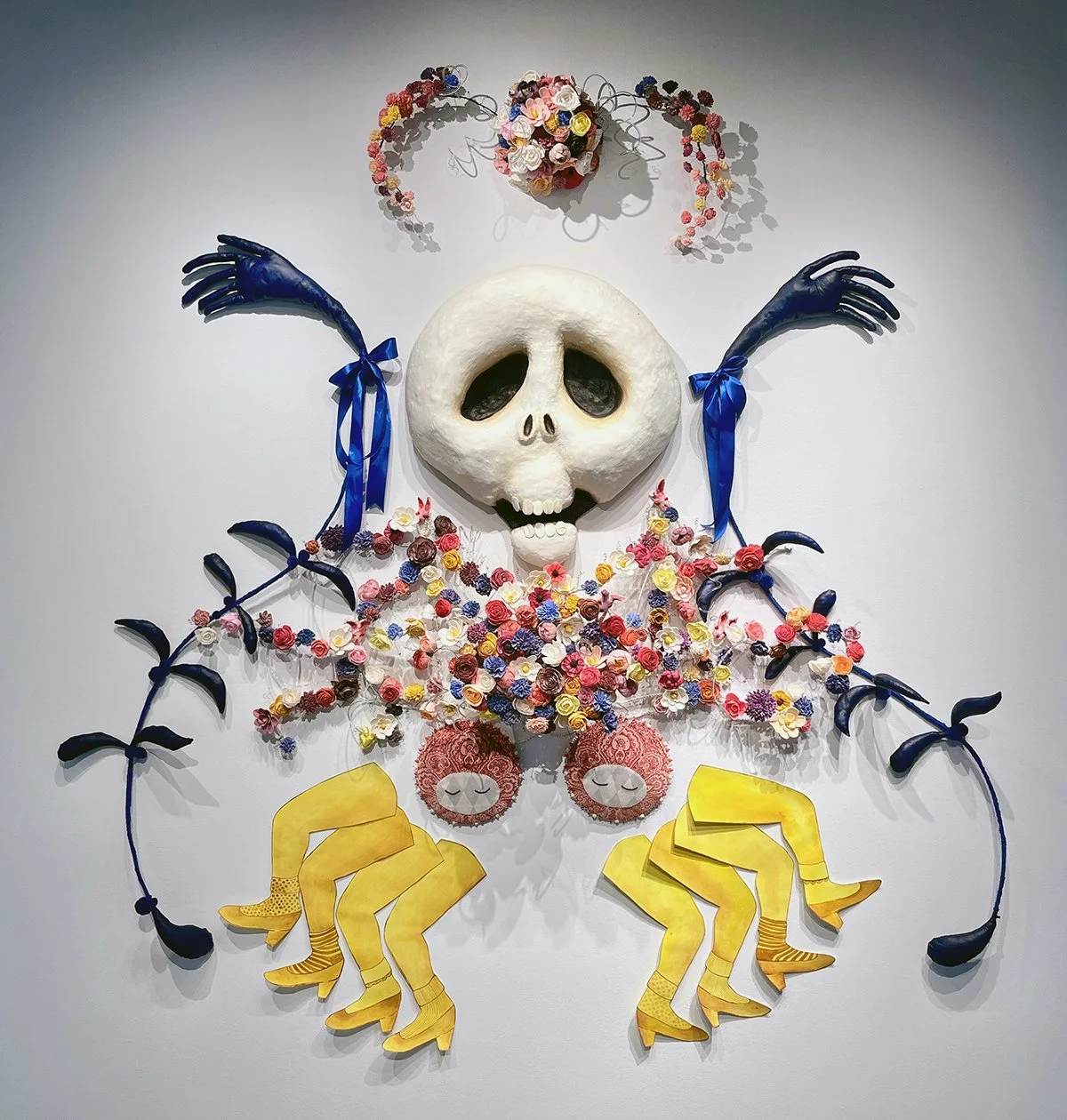
Katie Taft, I’m not sure where we’re going, but we’re going together, 2026, papier mâché, reclaimed fabric, copper pipe, IV tubing, bailing wire, yarn, bits and bobs, and other things. Image by Jenna Miles.
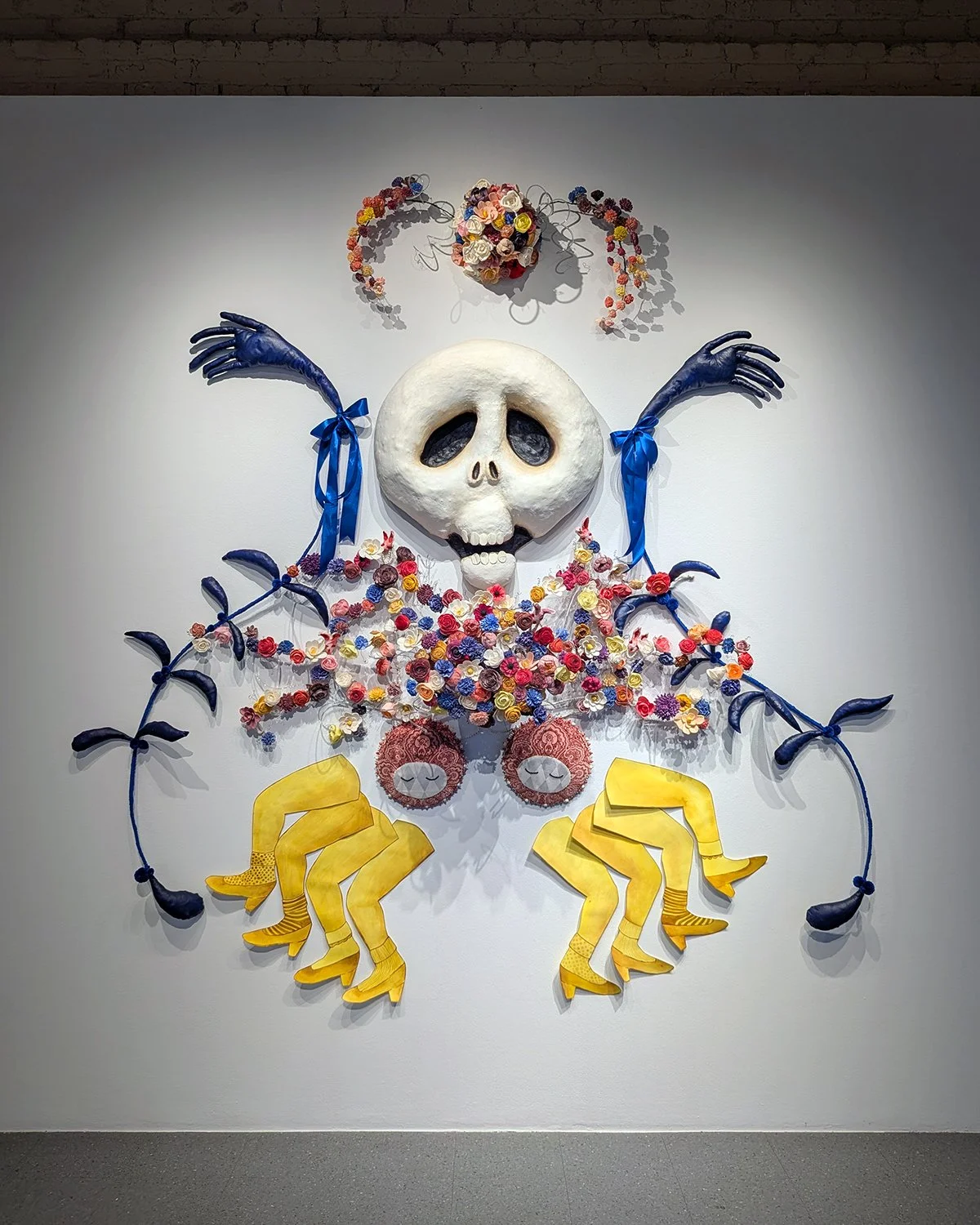
That said, I will end with a piece by the artist who manages the education programs at the CVA: Katie Taft. I’m not sure where we’re going, but we’re going together is a party-of-an-installation—sort of a Parisian version of a Day of the Dead altar. A central papier mâché cartoon skull is crowned by, and floats upon, beds of colorful sola wood flowers and IV tubing, buttressed by shiny blue filigrees of ribbons, leaves, and hands, upon a base of kicking, yellow can-can legs.
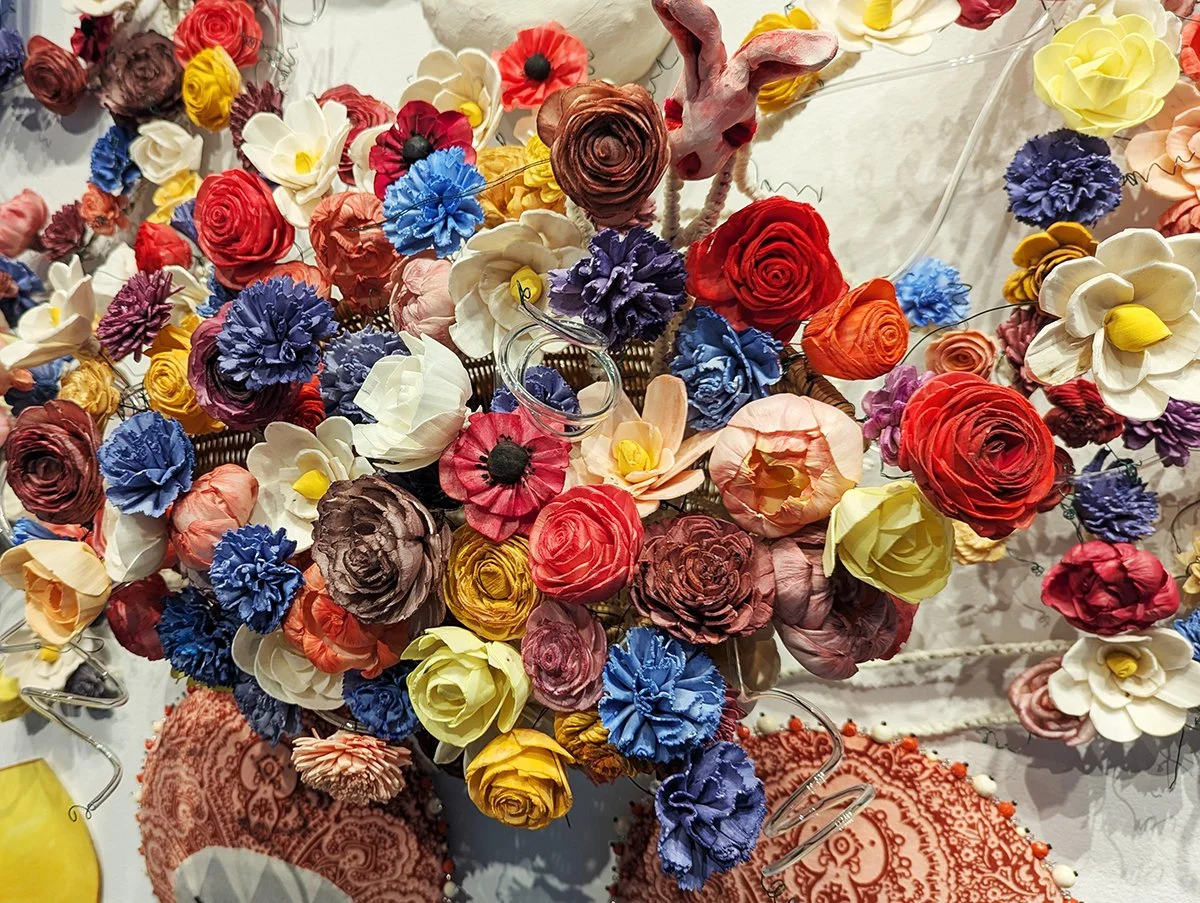
A detail view of Katie Taft’s I’m not sure where we’re going, but we’re going together, 2026, papier mâché, reclaimed fabric, copper pipe, IV tubing, bailing wire, yarn, bits and bobs, and other things. Image by Raymundo Muñoz.
Inspired by time spent in Paris among “tarot enthusiasts, a cartomancy scholar, and a graveyard expert,” the work is the latest iteration of Taft’s Chemonauts series. Described as a “coping mechanism” for dealing with past chemotherapy treatments, the installation is a playful and beautiful expression of pain and healing, death and living, existential uncertainty, and fortitude of the collective.
All in all, Collective Nouns gives space for each artist to explore their current and recent practice and interests, pulling them out of the background and—by sight or sound—illuminating what is hidden.
Raymundo Muñoz (he/him) is a Denver-based printmaker and photographer. He is the director/co-curator of Alto Gallery and board president of 501(c)(3) non-profit Birdseed Collective. Ray is guided by the principle that art is a bridge, and it connects us to ourselves and each other across time and space.