
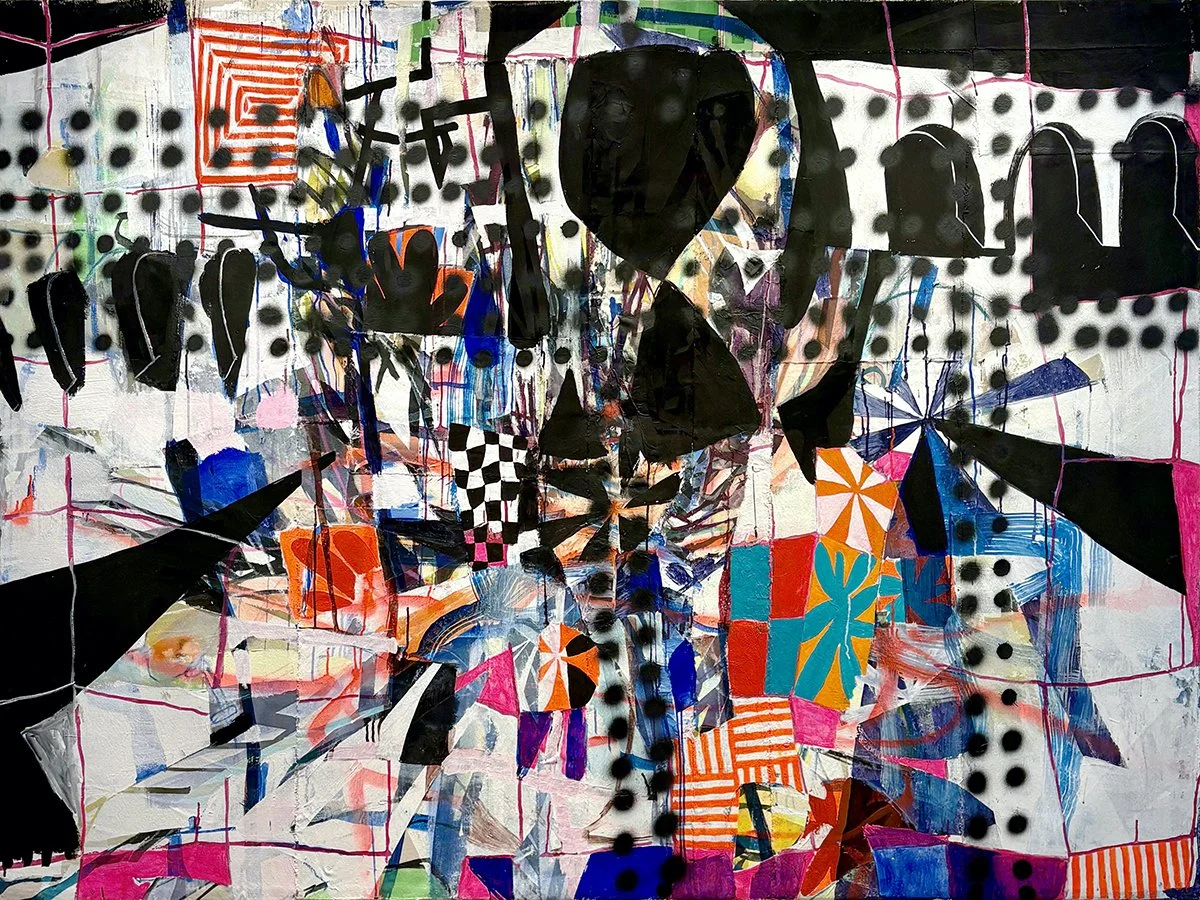
Brief Transit | Time Travelers
Galen Cheney: Brief Transit | Clark Derbes: Time Travelers
Nick Ryan Gallery
1221 Pennsylvania Avenue, Suite 110, Boulder, CO 80302
April 25–June 12, 2026
Admission: free
Review by Felicity Wong
The two concurrent exhibitions at Nick Ryan Gallery feature the work of New Englander artists Galen Cheney and Clark Derbes. Brief Transit showcases paintings by Cheney, a self-described “painter’s painter” from Massachusetts. [1] In Time Travelers, Derbes, who lives in Vermont, displays a selection of polychromed wooden sculptures.
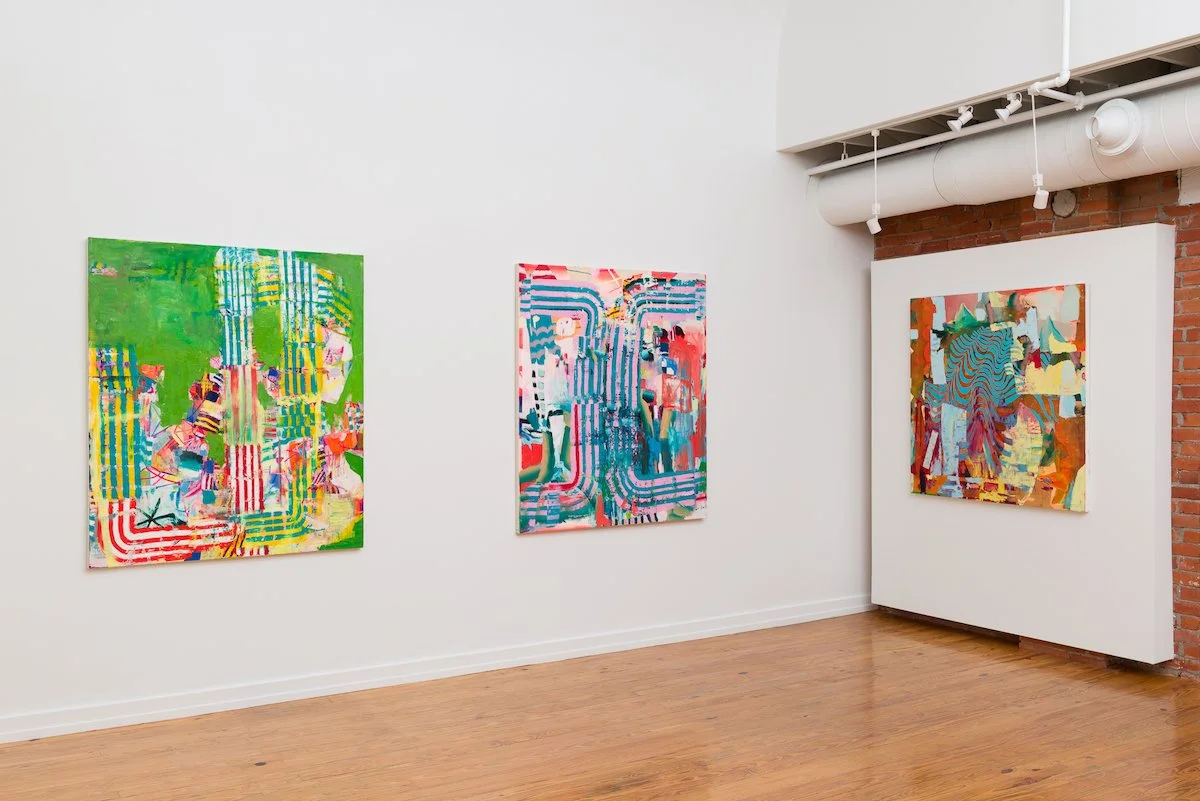
An installation view of Galen Cheney’s Brief Transit exhibition at Nick Ryan Gallery in Boulder. Image by Wes Magyar, courtesy of Nick Ryan Gallery.
Held on separate floors, Brief Transit and Time Travelers seem like visual polar opposites. When I walked into the main galleries in the early evening, gentle sunlight spilled into the space, highlighting the bright colors, gestural brushstrokes, and abstracted motifs in Cheney’s paintings. Just half an hour later, I ambled down to the basement floor, where the lighting was slightly dimmed. A number of geometric wooden sculptures were placed neatly on pedestals and against walls—and I was struck by how Derbes’ ordered, repetitive forms contrasted with the artwork upstairs.
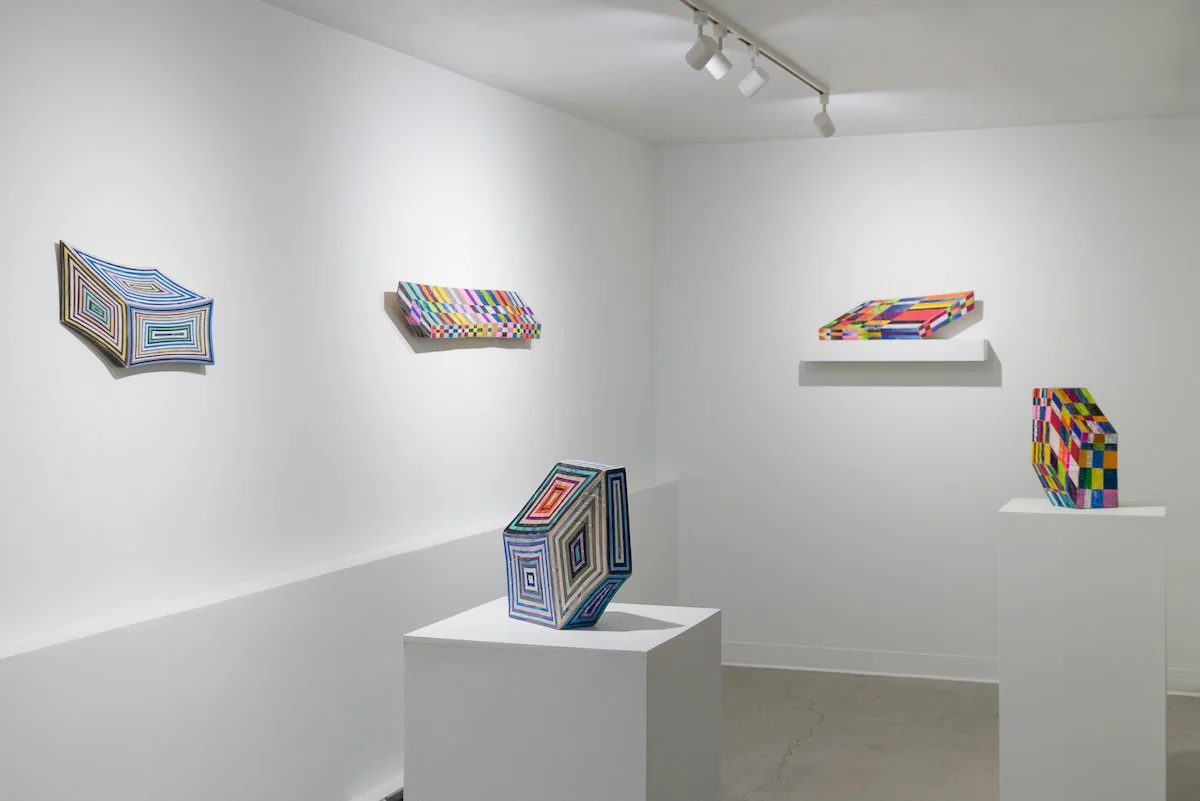
An installation view of Clark Derbes’s Time Travelers exhibition at Nick Ryan Gallery in Boulder. Image by Wes Magyar, courtesy of Nick Ryan Gallery.
Cheney’s and Derbes’ interlocutors within enshrined canons of 20th-century Western art draw out strong aesthetic oppositions between the two exhibitions. The conceptualism that Derbes is in dialogue with reacts to, and even rejects, the strategies of abstraction that Cheney employs. But just as abstraction has been largely influential to movements of conceptualism and minimalism, those points of opposition between Brief Transit and Time Travelers crystallize into connections upon further observation.
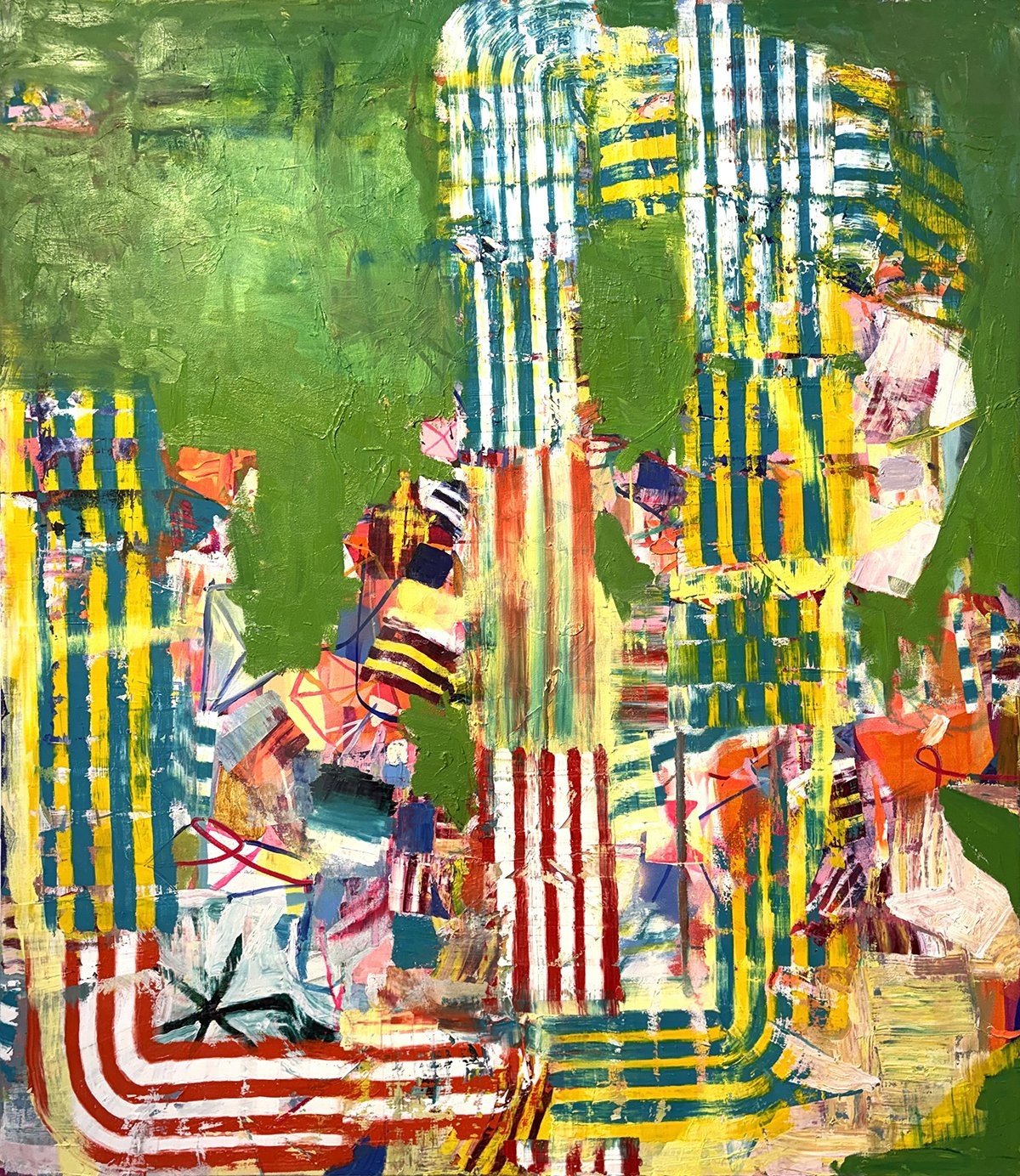
Galen Cheney, Meadowlark, 2024, oil and flashe on canvas, 58 x 50 inches. Image by Felicity Wong.
Certainly, Cheney and Derbes take on investigations of color, line, and material with great vigor. But perhaps more curiously, both artists also beckon the viewer to look closer—to trace the edges of the canvas that appear in the middle of Cheney’s paintings, or the roughness of the wood that Derbes accommodates for as he fashions it into sculpture. These acts of close looking allow us to destabilize interpretations of the artists’ abstract and conceptual works as the wholly purified forms they might appear to be when one glosses over them quickly.
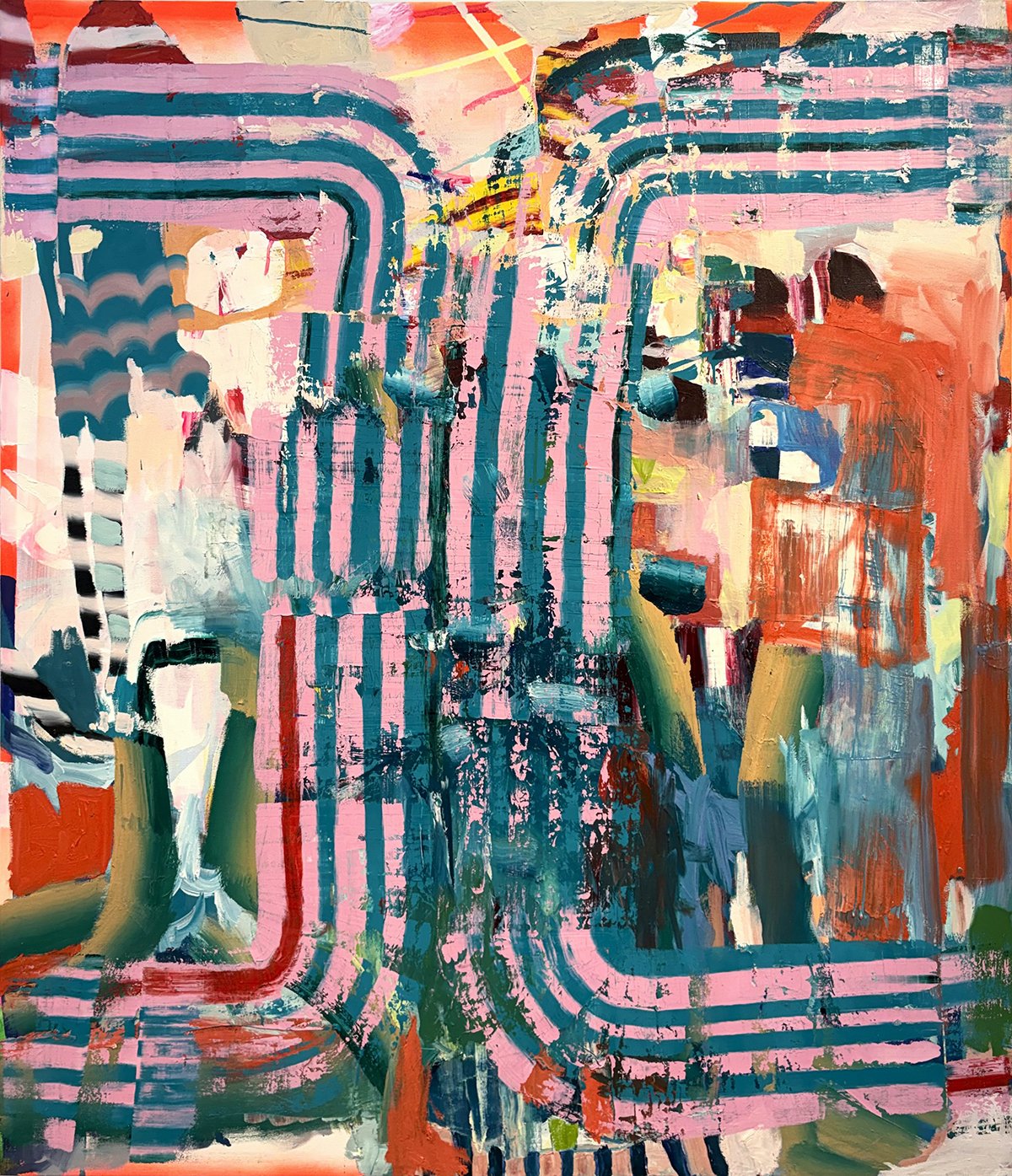
Galen Cheney, Heartthrob, 2024, oil and flashe on canvas, 58 x 50 inches. Image by Felicity Wong.
Using oil, acrylic, and flashe on canvas, Cheney inserts recurring visual forms across her work. Meadowlark and Heartthrob are a pair of paintings characterized by key resonances. The former has a more dominant palette of green, whereas the latter mixes together collaged sections of blue and orange. However, winding paths of about seven or eight thick lines in alternating colors, akin to train tracks or the raked gravel in a karesansui (Zen garden), cover both canvases. In Meadowlark, the paths transition from red and white to blue and white to blue and yellow; in Heartthrob, they remain a stark pink and teal. Cheney captures a sense of movement and certainty with these paths amidst cacophonous backdrops of color.
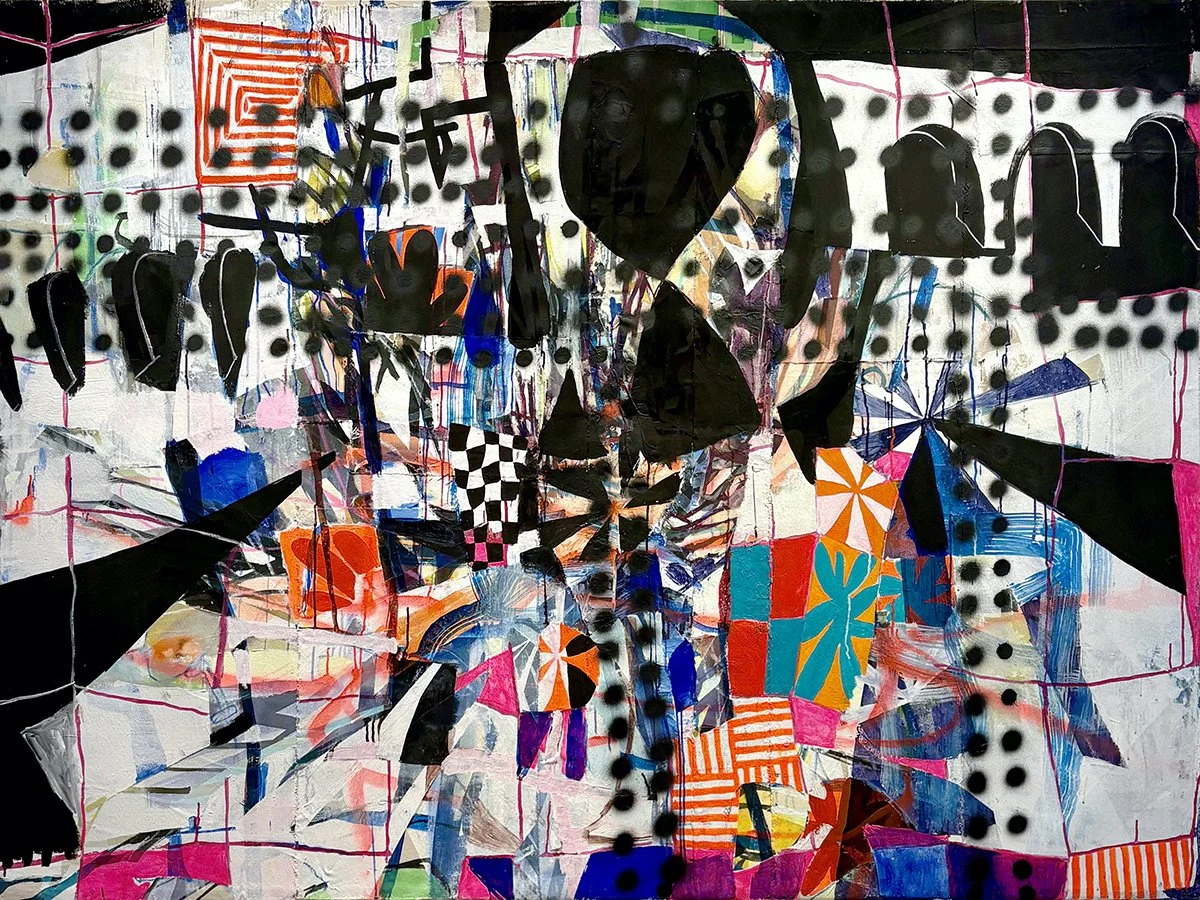
Galen Cheney, Conjurer, 2023, acrylic, flashe, and spray paint on collaged canvas, 59 x 80 inches. Image by Felicity Wong.
In Conjurer, Cheney incorporates bits of neon stripes, petals, paint drips, and checkered patterns on paper and canvas to reflect the chaos of city landscapes. Here, the edges of the canvas that Cheney collages are visible, and the repeating black ovals and keyhole-esque shapes in the top half of the painting pull the viewer into what seem to be tunnels.
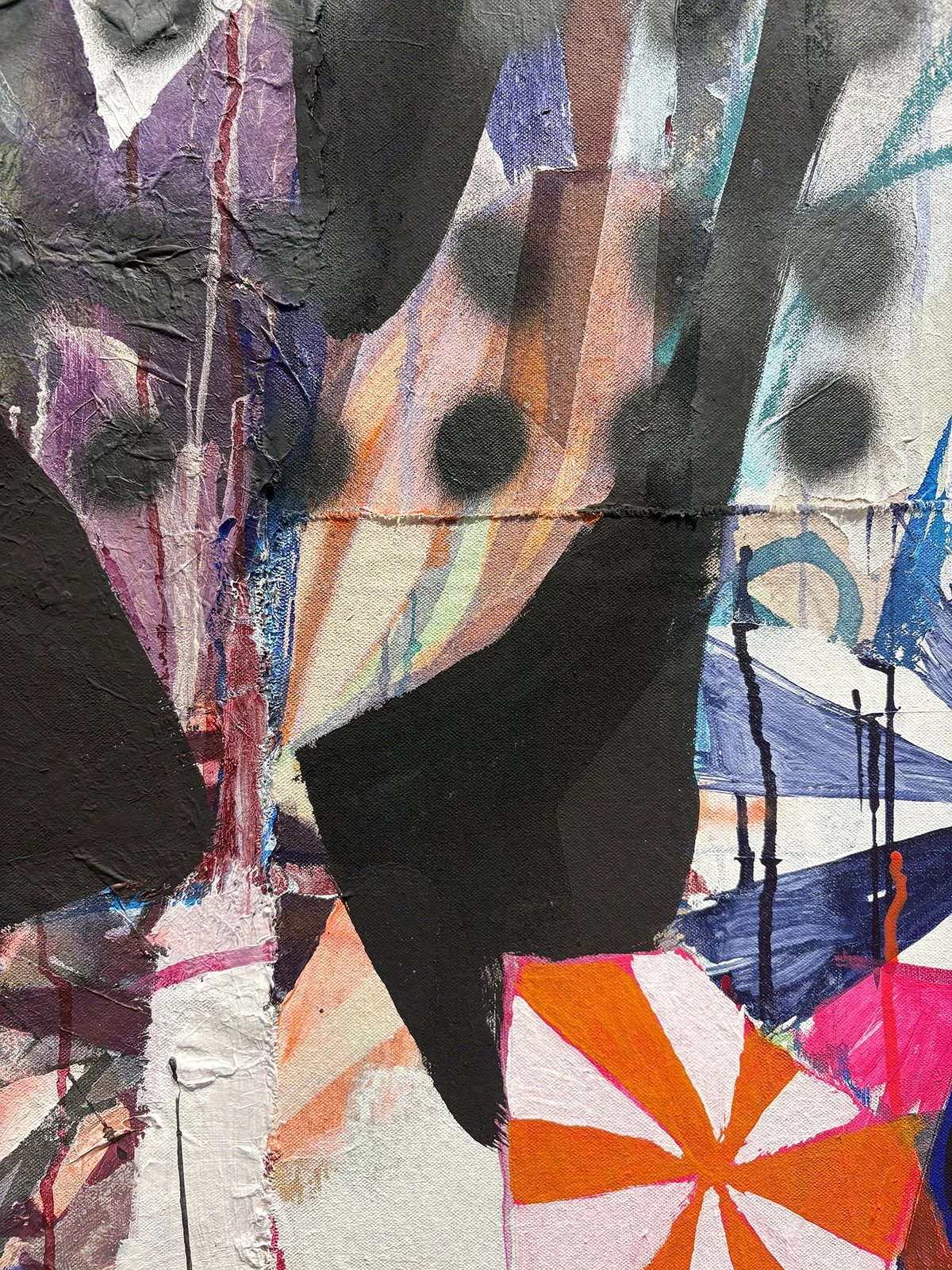
A detail view of Galen Cheney’s Conjurer, 2023, acrylic, flashe, and spray paint on collaged canvas, 59 x 80 inches. Image by Felicity Wong.
The artist’s interest in urban settings manifests clearly as she thinks of abstracted form through architectures, especially in the upper left and right corners. And like the raked paths in Meadowlark and Heartthrob, which index deliberate movement, the repeating dots of graffiti spray paint provide structure and order on top of the clashing patchwork of colors, lines, and textures.
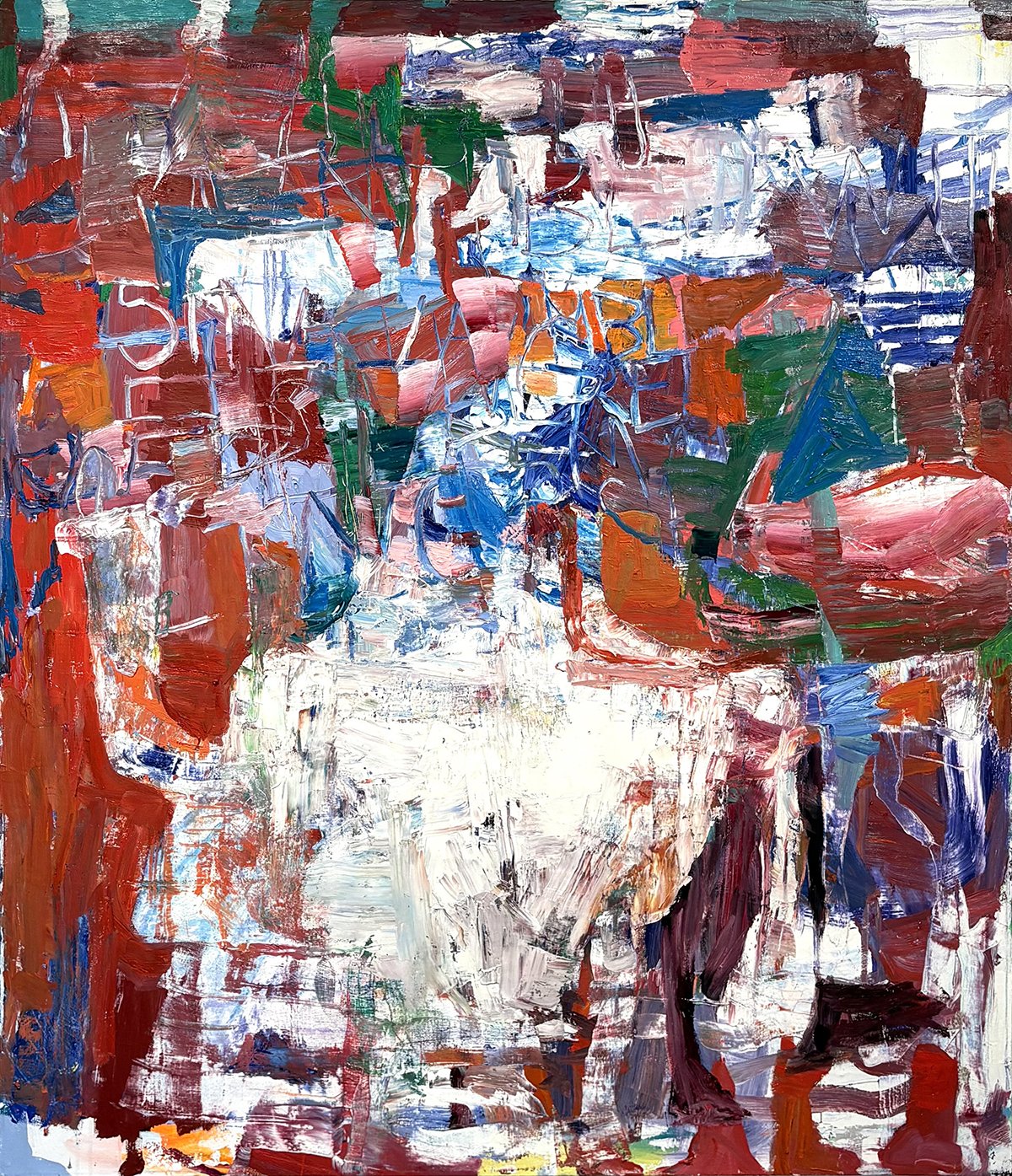
Galen Cheney, Selfie, 2025, oil on canvas, 58 x 50 inches. Image by Felicity Wong.
A brushstroke-forward painting, Selfie presents splotches of thick textured paint in shades of red, blue, orange, dark green, and deep purple. A misshapen white figure hovers near the center. Just above, one can make out an S, N, E, B, and G, among other alphabet letters, in blue or white paint. Their presence is unmistakable, but they meld together with lines that section off the patches of paint from each other. Ultimately, the texts jumble together, their illegibility mirroring the ambiguity of the white figure.
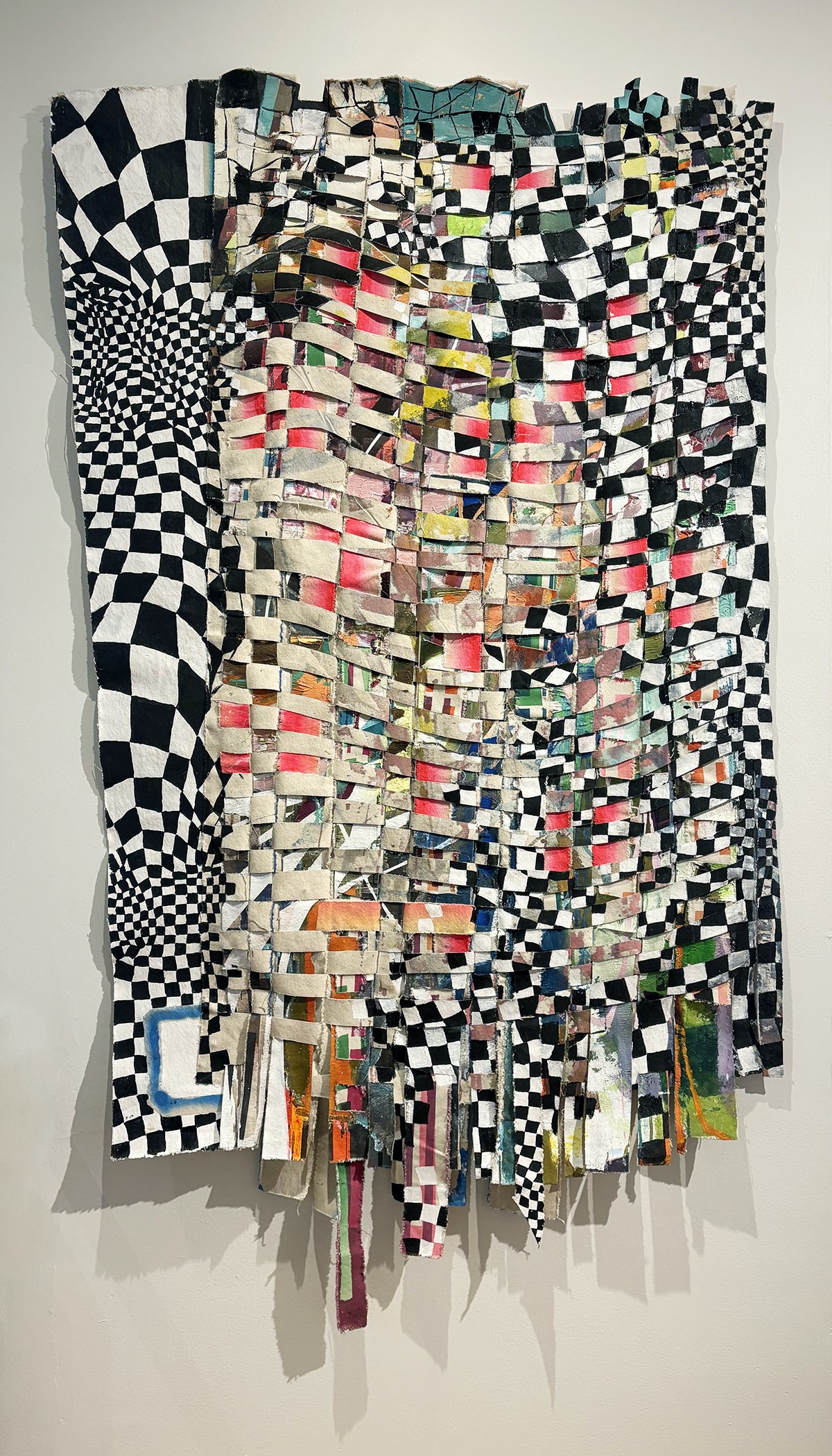
Galen Cheney, Dream Machine, 2023, acrylic and textile color on woven canvas, 64 x 37 inches. Image by Felicity Wong.
Along with paths, dots, and text, Cheney turns to textiles in her painting. Hung by the staircase in a liminal space of the gallery, Dream Machine consists of beige canvas strips woven with other multi-colored strips of coral, green, yellow, green, mauve, and black-and-white. The remnants of those strips hang at the bottom of the textile painting, and black-and-white painted checkered canvas surrounds the larger weave itself.
Notably, the canvas in Dream Machine lifts off the wall and casts slight shadows, which, in combination with the irregular concentration of checkered rectangles throughout the work, give the painting extra dimensionality. This effect epitomizes what Cheney’s other paintings hint at with their layered canvases and bulkier brushstrokes. Throughout the Brief Transit exhibition, visual symbols appear and reappear: recognition of the checkered pattern or the raked paths in multiple paintings cements a formal cohesion—a conversational moment—between all of Cheney’s paintings.
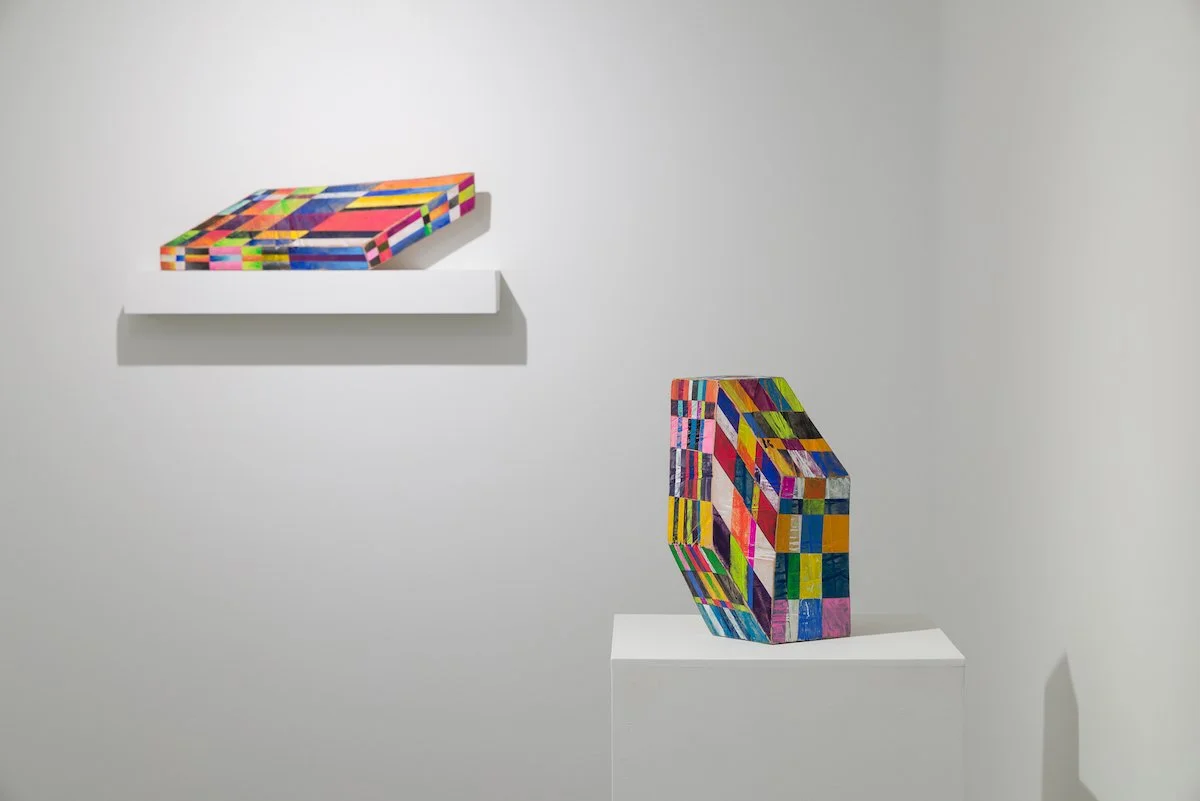
An installation view of Clark Derbes’s Time Travelers exhibition at Nick Ryan Gallery in Boulder. Image by Wes Magyar, courtesy of Nick Ryan Gallery.
While Cheney’s paintings exclusively live on the wall, Derbes’ polychromic wooden sculptures both sit against the wall and stand alone. To create these, the artist cuts and carves, sands, and paints pieces of wood with a watercolor brush, burnishing them at the end. They are no ordinary polyhedrons; rather, their warped constructions manipulate the viewer’s perception of the object. In this series, the silhouette of a wooden sculpture changes depending on the viewer’s vantage point. Taking a step further away or closer, or left or right, shifts the colors and form that meet the eye.
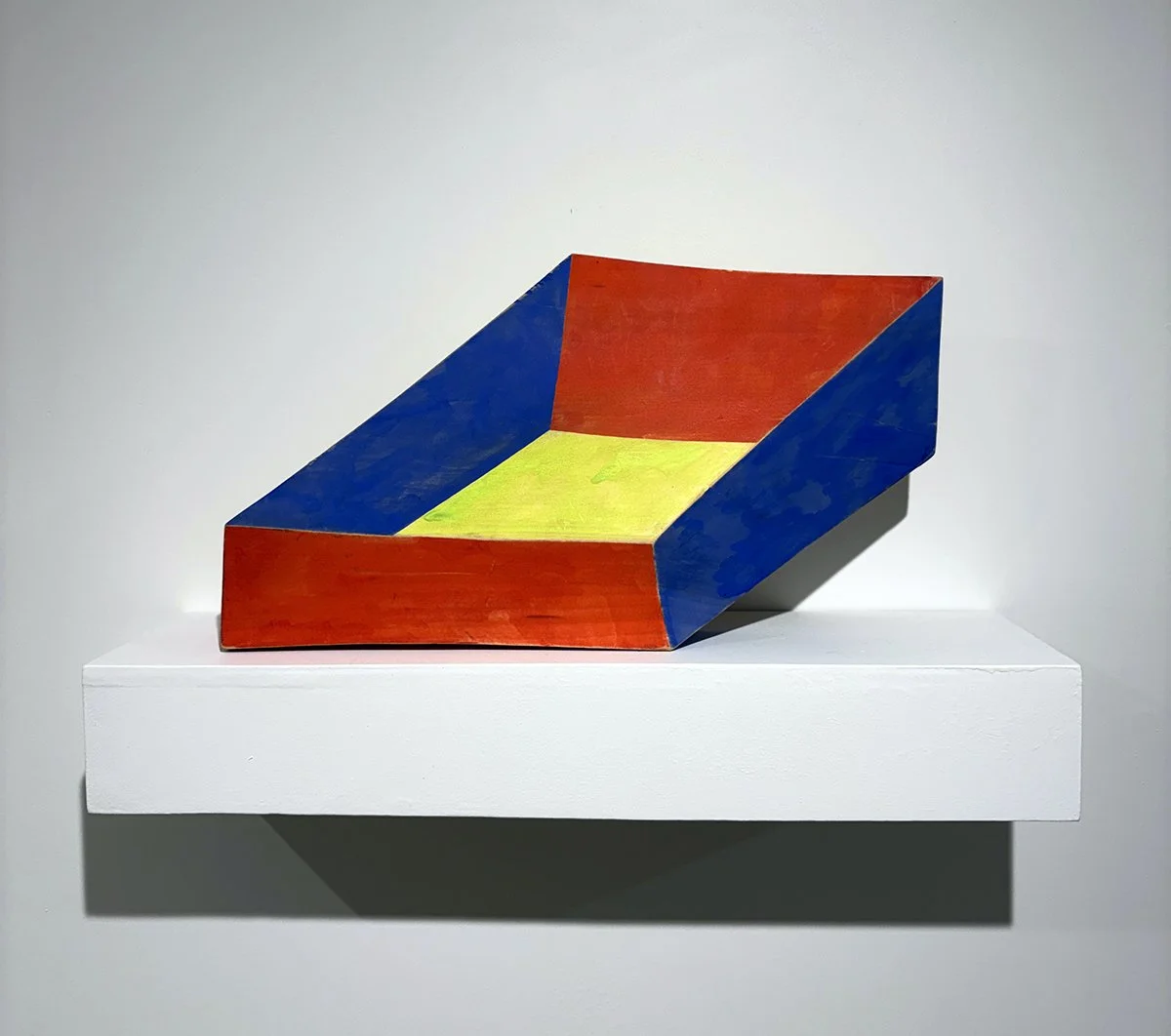
Clark Derbes, Box (Fun), carved polychromed maple, 9 ½ x 17 x 3 inches. Image by Felicity Wong.
For example, Box (Fun) looks like a two-dimensional painting of a box or drawer, but its shadow gives away a three-dimensionality that invites the viewer to more carefully examine the sculpture. In this way, the form fundamentally shapes the viewer’s relationship with their surrounding space. Moreover, the opacities of blue, red, and yellow paint on Box (Fun) vary. Derbes’ visible brushstrokes are evidently applied with uneven pressures, contributing to the optical illusion of the box as a two-dimensional rendering.
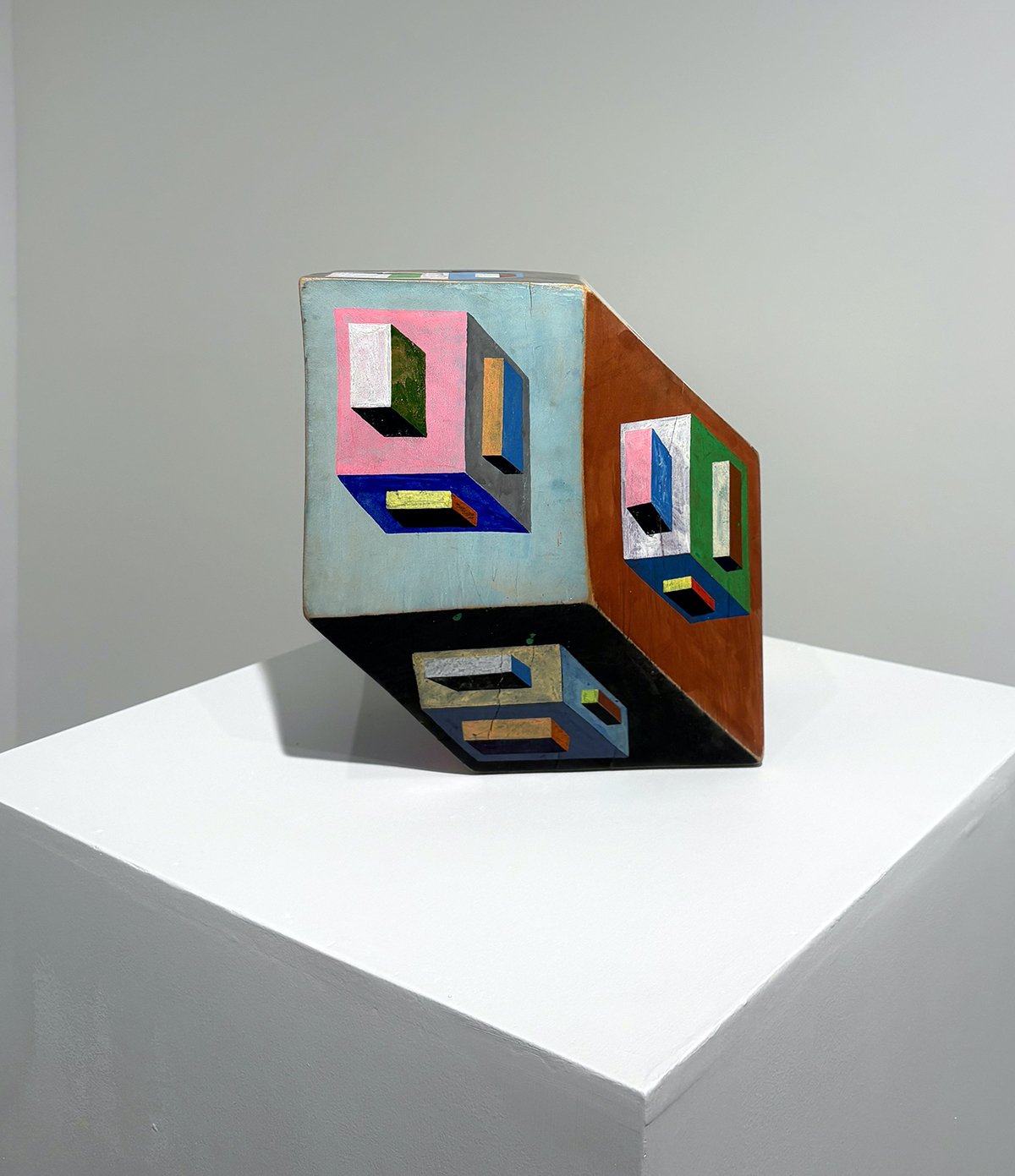
Clark Derbes, Fractal Generator, 2024, carved polychromed maple, 11 x 9 x 8 inches. Image by Felicity Wong.
Sculptures like Fractal Generator rely upon principles of mathematical topology. From one angle, the viewer can see six surfaces of the wooden block, but from another, only three are visible. Derbes paints a rectangular box on each differently-colored surface, also with faces of different colors. Attached to each of those faces is a rectangular box with more differently-colored faces. These boxes, which all have the same character, repeat to become part of a larger whole. This repetition speaks to one of Derbes’ influences, Elizabeth Murray, who was interested in how broken parts of something could be assembled together and conceived of as a conceptual whole. [2]
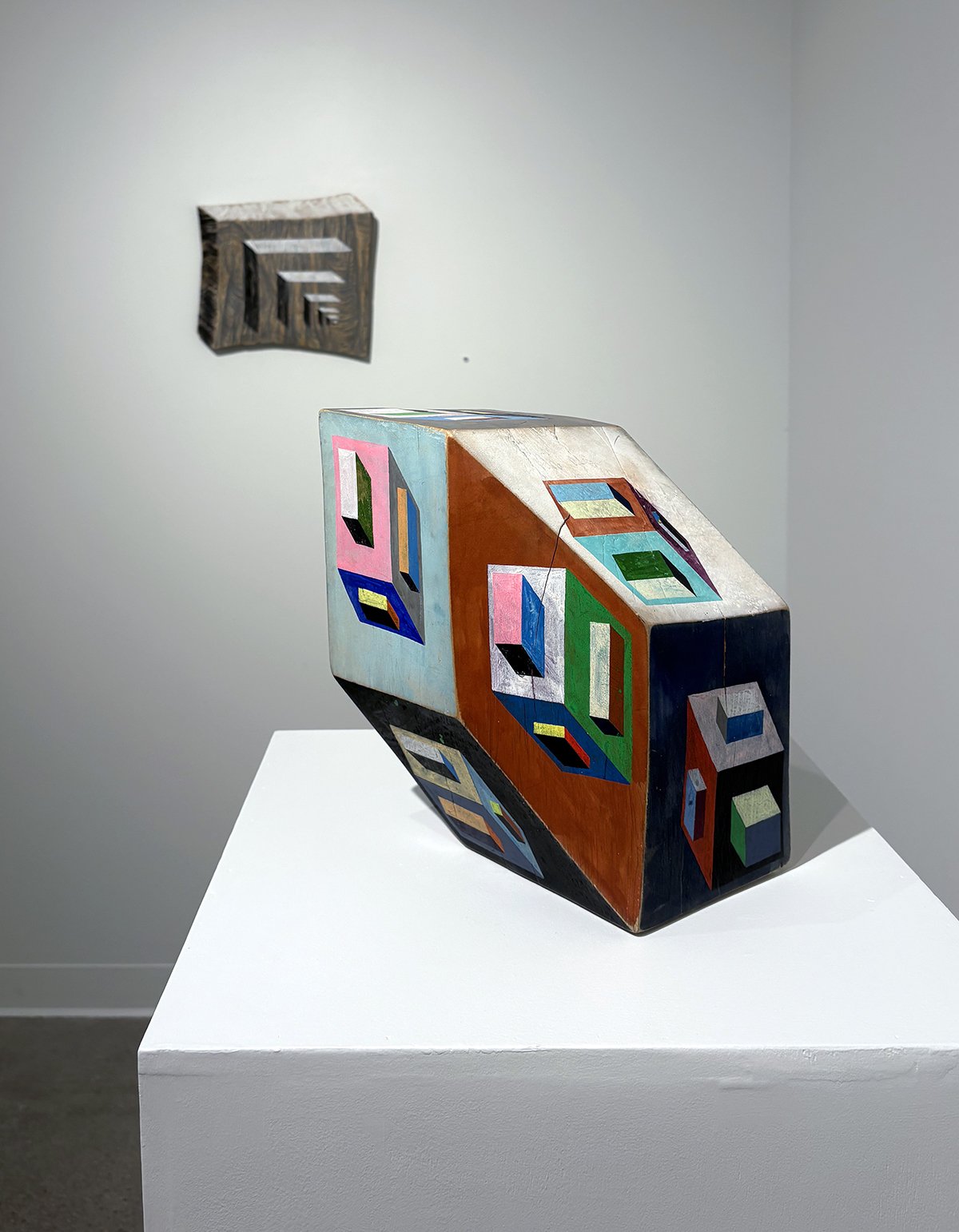
Clark Derbes, Fractal Generator, 2024, carved polychromed maple, 11 x 9 x 8 inches. Image by Felicity Wong.
Additionally, Fractal Generator is reminiscent of a work by another of Derbes’ inspirations: Sol Lewitt. In Lewitt’s Distorted Cubes (B) (2001), images of cubes are stretched and flattened along multiple axes. [3] Each face of the cube is colored differently, and the cubes are inscribed inside two-dimensional boxes of differing colors. Derbes brings Lewitt’s linoleum cut study of geometric systems into the third dimension, playing with the relationship between the viewer’s position and their perception of how objects can be stretched and flattened.
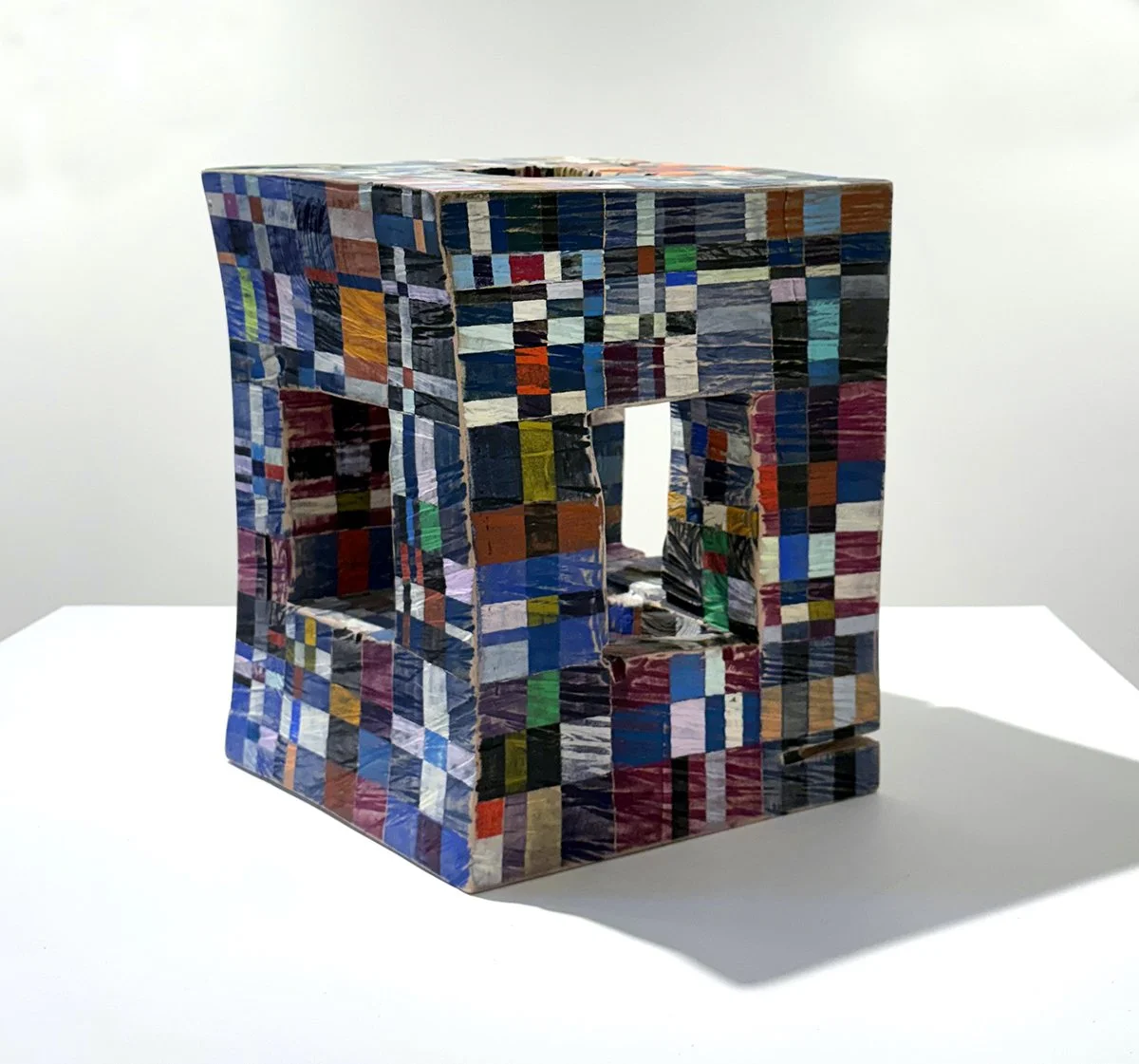
Clark Derbes, Memory Bank II, 2026, carved polychromed red maple, 13.5 x 10.5 x 9 inches. Image by Felicity Wong.
The materiality of wood figures significantly into Derbes’ work. Memory Bank II is a wooden oblong, but the artist has removed its core and carved rectangular windows into each of its wooden faces. The wood’s surface, enveloped in a myriad of tiny orange, purple, green, blue, and yellow rectangles, is asymmetrical, precarious, and textured. Derbes sources his wood from arborists in his neighborhood. The singular pieces that form the foundation of his sculptures are therefore leftovers.
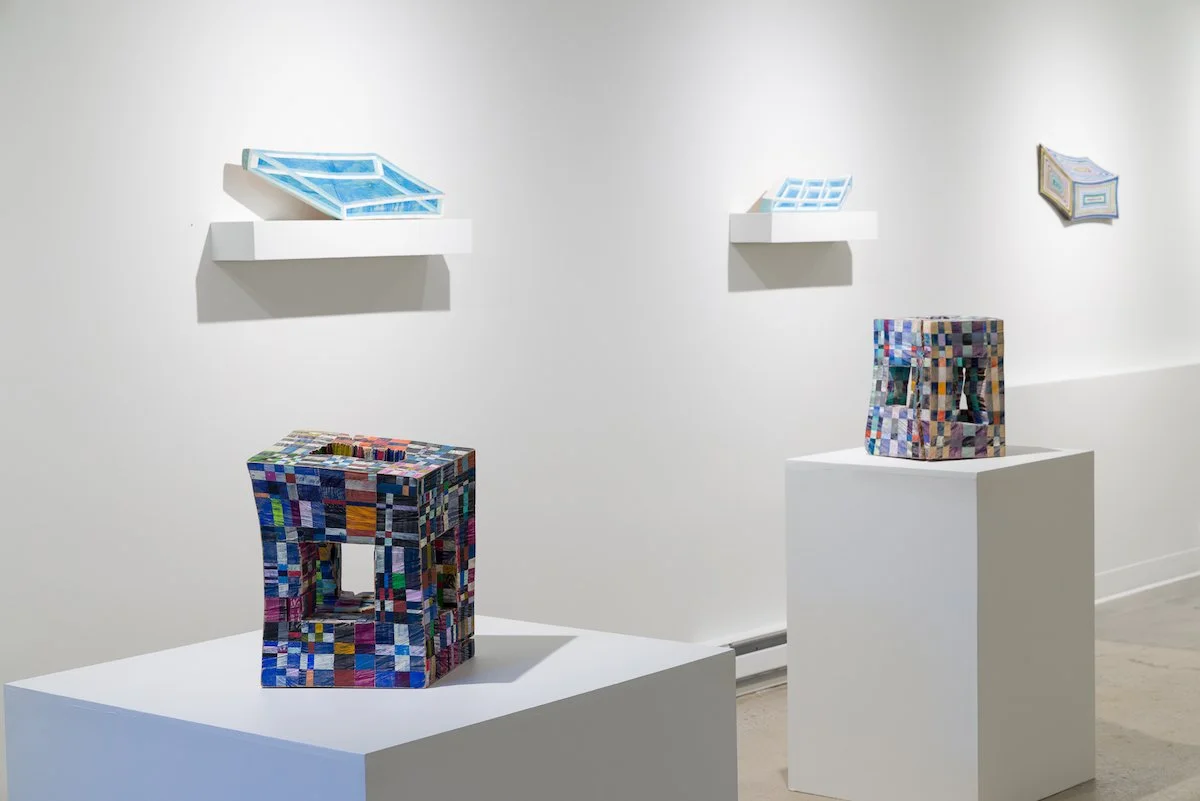
An installation view of Clark Derbes’s Time Travelers exhibition at Nick Ryan Gallery in Boulder. Image by Wes Magyar, courtesy of Nick Ryan Gallery.
Diverging from canonical conceptual artists who worked with softer materials like paper or canvas, Derbes lets the qualities of the wood guide his deeply intuitive process of making. His choice of wood—elm, poplar, or oak—depends on the scale of his sculpture. Oak, for example, is splintery and heavy, and therefore the most difficult to carve and paint. In general, Derbes must anticipate the wood’s cracks and warpings. Memory Bank II’s bumpy, skin-like surface thus becomes a new arena for the artist to negotiate the forms of “found” natural objects.
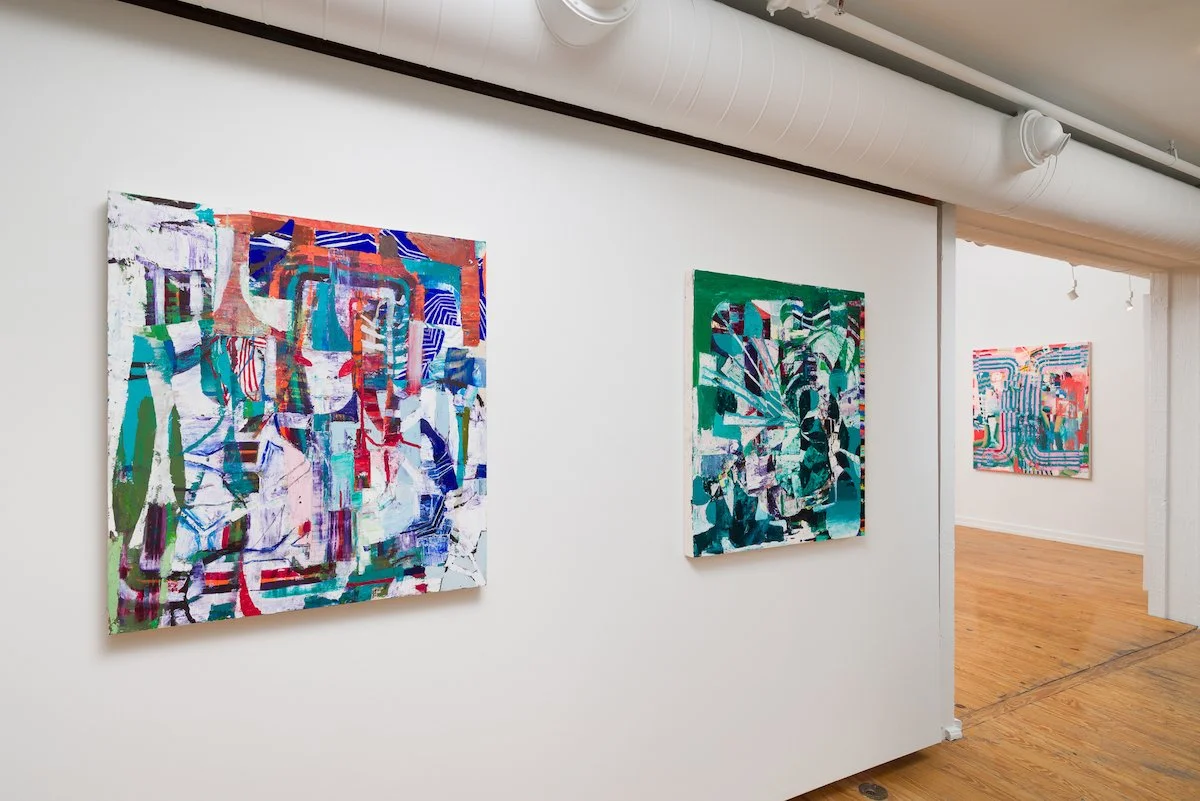
An installation view of Galen Cheney’s Brief Transit exhibition at Nick Ryan Gallery in Boulder. Image by Wes Magyar, courtesy of Nick Ryan Gallery.
Across the two exhibitions, Cheney and Derbes utilize similar visual vocabularies—a diverse range of colors, repetition, and distinct elements of order—in service of formal experimentation. Cheney pushes the boundaries of two-dimensional Abstract Expressionism through unconventional avenues like text and textile. Derbes welcomes unpredictability and references an external reality, i.e. the natural world, with his use of wood in geometric sculpture—two traits not traditionally present in conceptual or minimalist practices. Together, the artists effectively challenge the limits of existing traditions of artmaking oriented towards purity.
Felicity Wong (she/her) is a writer/researcher focused on modern and contemporary art, especially as it intersects with entwined histories of race and garment/textile labor across Africa, Asia, and their diasporas. She holds a BA in English from the University of Notre Dame and an MA in art history from the University of Colorado Boulder.
[1] “About Me,” Galen Cheney – Artist, accessed May 6, 2026, https://www.galencheney.com/about-galen-cheney/.
[2] “Elizabeth Murray: Painters Progress,” Museum of Modern Art, accessed May 6, 2026, https://www.moma.org/calendar/exhibitions/5894.
[3] “Sol Lewitt, Distorted Cubes (B) from Distorted Cubes (A-E),” Museum of Modern Art, accessed May 6, 2026, https://www.moma.org/collection/works/91406.