
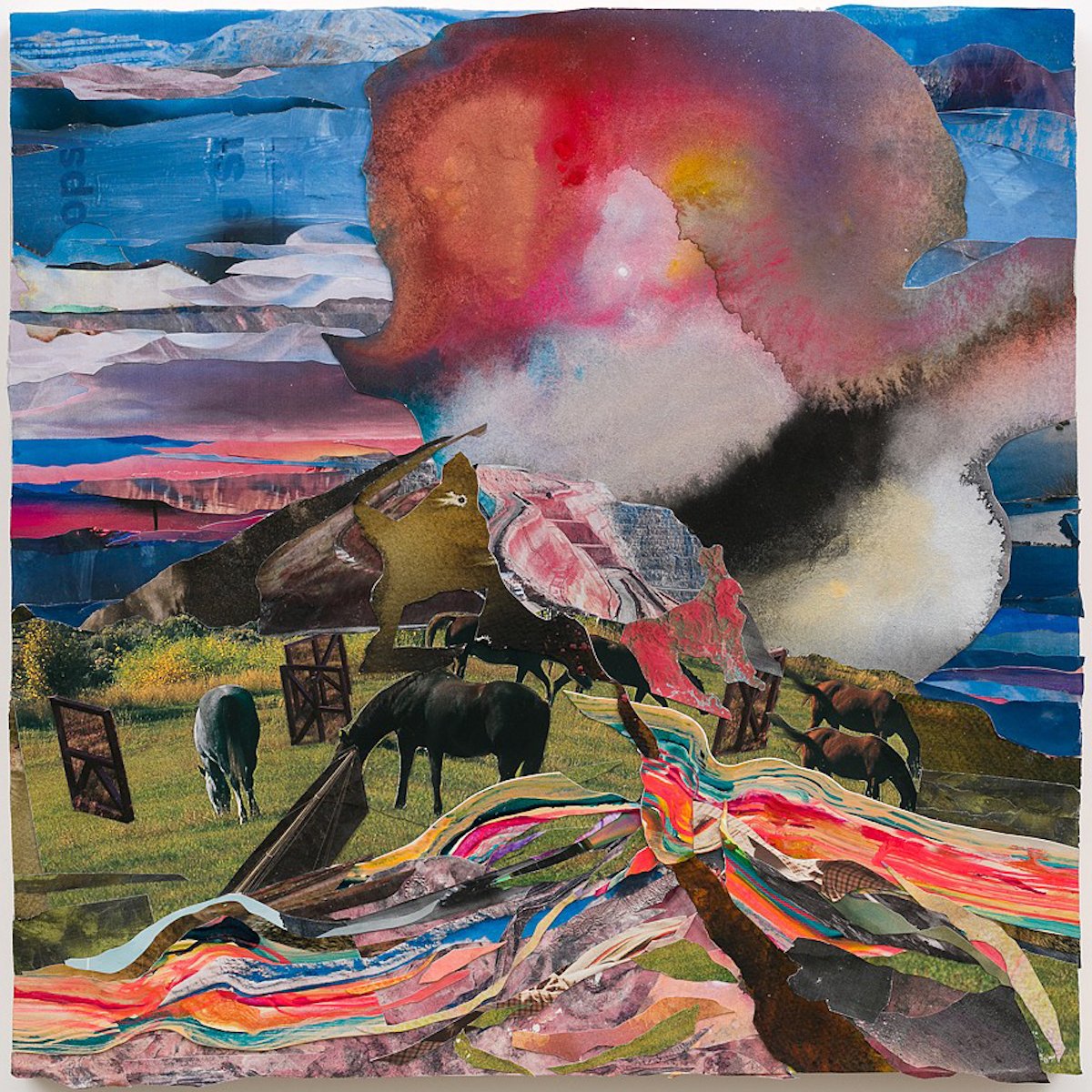
Libby Barbee
Libby Barbee
Denver International Airport
Airport Office Building
March 19–June 30, 2026
Admission: free
Accessible without going through airport security, Monday–Friday: 7:30am–4pm
Review by Maggie Sava
Thanks to recent internet trends, there is a growing fascination with the feeling of occupying liminal spaces. Be they empty retail stores, abandoned office buildings, or personless playgrounds, something about the simultaneous ordinariness and inexplicable strangeness of these places activates our imagination.
The airport has always felt like a liminal space to me—a temporary place to be between coming and going. It’s never a destination, only a necessary stop along the way. Adding to its sense of being “in between” is the fact that most of my time at the airport is spent just waiting, anticipating the next step in my journey.
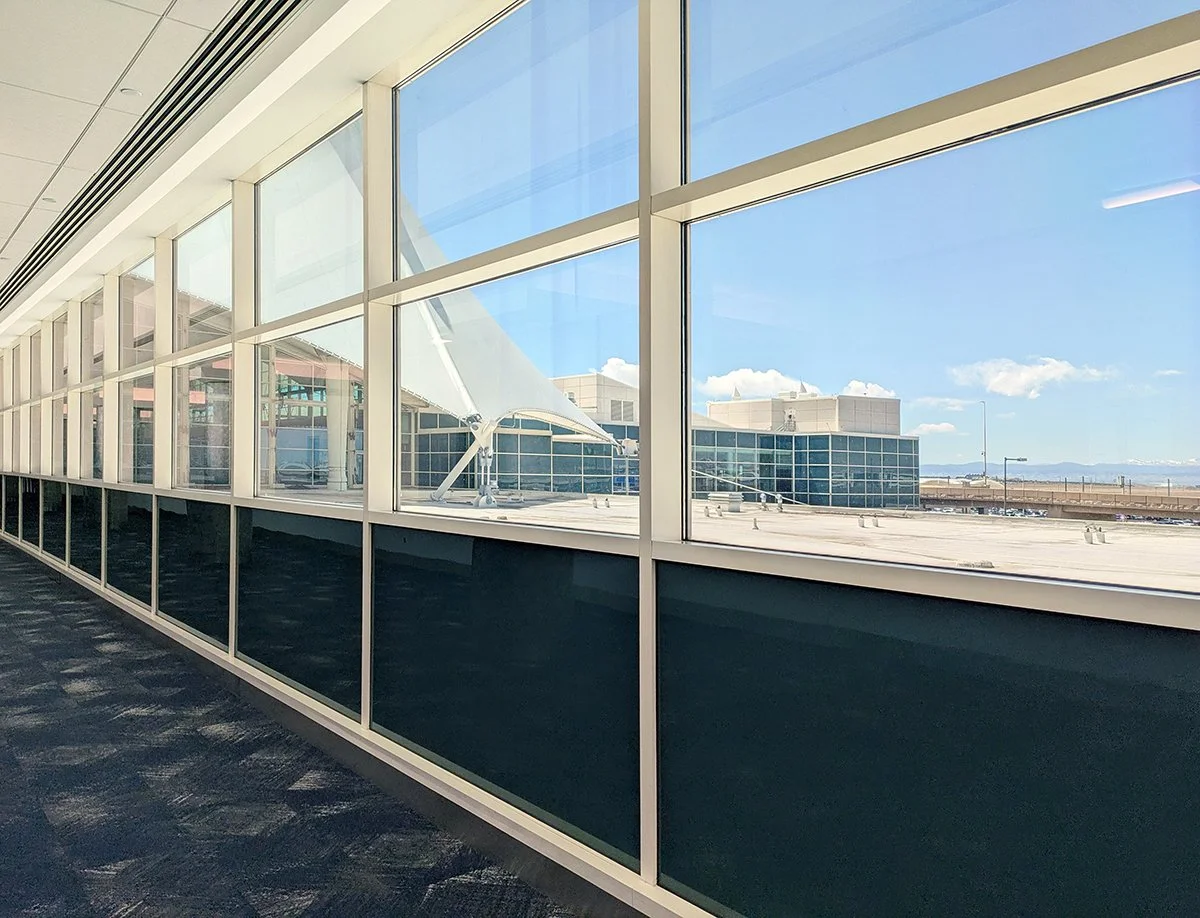
A view looking out the windows of the interior hallway of Denver International Airport that leads to the Airport Office Building. Image by Maggie Sava.
As a place that sees immense traffic—over 82 million passengers each year—the Denver International Airport (DIA) is one of busiest places in the world. It serves people between their point A’s and their point B’s, meaning it also has some of the largest captive audiences for art. And its art does not go unnoticed. For example, Mustang/Mesteño by Luis Jiménez, colloquially known as “Blucifer,” is now one of our state’s icons and, as a staple in Denver’s shared visual culture, informs the city’s public identity.
Just as place can inform art, art can shape our sense of place. Having art at the airport can provide the opportunity not only to bolster the public image of the city and state, but can also reconnect travellers with what it means to be “here.” Alex Sweetman’s Art Chronicles photo series documents the airport’s construction in the state’s distinctive prairie lands. Thomas “Detour” Evans’s It’s Not What You Take, It’s What You Bring Back is constructed of luggage as the ephemera of traveling, the stories of those who used said luggage, and the colors of the Colorado skies. It portrays the flow of arrivals and departures from the very spot where it is installed. And Spirit of the People by the Western American Indian Chamber depicts the Indigenous tribes of Colorado through photographs, paintings, murals, and music.
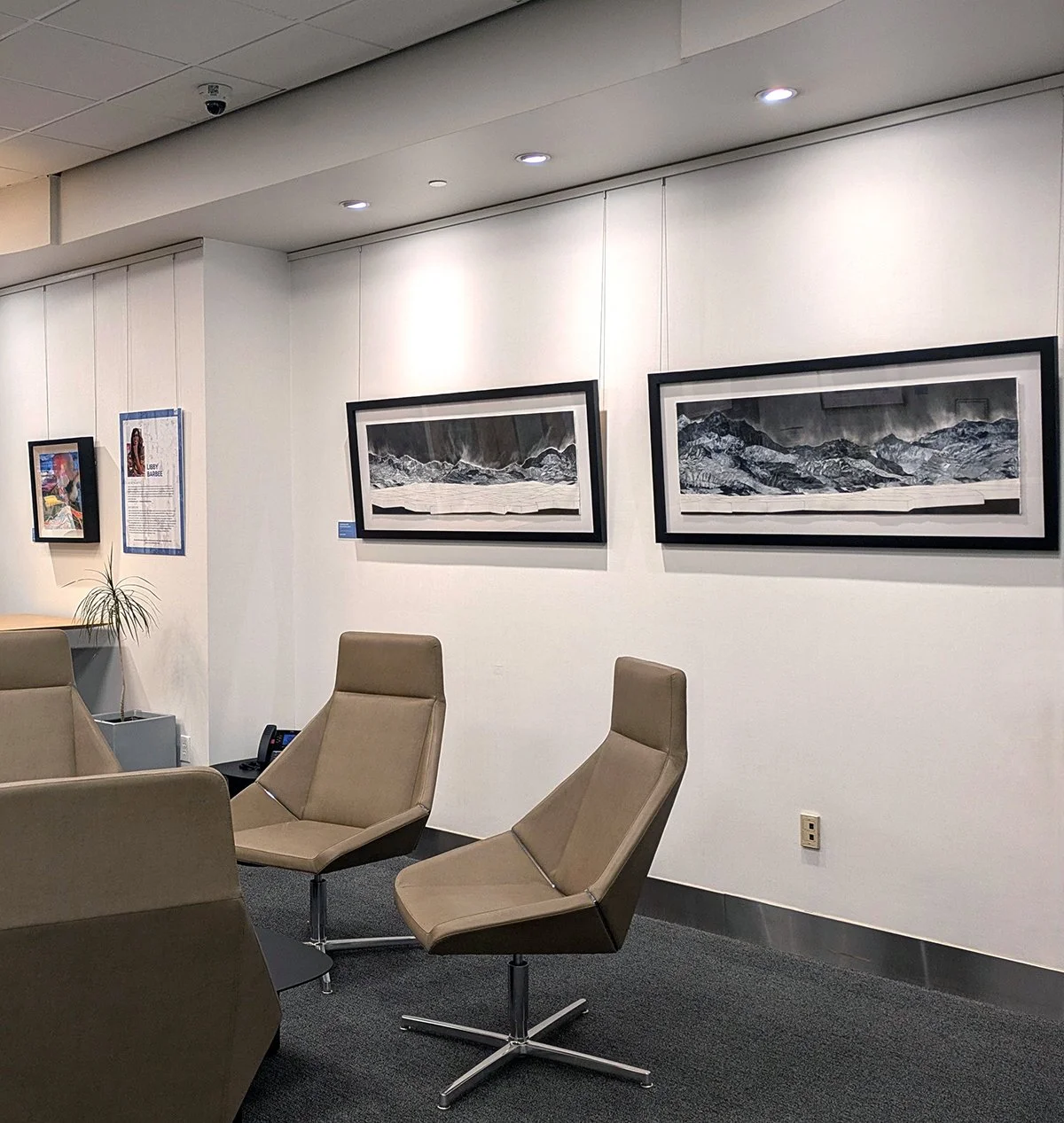
An installation view of Libby Barbee’s solo exhibition in the Airport Office Building at the Denver International Airport. Image by Maggie Sava.
Libby Barbee’s solo show, one of DIA’s latest temporary exhibitions on display in the Airport Office Building, sits at the nexus of these considerations of art and place. Consisting of six collaged works from over the past sixteen years, the show is a sharply focused exploration of Barbee’s career-long examination of our connection to our environment. As she notes in her artist statement, her work exposes the “contemporary political and social implications of frontier myth, and imagines the western landscape as both a culture-defining myth and as a thoroughly domesticated and culturally constructed space.” [1]
In many ways, my journey through the airport to Barbee’s show primed me to feel out-of-place. I entered the airport not as a passenger, but merely as a visitor. To get to the Airport Office Building, I walked past west security, then down a long hallway that runs parallel to the corridor that takes travelers to Concourse A. Through windows, I could see a stream of people walking towards their gate, luggage in tow, but there was no one else on my side of the hallway.
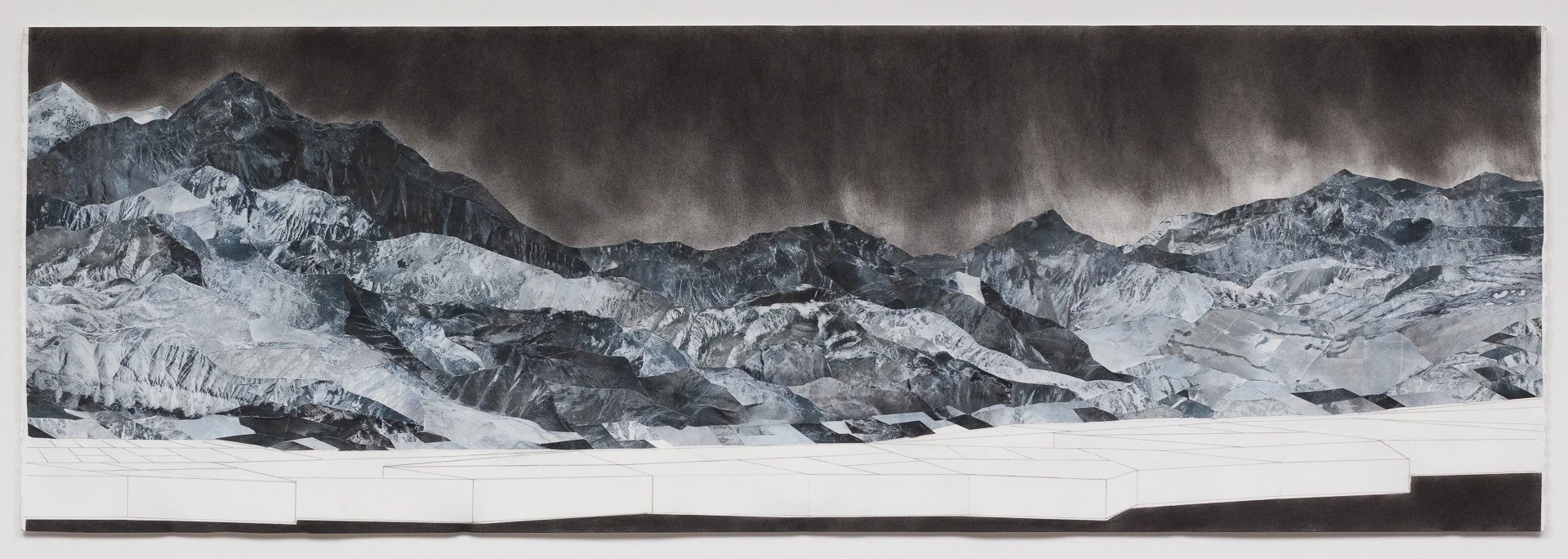
Libby Barbee, Constructed Mountainscape 1, 2022, collage and charcoal on paper, 16.5 x 50 inches. Image courtesy of the artist.
Barbee’s exhibition is hung in the lobby of the office, a space that is not often seen by non-employees, and no one else stopped into the office during the time that I was there. I felt very aware that I was behind the scenes, in a space that felt new and unfamiliar despite its very standard office appearance. The sense of dislocation and defamiliarization I felt echoed as I looked at Barbee’s collaged works. To make these images, Barbee takes what she calls “fragments of cultural debris” and uses them to build out landscapes that exist somewhere between surreal geographies and glitches in the matrix. [2]
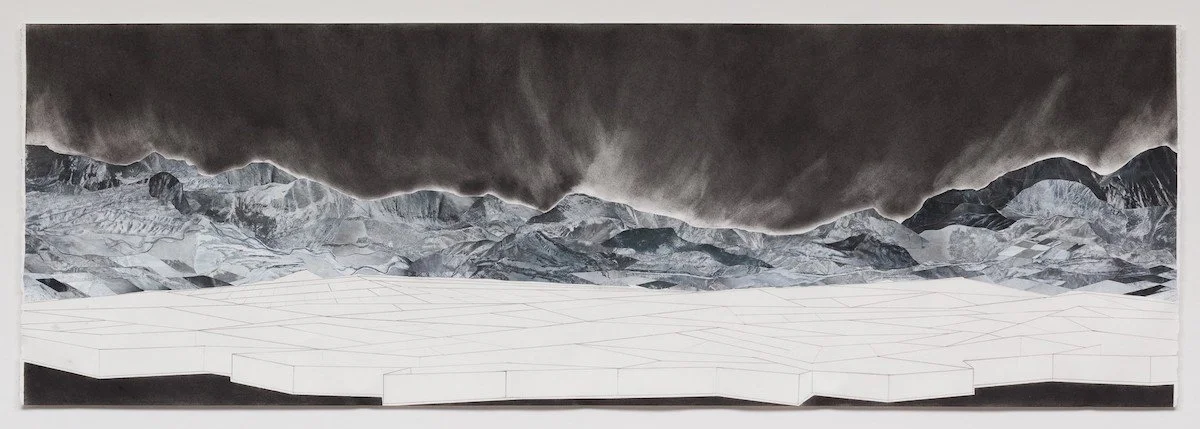
Libby Barbee, Constructed Mountainscape 2, 2022, collage and charcoal on paper, 16.5 x 50 inches. Image courtesy of the artist.
Constructed Mountainscape 1 and Constructed Mountainscape 2 depict rocky ranges that feel ubiquitous to me as someone who was born and raised in Colorado. As you look closer, you can see that these ridges are made up of pieces of gray, white, and tan paper pieced together to create the layered texture of the mountains. The geological outcroppings sit on what looks like the ground in a video game that has not fully rendered. Dimension is suggested by the framework of perspective lines, but otherwise it is void of color, texture, or shading. Underneath the ground is a solid black background, as if the edge of this pictorial world drops off into a deep void. This scene feels isolated and out of time, as if it exists beyond our realm.
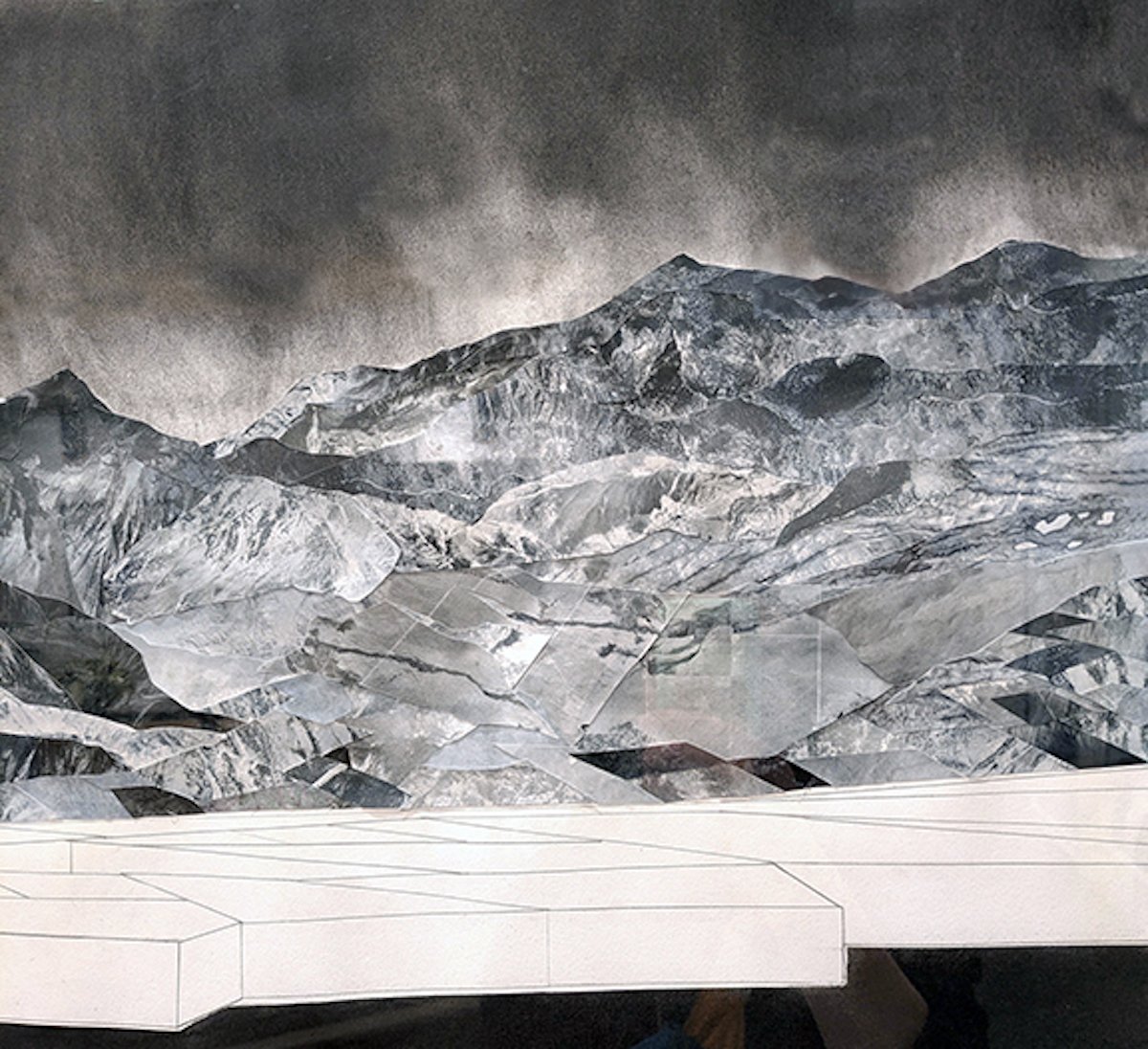
A detail view of Libby Barbee’s Constructed Mountainscape 1, 2022, collage and charcoal on paper, 16.5 x 50 inches. Image by Maggie Sava.
Place is not neutral, and it is important to think of these works in the context of where they are situated. The fact that these collages are shown in the American West and in an airport that now connects Denver with almost the entire globe (not to mention the fact that the airport itself was designed to resemble mountain peaks), makes Barbee’s interest in frontier myths all the more pronounced. Westword expansion justified through the notion of manifest destiny led to European settlers displacing Indigenous peoples, often through violent means. Those settlers also significantly altered the local landscape to meet agricultural, lumber, and, later, industrial demands throughout the course of their continental colonization.
The West was seen as wilderness to be conquered and domesticated until the land that now makes up the United States was under “American” control from one coast all the way to the other. However, many decolonial writers and thinkers have challenged the notion of the frontier, disrupting what it means to have an edge or border to “civilization.” Barbee’s mountainscapes visually estrange the concept of the frontier by placing mountains—prominent symbols of the American West—at what appears to be the end of the world, questioning what lies beyond what we have rhetorically or ideologically “rendered” as place.
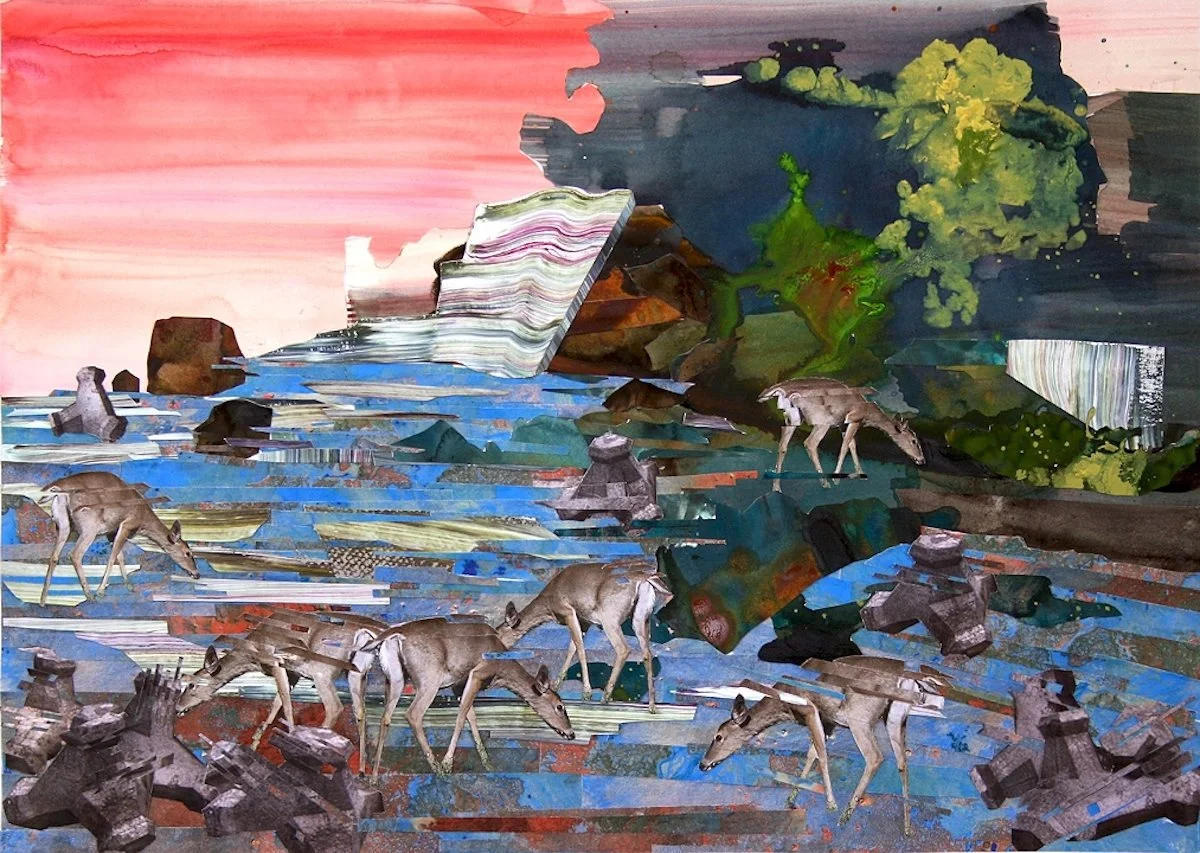
Libby Barbee, Incidental Interference, 2012, collage on paper, 14.875 x 20.75 inches. Image courtesy of the artist.
Not all of Barbee’s landscapes are as vast and uninhabited as the constructed mountainscapes. Incidental Interference is populated by grazing deer scattered and feeding along blue ground. It is unclear if they are walking on water or if they are in an otherworldly geography in which the ground is by nature blue.
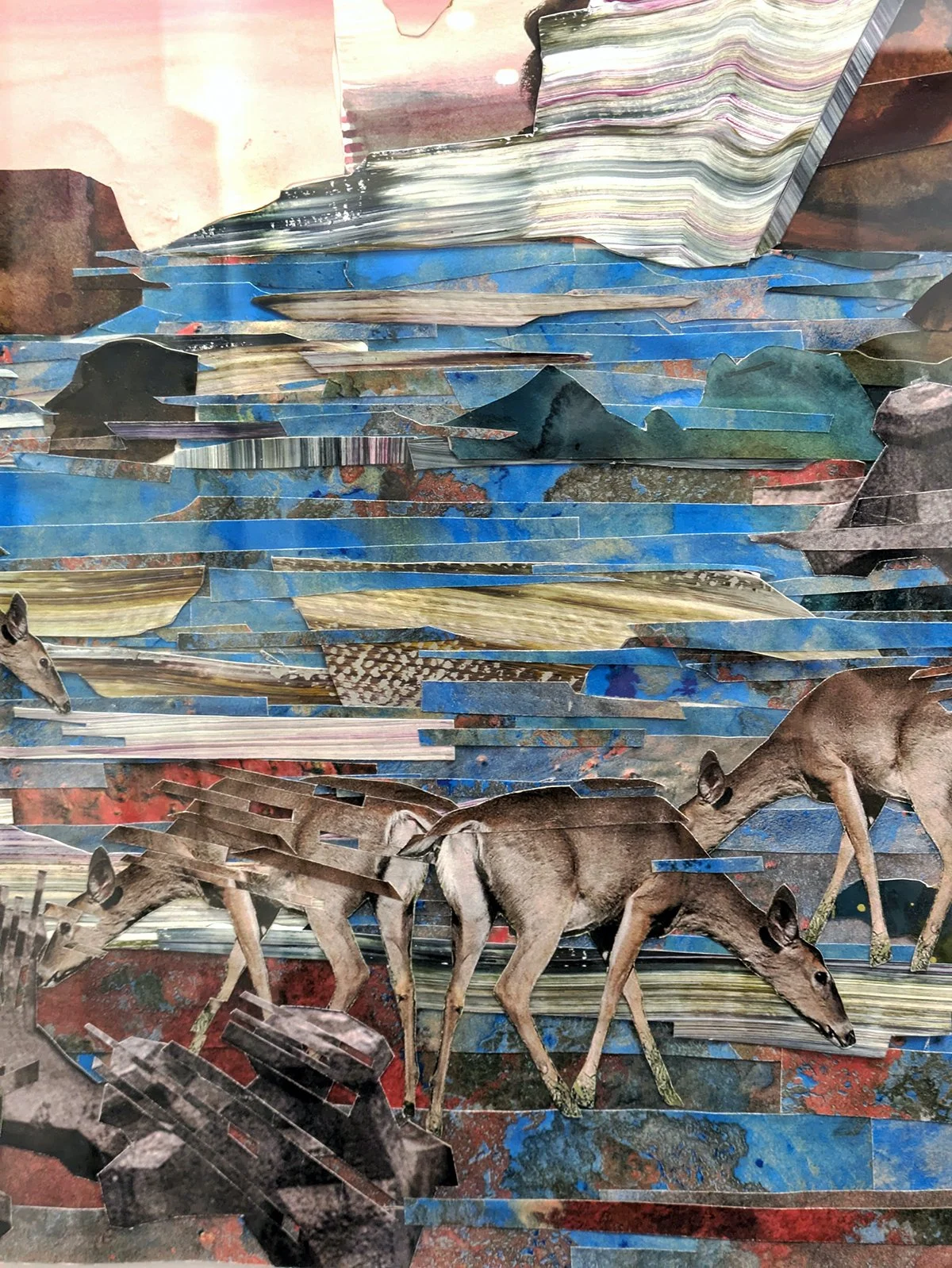
Detail of Libby Barbee, Libby Barbee, Incidental Interference, 2012, collage on paper, 14.875 x 20.75 inches. Image by Maggie Sava.
Adding to the strangeness of the image is the fact that the deer appear fractured and glitchy, as if their forms are interrupted by a weak signal. All of the deer seem oblivious to the looming cloud behind them, which might be ash from some sort of eruption, evidence of a fire, a storm omen, or billowing chemicals in the air.
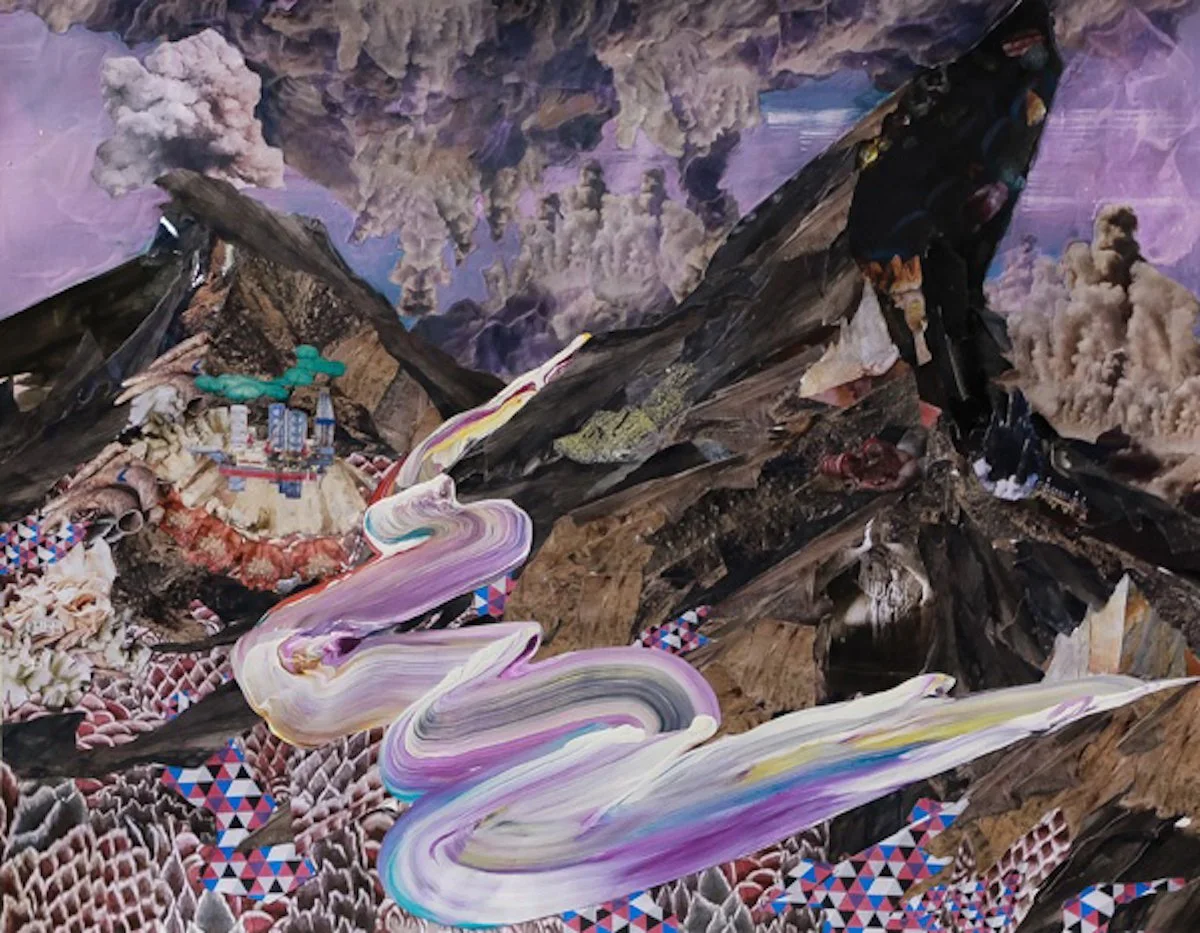
Libby Barbee, Black Magic, 2012, collage and paint on paper, 17.875 x 20. 875 inches. Image courtesy of the artist.
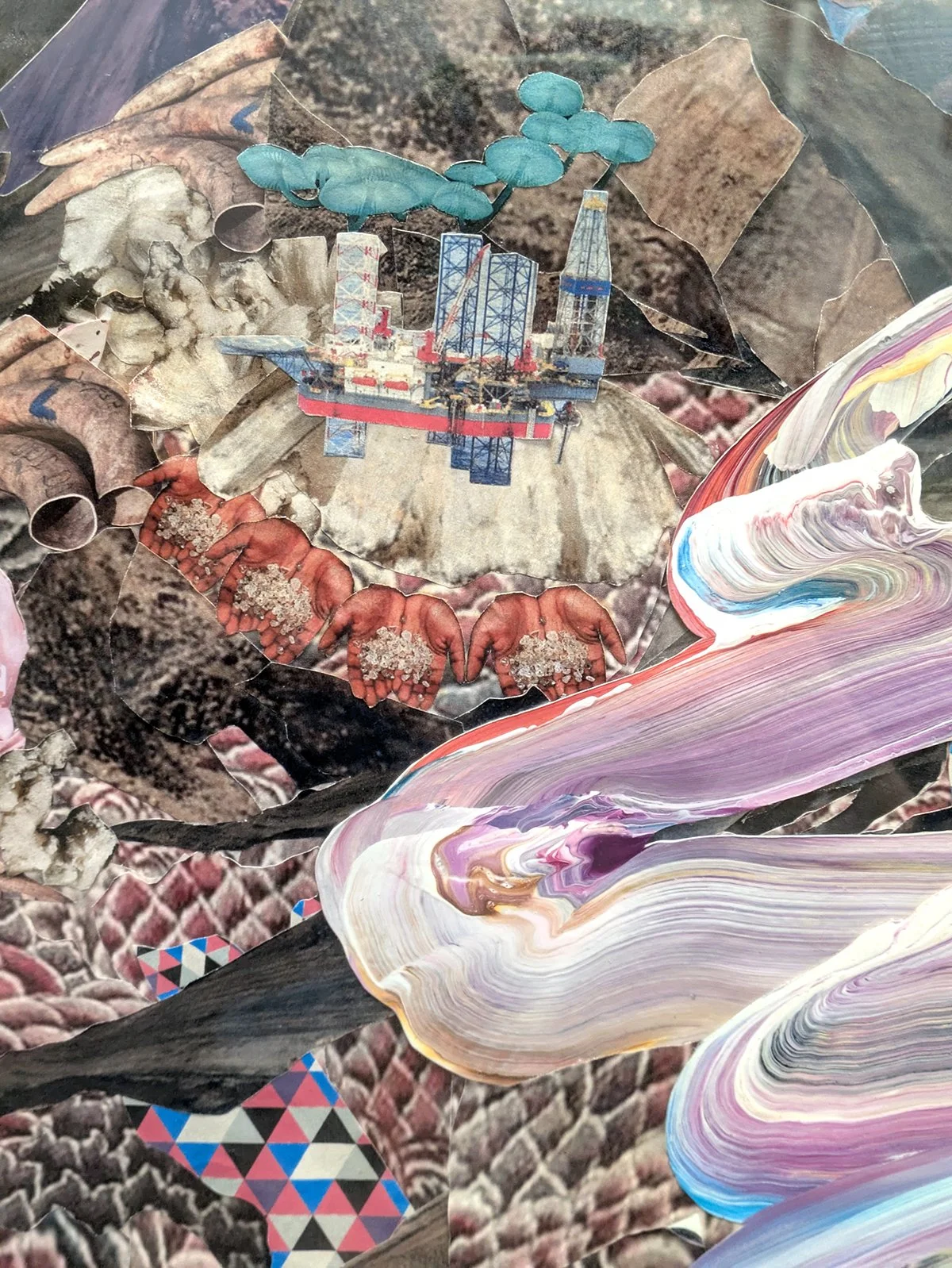
A detail view of Libby Barbee’s Black Magic, 2012, collage and paint on paper, 17.875 x 20. 875 inches. Image by Maggie Sava.
Black Magic is the only artwork in the show to contain direct visual evidence of human interaction with the environment. On the mountain on the left side of the collage sits what looks like a drilling operation with blue fungal growths jutting out above it. To the left of the industrial architecture is a pile of what appears to be animal horns, perhaps an allusion to the harmful practice of overhunting animals for trophies.
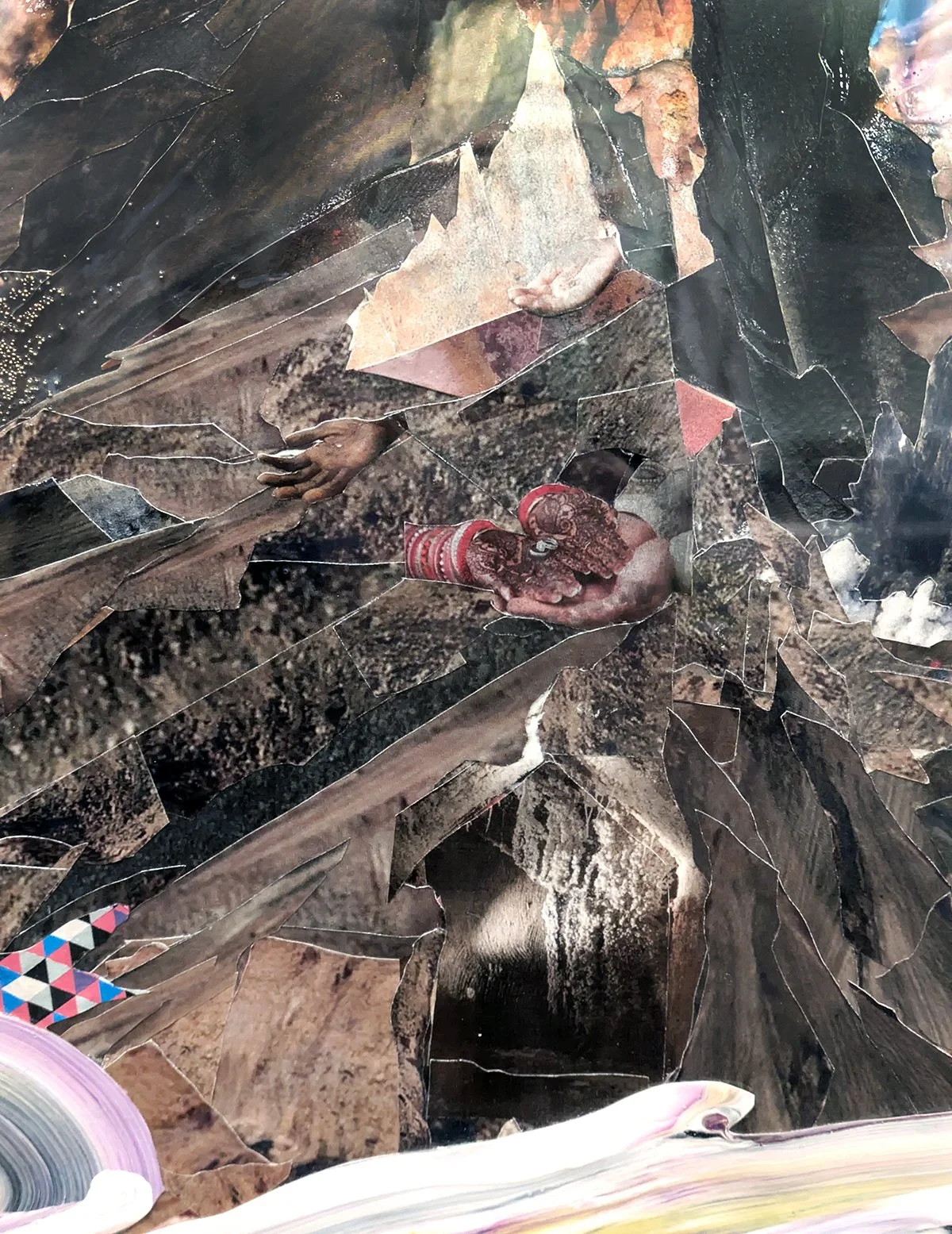
A detail view of Libby Barbee’s Black Magic, 2012, collage and paint on paper, 17.875 x 20. 875 inches. Image by Maggie Sava.
Incorporated into the composition are various outstretched human hands, most of which hold different offerings. A curving river of color divides the collage, taking the form of water but once again appearing not quite familiar, the colors not representing the vivid aqua tones that we expect to see in a mountain spring.
Although the colors appear cheerful and vibrant, Barbee’s scenes seem to direct attention to very serious implications. These landscapes all have impending clouds along the horizon, some looking like smog and others looking like more amorphous fields of color. The animals seem unsuspecting, while the human hands look like they may be making a plea. The cohesion of these images is disrupted by the edges of the layered images. These are not harmonious, serene, nature scenes.
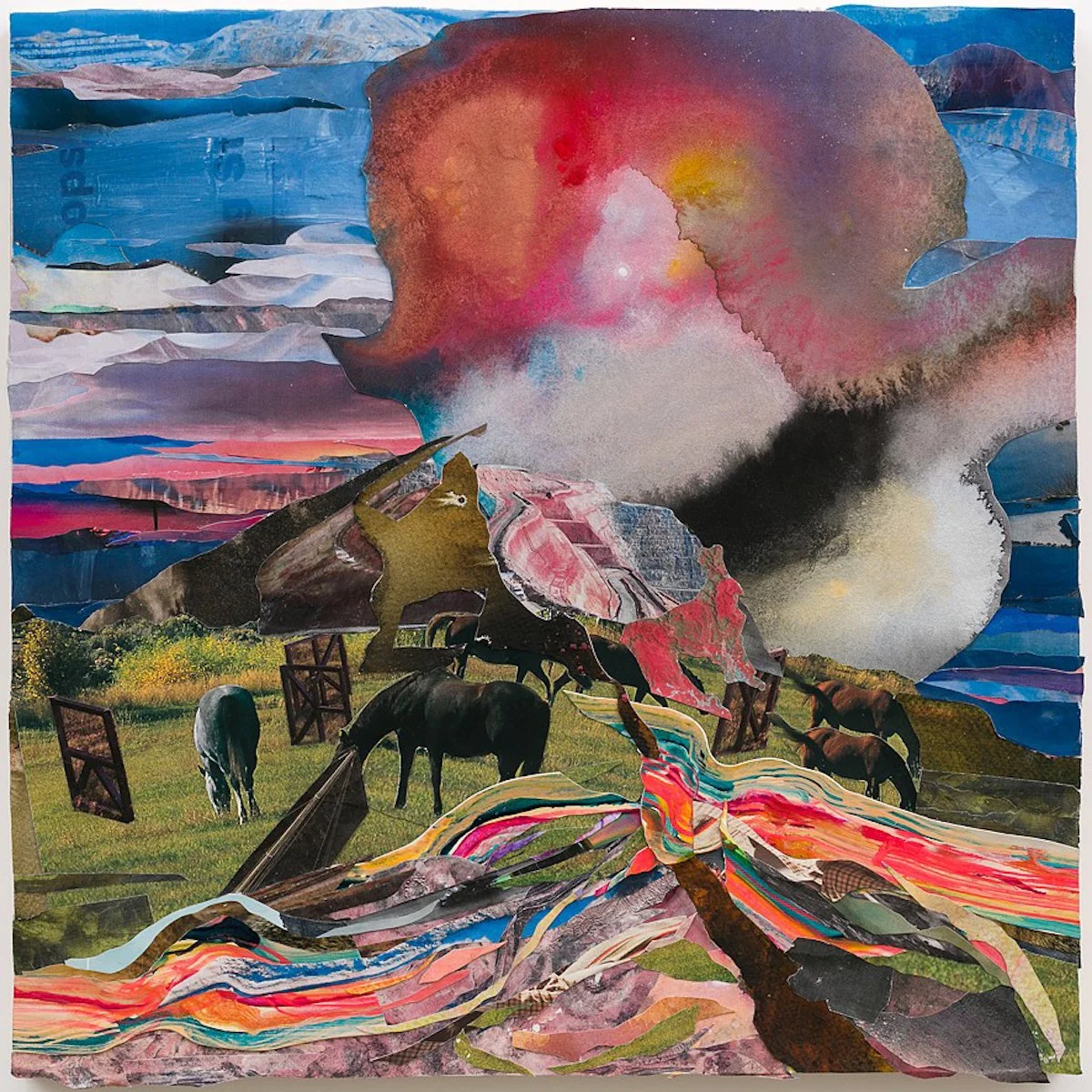
Detail of Libby Barbee, The Storm in the Skies, 2024, collage on paper, 15 x 15 inches. Image courtesy of the artist.
When we think of the contemporary political and social dimensions of our relationship to the environment, we cannot escape the bleak reality of human-caused pollution and climate change. Our fingerprint on the environment is having drastic local and global impacts, with rising temperatures worldwide being just one of many consequences that are threatening wildlife and human life. Many areas in the Denver area are on drought watch or restrictions, indicating limited water resources caused by shortages of precipitation over the past year.
As I looked at Barbee’s disrupted landscape and habitats, I was highly aware of the fact that these images are being shown in one of the world's most visited airports. Airports greatly affect their surrounding environs, creating increased air pollution, changes to the landscape over the course of construction, potential loss of habitats, contamination of water run-off, increased noise that affects wildlife, and other significant impacts. [3]
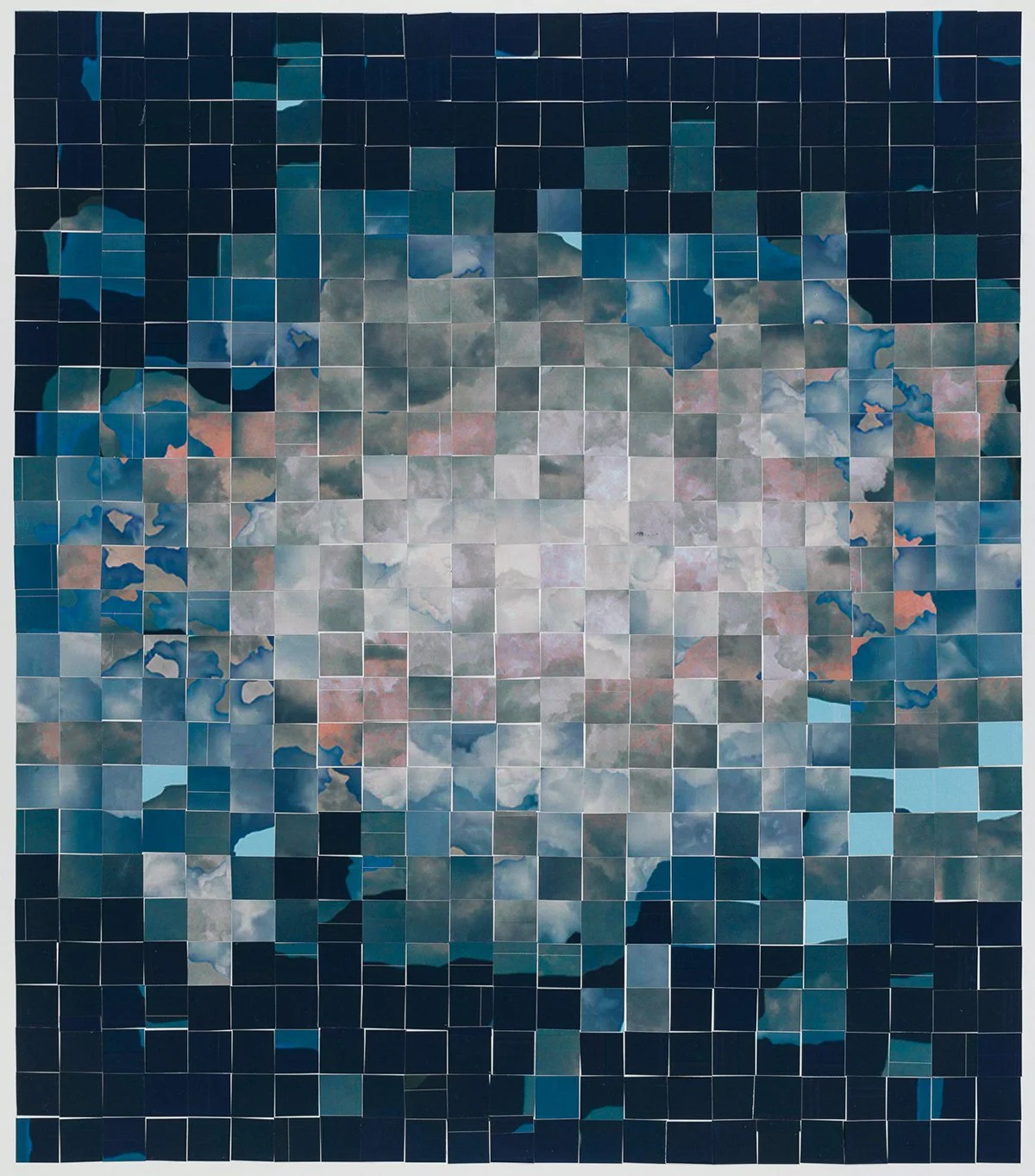
Libby Barbee, Blended Skies, 2024, collage on paper, 23 × 26 inches. Image courtesy of the artist.
The place in which we look at art can often shape our reading of what we see. I reflected on how so many people who pass through this airport, myself included, do not think of this building being situated in a place, as being in relationship to the land, and as disrupting and affecting said land all the while it is responsible for bringing so many people here and seeing them off to elsewhere.
To experience Barbee’s show, you really have to be invested in being “here,” both in regards to your reflective state and also in terms of having to go out of your way, particularly in a place where you would otherwise expect to put your head down as you pass through the lines you must navigate to get to your plane. You have to give yourself time to go down the path less travelled, so to speak—a hallway that runs parallel to but separate from that of all the other passengers—and be ready to enter an office that you likely would otherwise never visit. This unfortunately means this show is harder to access for the general public. If you do find yourself at DIA with time to spare, the effort and required state of presence needed to see this exhibition might just be a good exercise in a place of constant passage.
Maggie Sava (she/her) is an art historian and writer based in Denver. She holds a BA in art history and English, creative writing from the University of Denver and an MA in contemporary art theory from Goldsmiths, University of London.
[1] Libby Barbee, artist statement, solo exhibition at the Denver International Airport, March 19–June 30, 2026, Denver, Colorado.
[2] “Bio,” Libby Barbee, accessed April 27, 2026: https://libbybarbee.com/news.html.
[3] “Aviation’s Impact on Biodiversity,” Aviation Environment Federation, accessed April 27, 2026: https://www.aef.org.uk/what-we-do/biodiversity/.