
Wearing, Wearing
Wearing, Wearing
Union Hall
1750 Wewatta Street, Suite 144, Denver, CO, 80202
June 25–August 8, 2026
Curated by Felicity Wong
Curatorial Tour and Artist Talk: July 16, 6:00–7:30 PM
Admission: free
Review by Nina Peterson
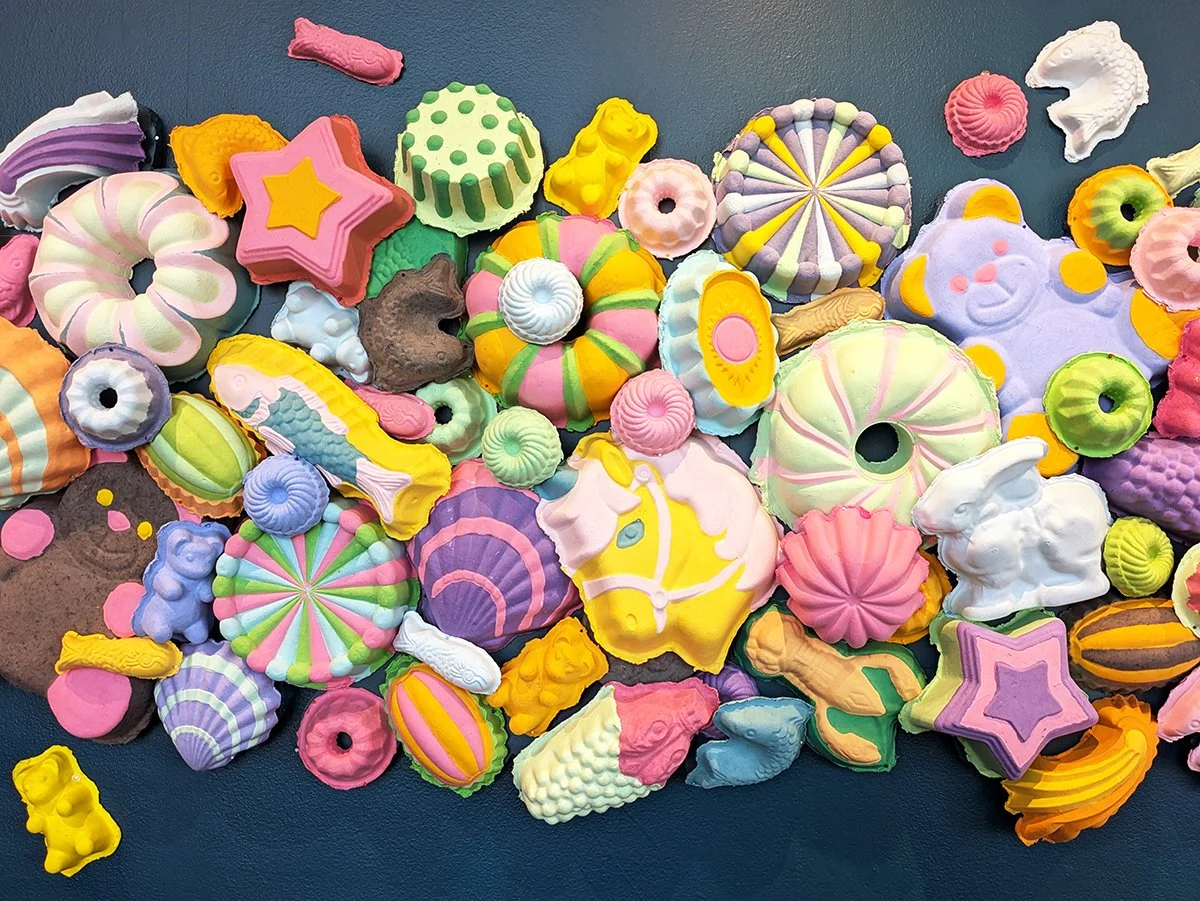
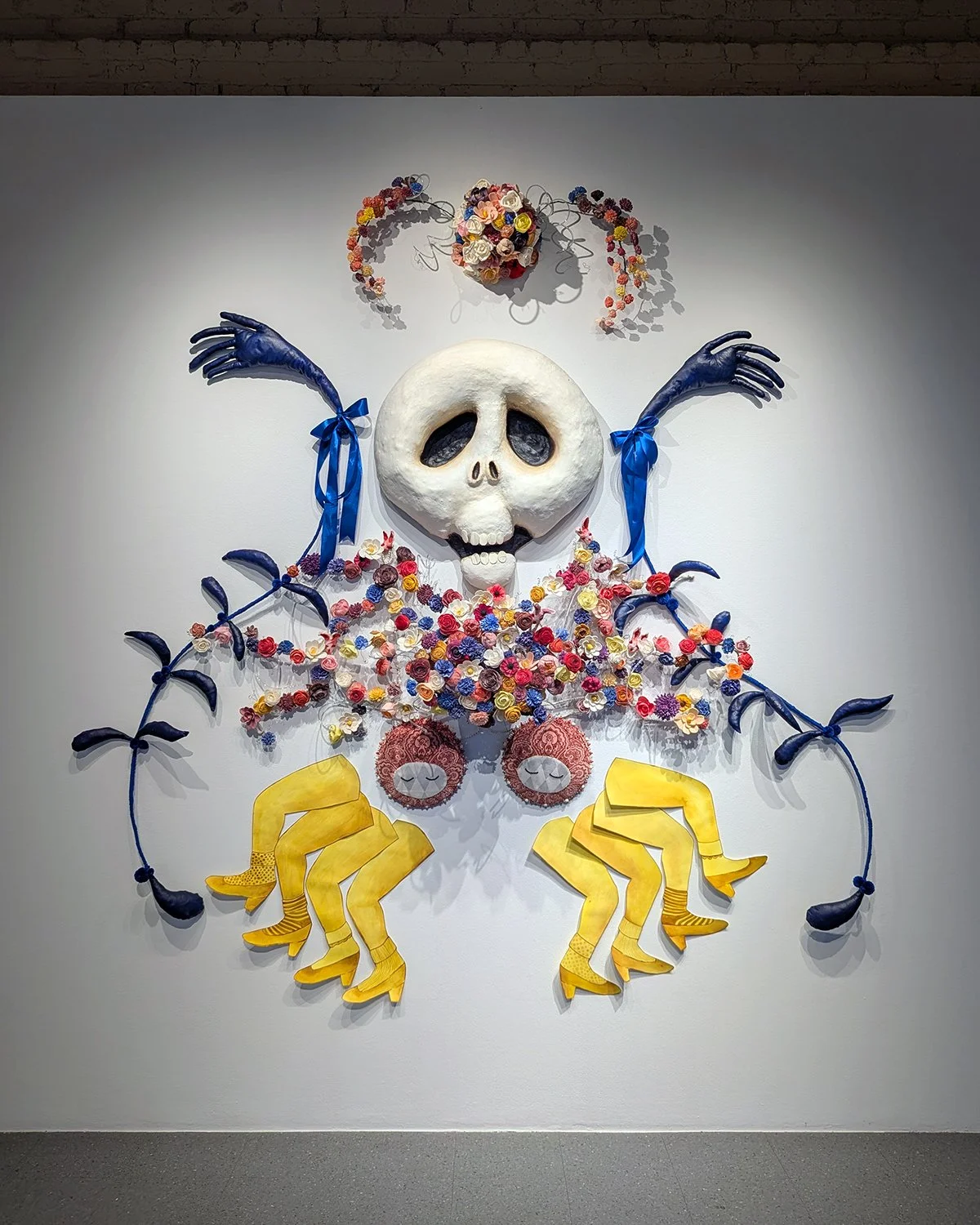
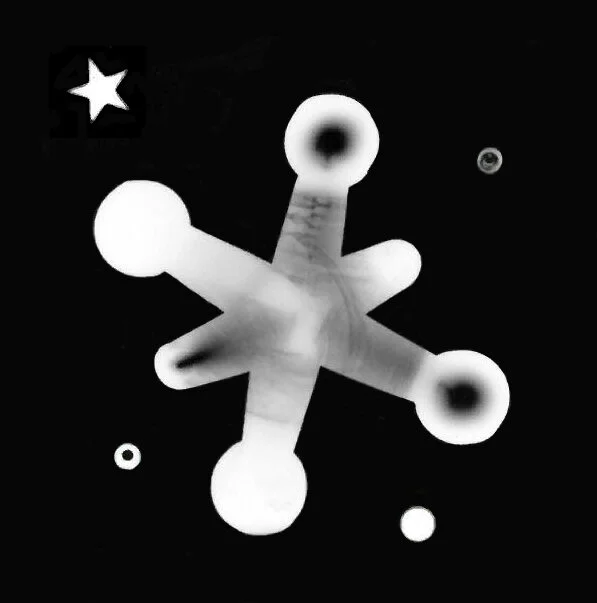
Wearing, Wearing examines how labor—including that of garment workers, white collar workers, consumers in the attention economy, and artists—creates value in the fashion industry. Curated by Felicity Wong as part of Union Hall’s 2026 Rough Gems curatorial program, the exhibition prompts visitors to engage with the racial politics of the garment industry and its colonial histories.
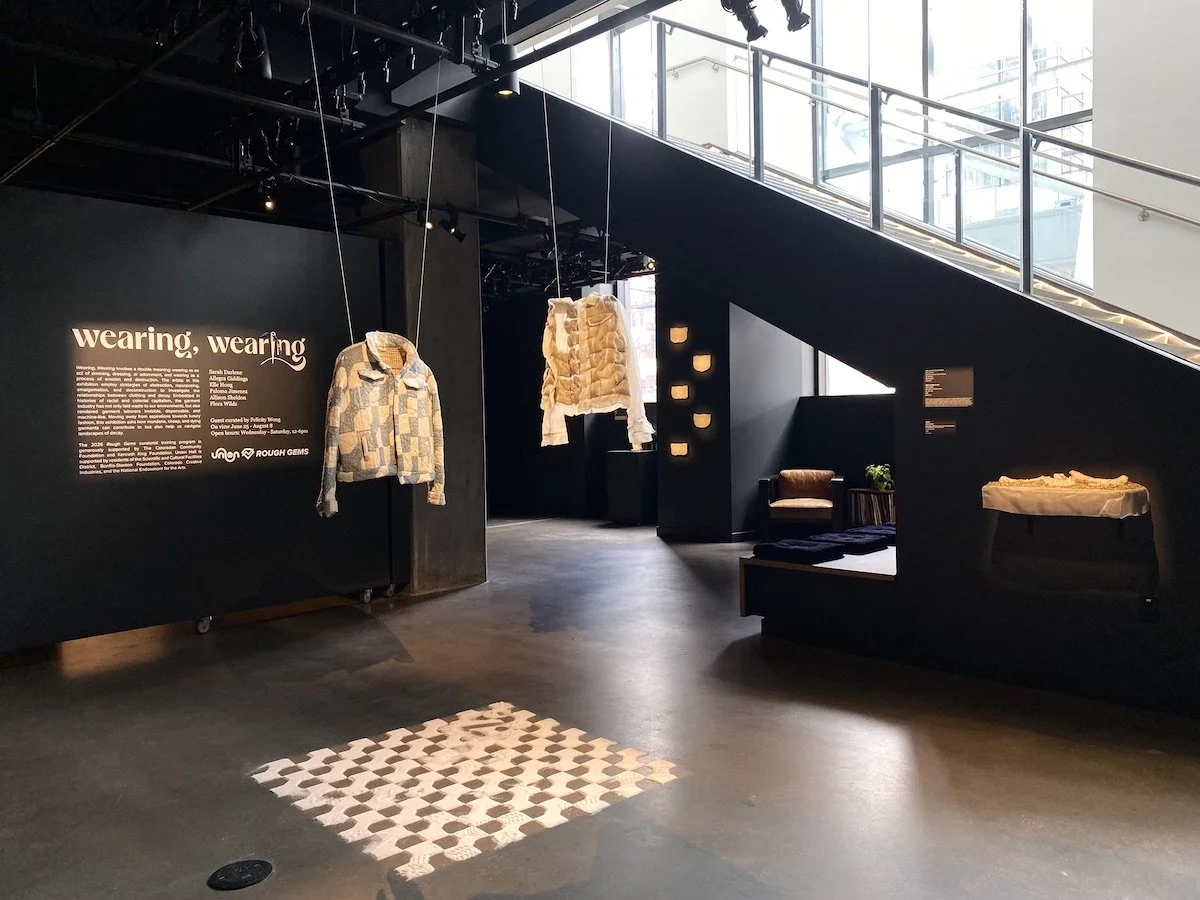
An installation view of the exhibition Wearing, Wearing at Union Hall in Denver. Image by Paloma Jimenez.
The show features collections, installations, mixed media artworks, sculptures, upcycled fashion collections, and videos by Sarah Darlene, Allegra Giddings, Elle Hong, Paloma Jimenez, Allison Sheldon, and Flora Wilds.

A detail view of Elle Hong’s Terms of Use, 2019, two single-channel videos and readymade mannequins. Image by Roxanna, courtesy of Union Hall.
Elle Hong’s Terms of Use makes apparent the way in which the fashion industry both presumes and produces the “ideal” consumer as normatively embodied: white, cis, and thin. The work is a two-channel video projected onto two mannequins installed on top of astroturf in the gallery. The projections include screen-captured recordings of YouTube videos as well as Hong performing as “AI doppelganger personalities,” as the wall text explains.
The mannequins are headless and white. This longstanding commercial convention, as design theorist Barbara Brownie explains, “tries not to impose an idea of who its target consumer may be” and references dressmaker's forms, thereby drawing attention to the work involved in making garments. [1]
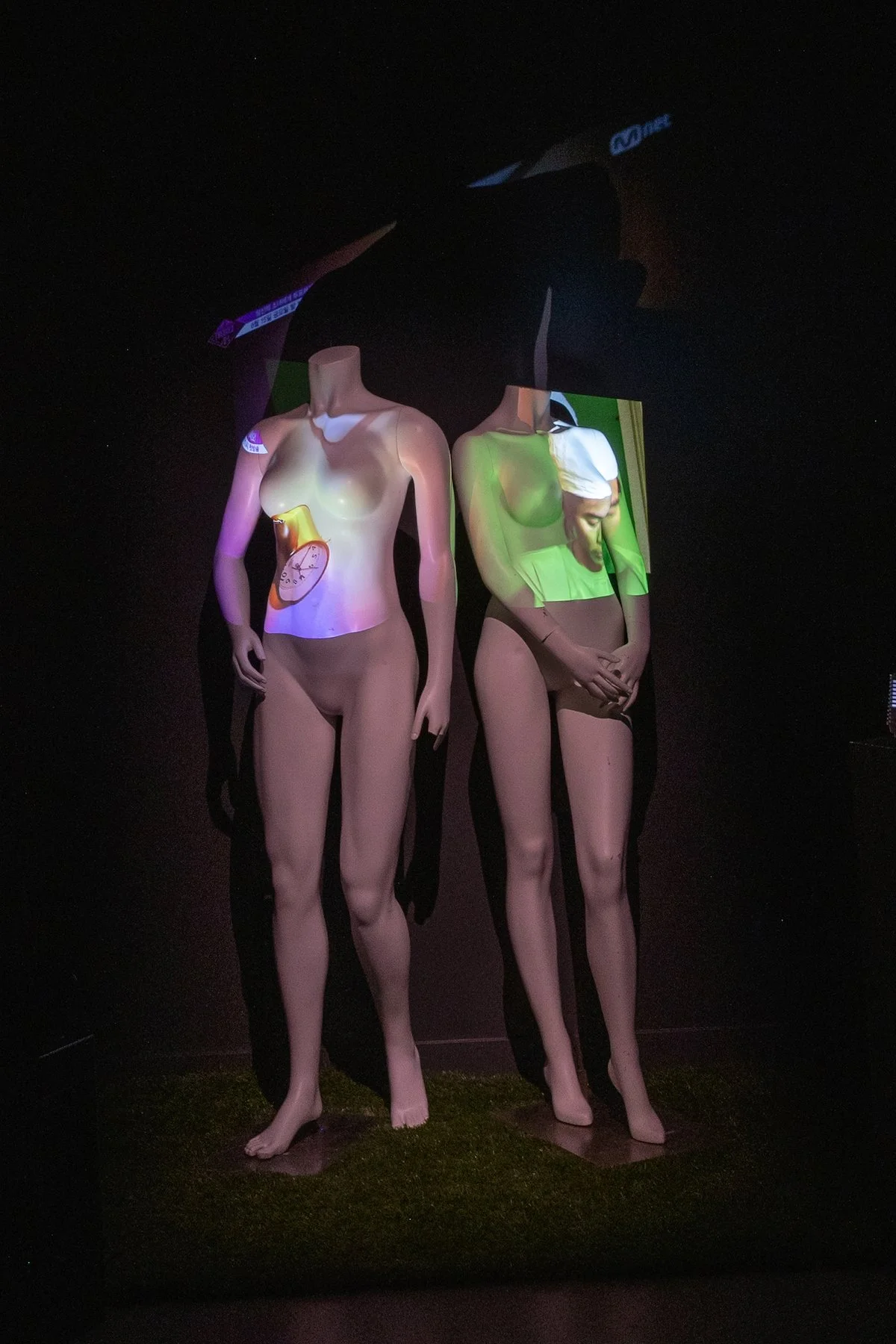
A view of Elle Hong’s Terms of Use, 2019, two single-channel videos and readymade mannequins. Image by Raymundo Muñoz, courtesy of Union Hall.
But the headlessness and the plastic pallor of the dummies does something different in Hong’s installation. Rather than inviting consumers to mentally project visions of themselves into the attire on display at the mall (during the era of its death knell, I’ll add, since Brownie wrote in 2013, and the 2010s marked a downturn in the mall’s commercial dominance), Terms of Use instead shows how whiteness violently propels the fashion industry online.

A detail view of Elle Hong’s Terms of Use, 2019, two single-channel videos and readymade mannequins. Image by Roxanna, courtesy of Union Hall.
Tech corporations shape desire and consumer behavior in the context of e-commerce and social media. In the attention economy, digital media users are unpaid workers; their online engagement generates data off of which Big Tech profits. [2] A wall text explains Hong’s work in this context: “When a user clicks ‘agree’ in a website’s Terms of Use section, they release their data to surveillance technologies governed by dominant ideologies of race, gender, sexuality, and class.”
Hong refuses these terms of use, performing against the determinative impositions of “mean images”—media theorist Hito Steyerl’s term for the way that machine-learning image generation tools inscribe race in terms of eugenicist statistics, racist stereotypes, and exploitation. [3] Instead, Hong makes queer use of digital technologies. [4]
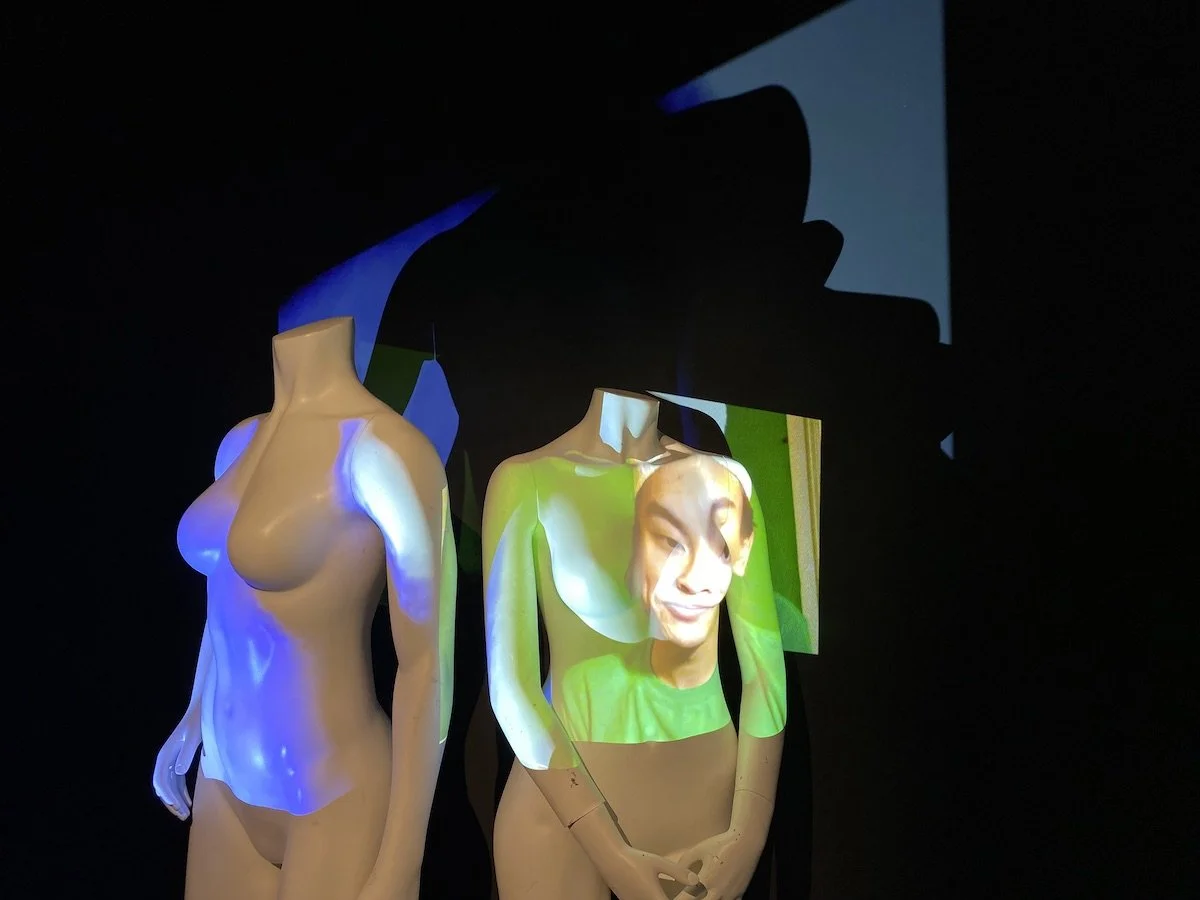
A detail view of Elle Hong’s Terms of Use, 2019, two single-channel videos and readymade mannequins. Image by Paloma Jimenez.
One sequence, projected on the mannequin on the right, shows a process during which Hong paints her face green. Hong then uses chroma keying to make it seem like her corporeality disappears: it is just her eyes and eyebrows, nostrils, and mouth that appear to float within a field of white and then within images of other women.
The video cycles through various boring, corporate, and advertising pictures of thin, white women in generic poses. One stands with her arms crossed, a stiff smile plastered across her face. The next looks up towards the camera from a seated position. A woman wearing braces slides into the picture from the left until her facial features map onto Hong’s, the orthodontic devices and teeth running up against Hong’s lips.
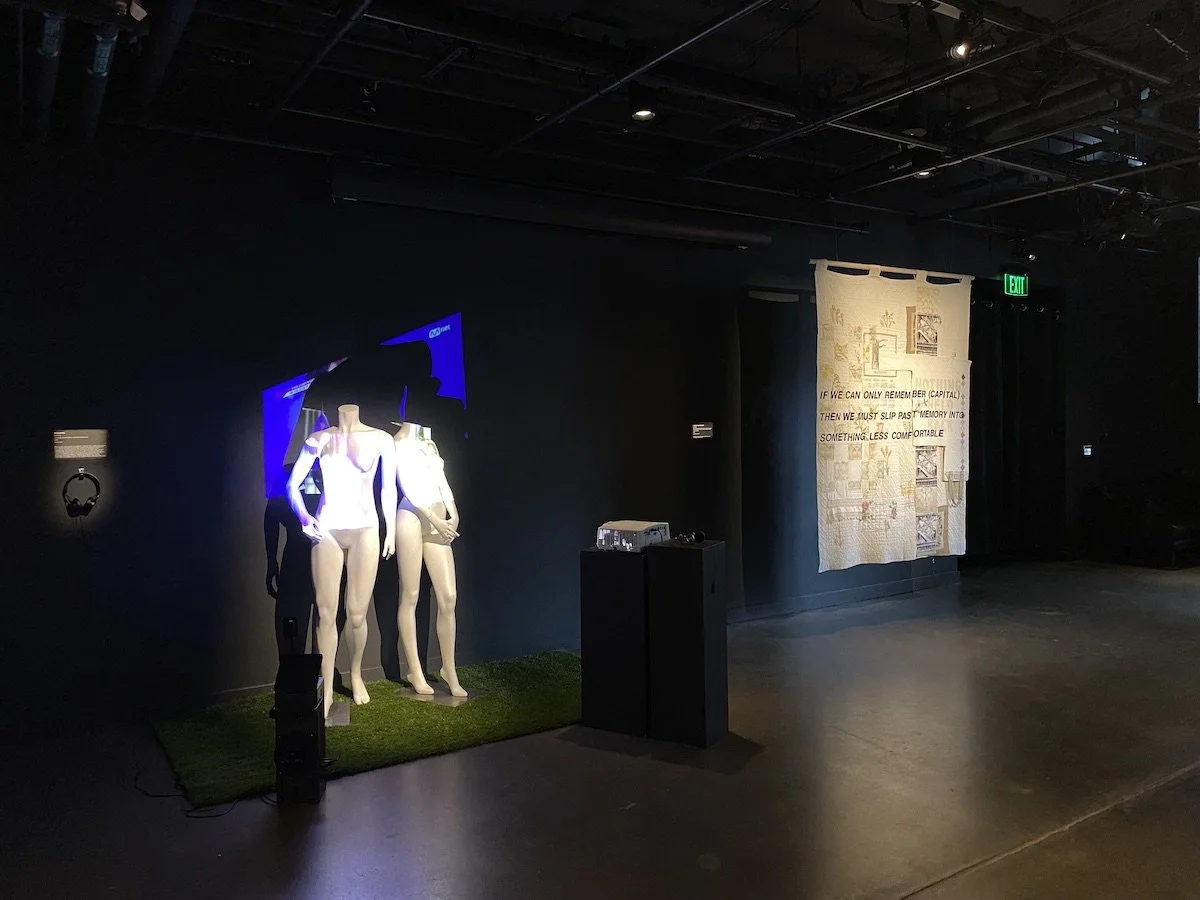
An installation view of the exhibition Wearing, Wearing at Union Hall. Image by Paloma Jimenez.
The mask-like effect is strange and funny, and its absurdity is amplified by the distortion of the video projected onto the mannequin form in the gallery. The curator Felicity Wong describes the work’s queer potential in relation to data extraction and image generation as follows: “by dressing the mannequins in videos of her parodying those systems, Elle explores how clothing can present new opportunities to resist the ‘proper’ use of emergent technologies.” [5]
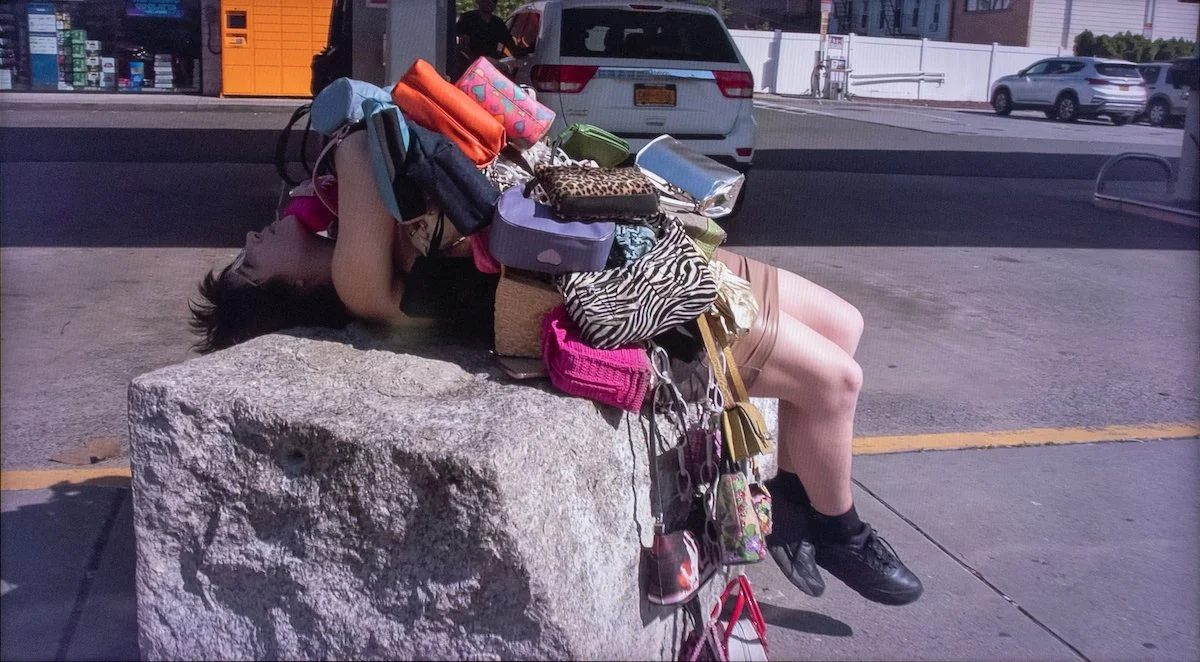
A still from Flora Wilds’s tiny purse trek, 2019, single-channel video. Image by Raymundo Muñoz, courtesy of Union Hall.
Flora Wilds’ tiny purse trek also engages with the digital culture of the fashion industry by joining tiny purses into something much larger and more unwieldy than the individual, dainty accessories. For the video, Wilds created and donned a zip-tied cluster of the eponymous miniature handbags, carrying the clunky garment across Brooklyn from Sunset Park to Greenpoint over the course of a day.
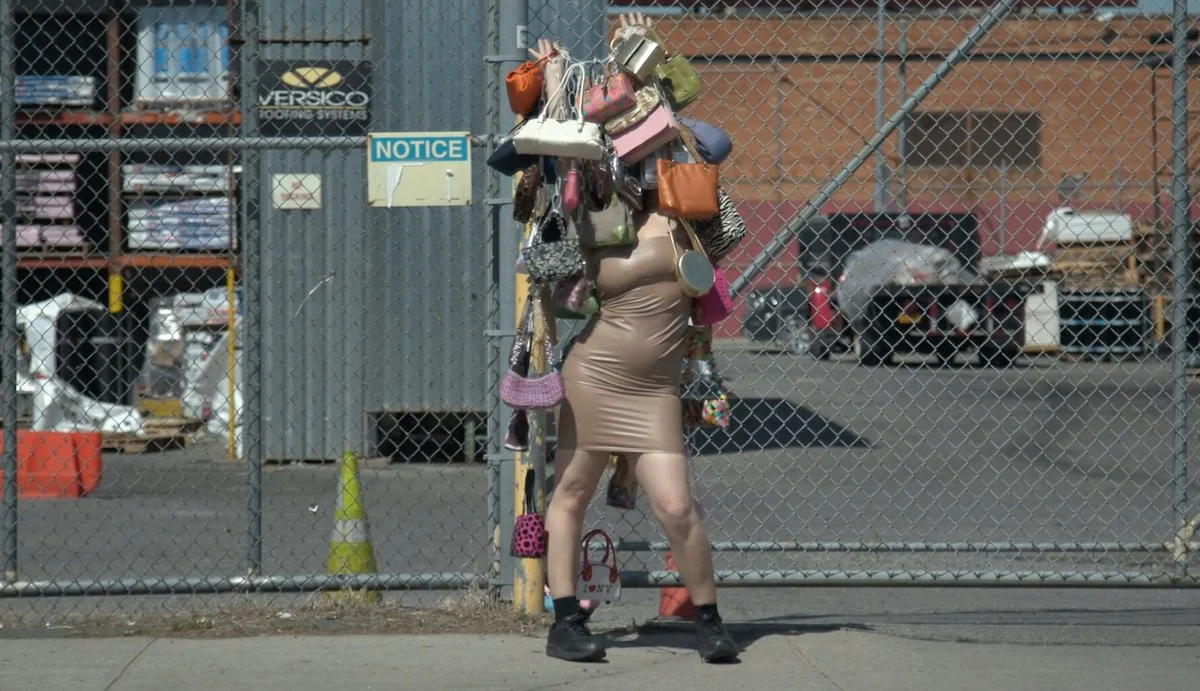
A still from Flora Wilds’s tiny purse trek, 2019, single-channel video. Image by Morgan LaForge, courtesy of Union Hall.
Long shots show the artist moving down the street, garbed head-to-toe in tiny purses. At one point in the video, she removes the vestment, dancing as she lifts it over her head. It is a scene at once sultry and humorous as she sways her hips amidst the dangling purses. Her head tilted back as if in exuberant joy, she then swings the purses around her body, the garment sprawling outwards in cumbersome tentacles. She pauses to take selfies.
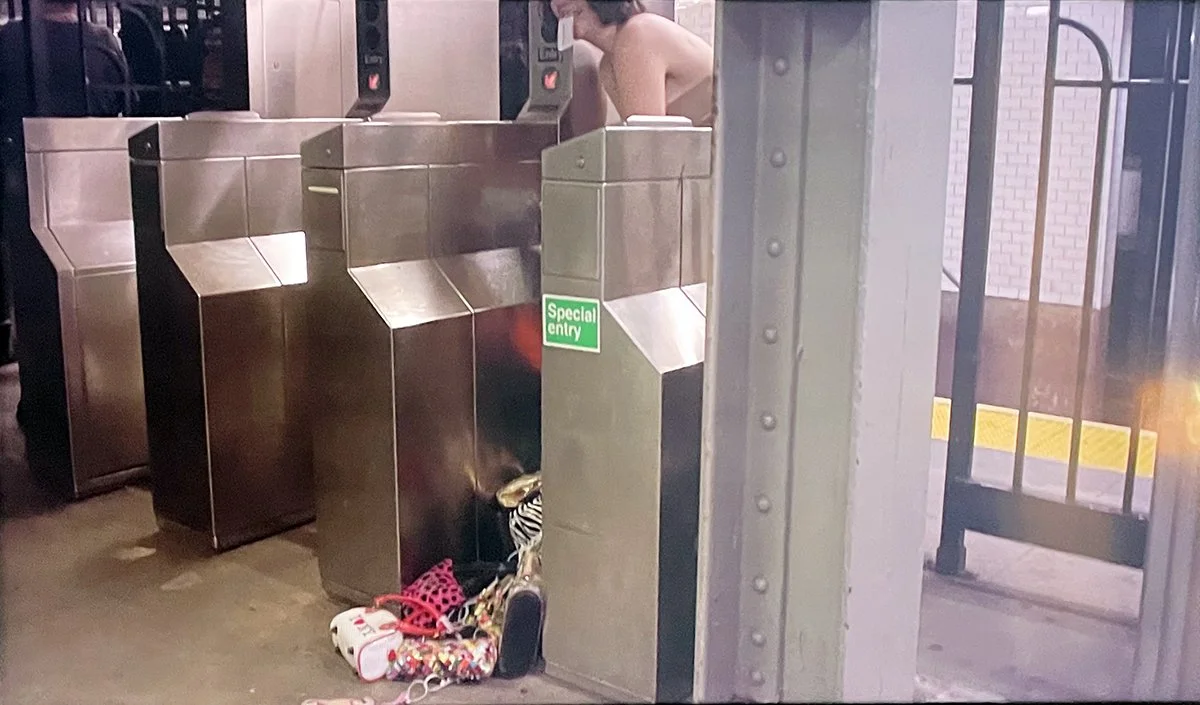
A still from Flora Wilds’s tiny purse trek, 2019, single-channel video. Image by Nina Peterson.
One shot in the video shows her posing, an orange mini bag embroidered in gold thread with the phrase “Life of the Party” just behind her head. In the following sequences, she strides down the sidewalk and under the walkway canopy of a funeral home. She takes the G train, the trailing bags getting tangled in the subway turnstiles.
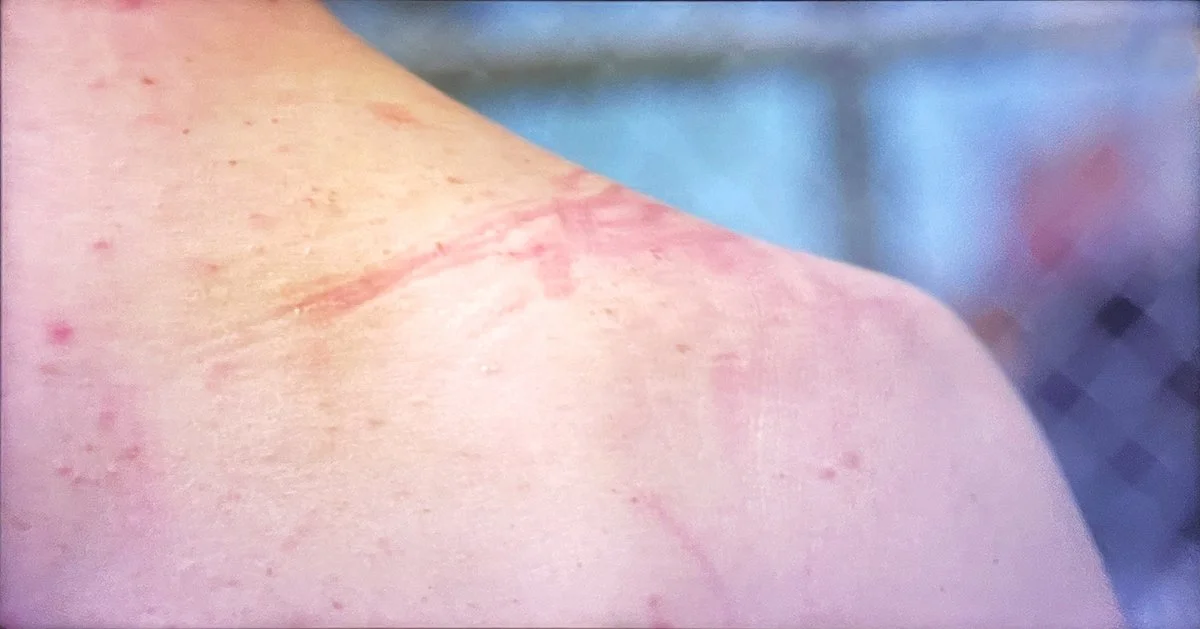
A still from Flora Wilds’s tiny purse trek, 2019, single-channel video. Image by Nina Peterson.
This is an endurance performance, with its strenuous cost indexed on the artist’s body. Shots of the red marks left by zip ties digging into her shoulders are intercut with sequences of the artist’s trek. As Wong notes, “the purses almost become an extension of Flora as they wear against her body on this trek.” [6]
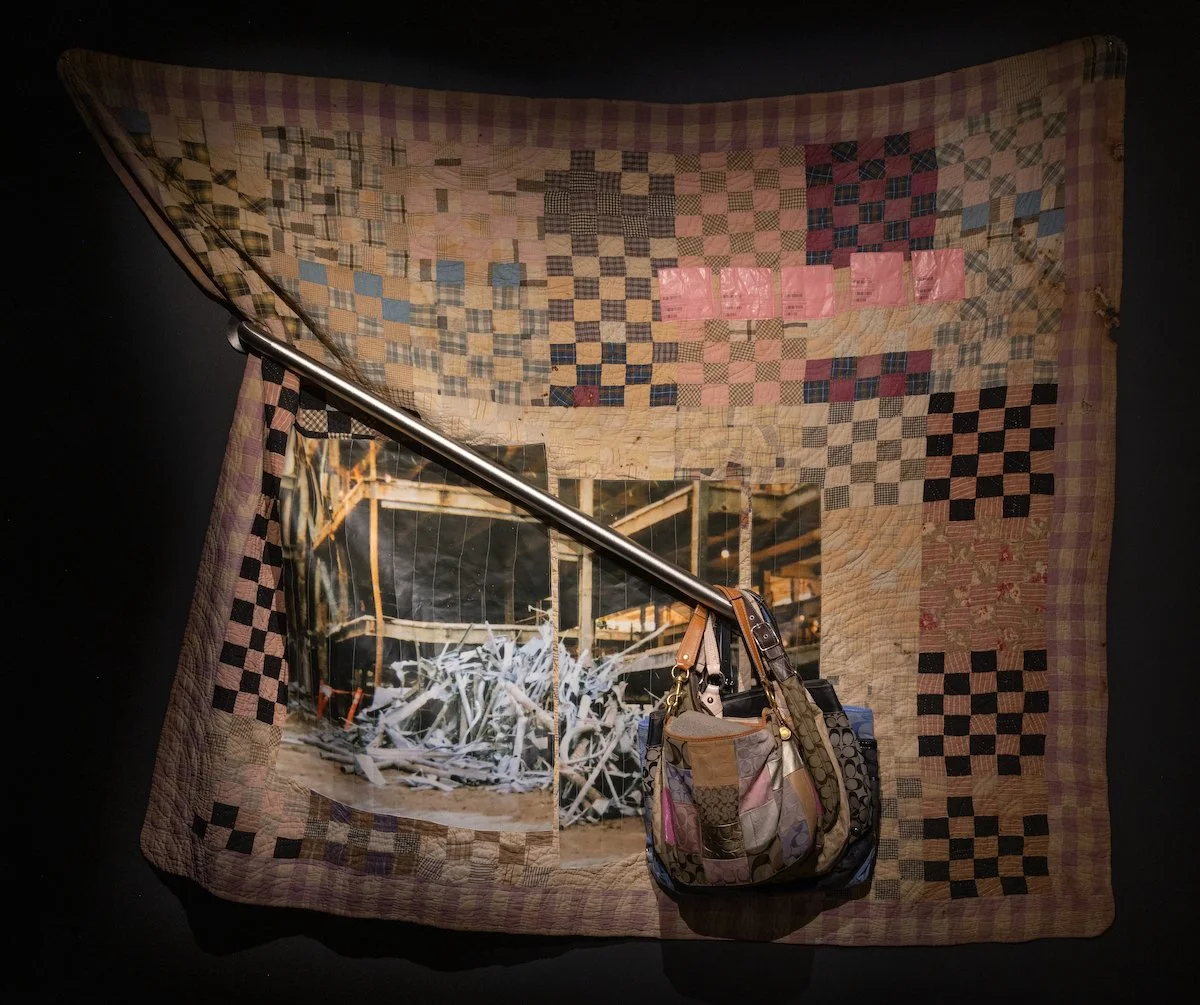
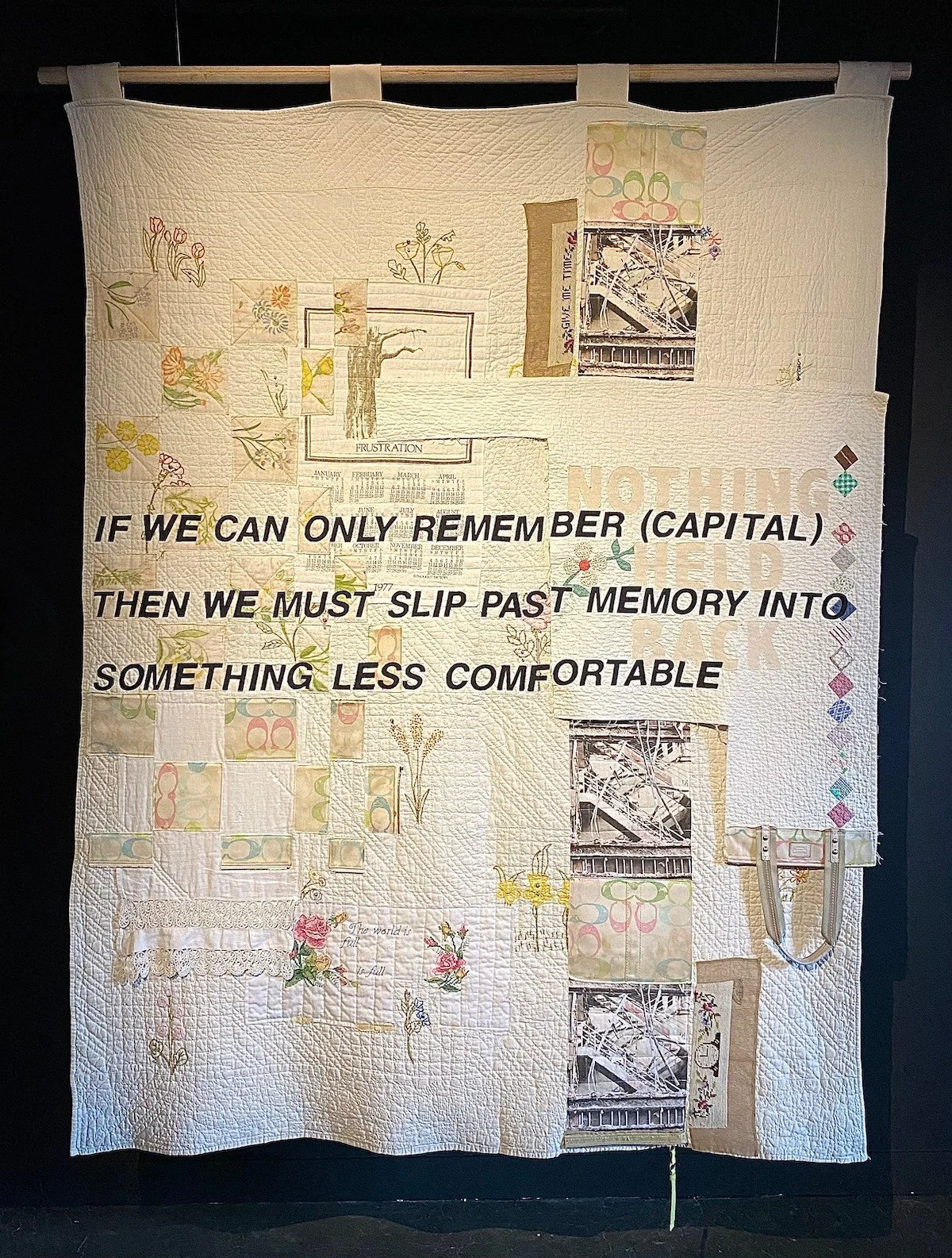
Flora Wilds, desire looping, 2022, quilt, textile-printed film photographs, canvas, Coach purses, concrete, barcode stickers, and metal accessibility grab bar. Image by Raymundo Muñoz, courtesy of Union Hall.
Wilds uses artistic effort to (re)visualize labor. Her work joins that of the labor of garment workers, often in offshored manufacturing facilities in Asia and Africa, as central to the production of the value of these fashion novelties. [7] The concrete effects of labor and its exploitation differ in these contexts, but tiny purse trek suggests how it is impossible to disentangle consumption and desire in the U.S. from the systems of exploitation that fuel commodity fetishism.
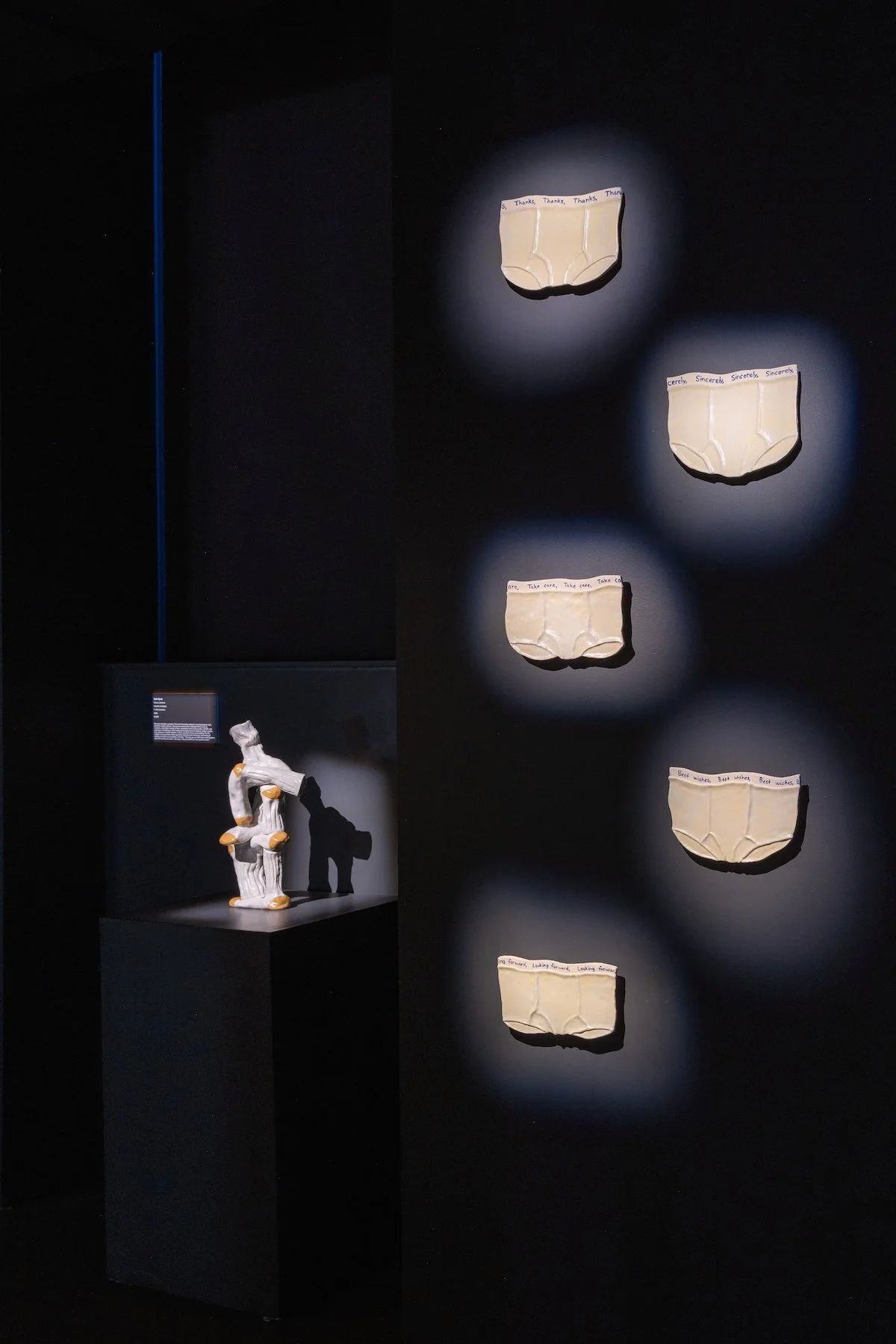
An installation view of works by Paloma Jimenez. Left: Spin Cycle, 2022, ceramic and glaze. Right: Five Business Days, 2026, ceramic and glaze. Image by Raymundo Muñoz, courtesy of Union Hall.
Paloma Jimenez’s series Five Business Days makes a joke out of the rhetorical decorum of white-collar work by linking it to the utility, banality, and culturally designated lowliness (a designation that also depends on its binaristic counterpart: eroticism) of underwear. The series comprises five pairs of ceramic and glazed briefs, each with a different, conventional e-farewell emblazoned on its clay elastic waistband. The glaze is iridescent, and the undies alluringly shimmer in the gallery lighting in a way that contradicts the ordinariness of underwear.
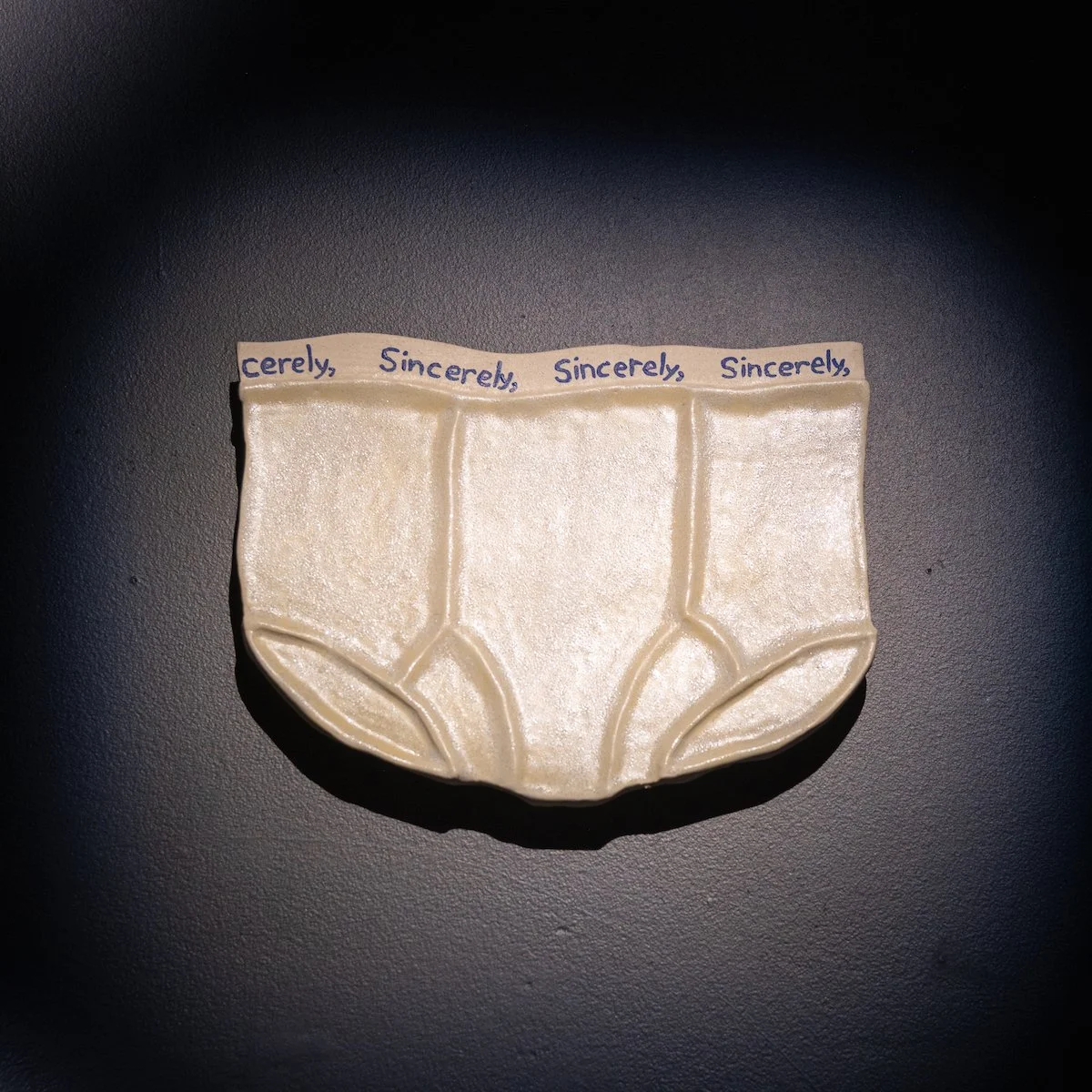
Paloma Jimenez, Five Business Days (Sincerely), 2026, ceramic and glaze. Image by Raymundo Muñoz, courtesy of Union Hall.
The wall text uses the word “intimates” to describe the garments that envelop feet and cover genitals, absorbing sweat and bodily fluids. It states: “Jimenez documents how undergarments serve as mundane, alternative records of time: unmatched socks heap up like a landfill, and underwear [reminds] us of the awkward formality of email signouts…” The phrases commonly used in email signoffs imply intimacy but convey a range of social familiarity and distance.
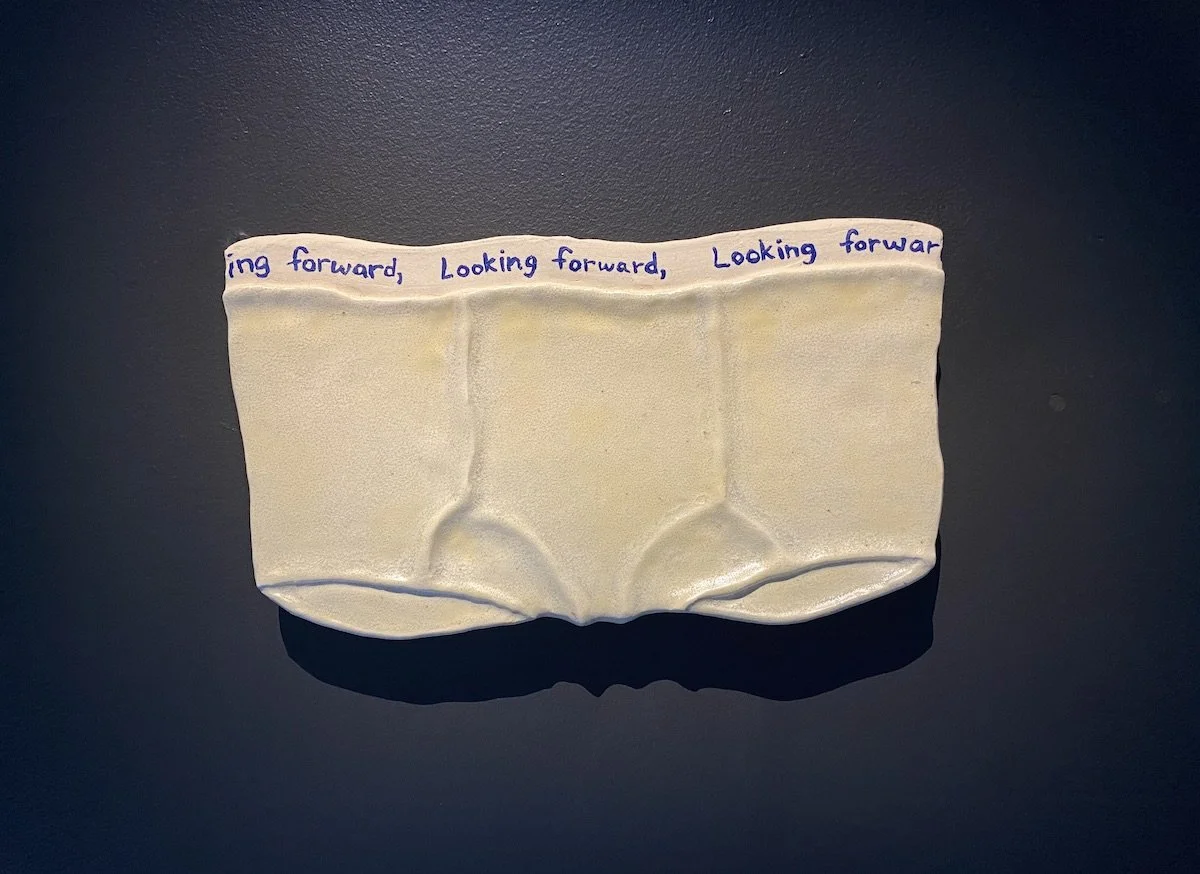
Paloma Jimenez, Five Business Days (Looking Forward), 2026, ceramic and glaze. Image courtesy of the artist.
The various valedictions might be typed with sincerity (as “Sincerely” would purport), but in Jimenez’s playful undies, they also ring as antiphrastic. “Looking forward,” in particular, could be an ironic closing phrase that might cloak the signer’s trepidation towards a task in politeness. Is this worker really looking forward to yet another meeting?
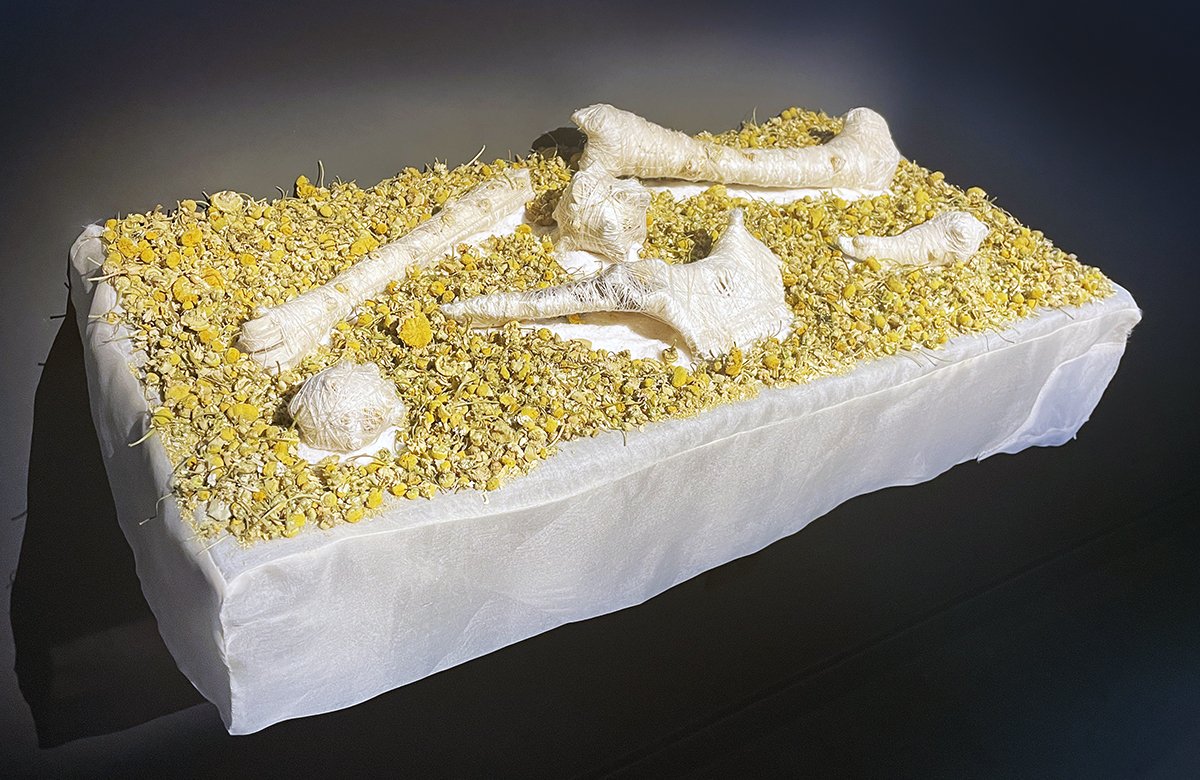
Allison Sheldon, cocoon, 2019, deer bones, silk thread, silk yarn, hair, dried chamomile, marigold flowers, silk organza, and salt. Image by Nina Peterson.
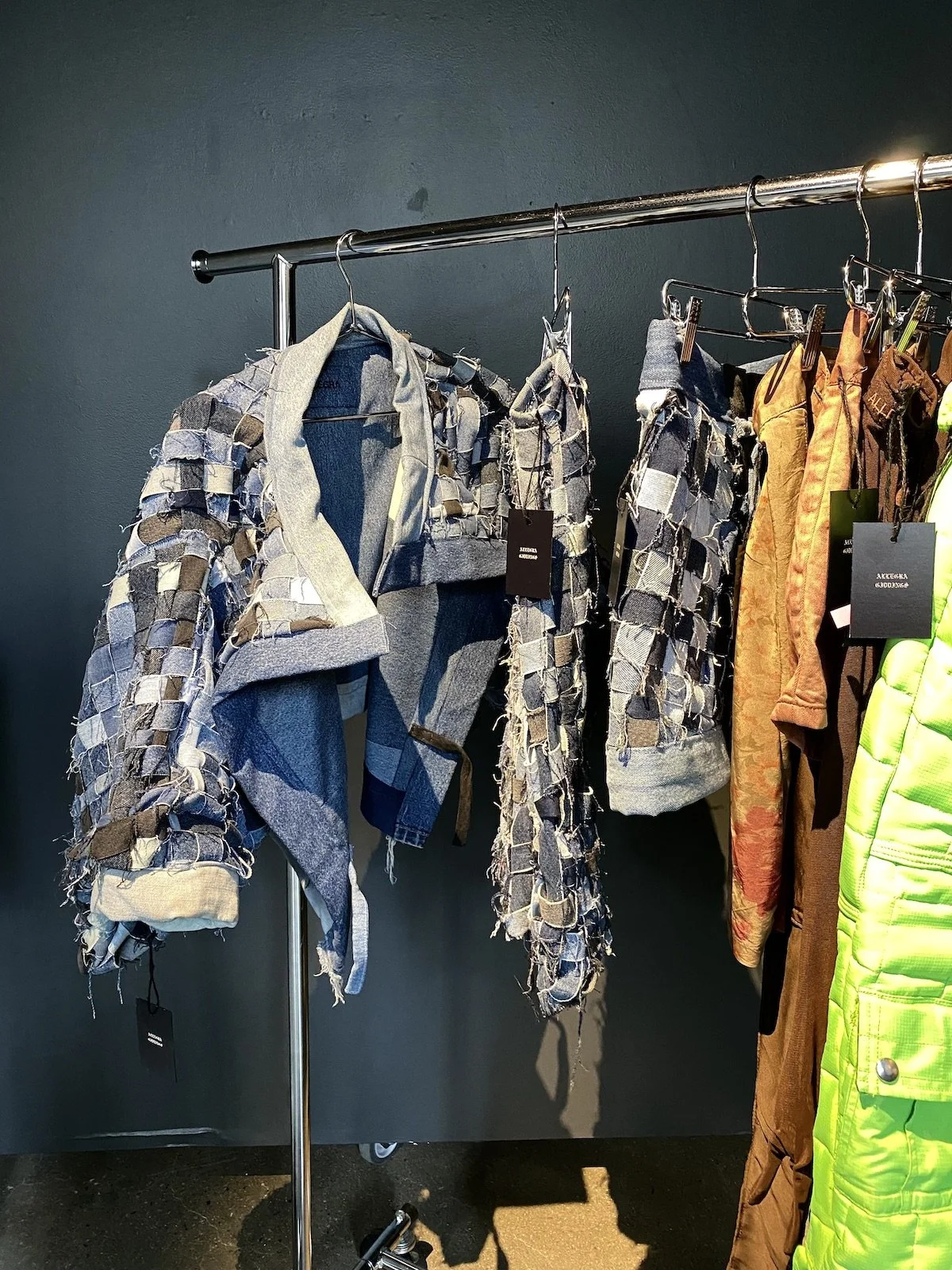
A view of Allegra Giddings’s Umi clothing collections, 2023. Image by Paloma Jimenez.
Throughout the exhibition, there are prominent signs of artistic labor—the hand-stitching in Sarah Darlene’s Petition for Change of Name and Flora Wilds’ IF WE CAN ONLY REMEMBER and desire looping, as well as Allison Sheldon’s meticulous wrapping of deer bones with silk thread in cocoon and Allegra Giddings’ complex weaving in Umi. These signs join those that index the devalued work, such as machine sewing, performed by precaritized and expropriated labor.
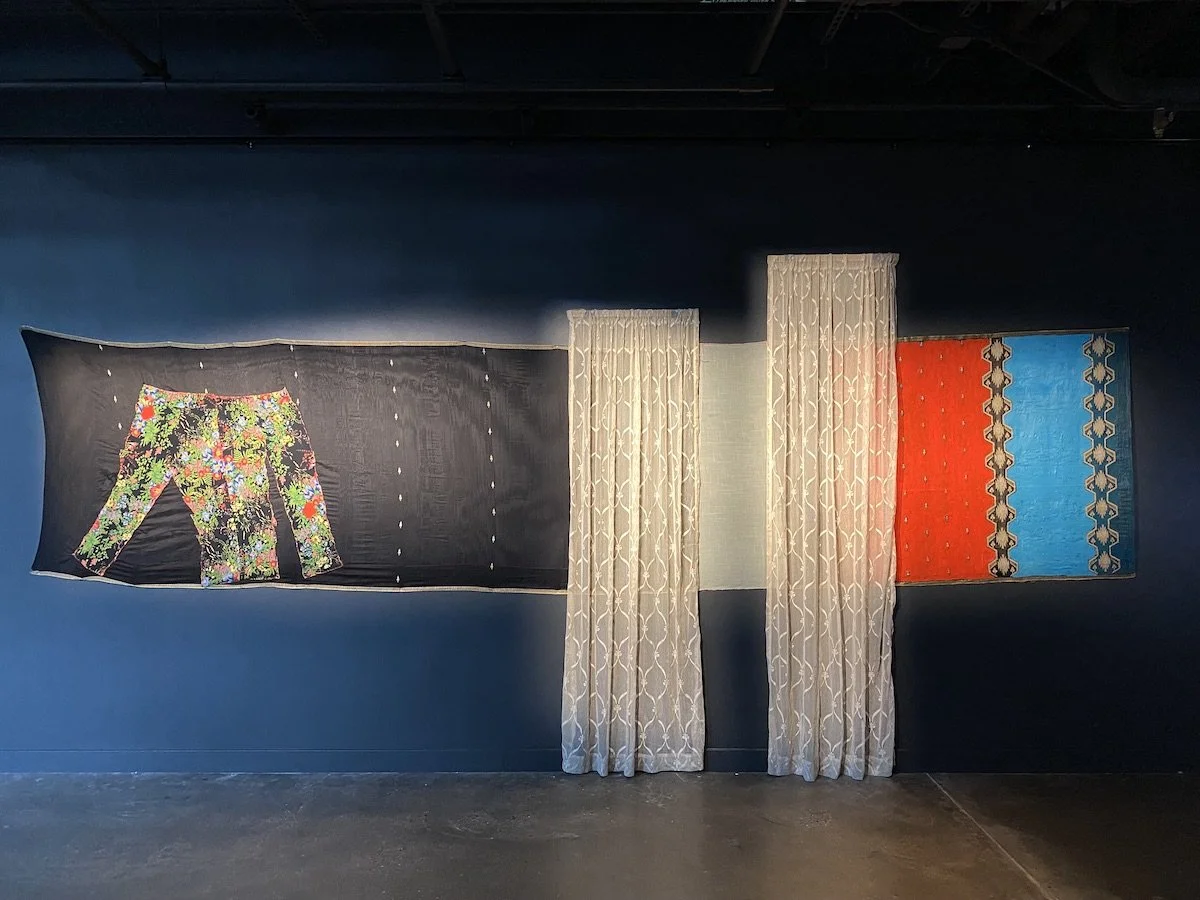
Sarah Darlene, Petition for Change of Name, 2024, acrylic, canvas, thread, artist’s floral pants, tapestry from New Orleans, and lace fleur-de-lis curtains. Image by Paloma Jimenez.
Against the hierarchical system of valuation that places artists and fashion designers higher than garment workers in the fashion industry, Wearing, Wearing insists that value derives from the work of laborers across racial capitalism’s stratifications. The exhibition implicates viewers in the systems designed to make consumers feel removed from systems of exploitation based on race, gender, and nationality.
Nina Peterson (she/her) is a PhD candidate in art history at the University of Minnesota. Currently based in Denver, she researches histories of photography, film, and performance in the twentieth and twenty-first centuries.
[1] Barbara Brownie, “Mangled mannequins – what happened to shop-window dummies?” The Guardian, August 16, 2013: https://www.theguardian.com/fashion/fashion-blog/2013/aug/16/mannequins-shop-window-dummies.
[2] For a discussion of the attention economy, see Jonathan Beller’s work, including The Cinematic Mode of Production: Attention Economy and the Society of the Spectacle (University of Chicago Press, 2006).
[3] Hito Steyerl, “Mean Images,” New Left Review, 140/141 (March–June 2023) DOI: doi.org/10.64590/uhm.
[4] Here, I employ “queer use” in the sense that Sara Ahmed means it: using something in a way that defies its designed purpose or using something against the conscriptions of racist, hetero- and cis-normative hegemony. See the final chapter of Sara Ahmed, What’s the Use?: On the Uses of Use (Duke University Press, 2019).
[5] From an email conversation with Felicity Wong and the author, July 3, 2026.
[6] Ibid.
[7] A list of resources and recommended readings about the fashion industry, gender, and racial and colonial capitalism compiled by the curator is available on Union Hall’s website: https://static1.squarespace.com/static/6233c76a158a7d25dd1fa1ca/t/6a45a28a14c6186cd9621421/1782948490990/Wearing%2C+Wearing+Fashion+Reader.pdf.