
The Genteel Revolutionary
Ellamaria Foley-Ray: The Genteel Revolutionary
Lydia and Robert Ruyle Gallery, University of Northern Colorado
1051 22nd Street, Greeley, CO 80639
February 2–March 4, 2026
Admission: free
Review by Brandy Coons
University art galleries tend to be located in or near the art department and separated from casual visitors. The Lydia and Robert Ruyle Gallery at the University of Northern Colorado (UNC), however, is housed in the UNC Campus Commons, next to an information desk, a performance hall, and other nearby student services. The gallery space is open-plan and peaceful, and the current exhibition featuring Dr. Ellamaria Foley-Ray’s work dedicated to the legacy of Dr. Rachel Bassette Noel feels perfectly situated in a living educational context. [1]
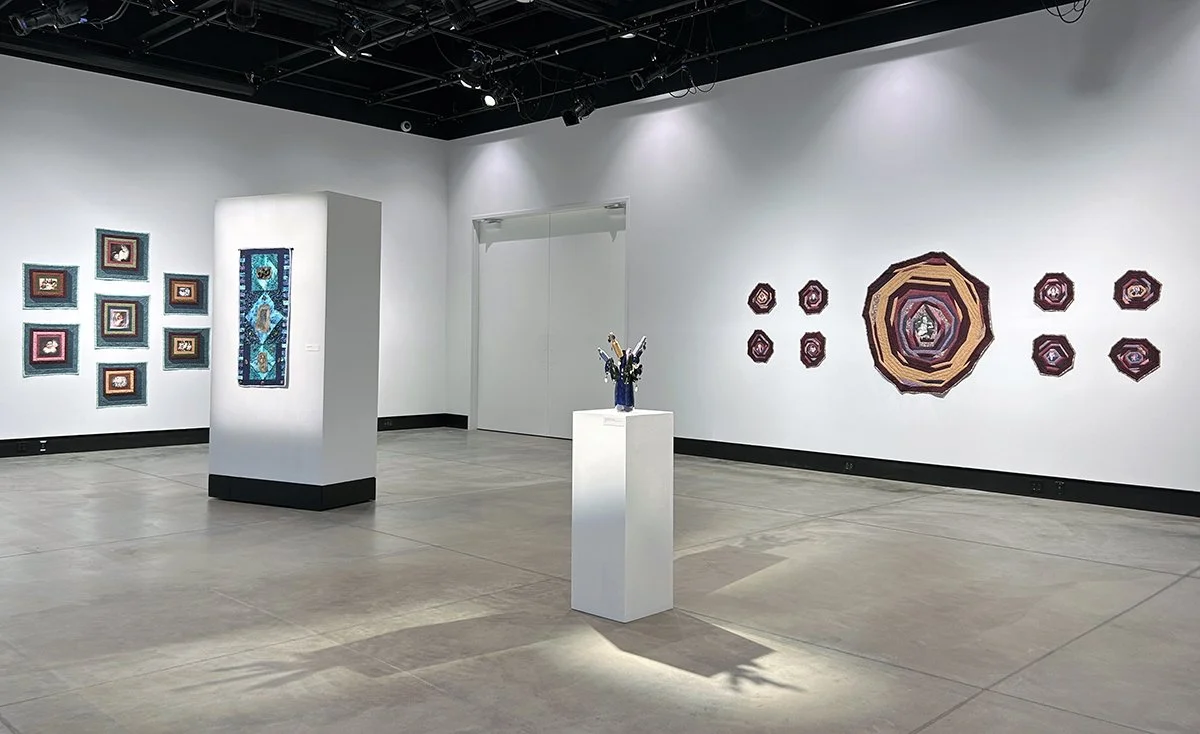
An installation view of Ellamaria Foley-Ray’s exhibition The Genteel Revolutionary in the Lydia and Robert Ruyle Gallery at University of Northern Colorado. Image by Brandy Coons.
As the first African American woman to hold public office in Colorado, Dr. Noel worked to desegregate Denver Public Schools, insisting with a “soft-spoken grace” that education is a right. [2] Dr. Ray’s “clay and cloth” quilts weave together her own connection to Dr. Noel, while emphasizing the importance of family, community, and faith.
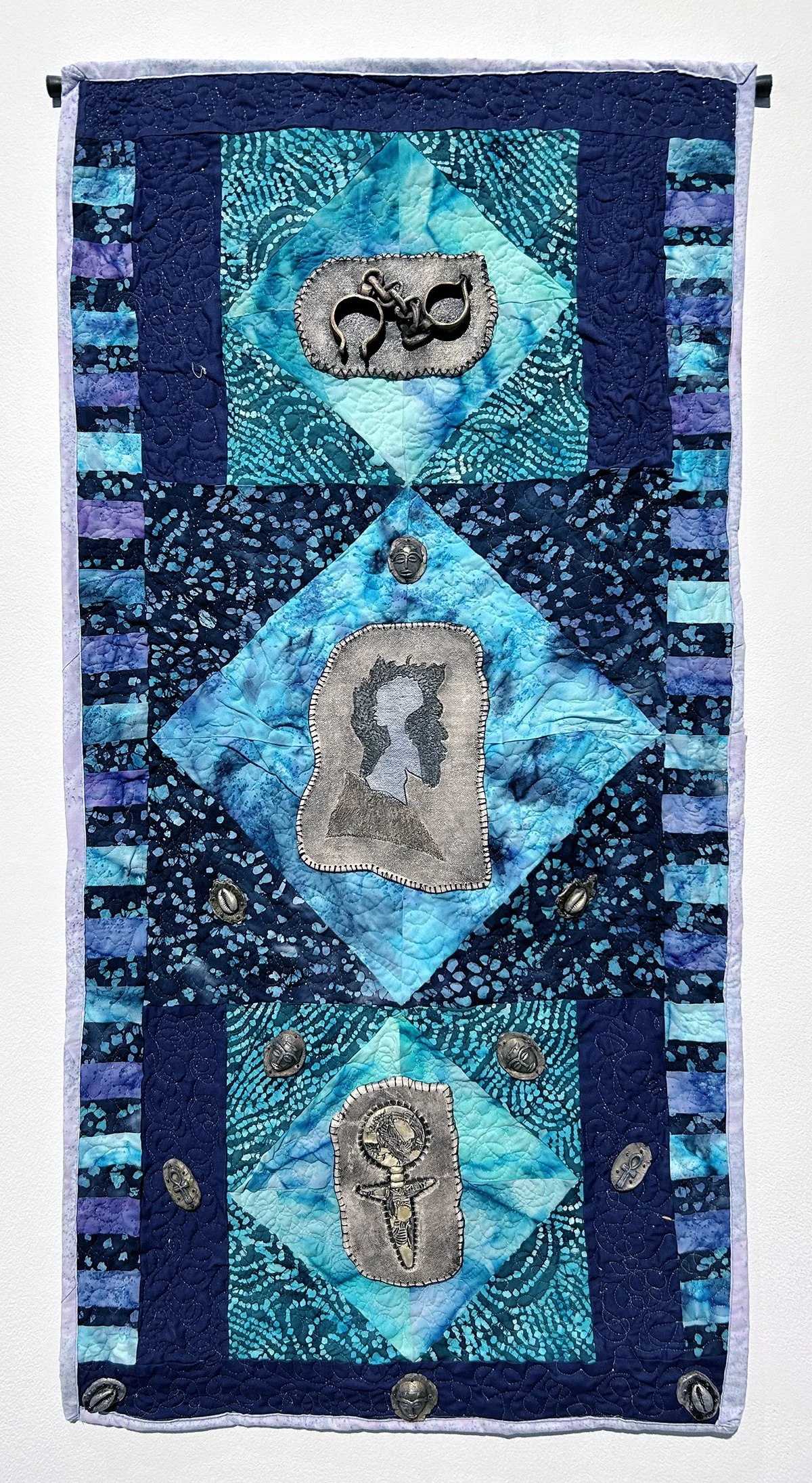
Ellamaria Foley-Ray, Dobo's Weighted Blanket, 2024, fabric, cotton, and ceramics, 43 x 23 x 1 inches. Image by Brandy Coons.
In Dr. Ray’s words, “she was a person who demanded that children have an opportunity to reach their highest potential, recognizing that your education was not just your own, but also everybody else. All the people who came before you.”
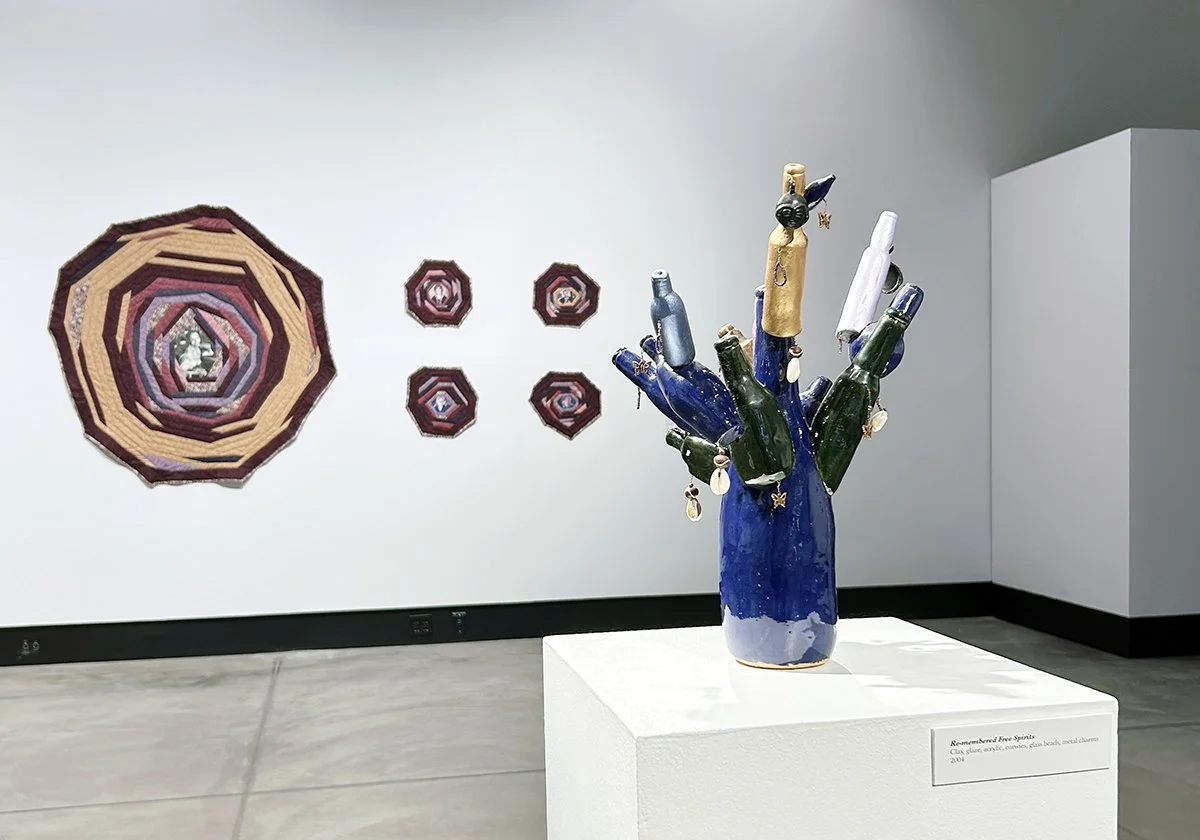
In the foreground: Ellamaria Foley-Ray, Re-membered Free Spirits, 2004, clay, glue, acrylic, cowrie shells, glass beads, and metal charms, 15 x 11.5 x 10.5 inches. Image by Brandy Coons.
Alongside the artworks, visitors can view the PBS episode of “Great Colorado Women” dedicated to Dr. Noel which details her biography and her influence in desegregating Denver’s public school system. As a community member, Dr. Ray describes Noel as “a known entity, a part of the drinking water of the community.” Dr. Ray herself was in the first cohort of students who participated in the changed school structure, taking the bus to a desegregated school. Additionally, on the occasion of her high school graduation, Dr. Noel presented her with a college textbooks scholarship award.
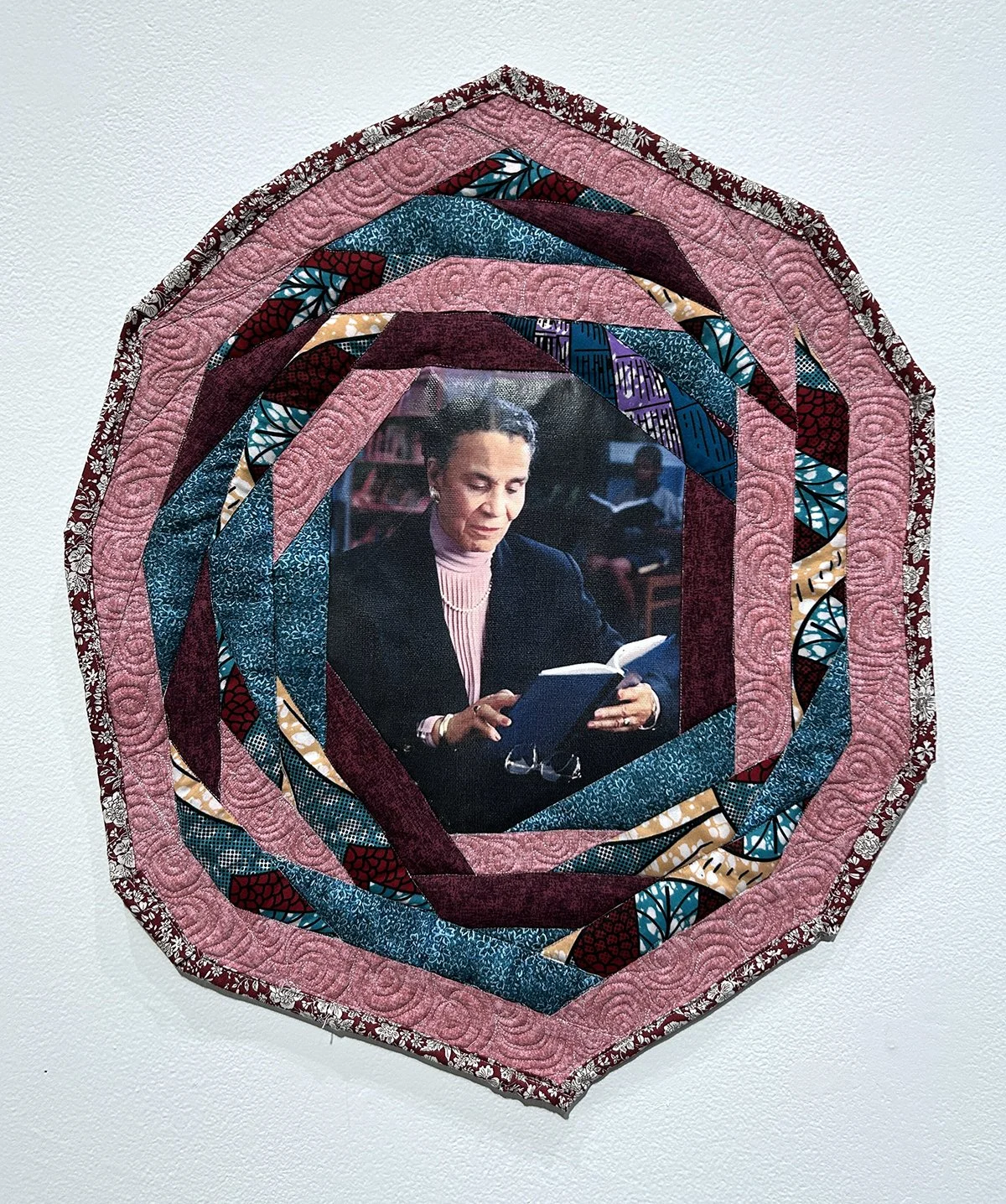
Ellamaria Foley-Ray, The Visionary's Granddaughter, 2025, canvas and fabric, 21.5 x 17.5 inches, featuring a photograph of Dr. Rachel Bassette Noel. Image by Brandy Coons.
The quilted works in the exhibition that are dedicated to Dr. Noel feature centerpieces of photographs printed on canvas. For instance, the work titled The Visionary's Granddaughter includes a color photo of Dr. Noel reading from a book, framed by an oval of patterned quilted fabrics in blue, burgundy, and pink. The artist drew this image and others from historical archives that depict Dr. Noel’s family and friends. They appear in one major grouping of rectangular works and another grouping of circular pieces focused on people from the wider community.
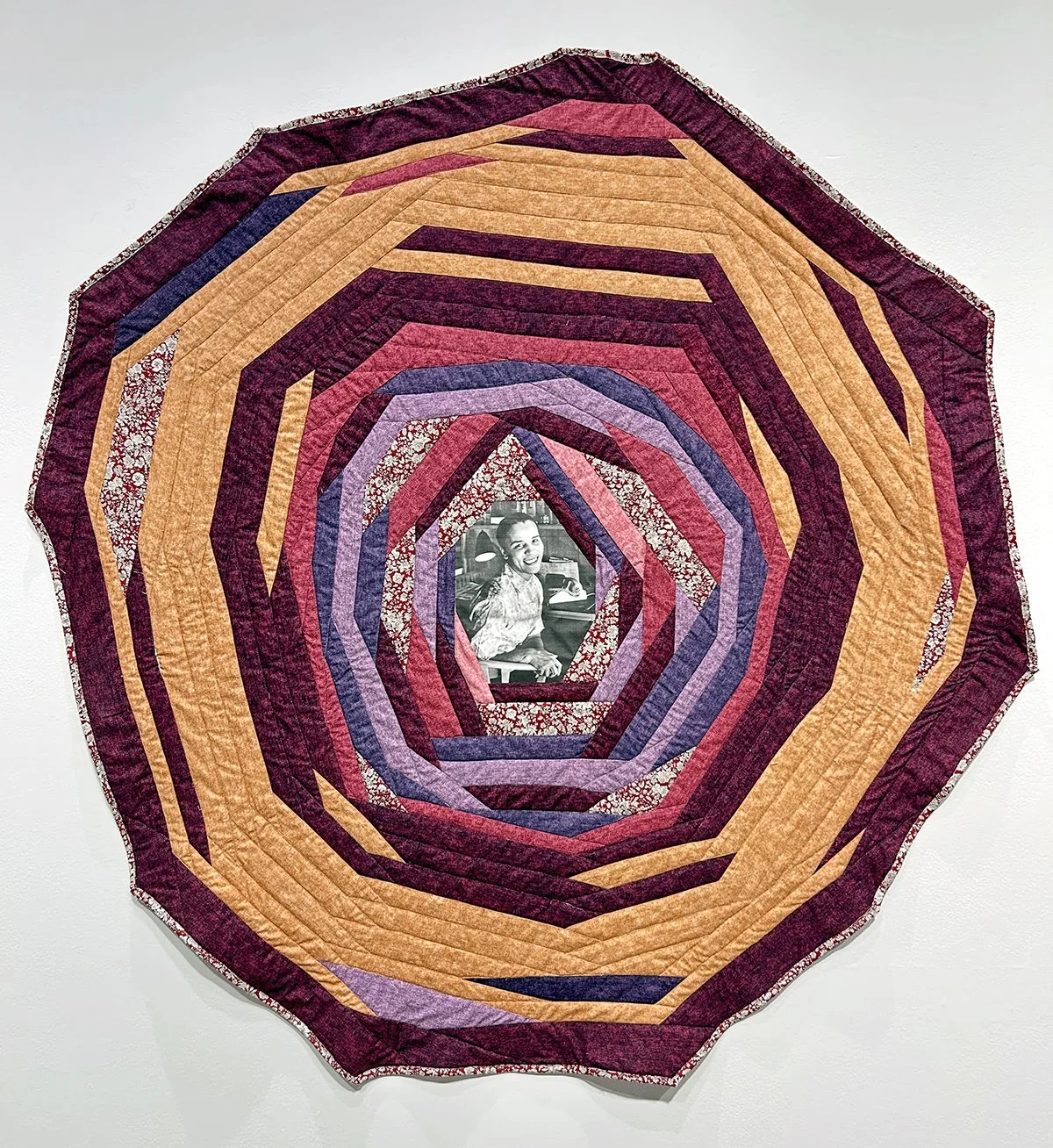
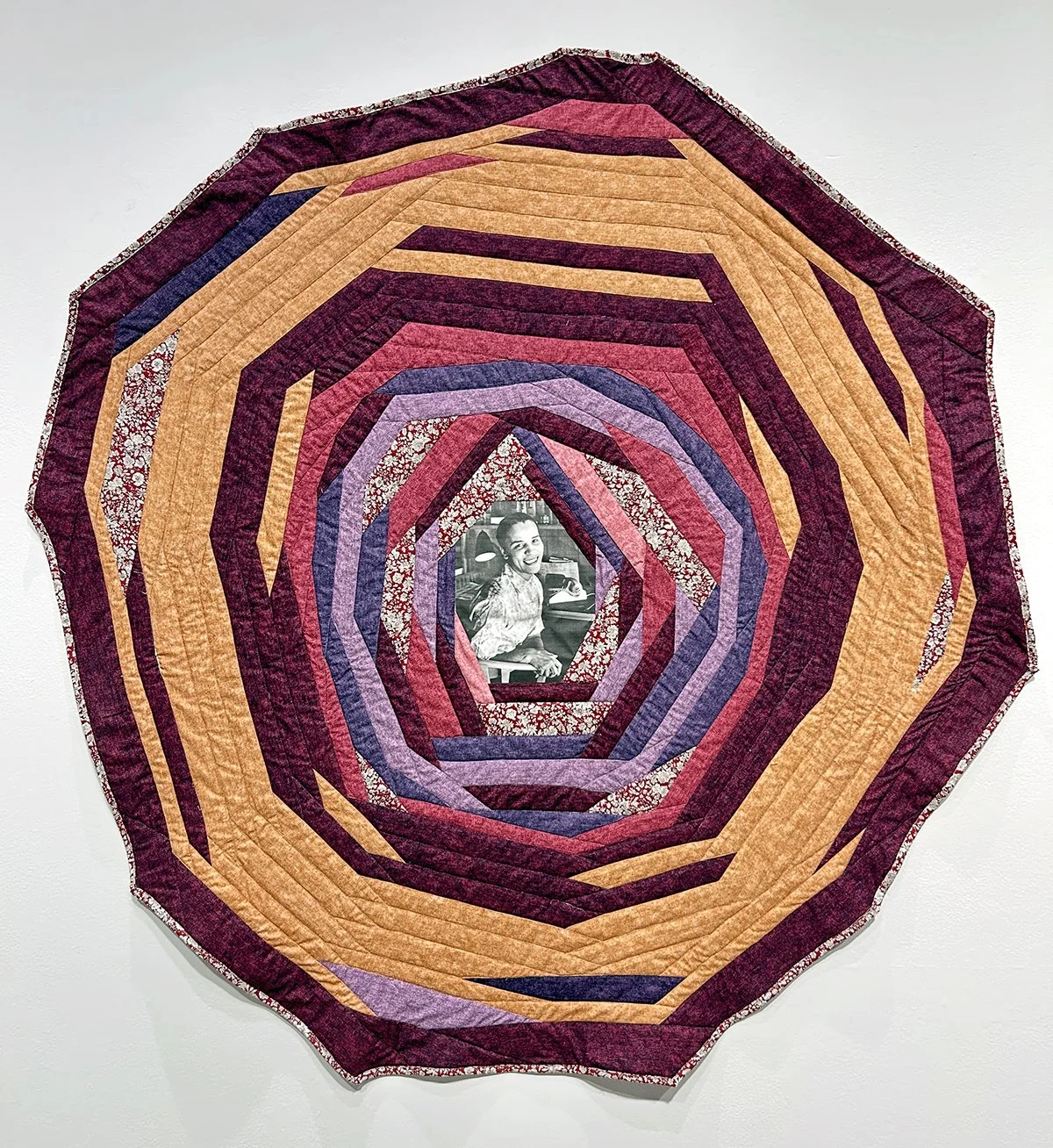
Ellamaria Foley-Ray, Circle, Be Unbroken!, 2026, canvas and fabric, 53 x 52 inches. A photograph of Dr. Rachel Bassette Noel is in the center. Image by Brandy Coons.
Dr. Ray creates the quilts through improvisational quilting, traditionally assembled from fabric scraps, resulting in intuitive, energetic patterns of color and shape. With a process that begins at the central photographs and expands outwards, the quilts express a wave of influence. She titles the largest portrait of Dr. Noel Circle, Be Unbroken!, referring to the 20th century hymn “Will the Circle Be Unbroken?” that was often sung as a protest song during the U.S. Civil Rights Movement in the 1950s and 1960s. The title emphasizes Dr. Noel’s command of endurance and continuity over the open-ended question.
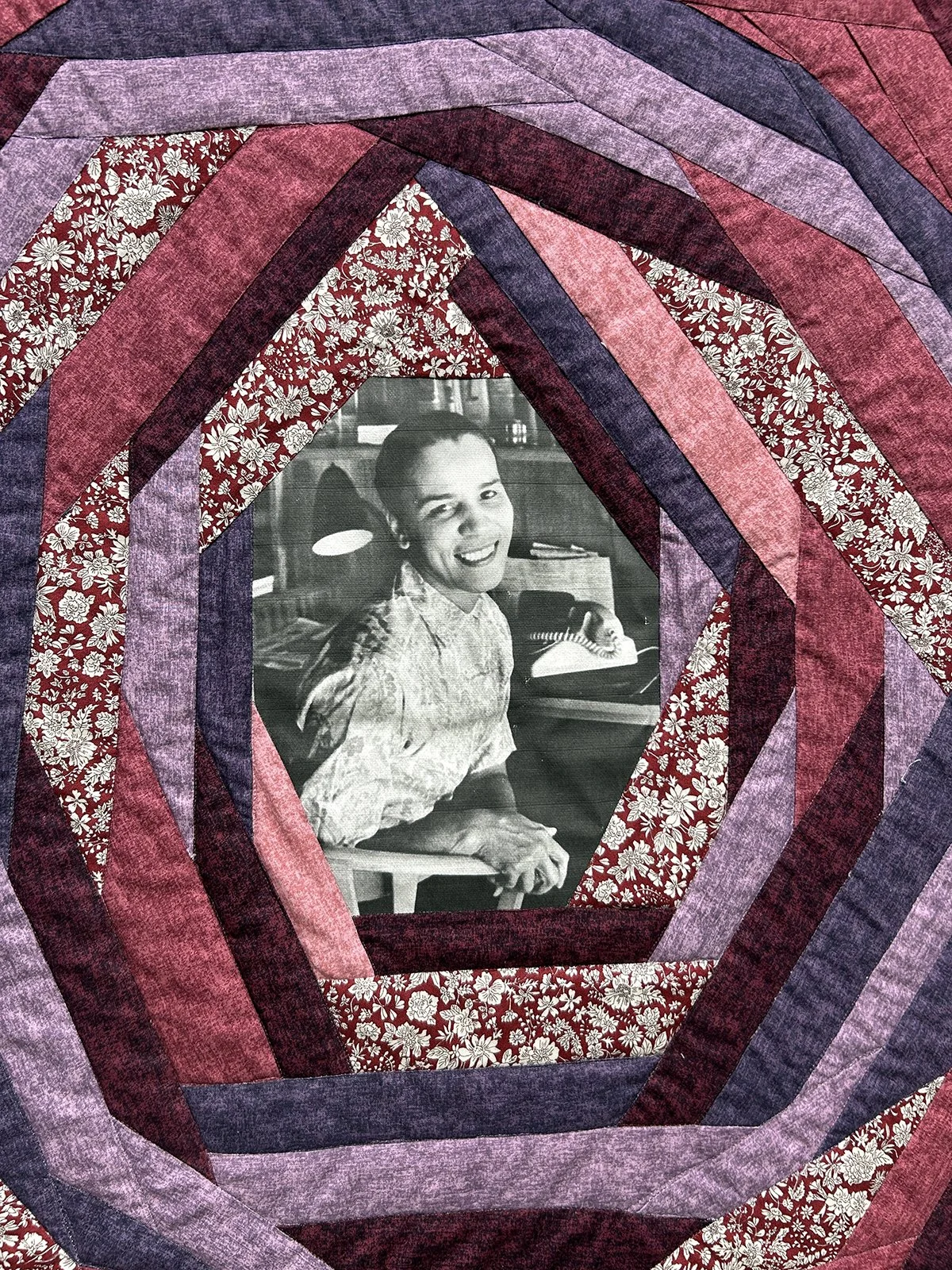
A detail view of the photograph of Dr. Rachel Bassette Noel in Ellamaria Foley-Ray’s Circle, Be Unbroken!, 2026, canvas and fabric, 53 x 52 inches. Image by Brandy Coons.
Circle, Be Unbroken! includes a black and white photo of Dr. Noel in her youth, looking at the camera and smiling, framed by precise bands of fabric in shades of gold, pink, purple, and red, as well as a floral material filled with white flowers on a red ground. This quilt is flanked on either side by smaller portrait quilts highlighting people who helped her in her fight for educational equality, and those working to preserve her memory. Through these groupings, Dr. Ray demonstrates her assertion that Dr. Noel “was clear that she did not do anything by herself.”
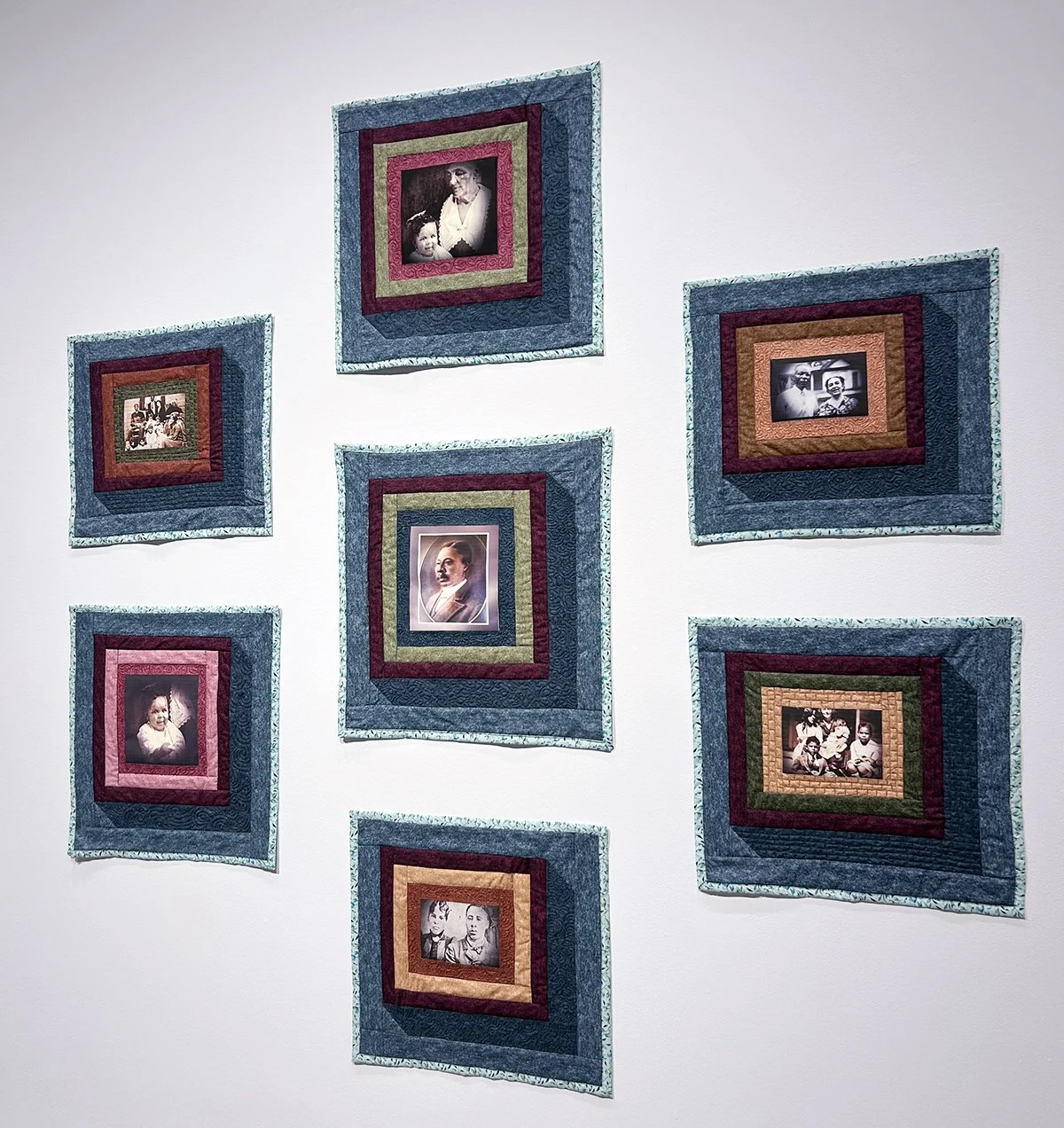
Seven of Ellamaria Foley-Ray’s quilted works featuring family photographs. Image by Brandy Coons.
Dr. Ray’s color schemes and fabrics were inspired by her own memories and impressions of colors that were popular in the 1950s, 60s, and 70s, reminding her of a time in her home when “decisions were made over the dinner table, in the dining room; powerful and enduring.” When she began sewing and quilting, Dr. Ray used her mother’s sewing machines, embracing a connection to her memories and family through her actions and the work of her hands.
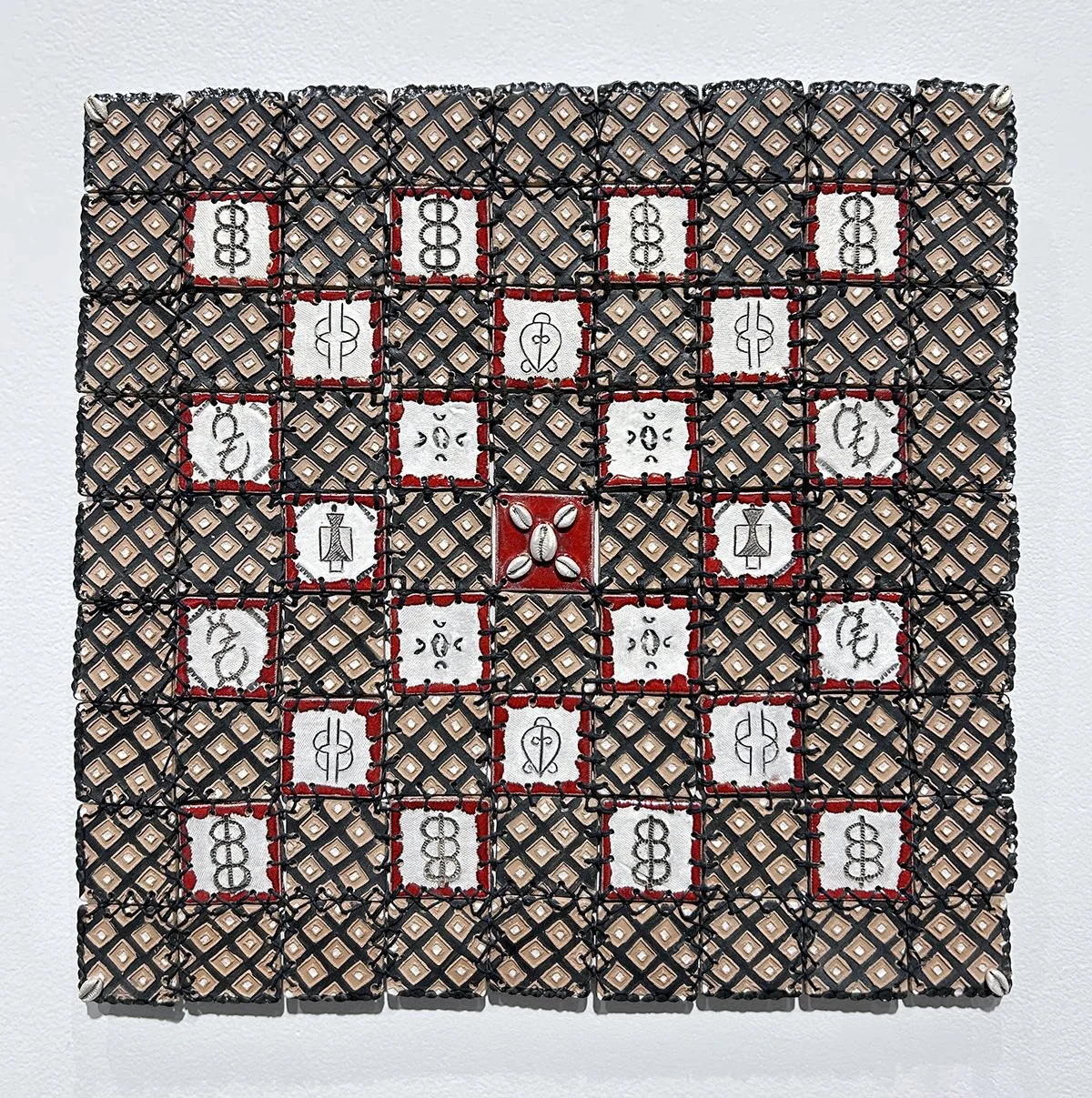
Ellamaria Foley-Ray, Proverbial Quilt of Desire, 2015, clay, underglaze, waxed cotton, and acrylic, 20 x 20 x .5 inches. Image by Brandy Coons.
Learning to work with fabric paralleled her practice in stitching clay. In the wall piece Proverbial Quilt of Desire, for example, the artist threads together clay tiles with a diamond pattern in black, brown, and white. Red-bordered tiles frame black symbols on white-painted cotton and the central tile is embedded with cowrie shells.
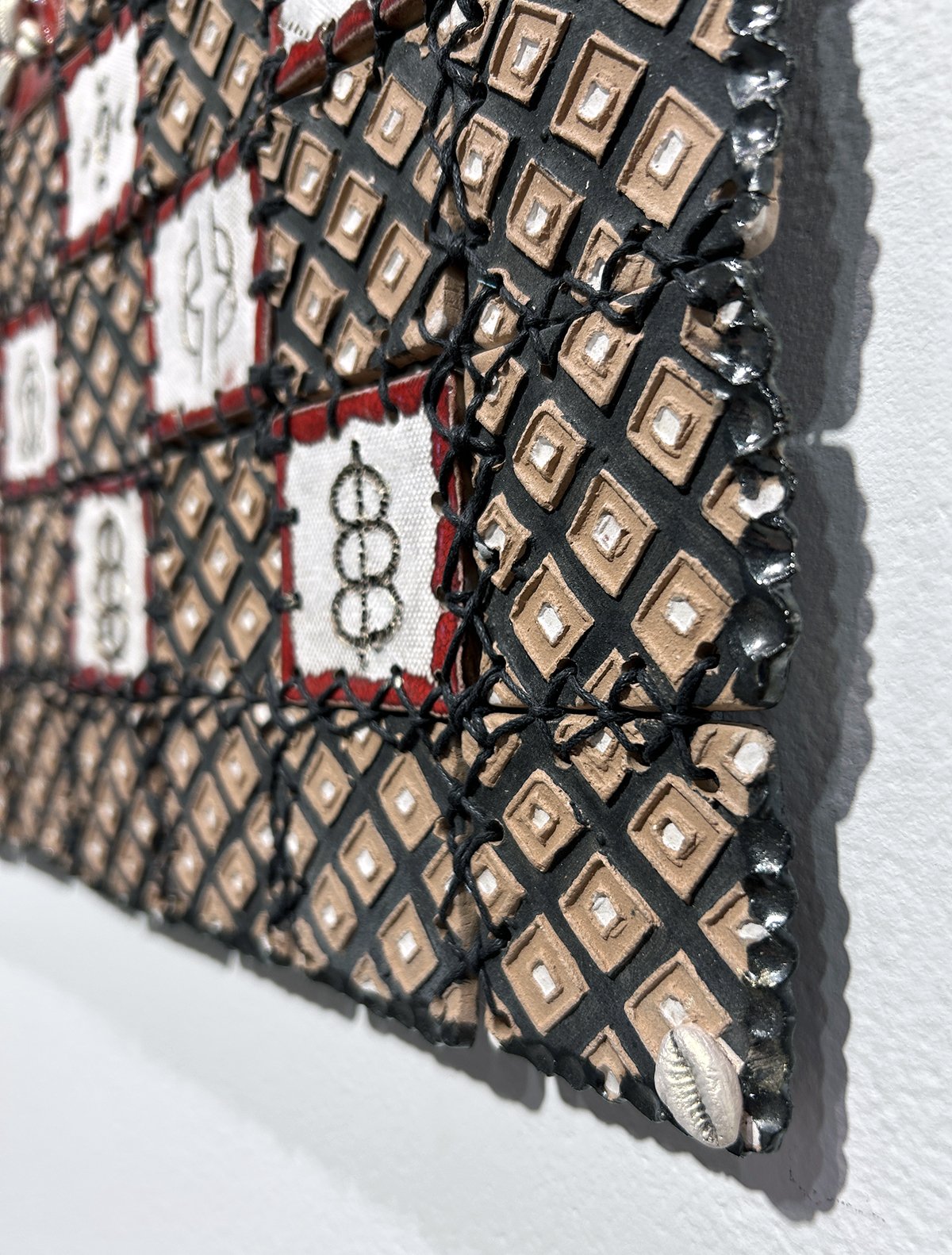
A detail view of Ellamaria Foley-Ray’s Proverbial Quilt of Desire, 2015, clay, underglaze, waxed cotton, and acrylic, 20 x 20 x .5 inches. Image by Brandy Coons.
These shells were used in Africa as currency starting as early as the 14th century and as protection charms by Africans in America, and the painted symbols have African origins as well. [3] As a professor of Africana Studies at Metropolitan State University in Denver, Dr. Ray is well-versed in this history and draws on it in her visual art.
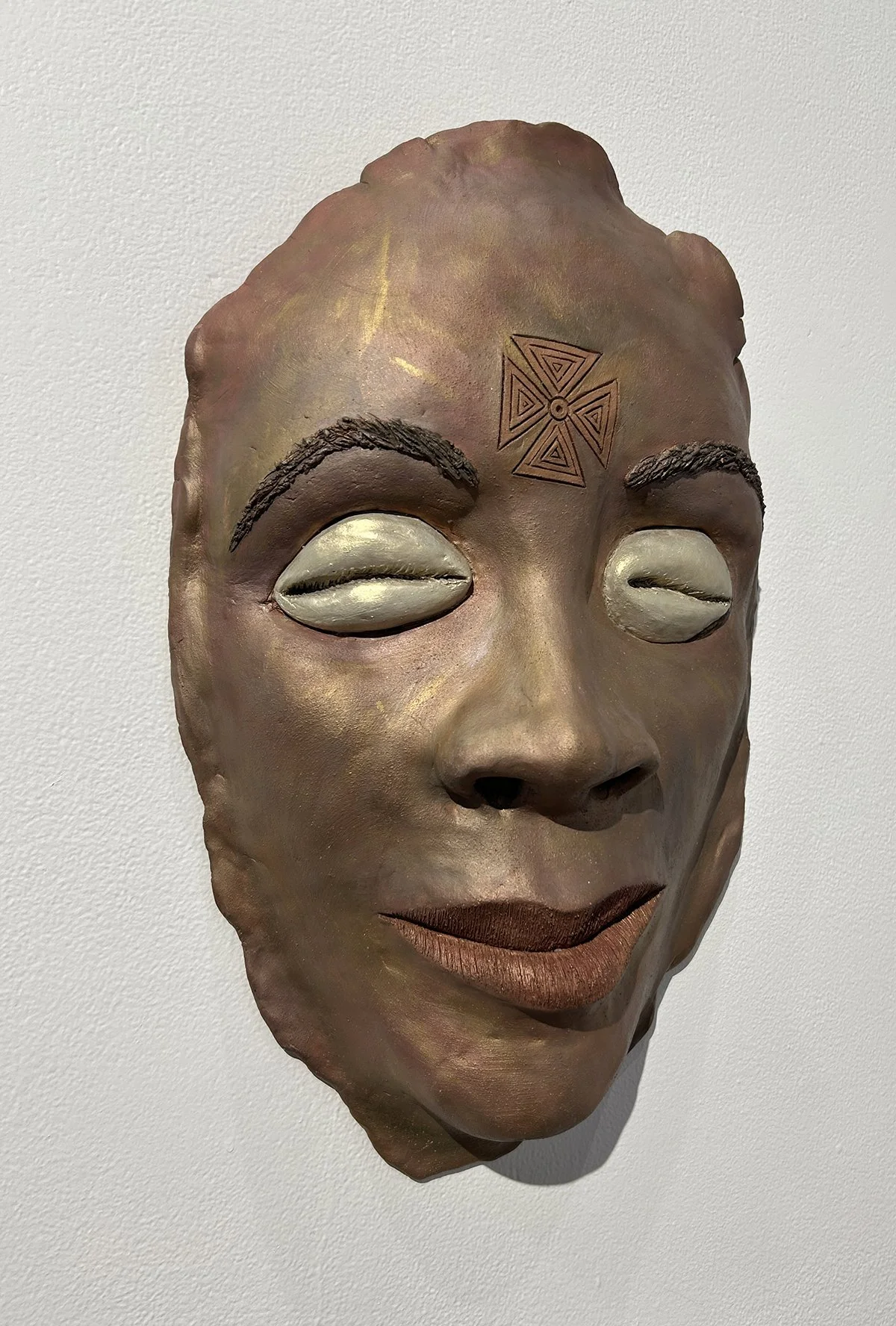
Ellamaria Foley-Ray, Her Spiritual Essence, 2004, clay, waxed pigment, and acrylic, 19 x 12 x 5.5 inches. Image by Brandy Coons.
Spanning decades of the artist’s research and practice in ceramics and fiber arts, The Genteel Revolutionary presents a continuum of creative and personal exploration. Dr. Ray’s work as a cultural anthropologist researching the past inspires the movement, life, and energy in her artistic work. The past is present in her fingertips and actions.
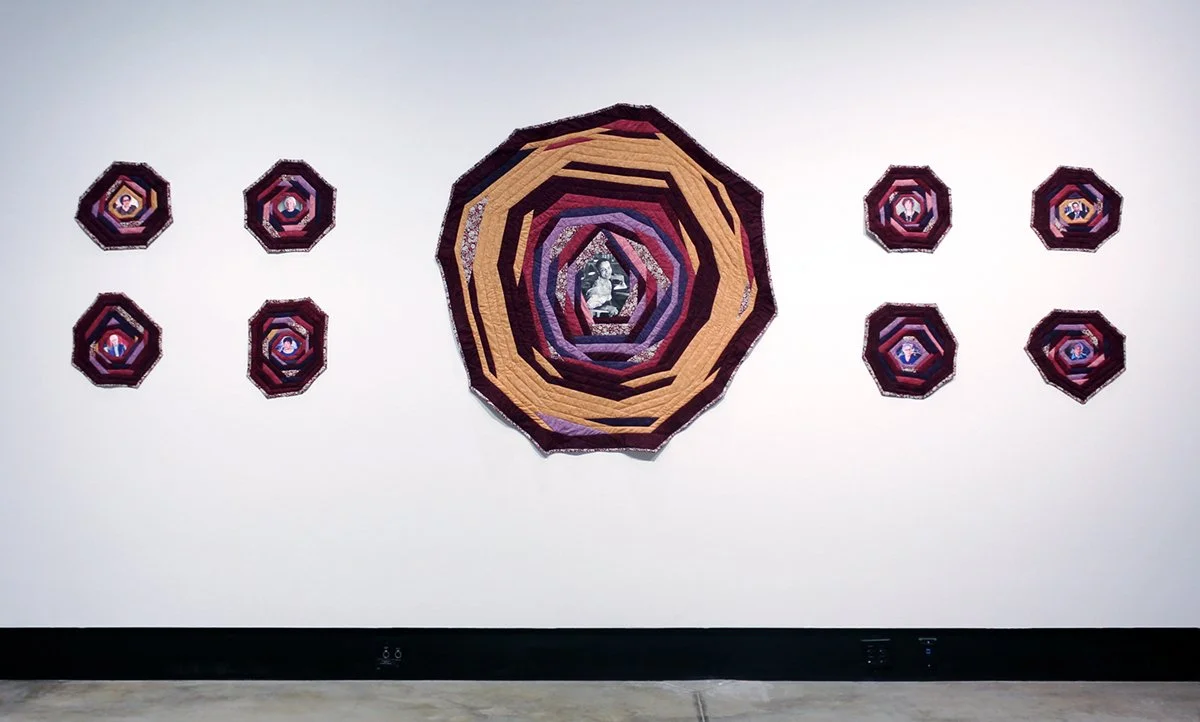
In the center: Ellamaria Foley-Ray’s Circle, Be Unbroken!, 2026, canvas and fabric, 53 x 52 inches, with a portrait of Dr. Rachel Bassette Noel at the center, surrounded by eight accompanying quilted works featuring photographs of individuals who supported Dr. Noel and continue her work. Image courtesy of the Ruyle Gallery.
Finding ourselves facing critical civil rights conflicts and challenges in the present day, experiencing these works in person inspires one to take action. It is easy to feel powerless, but we must remember the living legacy of people who came before us, to learn from them and to rely on community. In her own words, Dr. Ray asserts: “Remember that we have tools and skills and this isn’t the first time we’ve had difficult seasons, and we can make change. To ignite the viewer’s agency, that can transform into activism.”
Brandy Coons (she/her) is an artist and curator based in Longmont, Colorado. She holds a BFA in Photography from Louisiana Tech University.
[1] For more information about Dr. Rachel Bassette Noel, visit https://history.denverlibrary.org/colorado-biographies/rachel-noel-1918-2008.
[2] This and other quotes are from my conversational interview with the artist on February 15, 2026.
[3] You can learn more about the history and significance of cowrie shells in this article from the National Museum of African American History & Culture: https://nmaahc.si.edu/cowrie-shells-and-trade-power.