
Parting Gift: Fitting in America | An Impossibly Normal Life
Leonard Suryajaya: Parting Gift: Fitting in America
Matthew Finley: An Impossibly Normal Life
Colorado Photographic Arts Center
1200 Lincoln Street, Suite 111, Denver, CO 80203
February 27–April 18, 2026
Admission: free
Review by Nina Peterson
At the Colorado Photographic Art Center (CPAC), the two current solo exhibitions of works by Leonard Suryajaya and Matthew Finley queer family photographs. Family photography has been and continues to be a tool of nationalism and imperialism as well as a mechanism of constructing and enforcing normative visions of the family as a happy, white, heterosexual, nuclear unit. Against these disciplinary and exclusionary histories, Suryajaya’s and Finley’s images use photography as a method for imagining and practicing kinship otherwise.
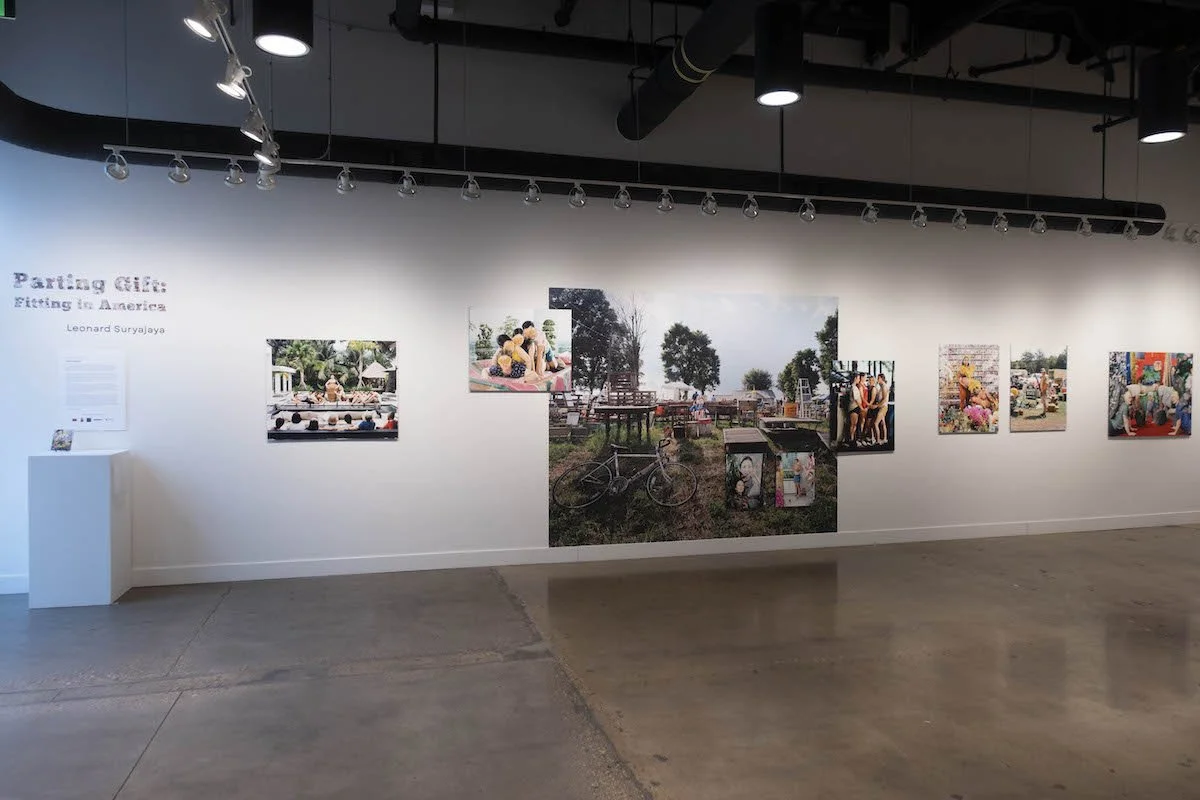
An installation view of Leonard Suryajaya’s exhibition Parting Gift: Fitting in America at the Colorado Photographic Arts Center. Image courtesy of the Colorado Photographic Arts Center.
Suryajaya’s exhibition Parting Gift: Fitting in America presents color photographs made in Indonesia as well in the United States along The Highway 127 Corridor Sale (an annual second-hand sale along Route 127, which runs through Michigan, Ohio, Kentucky, Tennessee, Georgia, and Alabama).
The Chicago-based artist grew up in a Chinese Buddhist household in Indonesia, a predominantly Muslim country. In an artist’s statement for the exhibition, he describes his intersecting identities as shaping his approach to photography. Representing both the artist’s extended family alongside his husband, friends, acquaintances, and strangers, the exhibition, as the artist explains, presents family portraiture as “a way to imagine a more elastic definition of love—one shaped not by origin alone, but by care, presence, and mutual recognition.” [1]
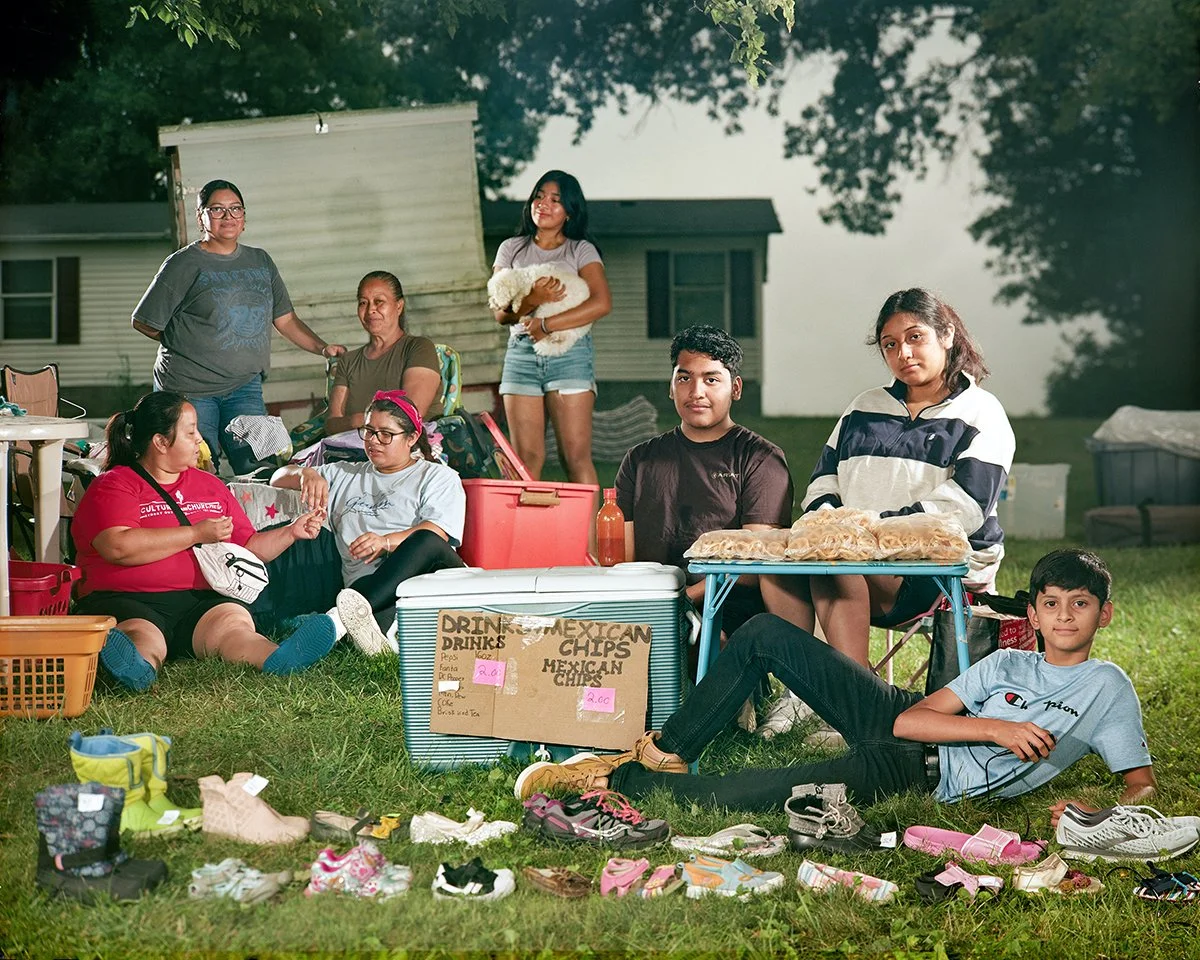
Leonard Suryajaya, Diego and Friends from Church, 2024, vinyl, 76 x 95 inches. Image courtesy of the Colorado Photographic Arts Center.
This mutuality is enacted and visible in a recurring motif: the use of a remote shutter release by the subjects of Suryajaya’s photographs. In Diego and Friends from Church, a school-age boy leisurely reclines in the foreground of the image, his fingers casually enveloping the shutter release bulb, its cable meandering across the grass, betwixt shoes for sale, and out of the frame in the lower right corner of the composition. In Faye and Debra, two women, one Black and one white, stand side-by-side, holding hands, their fingers woven together to clasp the shutter release bulb.
The use of the remote shutter release is a device for asserting the agency of those pictured by enabling them to push the button that creates the photograph. While the artist choreographs the composition, the photographic subjects’ control of the shutter release signals the collaborative ethos of the project. In the context of the family picture’s history as a tool of empire, the cable release bulb is also an anti-imperialist gesture of resistance: these are not the family albums produced in the name of reifying colonial white supremacy. [2] Rather, they queer the notion of family altogether by sharing the power to make the picture.
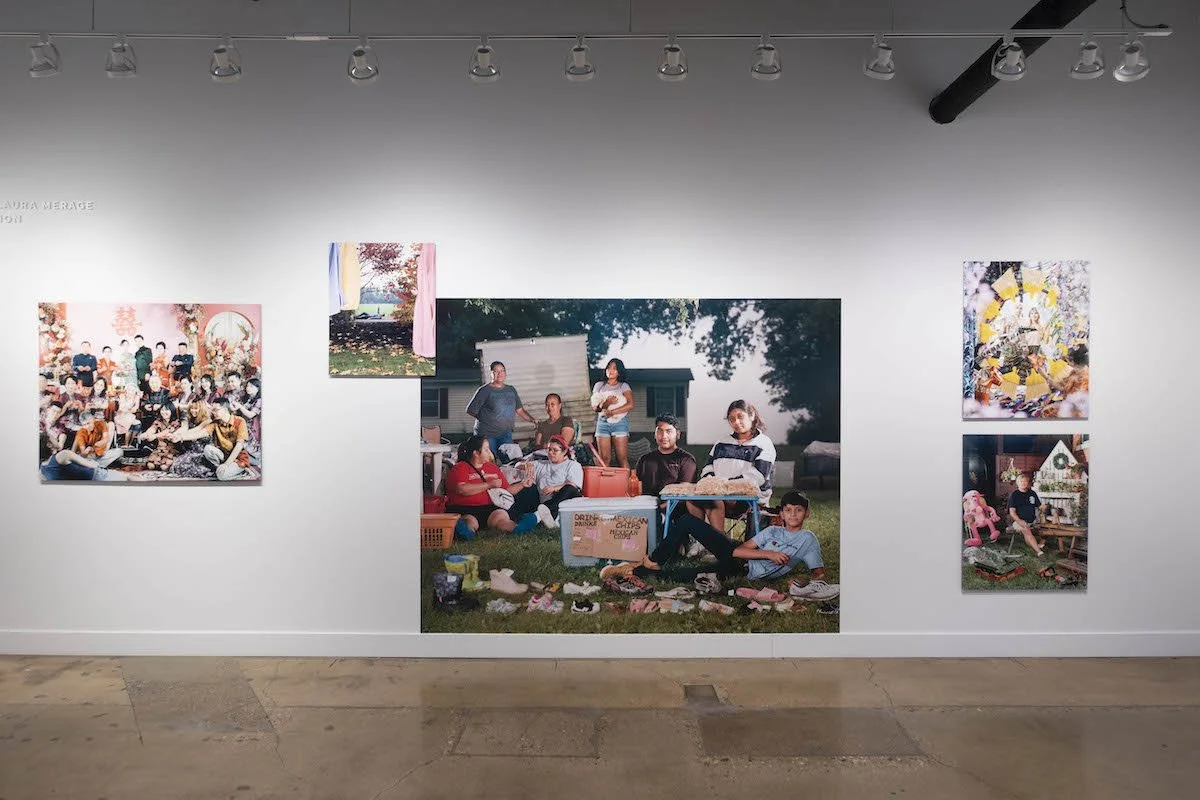
An installation view of Leonard Suryajaya’s exhibition Parting Gift: Fitting in America at the Colorado Photographic Arts Center. Image courtesy of the Colorado Photographic Arts Center.
As the artist puts it, the remote shutter release allows the subjects to “shape their own representations.” [3] Suryajaya’s process is thus communal rather than a disciplinary imposition of the photographic frame on those fixed in the camera’s gaze.
In Pointing Up, the remote shutter release bulb and the hand holding it pop out from behind a pink curtain. The cable that links the bulb to the camera cascades in curlicues down the length of the drapery. Just above the hand gripping the bulb, someone’s right eye peeks out from behind the curtain. The emerging hand and the peeking eye draw attention to the theatrical nature of the image but also exemplifies what the artist calls moments of “rupture”—instances in which the strict comportment and stability of the family photograph falls apart. [4]
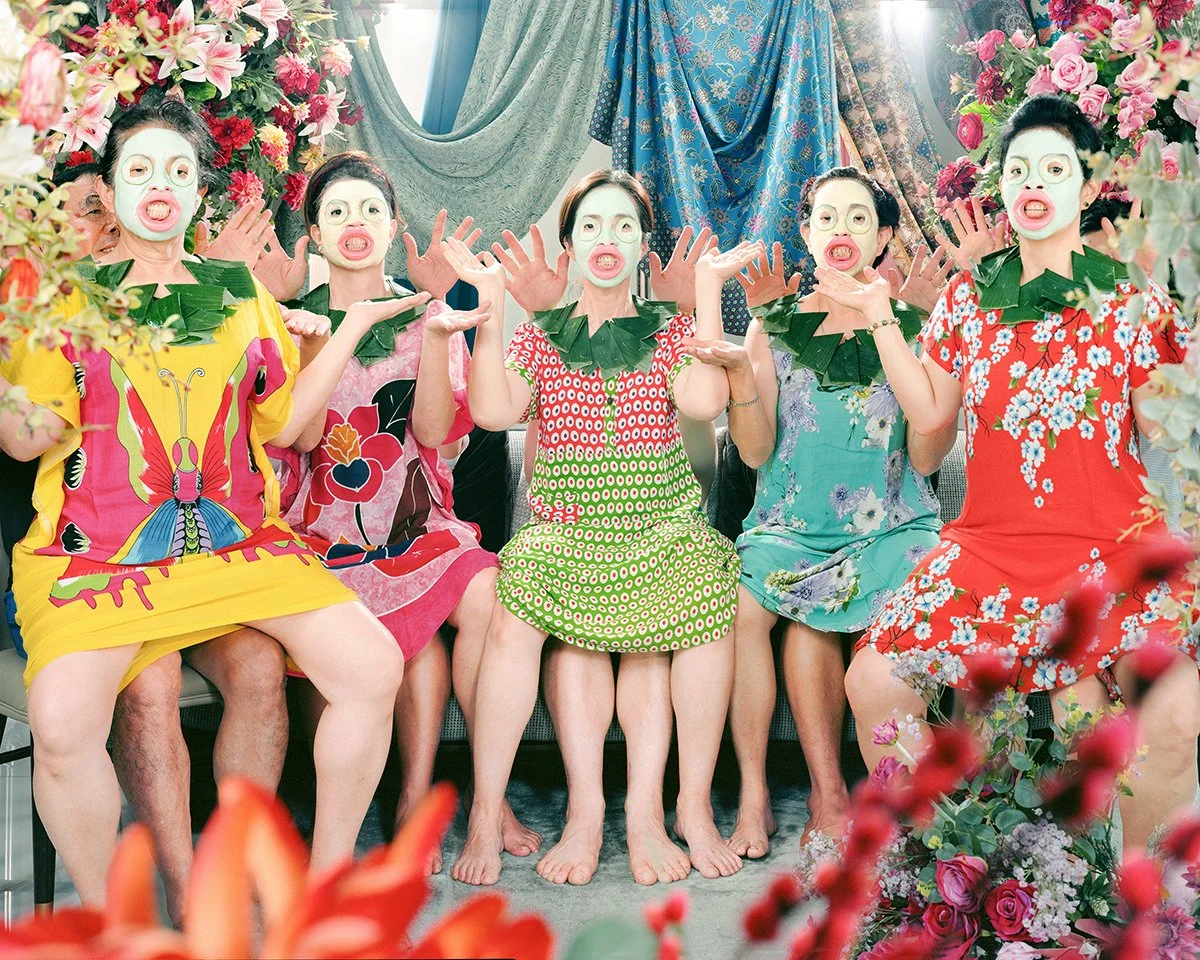
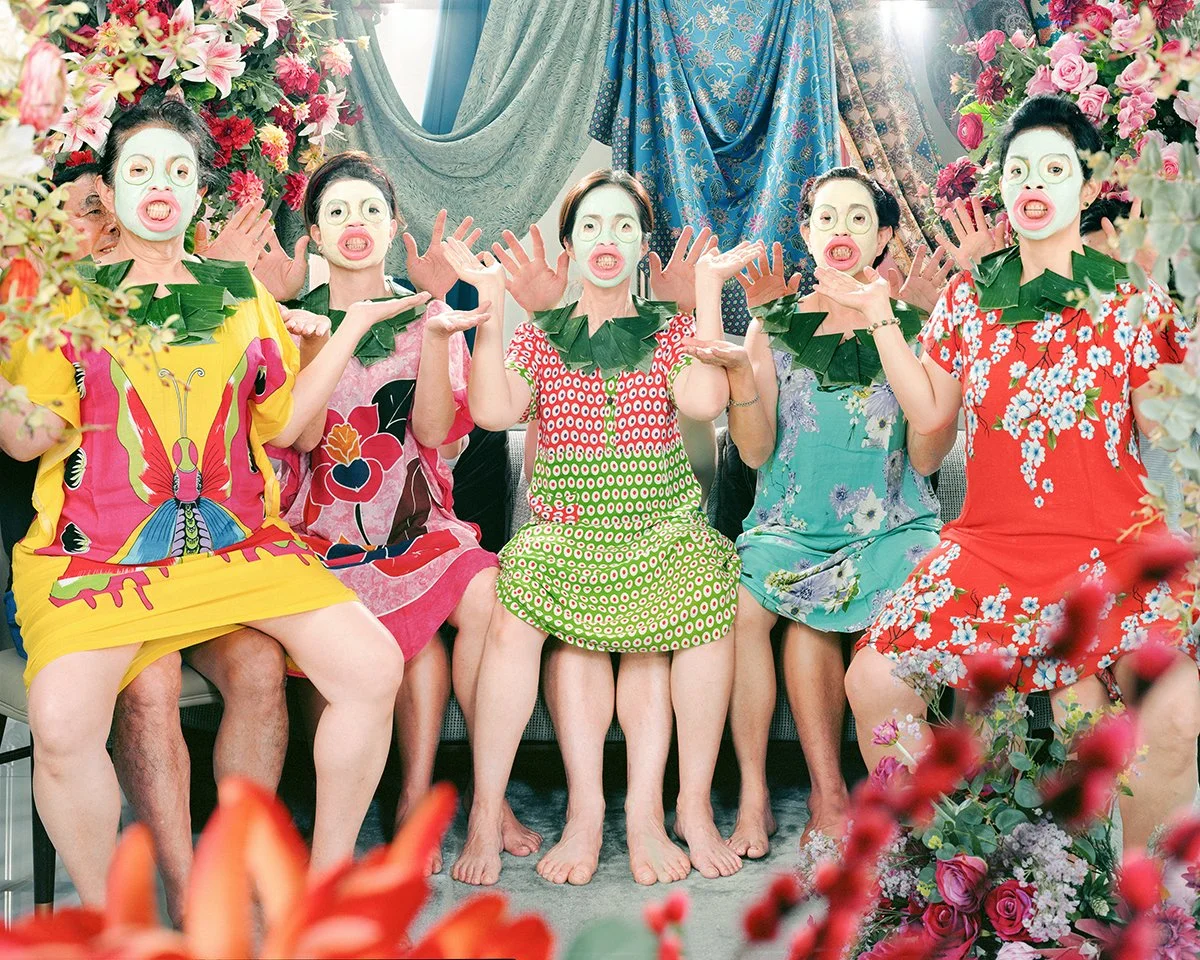
Leonard Suryajaya, Alien Aunties, 2025, inkjet print, 28 x 35 inches. Image courtesy of the Colorado Photographic Arts Center.
I see another instance of such rupture in the upper left corner of Alien Aunties, where a figure peers, grinning, over the shoulder of one of the eponymous aunties, revealing the embodied source of her extra limbs. In this photograph, five figures sit amidst bouquets of roses, lilies, and lushly patterned drapery. This arrangement of figures in a line, parallel to the picture plane, with their hands raised and palms facing outwards or upwards, also evokes the stage and arrangement of performers in traditional Indonesian dances. These diverse practices often involve complex choreographies of synchronized hand movements and gendered performance roles.
The photograph mixes and exaggerates body parts in a surreal way. There appears to be too many hands and limbs for the number of people pictured. A green clay mask is spackled onto the figure’s faces and cucumber slices simultaneously frame and occlude their eyes. Lip-shaped cheek retractors peel their expressions into absurd smiles. These elements create the illusion of the aunties as extraterrestrial creatures.
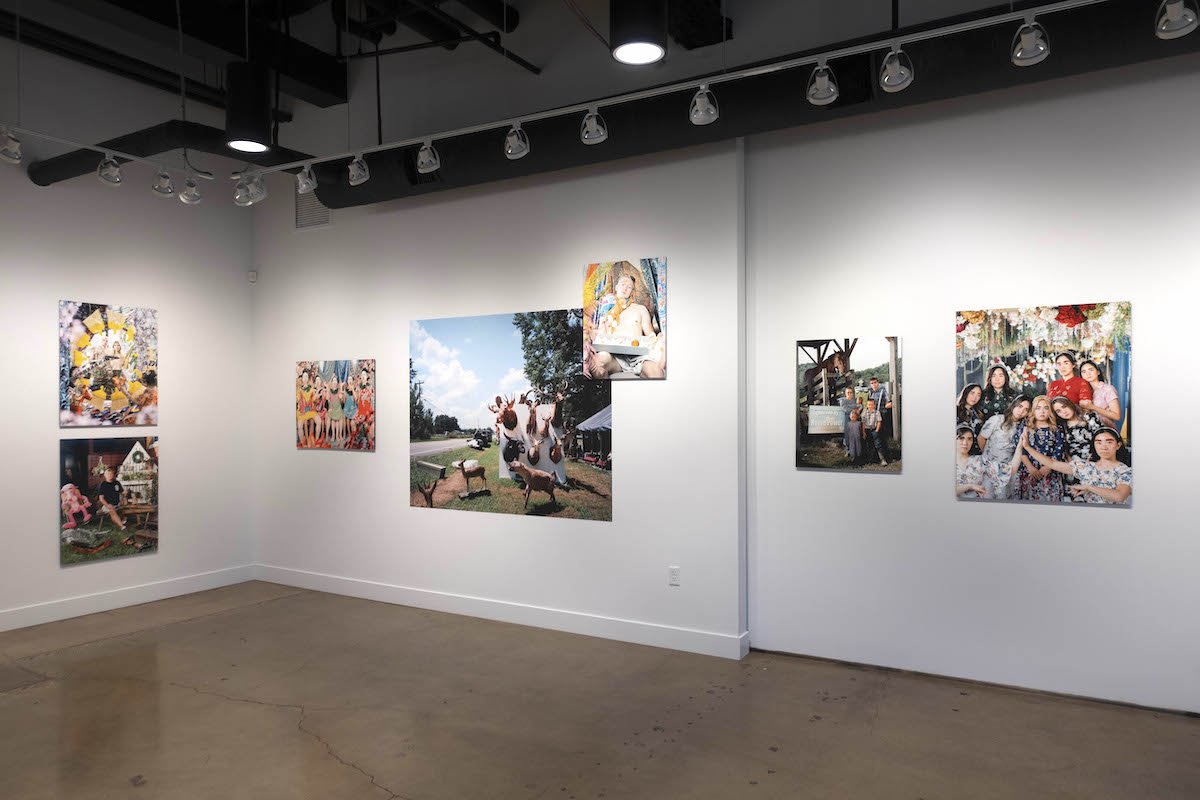
An installation view of Leonard Suryajaya’s exhibition Parting Gift: Fitting in America at the Colorado Photographic Arts Center. Image courtesy of the Colorado Photographic Arts Center.
The accoutrements used in feminized practices of beauty obfuscates the women’s individual identities, homogenizing them yet also protecting and honoring them. The absurdism of the scene speaks to racist stereotypes about Chinese people looking the same, which gave rise to the conventions of identification photography and repressive mechanisms through which Asian-ness was made to preclude national belonging in the U.S. [5] Paired with the political connotations of the work’s title, the otherworldliness of these figures critiques racist systems that use photography as a tool of exclusion and for the production of racial hierarchy.
“Alien” is a derogatory term when it enforces hierarchy in immigration status. Its etymology traces to the language of the Chinese Exclusion Act of 1882, which labeled Chinese migrants “permanent aliens,” foreclosing the possibility of their U.S. citizenship and formalizing sinophobia in the structure of immigration law. And of course this term continues to be weaponized, especially against Latine/a/o/x and Asian and African diasporic communities currently under siege by fascist immigration enforcement operations. [6]
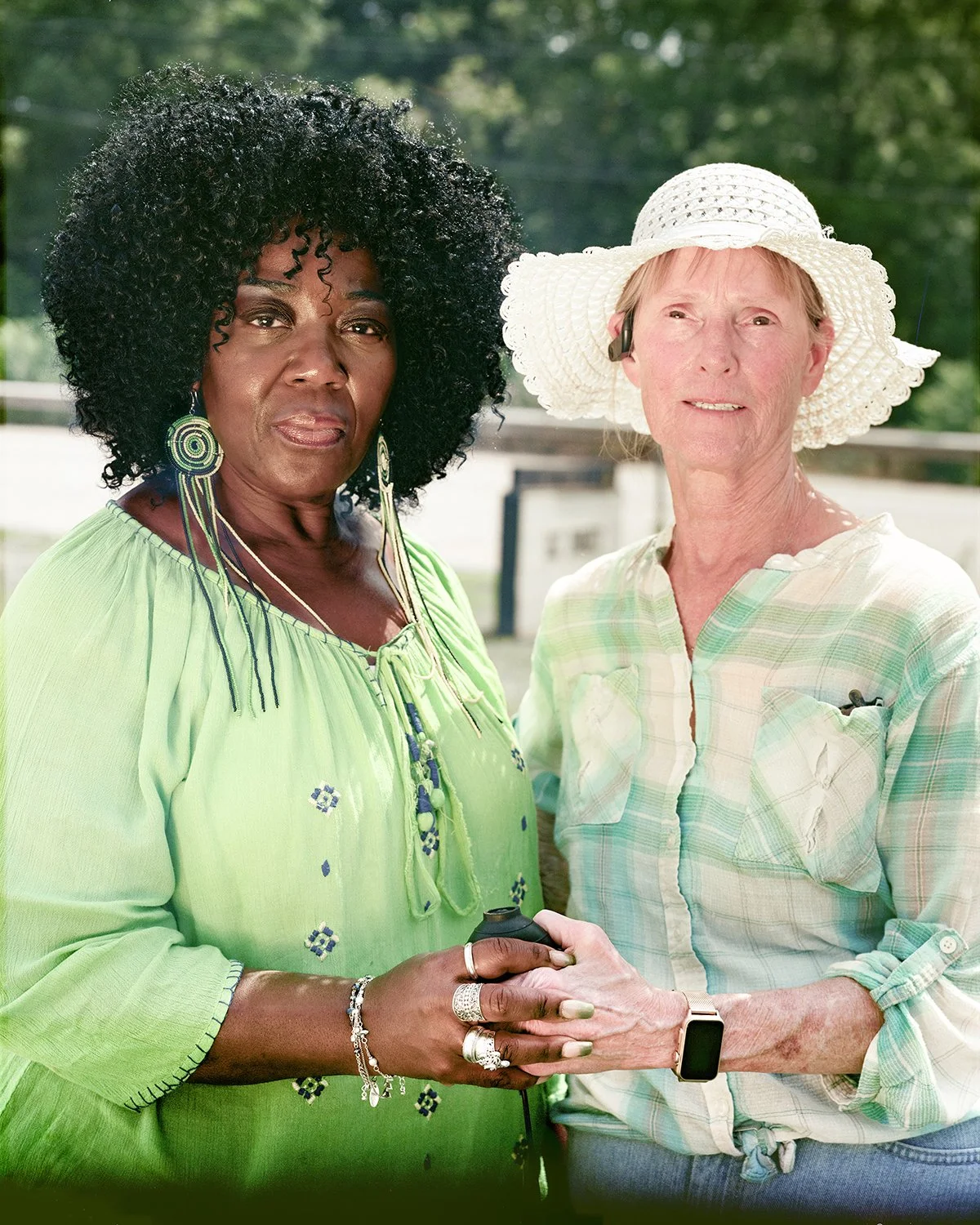
Leonard Suryajaya, Faye and Debra, 2024, inkjet print, 12.8 x 16 inches. Image courtesy of the Colorado Photographic Arts Center.
But these are fierce and fabulous aunties—women in queer, of color communities who hold often ambivalent positions as overbearing or old-fashioned but also as protective carers. Scholar of performance studies Kareem Khubchandani explains: “Aunties are women, femme, and queer figures adjacent to or at the periphery of a nuclear family formation… As a form of kin, aunties blur the boundaries of the family, with the capacity to both surveil and sabotage its circumference.” [7]
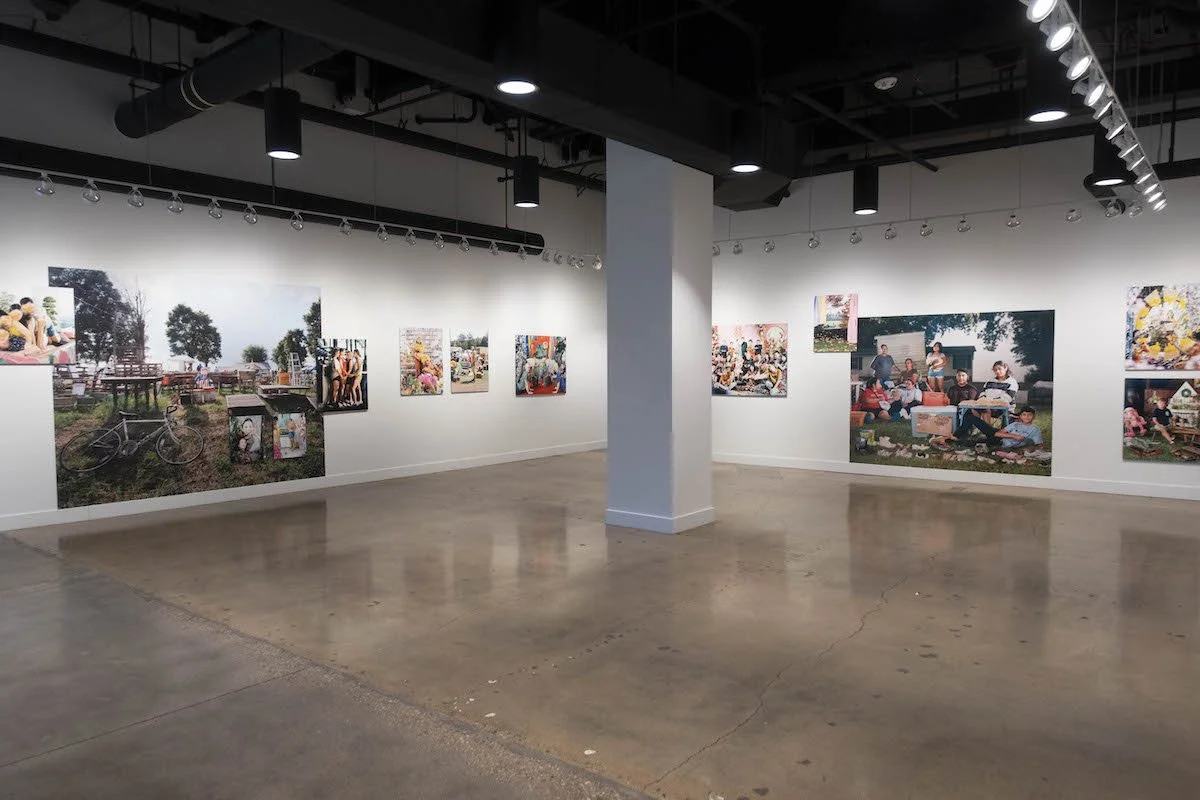
An installation view of Leonard Suryajaya’s exhibition Parting Gift: Fitting in America at the Colorado Photographic Arts Center. Image courtesy of the Colorado Photographic Arts Center.
The moments of rupture in Suryajaya’s work burst from violent contexts of policing gender, sexuality, and national belonging, suggesting how these disciplinary structures, despite their brutality, are not totalizing. Along with the densely patterned and vibrantly colored stages in which the absurdist scenes unfold, these ruptures suggest what cultural studies scholar Chris Eng has theorized as “extravagant camp.” That is, Asian American artists’ deployment of camp aesthetics as a distinctly political strategy of “grappling with histories of racialization and shifting parameters of U.S. national belonging.” [8]
While the image of Suryajaya’s Aunties performs an extravagant camp that parodies anti-Chinese bias along with the homophobic legal systems in the U.S. and Indonesia, it is Matthew Finley’s uncle who refuses the compulsory heteronormativity constructed by the family photograph.
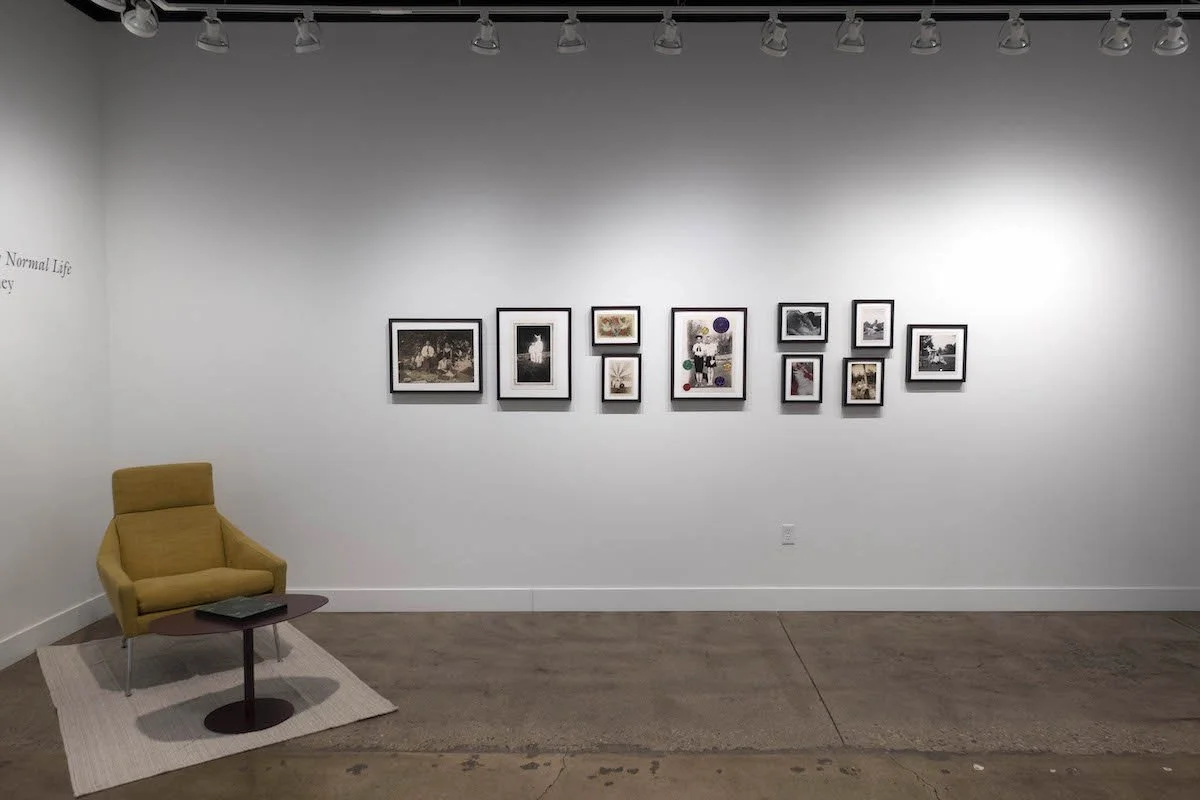
An installation view of Matthew Finley’s exhibition An Impossibly Normal Life at the Colorado Photographic Arts Center. Image courtesy of the Colorado Photographic Arts Center.
According to Finley, he began work on An Impossibly Normal Life while conducting research on his family history. He learned from his mother that one of his uncles, who died young, may have been gay. Created from vintage, black and white photographs compiled from various sources, Finley’s body of work is, in the artist’s words, an act of “wish fulfillment.” [9] It creates unconditional love and support that many young queer people, including Finley and his uncle, did not and do not experience growing up.
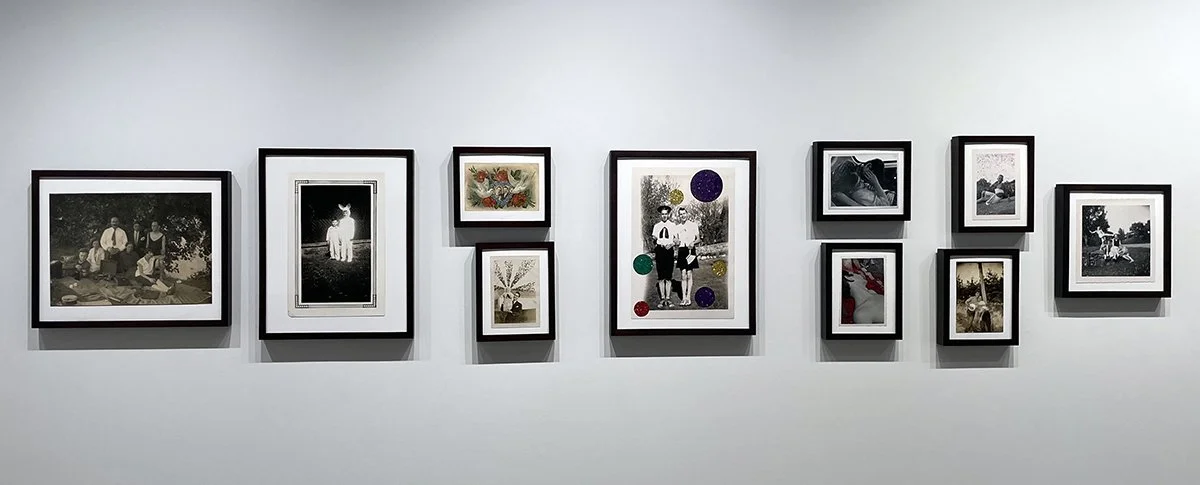
An installation view of a grouping of photographs in Matthew Finley’s exhibition An Impossibly Normal Life at the Colorado Photographic Arts Center. Image by Nina Peterson.
Finley generates an alternate archive, bringing together family photographs from multiple, unidentified families to fashion a new family bonded by unequivocal care. He constructs a series of family photographs that situate his uncle Ken in a “parallel universe” where “fluidity in gender and sexuality is the societal norm.” [10] An Impossibly Normal Life presents the major events in Ken’s life through a queer gaze that makes use of glitter as a campy mode of reading the archive against its grain. It doesn’t seek to maintain an objective distance from the archive—which is full of dubious truth claims anyway.
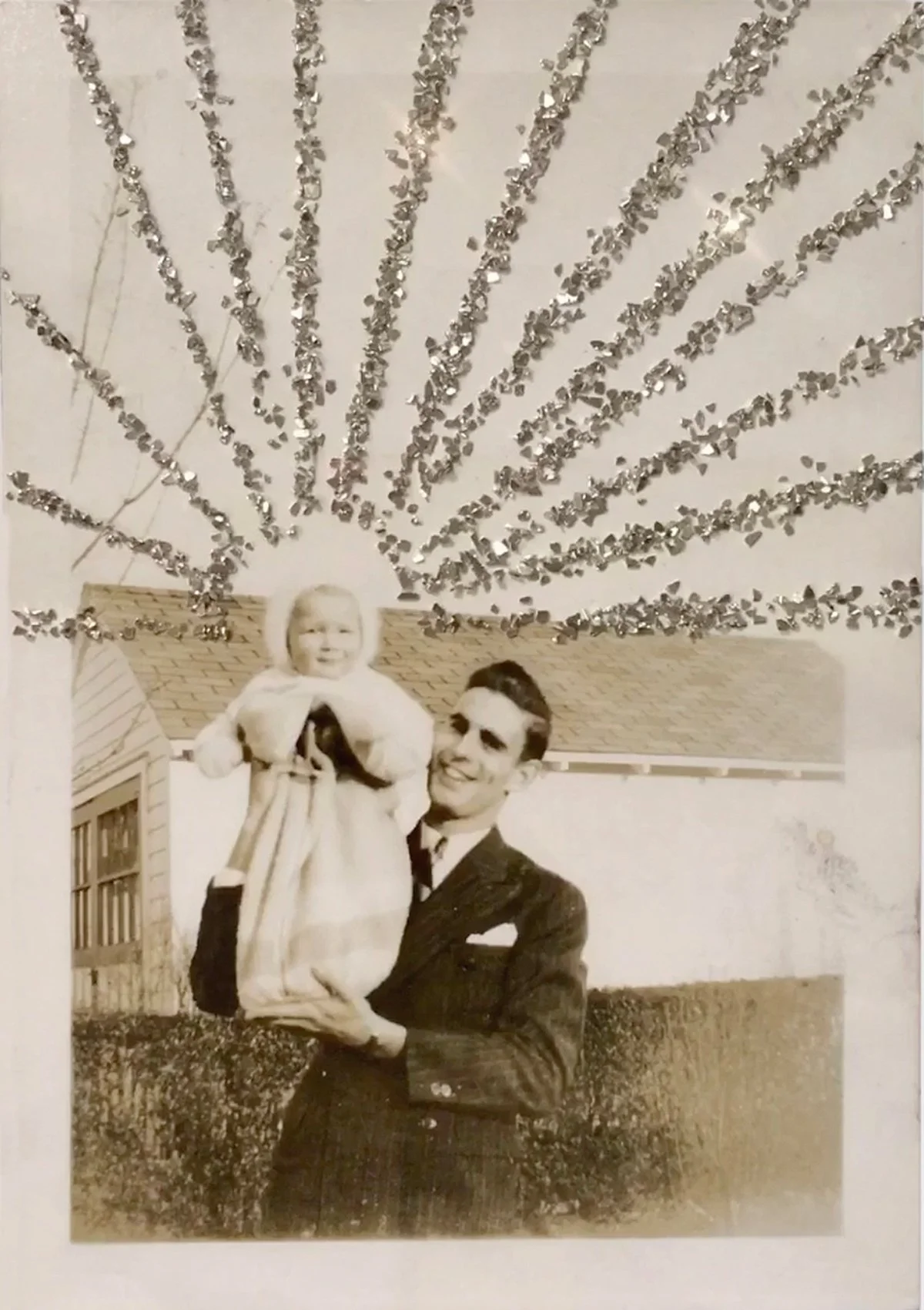
Matthew Finley, He has Arrived! ha!, 2024, archival pigment print mounted to board with glitter and varnish. Image courtesy of the Colorado Photographic Arts Center.
The images are clustered on the gallery walls to suggest the progression of Ken’s life through stages: childhood, young adulthood, graduation, employment, marriage. The photographs document the celebrations of milestones as well as quotidian events.
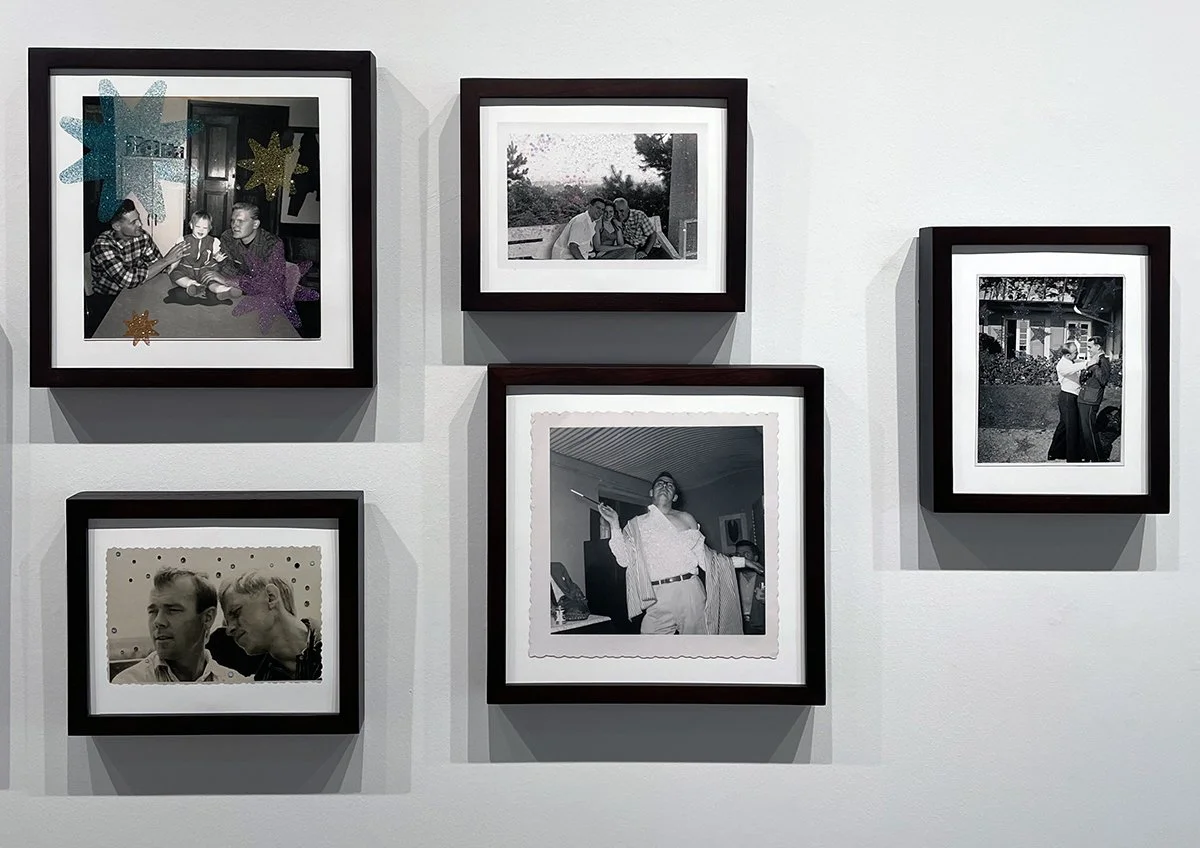
An installation view of five works in Matthew Finley’s exhibition An Impossibly Normal Life at the Colorado Photographic Arts Center. Image by Nina Peterson.
To these found vernacular images, Finley adds glitter and rhinestones, which the artist describes as “a nod to the long history of queer nightlife and drag.” [11] Indeed, such spaces and practices have long forged kinship against the structures and violences of heteronormativity. The artist’s addition of sparkle is also a form of campy reparative reading in the sense that queer theorist Eve Sedgwick means it. “The desire of a reparative impulse,” Sedgwick writes, “is additive and accretive.” [12] Finley’s use of glitter—a dazzling intervention—to read this alternative archive of queer family life is additive, not suspicious; it creates a new form of knowledge that works against hegemonic systems of making sense of the world.
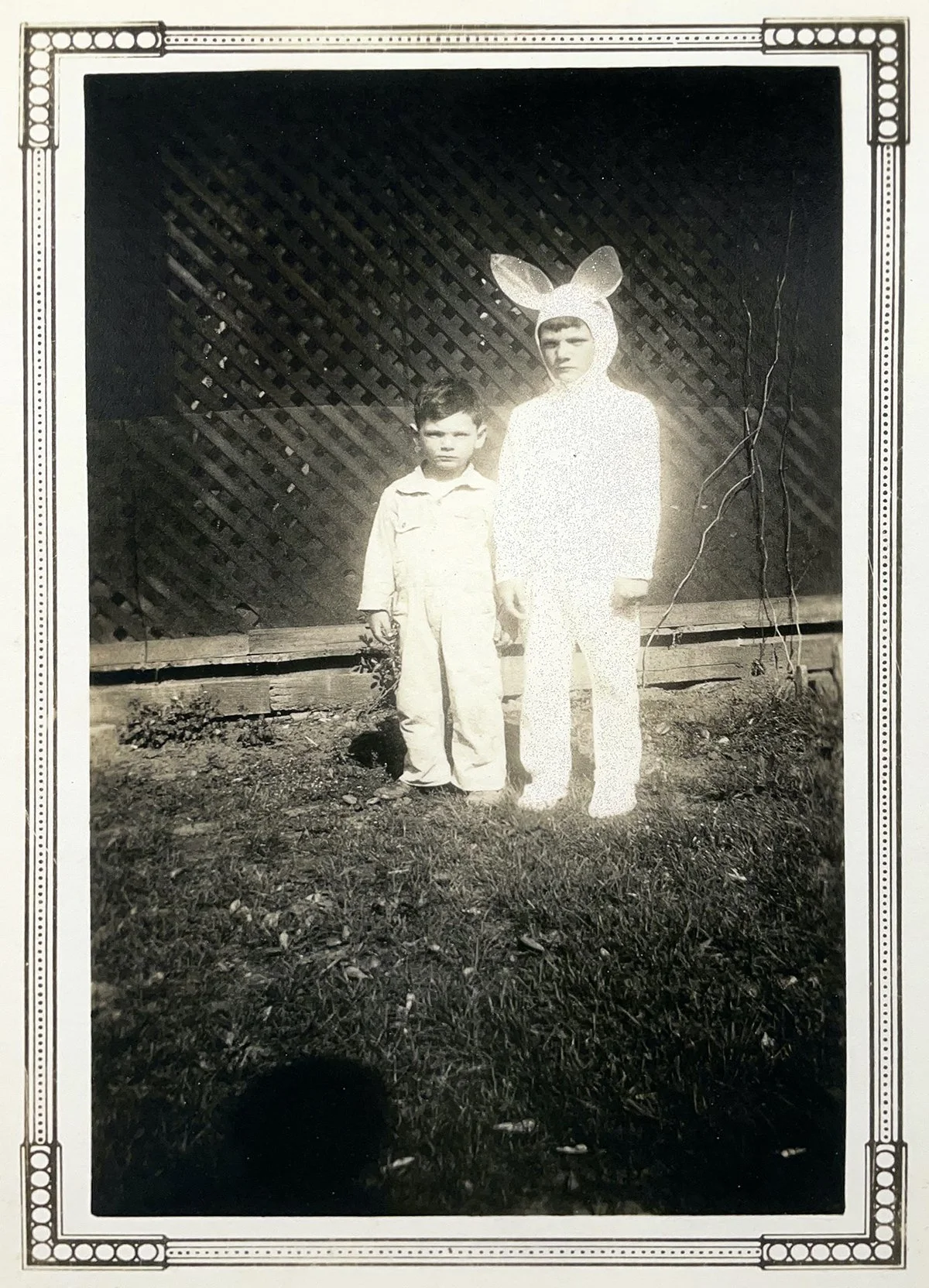
Matthew Finley, Halloween, mom made our costumes. John and I must have been fighting, 2024, archival pigment print mounted to board with glitter and varnish, 18 x 22 inches framed, 4/10. Image by Nina Peterson.
In Halloween, mom made our costumes. John and I must have been fighting, the bunny-suited boy’s facial expression is inscrutable. Is it smugness, embarrassment, boredom, pride? The title of the work prompts viewers to read the young Ken’s expression as annoyance born from sibling rivalry, but in any case, he refuses to obey that hackneyed photographic injunction, so often repeated in the context of family photography, demanding the performance of a cheesy grin. Sparkling with the flecks of glitter Finley adheres to further enunciate the costume, the bunny suit—the object of what apparently causes the boy’s un-interpretable feelings—emphasizes the apparent awkwardness, misfittingness, queerness of its wearer.
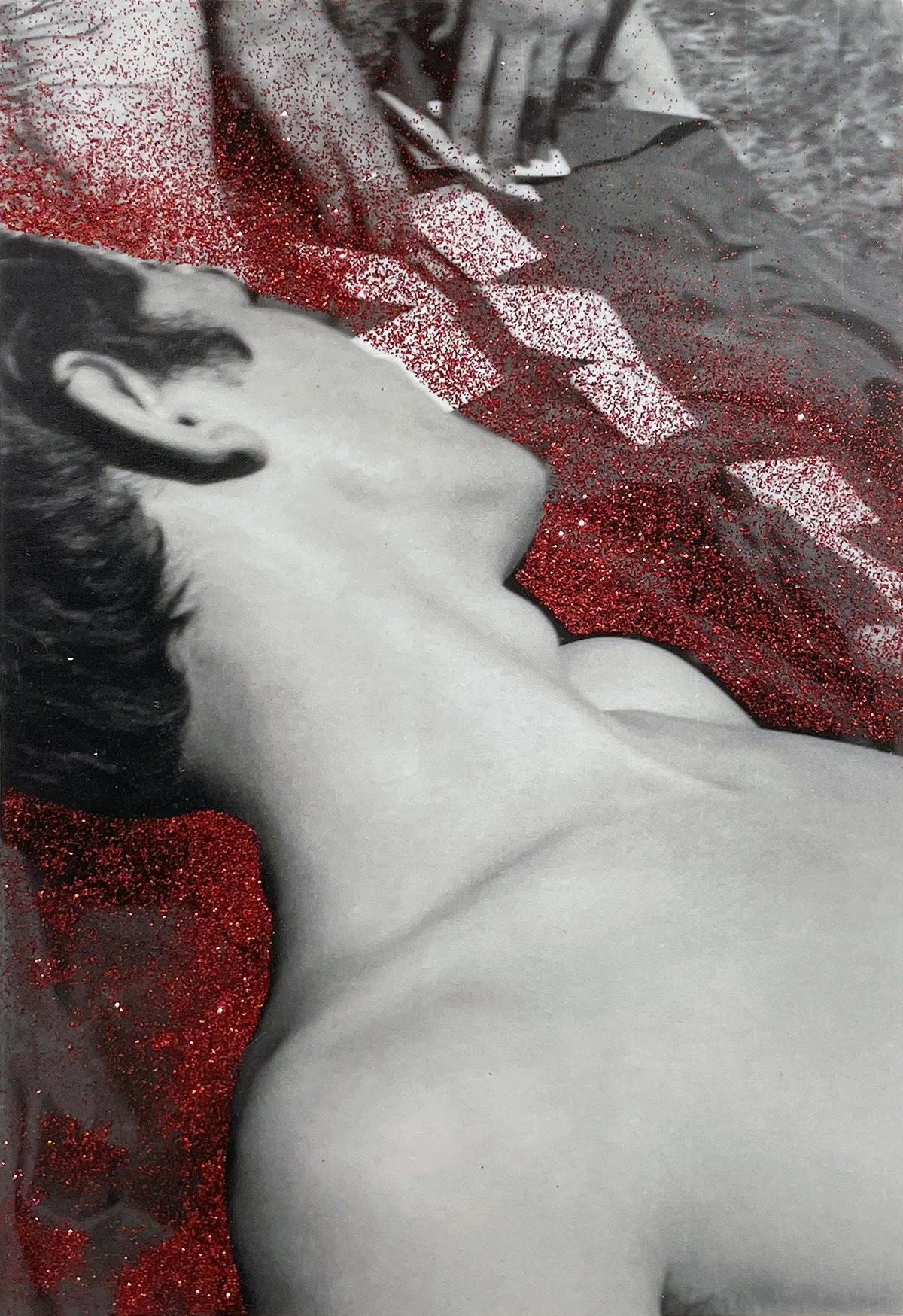
Matthew Finley, I had asked him to teach me guitar, just to spend time with him, 2024, archival pigment print mounted to board with rhinestones and varnish, 12 x 10 inches framed, 2/10. Image by Nina Peterson.
We see glitter materialize as a kind of “glue of surplus beauty,” to again borrow Sedgwick’s words, in I had asked him to teach me guitar, just to spend time with him. [13] The artist applies red glitter around the head and shoulders of a young man, creating a vermilion aura surrounding him as he turns his face away from the camera. This gesture, paired with the iridescent luminescence, imbues this figure with a certain out-of-reach-ness—an erotic inaccessibility that suggests Ken’s sense of longing. The halo-effect emphasizes the contours of his jawline and collar bone and illuminates him as the object of Ken’s desire.
Applying glitter—iridescent flecks well-known for their persistence, proliferation, and stickiness—presents this image of homoeroticism as a beauty that grows despite forces that seek to limit it. The glitter is a metaphor for queer love and relationships that attest to and make possible a kind of sustenance systematically denied to queer people in homophobic society.
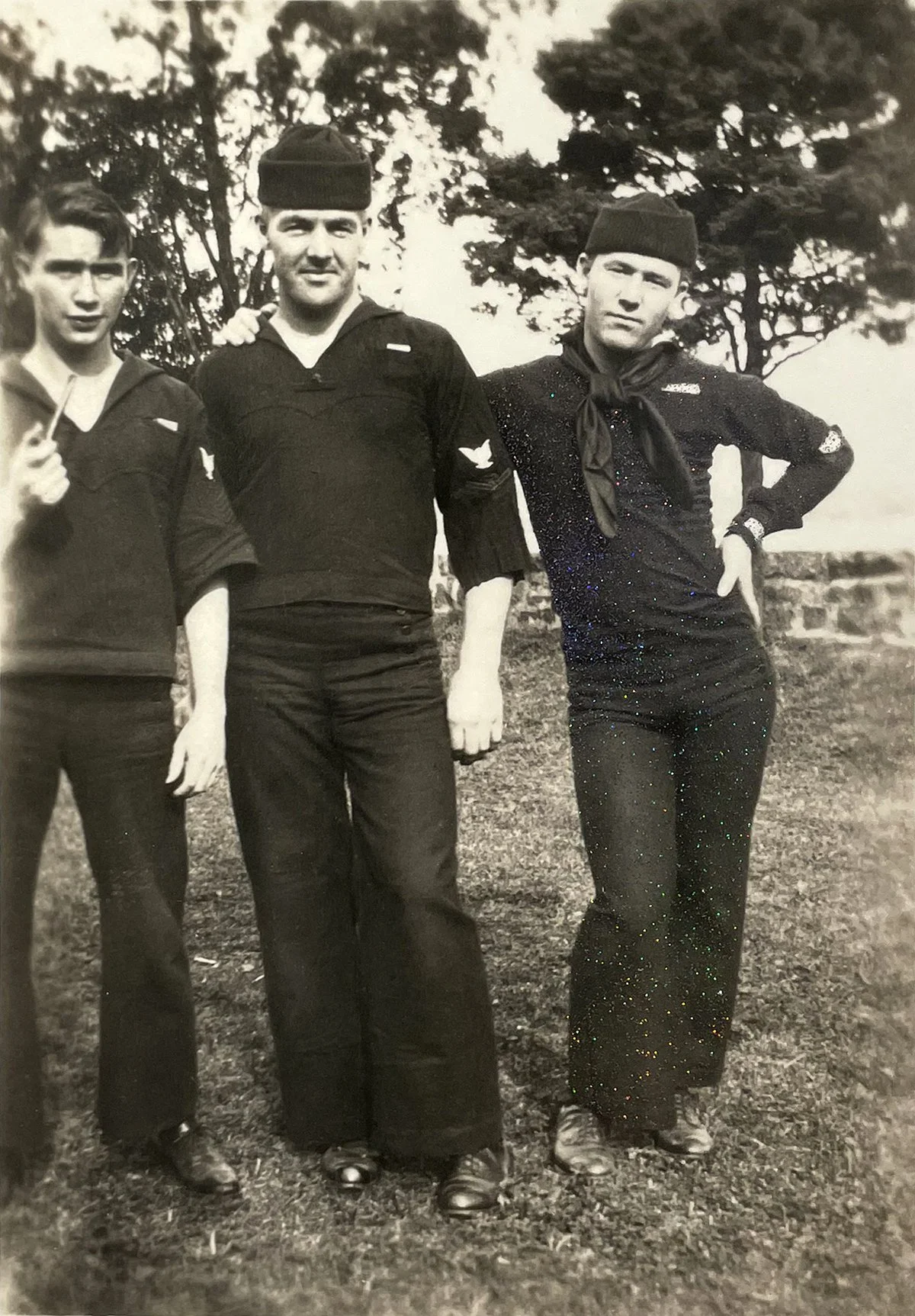
Matthew Finley, Rebel, Brute and I in the Navy, 2024, archival pigment print mounted to board with glitter and varnish, 22 x 18 inches framed, 2/10. Image by Nina Peterson.
Institutionalized homophobia as well as gay men’s strategies of resistance are implicit in Rebel, Brute and I in the Navy. In this photograph, three men stand shoulder-to-shoulder in a line, each sporting a Navy-issued uniform—the iconic wide-legged button front pants and a military insignia on each man’s left arm. During the early and mid-twentieth century, the U.S. military formally criminalized and pathologized homosexuality, issuing “blue discharges” to punish gay service members and remove them from the Navy. [14]
Finley’s choice to apply glitter to the uniform of the sailor on the right, who stands with a sassy hand on a popped hip, encodes the trio with the performative cues of gay culture, both masculinism and flamboyance. It invites us to see these military men as living in community and in love. Art historian Richard Meyer describes the relationship between hypermasculinity and flamboyance in mid-century gay culture, noting how “the relation between swaggering outlaws and flamboyant divas (between clone and camp styles) is not always an oppositional one but sometimes a subtle shift in costume or context.” [15]
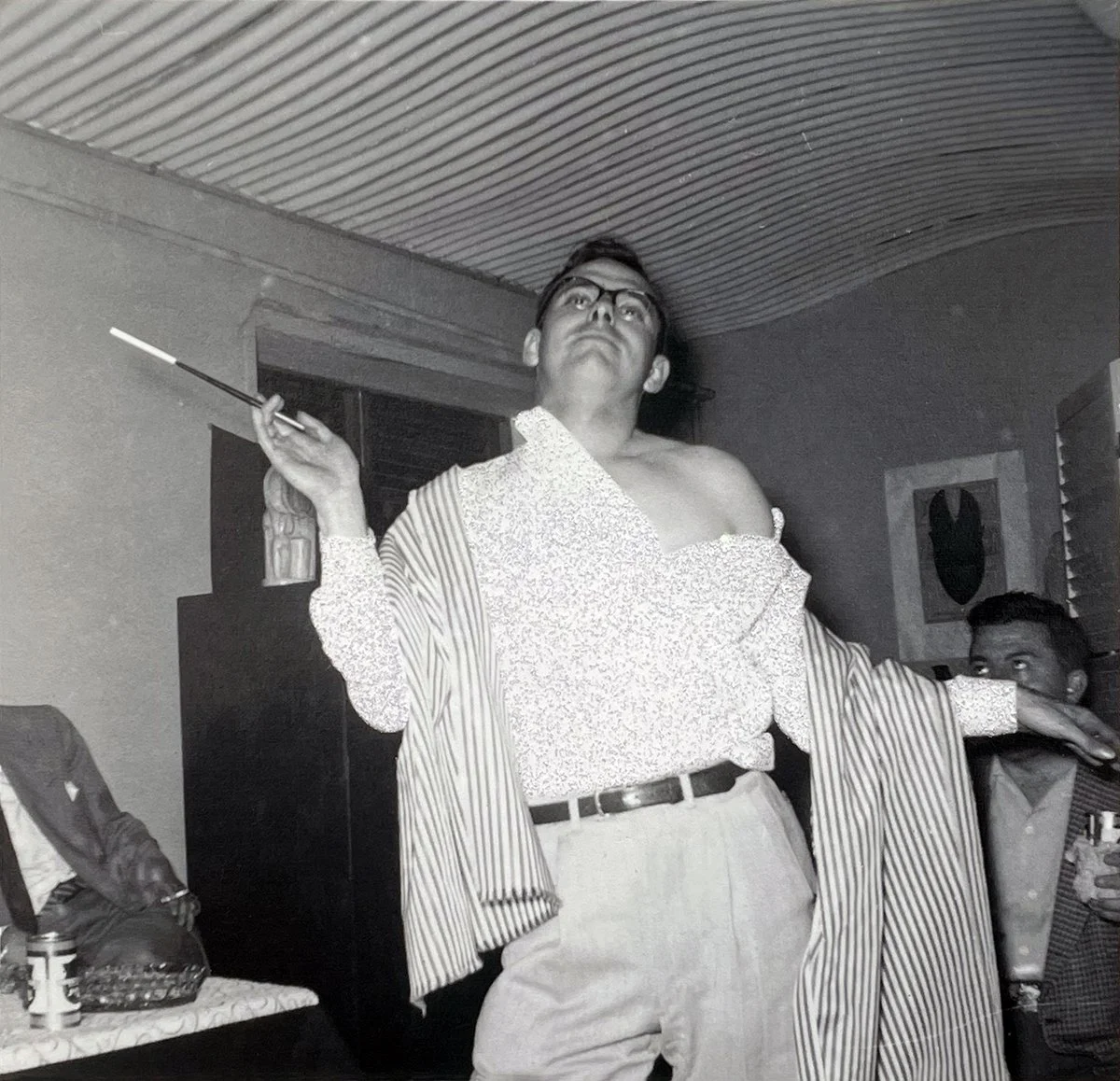
Matthew Finley, Me, camping it up at a party, 2024, archival pigment print mounted to board with glitter and varnish, 14 x 14 inches framed, 2/10. Image by Nina Peterson.
Gay men performed hypermasculinity and camp in the mid-twentieth century, before the events of the Stonewall Rebellion in the late 1960s precipitated societal and political shifts that started to make it safer to be openly queer (at least for white gay men). [16] Me, camping it up at a party engages this history and envisions camp as a celebratory practice, with Uncle Ken dancing exuberantly.
These two exhibitions at CPAC reject the normative histories and photographic mechanisms of producing the white, heterosexual nuclear family as the ideal of the American family. Instead, they offer two distinct campy methods—extravagant or absurdist camp and reparative camp—of forging familial bonds and new visions of kinship.
Nina Peterson (she/her) is a PhD candidate in art history at the University of Minnesota. Currently based in Denver, she researches histories of photography, film, and performance in the twentieth and twenty-first centuries.
[1] See the artist’s statement in the exhibition.
[2] For more about the histories of family photography as a tool of empire and white supremacy, see Shawn Michelle Smith, “‘Baby's Picture Is Always Treasured’: Eugenics and the Reproduction of Whiteness in the Family Photograph Album,” in American Archives: Gender, Race, and Class in Visual Culture (Princeton, NJ: Princeton University Press, 1999), 113–32; and Laura Wexler, Tender Violence: Domestic Visions in the Age of U.S. Imperialism (Chapel Hill: University of North Carolina Press, 2000).
[3] Leonard Suryajaya, “Land of the Flea,” statement on the artist’s website, accessed on April 4, 2026: https://www.leonardsuryajaya.com/land-of-the-flea/cbiwn03xed49409h2708ghnq3d66n9. See also Paige Williams with photography by Leonard Suryajaya. “Land of the Flea: What America is buying and selling.” The New Yorker. September 9, 2024: https://www.newyorker.com/magazine/2024/09/16/land-of-the-flea.
[4] As the artist noted in a panel conversation convened at CPAC, he is interested in moments that “rupture” the traditional notions of family. Panel Discussion with Matthew Finley and Leonard Suryajaya, convened by the Colorado Photographic Arts Center on February 28, 2026. Audio recording available on the CPAC website: https://cpacphoto.org/parting-gift-fitting-in-america/.
[5] Lily Cho, “Anticipating Citizenship Chinese Head Tax Photographs,” in Feeling Photography (Duke University Press, 2014), 162.
[6] Michael Lechuga in conversation with Marissa Lucero, “'Alien:' Tracking its story throughout immigration history,” UNM News. September 22, 2021: https://news.unm.edu/news/alien-tracking-its-story-throughout-immigration-history.
[7] Khubchandani further explains, “the nuclear unit here also stands in as a metonym for other boundaried institutions such as the university, corporation, or nation that reproduce heteropatriarchal, capitalist ideologies and structures. Aunty can name a biological relation (a parent’s sister or cousin) or a generational one (that between a young person and an older mentor, guardian, or relative), but aunties can just as well be strangers.” Kareem Khubchandani, “Critical Aunty Studies: An Auntroduction,” Text and Performance Quarterly 42, no. 3 (2022): 223. https://doi.org/10.1080/10462937.2022.2081912.223.
[8] Chris A. Eng, Extravagant Camp: The Queer Abjection of Asian America (NYU Press, 2025), 21.
[9] Matthew Finely used this term during the panel conversation convened at CPAC.
[10] Matthew Finely used this term during the panel conversation convened at CPAC. See also the artist’s statement in the exhibition.
[11] Eve Sedgwick, “Paranoid Reading and Reparative Reading, or, You’re So Paranoid You Probably Think This Essay is About You,” in Touching Feeling: Affect, Pedagogy, Performativity (Duke University Press, 2002), 149.
[12] Sedgwick, “Paranoid Reading and Reparative Reading,” 150.
[13] Ibid.
[14] For a brief history of persecution of gay service members in the U.S. military, see “Blue and ‘Other Than Honorable’ Discharges,” National Parks Service, accessed April 4, 2026: https://www.nps.gov/articles/000/blue-and-other-than-honorable-discharges.htm.
[15] Richard Meyer, Outlaw Representation: Censorship and Homosexuality in Twentieth-Century American Art (Oxford University Press, 2002), 101.
[16] Of course, the safety to be openly queer is still not evenly distributed, with trans* and folx of color especially at risk with the re-entrenchment of bigoted attitudes and policies, perpetrated in anti-trans* attacks and legislation. “1969: The Stonewall Uprising.” The Library of Congress, accessed April 4, 2026: https://guides.loc.gov/lgbtq-studies/stonewall-era.